.webp)
Rosa Barba: “Drawing Vocabularies” at Centro de Arte Moderna Gulbenkian
Review
Minne Kersten explores domestic spaces as sites of memory conceived as film sets. Working across video, installation, painting, and sculpture, the Netherlands-based artist stages events in constructed rooms. Drawing on literature, psychoanalysis, and architectural theory, Kersten investigates how objects and interiors become sites of recollection layered with meaning.
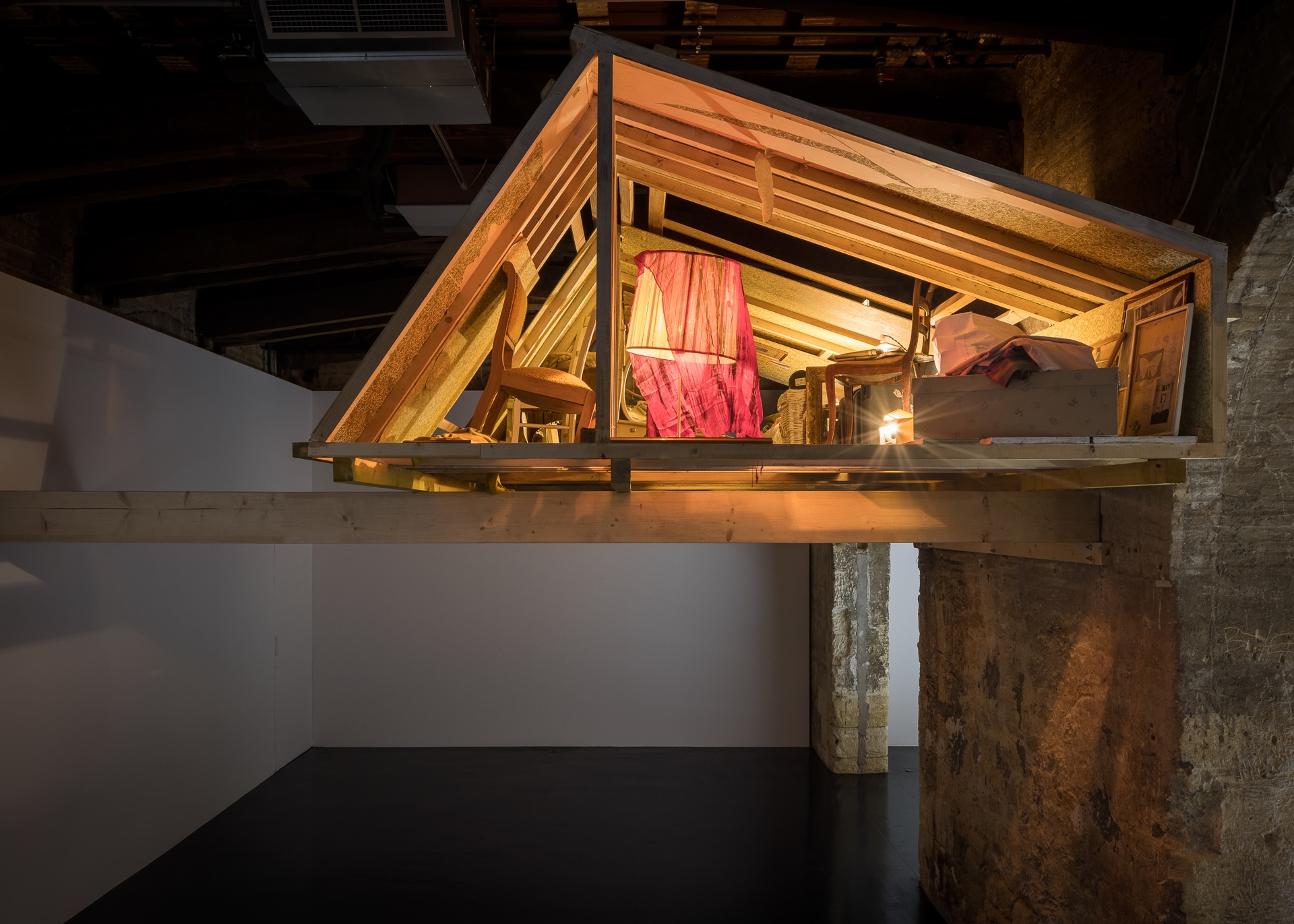
Her solo exhibition room temperature at Ginny on Frederick this fall marks the United Kingdom premiere of Where I’m Calling From (2025), a video project with a meticulously constructed attic that functions as both the film set and an immersive environment fabricated within the London gallery. During filming, the attic was briefly inhabited by moths. Their presence aligns with Kersten's interest in binaries: light and dark, life and death. When we met on Zoom to discuss the work, Kersten sat before a vast collection of books in her Amsterdam apartment—a fitting backdrop for an artist whose practice is as responsive to literature and theory as it is steeped in cinematic history.
Sandy Kelso: Can you talk me through the process of creating your installations? When did you start working with the moving image?
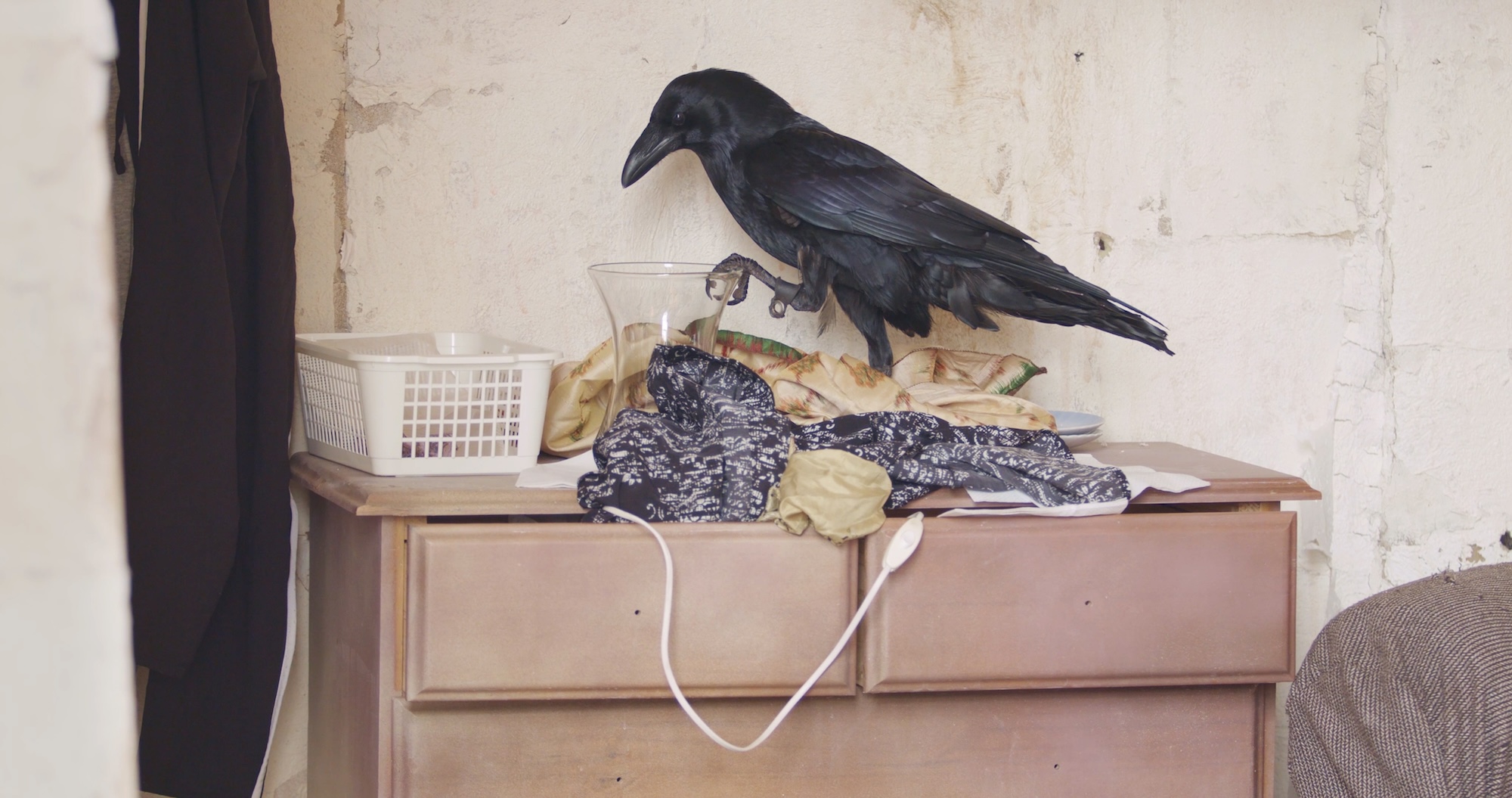
Minne Kersten: I began working with moving image early on in my practice, actually in 2021, with Constant Companion, which was first exhibited at Annet Gelink Gallery in Amsterdam. In the video, we see a raven burglarizing a space, causing havoc, making holes in walls and tearing paper. The space itself is devoid of interference by human life, as though it could’ve been abandoned or left behind. This work was pivotal for me in creating a methodology for installation and filmmaking.
My videos document a happening I stage inside a domestic space. I’m interested in how cinema is a construction of memory, so the choice of medium became necessary for the sequence of works, Constant Companion, The Same Room (2023), and Where I’m Calling From. They are all situated within the site of the home, because home is ultimately understood as an archetype for comfort and safety, yet also [as] a place of self-sabotage and survival. I’m interested in the notion of home invasions or things that come inside that we read as a disturbance. It’s not about my own memories; it’s more of an abstraction about how space functions as a container. I was reading a lot about place memory and Stone Tape Theory—this idea that architecture could be receptive to traumatic and emotional events and act as a witness. What happens after these spaces have gone through an event is then shown in museums or galleries and positions the viewer as the reader.
SK: That’s interesting, so the viewer is a participant in that sense. How, then, does the presence of animals function in comparison?
MK: For me, it was a way to talk about crisis or psychological collapse. In Constant Companion, the raven is a very loaded, symbolic character throughout literature. Ravens can represent omens, mythology, folklore; I mean, there are so many connotations with them connected to death. I find these binaries really interesting: good and evil, day and night, safety and threat, absence and presence, attraction and repulsion [can] both arouse and incite an audience.
The creatures that I use are specifically chosen because I [feel] they [can] disrupt those conventions. When I work on a project, I take a long time researching. For Constant Companion, I spoke with people who live with ravens to understand the relationship between humans and the bird. It’s known [that] they’re very intelligent and have a very strong memory, so it was also a way to tell the story of a space through an external perspective, which creates a dialogue between the space and the creature inside. In this way, the space becomes the protagonist.
With the moths in Where I’m Calling From, this was also about the cycle of life and death. I worked with an entomologist to breed these cocoons and moths when I was living in Paris. I was sleeping next to them, and they were making these sounds at night, which ultimately became a part of the film.
SK: I’m curious where your research begins. Are you reading widely and then something leads you down a sort of rabbit hole?
MK: It’s really like an hourglass. In the beginning, I know that the work is going to exist if I can see it and if I have the feeling for it, but I have to investigate it and explore why it nags at me. Then I read a lot to understand different perspectives, often architecture theory, a lot of psychoanalysis, and fiction. Then it narrows down until it becomes a very clear image, and that’s where my job really stops, and the work itself starts to exist.
SK: Right, because then it’s up to the viewer.
MK: Yes, and I’m much more interested in abstraction than telling a narrative or a story. I started out studying literature at art school. I was writing, but I never had characters. They never interested me. My writing always had more to do with observational and structural experiments. I was interested in what objects, spaces, and systems revealed about people. I think objects, especially, are tools to talk about history and memory. To me, objects tell so much about a person. Let’s say someone disappears from a place; you encounter that place through their objects in their absence. I consider possessions as a gateway into the human psyche. Contained within them are all the hopes, dreams, fears, and desires of their owners. Objects are not subject to death in the same way we are. The fact that they outlive us speaks to how we deal with materiality. The domestic space then becomes a powerful, haunting symbol of absence, failed aspirations, and loneliness. It is imbued with a sort of mystical animism, the weight of a past life, a spirit, or remnant of a lost soul. Both my installations and videos belong to chapters of a life woven from memory and conjecture, fact and fiction.
SK: When you’re collecting objects for your installations, do you have some sense of what you’re looking for?
MK: Yes, it’s actually quite structured. I start with maquettes of spaces so I can see how I envision them larger. It’s a very sculptural process as well. For example, with The Same Room, I was looking at how specific objects disintegrate. I know the event that will take place in the space, and then I am orchestrating everything so it works together. Sometimes there are personal memories involved, but I try not to make that too important to the viewer. It’s important to me for a space to feel very specific, like it feels real, but in that sense it also plays with this illusion of cinema and set design, where you feel like the construction exists for you to believe. There is this very thin line between construction and orchestration that tips into belief. So it’s a very reactive process. I go to a lot of thrift stores and collect objects, which elevates them from this life of debris to memory, and speaks to this collective subconscious. Same with the books that end up in my installation. They’ve been read. They have been in very intimate proximity with people.
SK: Going back to what you said about set design, the camera’s rotation around the room feels akin to Chantal Akerman’s La Chambre (1972). Was this intentional? Who are some filmmakers that have influenced you over the years?
MK: I love Akerman’s work. Recently I’ve been interested in the genre of horror. It’s a very inventive genre in the sense that it finds ways to depict things that are not physically there and the experience of space, which is warped by a psychological state. I find it interesting how the camera moves in horror in certain ways that are from a perspective that’s not human. When I was younger, I really loved The Mirror by Tarkovsky. It's a classic, but it’s not cinema; it is a memory, what you’re watching, and it’s constantly rewriting itself so you can’t rely on the narrative because it’s looping somehow.
But yeah, what you said about this movement of the camera, I imagined that the camera in Where I’m Calling From was moving around a light bulb, traveling through the space going lower and higher. Then sometimes you encounter shadows, the moths, but it’s all subtle, and the sound that you hear feels like electricity, which is partly because when I was sleeping next to the moths they made this flickering noise.
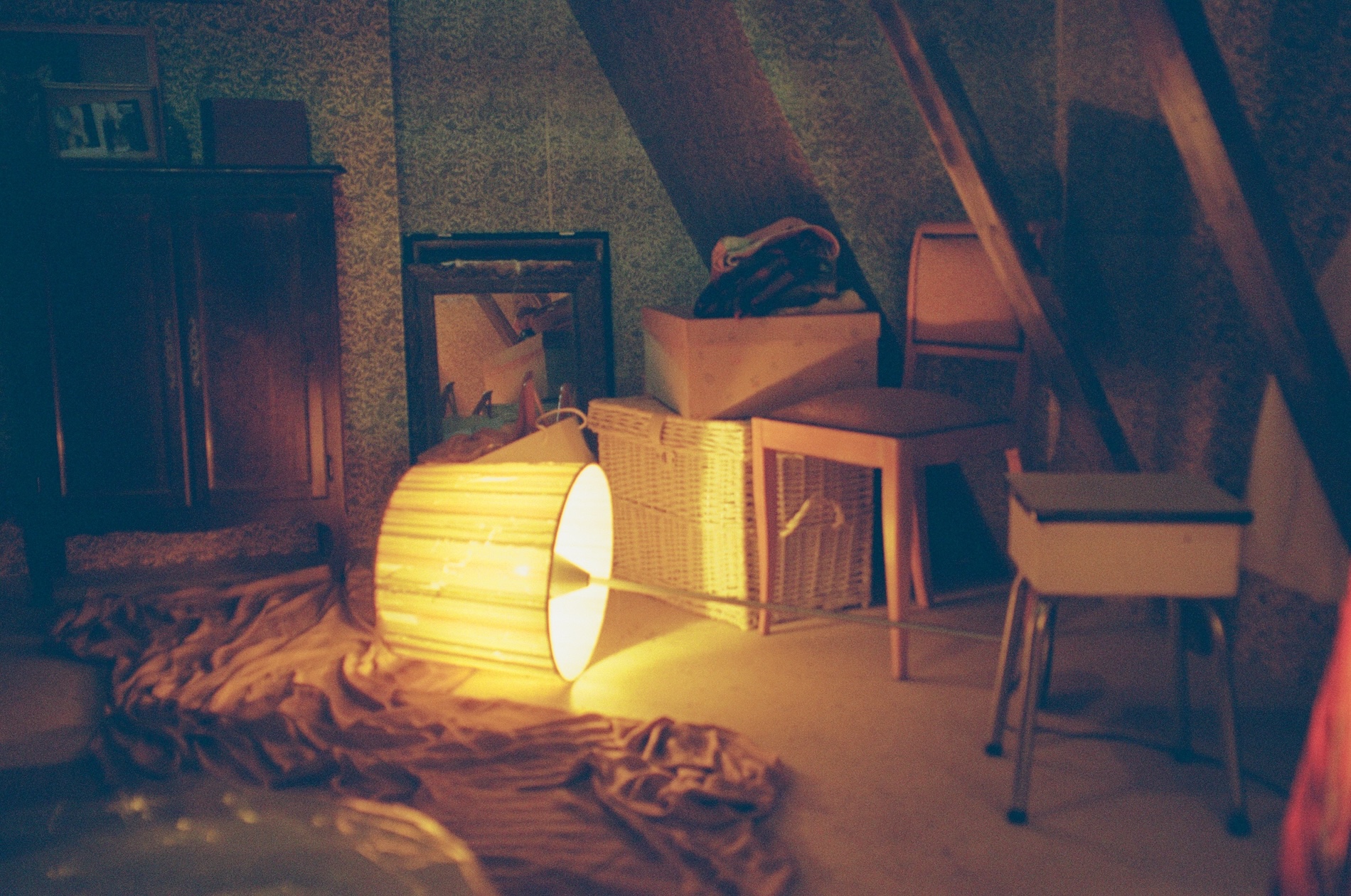
SK: When I was watching the video, I couldn’t tell whether the light was artificial—from the lamps on the floor, studio lights, or from a window—but I liked that I didn’t know. Perhaps this speaks to the experience of the moths as well?
MK: True, moths often try to come inside our domestic space. If it’s night, they come to the windows for light. Originally they navigated their flight according to the moon, but because we have erased the night with constant artificial light, they’ve become really disorganized, and biologically, they haven’t adapted, so that’s why they fly toward lightbulbs. This idea of light and of the sound of light as their wings like electricity or static heightens the claustrophobic confinement of the space, I think.
SK: Oh definitely. It seems that much of your cinematic oeuvre is interested in light and shadow in this way.
MK: Well, light and darkness. In Western society, since the Enlightenment anyway, darkness has had very negative connotations. It became connected to our fears, our anxieties, ghost stories, things that are not really perceivable. I thought that the moths would allow me to talk more about this idea that darkness is not just an absence of light but also a presence on its own that has a lot of character and substance.
SK: There can be a lot of calm in darkness that we often don’t acknowledge and, as you say, when we think of storytelling, and especially in the horror genre, darkness is utilized to heighten moments of intensity.
MK: Horror operates in this way. It inhabits the fabric of ordinary life, picking away at the limits of reason. It provides ways of defining, for example, what is evil and what is good in society, what is monstrous and what is normal, what should be seen and what shouldn’t. It’s psychological and explores the edges of logic. But in my videos, which are of domestic spaces, I’m not interested in showing the moment when something comes inside or leaves. It is not about the drama of something infiltrating. The films themselves are actually quite peaceful.
SK: Very much so, but it’s interesting how you signal the genre and yet the viewer has a different experience with your work than they would a horror film. They’re not waiting for the jump scare or some revelation. They’re able to spend time as observers in the space, whether physically moving through an installation or watching your films.
MK: Yes, and going back to your question about why I use film, it also has to do with time in this way. Films trap time and really elongate it, which stretches your interpretation of what you’re seeing. For example, in The Same Room you don’t see the water rising; it’s just there, and it’s always on a loop. Or with the raven, maybe you think of The Birds (Hitchcock), but really my creature is a caretaker, and I think for me, especially earlier, this was important in thinking about how we create images for absence or images of death.
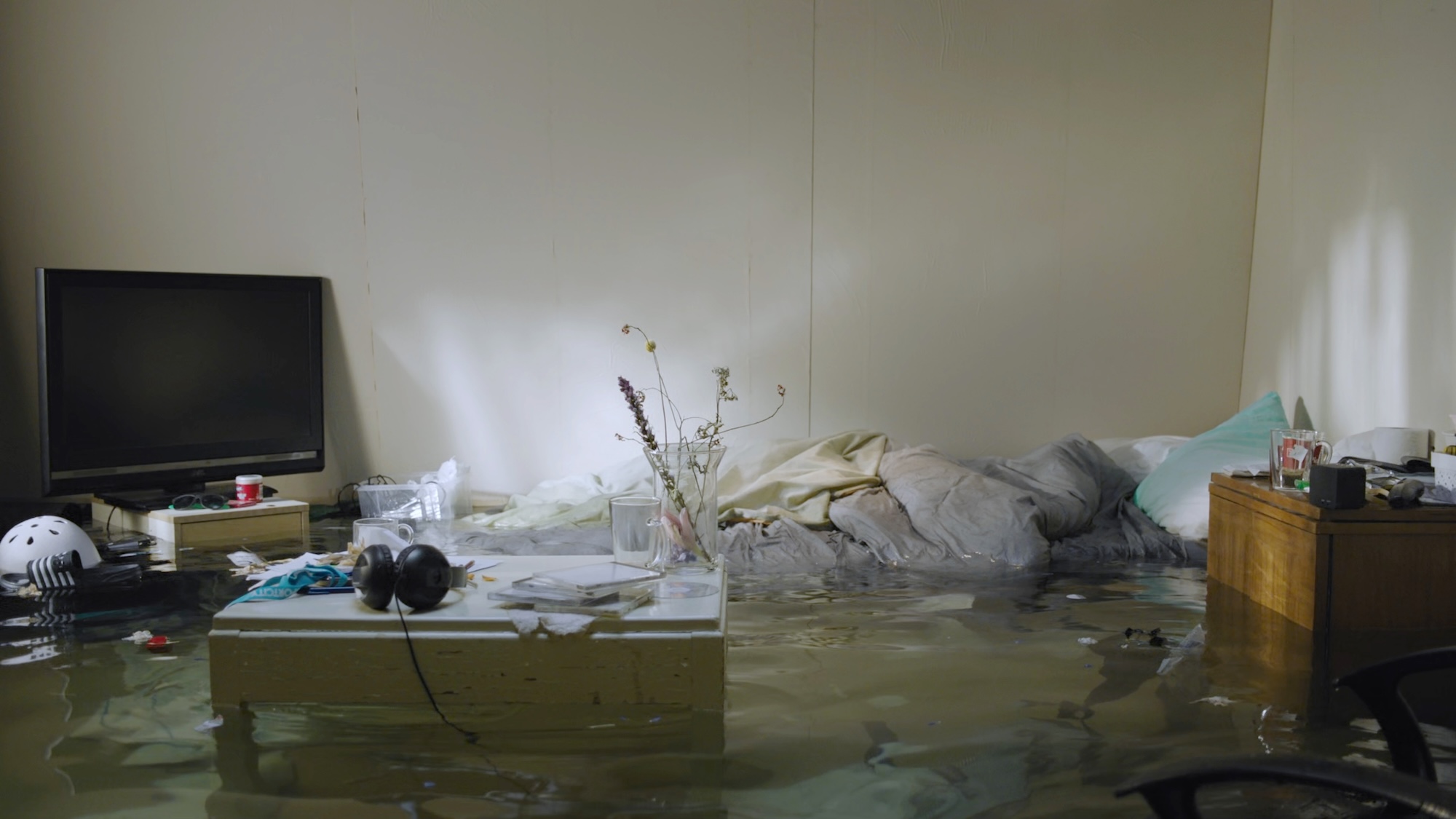
SK: In The Same Room, you flooded an interior space with water to demonstrate how a place can preserve stories but can also overwrite them. What do you mean by overwrite in this sense?
MK: We get to know the world through what gets left behind. A lot of our history, when we’re in conversation with our past, is archaeological and related to the Earth. Earth has scars from trauma, but water engulfs and closes its surface so you can never return to the same space. There’s a fragment I remember from Mirror of the Sea by Joseph Conrad, in which a sailor describes this beautiful day at sea. But in the distance there’s this wreckage from a storm last night, and you can see the top of another ship sinking. The water closes over the wreck as it sinks, erasing the memory, so in this way, water overwrites. It doesn't leave the same traces of memory as the surface of the Earth. In The Same Room, I wanted to have earthly objects in the space so that the moment when water enters, it caresses the space and speaks to that different relationship with memory.
SK: That juxtaposition seems to be present throughout your work.
MK: Yes, I really want the images I’m creating to do the opposite of what you expect them to do.
SK: I’m curious about the titles of your work. They feel specific too. Where do they come from? Are they literary references?
MK: I like to think of my titles as creating the condition for the work to exist. In Where I’m Calling From, I wanted to have this long-distance phone call, like someone trying to communicate from a place and explain an experience that they perhaps don’t have the language for. With The Same Room, I wanted the title to suggest there is another room, or phantom room, or if it is the same room where a traumatic event has taken place inside, those stories get overwritten by new people moving in, for example.
In general, I really like the structure of a loop. The films and spaces are entrapments, a repetition of thought and a cyclical movement that's ongoing. The films don't care about the viewer. They just keep existing, and I hope that speaks to how we read images rather than what the work is stating about them.
room temperature will be on view at Ginny on Frederick from September 11th to October 17th, 2026.
This interview has been edited for clarity and length.