

Building Communities Through Mission-Driven Philanthropy: In Conversation with Lesley Bodzy and Cynthia Wu
Interview
The body is often computed before it is understood. A regular story: in taking a selfie, the phone camera renders the body as data, runs it through an algorithm, and spits it out to be projected in pixels to reach the human eye. On a constantly shifting profile, a click generates capital, but not for the owner of the finger. The boundaries that define the body, the workday, and the private sphere against the digital are increasingly difficult to perceive. How can selfhood or identity be constructed in these conditions?
This is the question that occupies Luke Shannon, a generative artist whose work spans computer screen displays to installations involving large technological objects. Though ranging widely in scale, medium, and location, Shannon’s oeuvre illuminates some of the most private parts of digital dispossession in its interrogations of the corporeal, temporality, and ontology.
In September, Shannon’s piece, Most Improved (2025–ongoing), was featured in WEBSITES WEBSITES WEBSITES!, a group exhibition presented by ARTXCODE and Rhizome for Rhizome’s 30th anniversary. In the corner of the crowded room, an inconspicuous Apple computer displayed a monochrome website: “A little better,” it proclaimed, “one change at a time.” In smaller text just beneath, it read, “A public record of becoming, one small decision at a time.” Shannon had created a blank website and fed it to an LLM with the single repeating command, “Improve this site.” The continuously complicated result, where more and more functions and text were added, is paradoxically a stripping of the LLM down to its recursive logic, where ‘improvement’ is defined as the capturing of contingency, contingency that is fabricated. The LLM invents difference where there was none: a white page becomes filled with black.
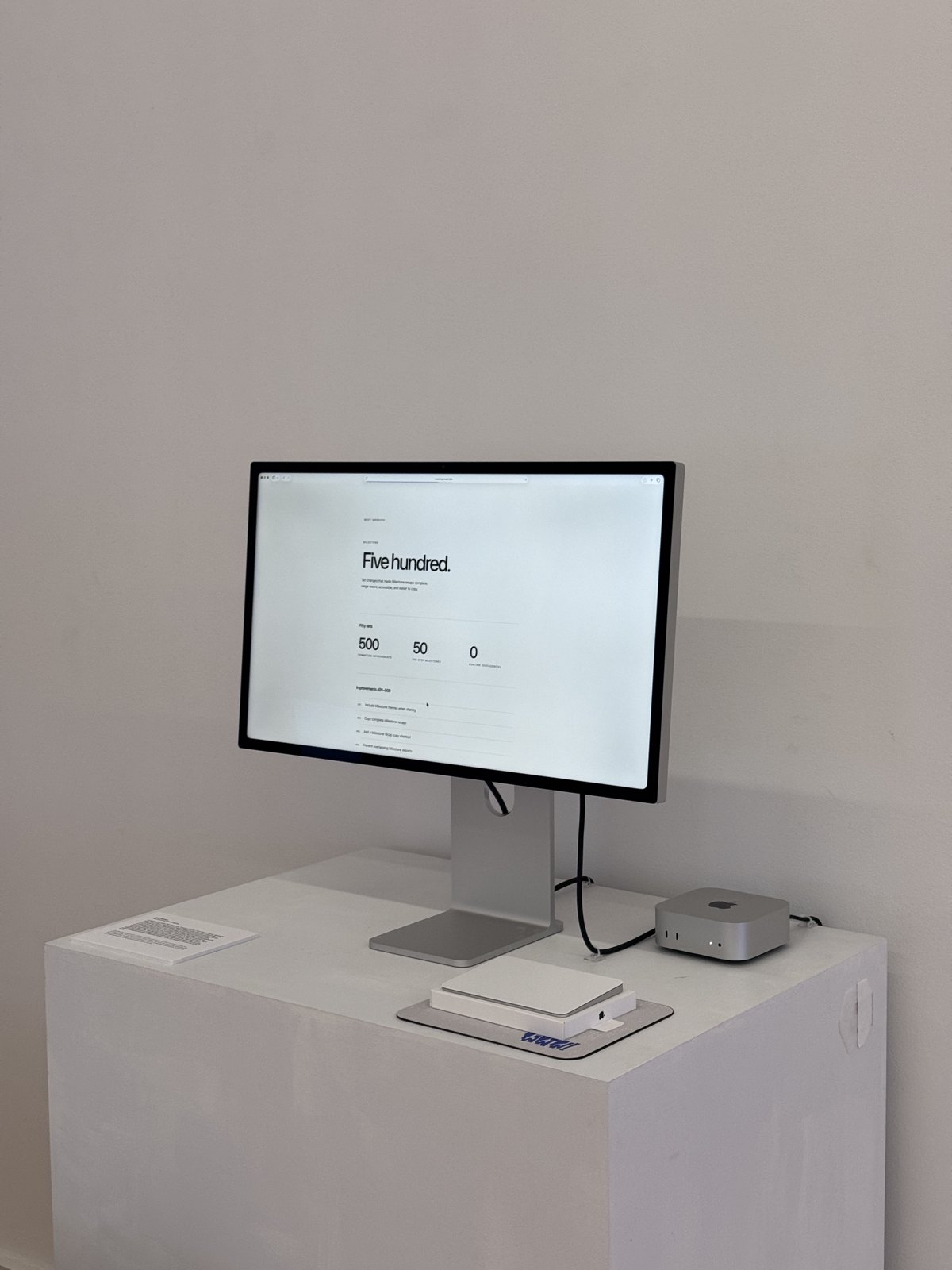
This collaboration between human and machine highlights AI as the central actor with decision-making and affective capabilities. It shows time as measured in improvements, not so differently from how we (humans) may understand ourselves as discrete individuals. I was surprised to feel something akin to empathy for the website and its wretched condition of never-ending dissatisfaction with itself. Especially with its usage of the language of “becoming,” Most Improved evokes the history of the development of artificial intelligence as shaped by theories of human cognition rooted in Western scientific modern thought and philosophical tradition. As the boundary between man and machine crumbles more and more with the increased networking of the world, Shannon’s interest in selfhood extends to non-human forms both as agents and as integrated into human perceptions of selfhood.
The artist discusses his experimentation with a new work incorporating short-form video: “People identify with their algorithm,” he says. “It displays your desires, but also in a way where you can’t predict what it’s going to demonstrate or communicate. It seems so much a part of you that way.” The algorithm’s encoding of “latent desires,” as Shannon puts it, “refutes direct testimony.” In other words, it holds power as an arbiter of truth as well as a keeper of privacy—how would you feel if your algorithm was put on public display?
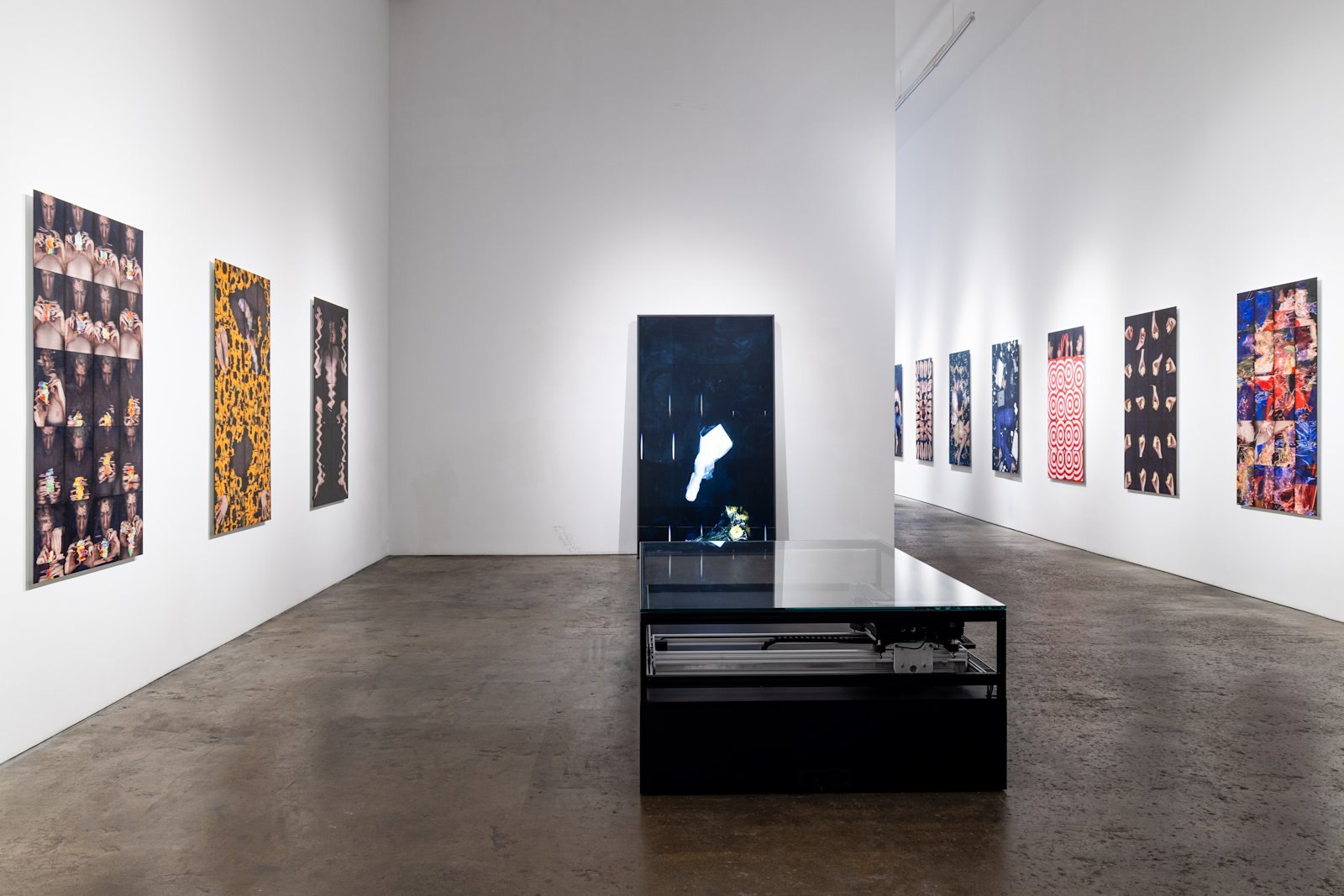
At best, vulnerable, and at worst, violated in the realization that what used to be internal and private about ourselves is both scattered across the Internet and reproducible. This reveals the machinic gaze’s dual construction simultaneously as surveyor and witness—the idea behind Shannon’s Replacement Character (2025), a life-sized scanner bed constructed from a document scanner and a 4’ x 6’ plotter. The resulting images depict bodies that are horizontally oriented from being sprawled out to curled up. Each scan is gridded, splitting and fracturing the body into pieces. Some of Shannon’s scans feature only one limb that is mirrored and refracted across sections, while others capture his entire body. He likens these images of disembodiment and fragmentation to the experience of being on the Internet. The networked world, he says, provides “this fundamental new ability and power to see images from all over the world and to talk to different people. This expansion is simultaneously fragmenting, where you become split across all these different places.”
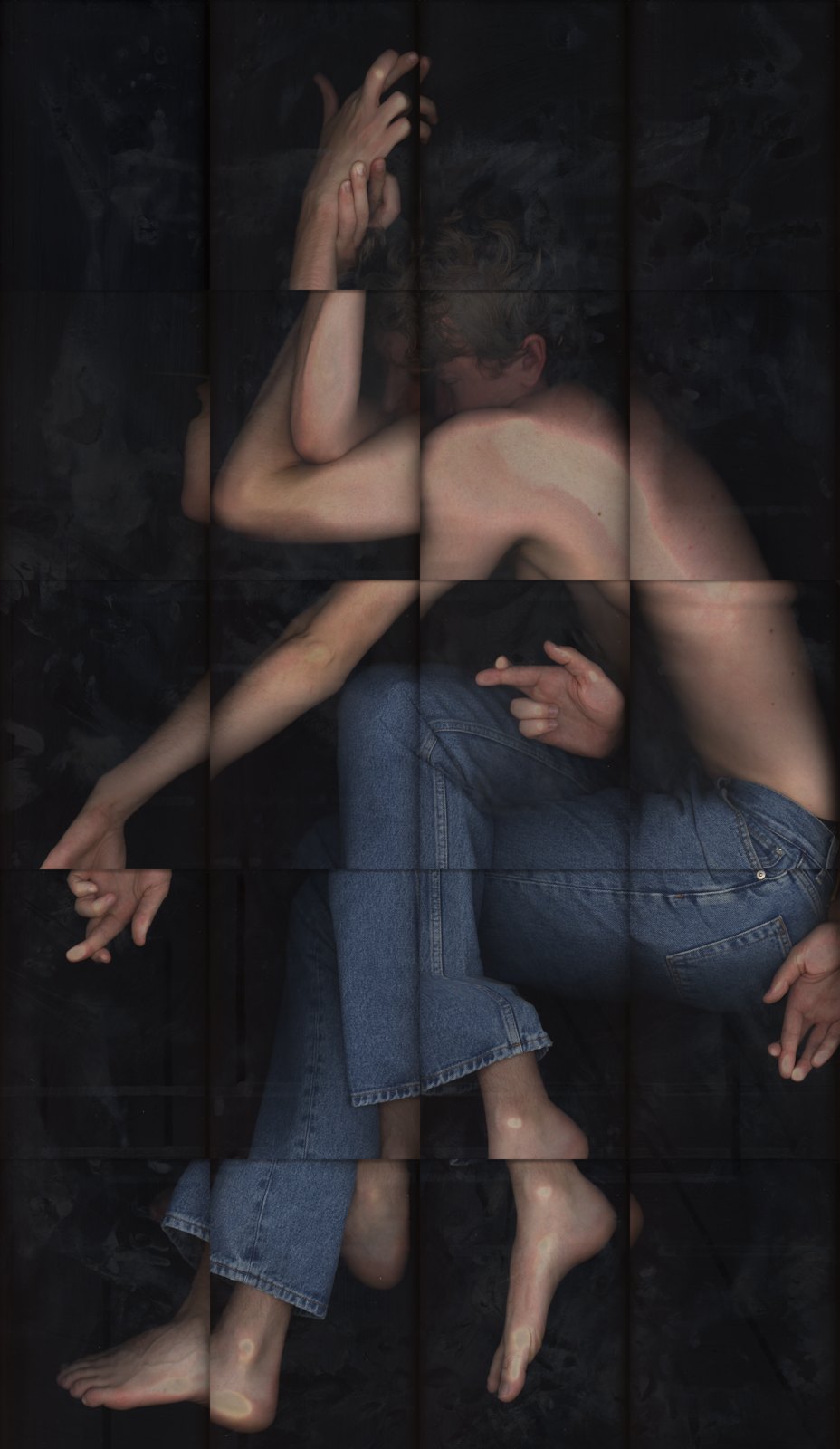
The intimacy of Shannon’s portraits, made from a body pressed up against a machine, puts forth a certain vulnerability. “The goal is for it to be a simple idea,” he says, “each section is a different small part of you that is interchangeable and replaceable in a way.” Replacement Character’s scans are captured over a much longer duration than a regular photograph, offering an alternative to the dominant visual form by creating a composite of potentially replaceable images. Recognition is immediately available in the visual depiction of fragmentation itself, an inverse Lacanian mirror stage of sorts, which Shannon says he had in mind during the production of the work.
The body serves as a continuous site of inquiry for the artist, who discusses an interest in its boundaries. The body’s incessant imaging, as well as the incoherence of living between the screen and the material world, requires a reconstruction of binaries such as the physical/digital in order to make sense of one’s orientation. “The barrier we have between our internal selves and what’s outside of that is actually very fluid,” he remarks. However, the immersive experience of being on one’s phone, he explains, can feel freeing in how it transports oneself from the body to a different plane with the agency to move around and communicate beyond one’s physical location. At the same time, this unmooring contributes to the feeling of fragmentation. “People don’t think of the digital world as physical at all,” he adds, “the fact that a phone is actually doing physical things is incredible.”
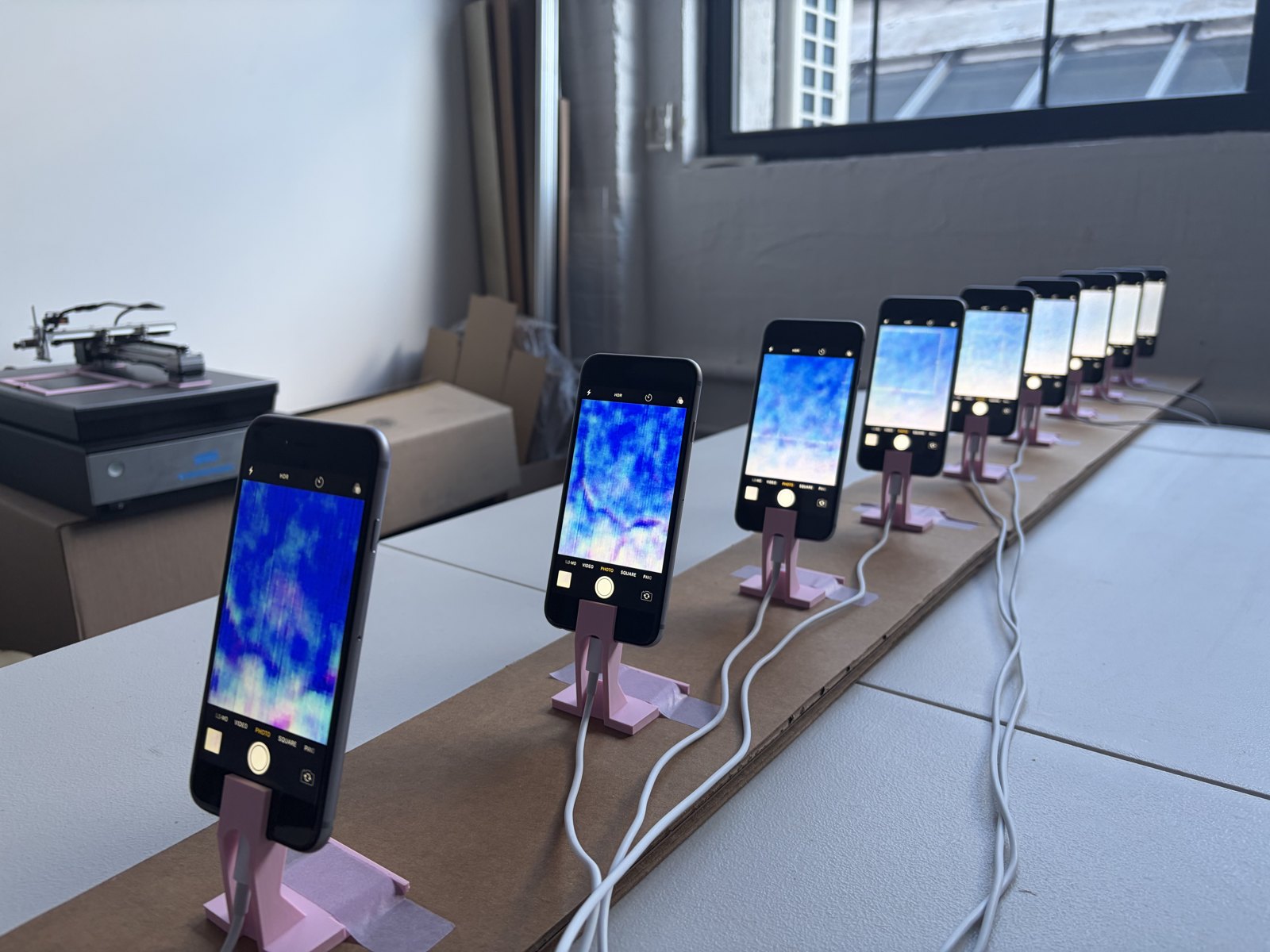
In his studio, a line of 24 iPhone 6s is set up with each camera facing the previous camera’s screen. Waving a hand in front of the first iPhone causes a ripple effect across the screens, each clip slightly deviating from its predecessor. With this visualization of Gilles Deleuze’s famous concept that there is no repetition without difference, the digital’s illusion of limitless reproduction is shattered.1 Shannon is an artist who works with informatic systems to challenge the veils of abstraction surrounding them. The key, he says, is to think both technically and historically. He explains:
“There are images that are part of operations that are serving a very different function than images historically, which were for people. You have to read it representationally, like art historically: what is this person saying about politics or what is this actually representing? What am I seeing? Then, you have to read it operationally at the same time: how is it being distributed? How can the same message be dispersed two different ways and have it mean two different things? Doing both of those readings at the same time is more and more important when thinking about media right now.”
Generative AI introduces a novel kind of image that indexes nothing. The destabilization of visuality has Shannon noticing a re-legitimization of narrative over the prior dominance of the photograph. He talks about Gideon Jacobs’ analysis of Trump’s performance of images, where “Trump prompts reality in a way. Something doesn’t have to be real to be effective for him.”2 But how can we determine what’s real? Time has become just as unreliable as the visual, requiring similar reworking. When thinking about the replacement of images and the self during the building of his plotter-scanner, Shannon considered the concept of the ‘perpetual now’: “Things aren’t becoming history in the way that they were. We’re losing historicity because images, news, and real events aren’t able to sediment into a historical layer that can then be built upon.” This is due to the churn that occurs online on pages and profiles that are constantly refreshed to stay ‘up to date,’ he explains, “it changes the way you perceive things in your memory and also in the way that history is laid out.”
We should remember that linear, quantified, and universal time is actually quite a new development, historically speaking, as the world became more and more commercially connected and geographically spread out. The centralization of time improved labor management, expanded supply chains, and eventually connected computers all across the world. Mankind didn’t always know time to operate cumulatively, nor did it always have photographs to be truths.
So what happens now? How vulnerable to be having this conversation about bodies and bewilderment. The Lot Radio plays in the background of the studio, where harsh daylight and fuzzy electric sounds dance upon the white wall. We talk about finding agency in relocating how we know ourselves: not as whole, coherent beings, but as beings distributed across grids, lenses, and algorithms, holding history in one hand, refraining from clinging to what has disappeared, and offering it to others in fragmented forms.
1 Gilles Deleuze, Difference and Repetition, trans. Paul Patton (New York: Columbia University Press, 1994), 23.
2 Gideon Jacobs, “Trump l’Oeil,” Los Angeles Review of Books, November 3, 2024.