.jpg)

.webp)

%20.jpeg)
Face to Face: September 2026
Interview
The Ovaherero communities of today’s Namibia refer to the horrors of German settler colonialism as Omauje Nga Haikana—“worlds destroyed beyond repair.” The 1904-8 “extermination orders” against them and the Nama people led to a century of misery and inequality. They also put in motion the destruction of the ecosystem that the victims cared for and inhabited. Through art and forensic research, the Fractured Lifeworlds exhibition at Berlin’s Spore Initiative confronts the visitor with the intertwined reality of human and environmental loss. It was only in 2021 that Germany finally recognised the genocide, but claims for intergenerational justice remain unheard. This makes bringing the display to Berlin even more striking.
This summer’s presentation, Bush, is only the first of three iterations (Wind; Sand) that will run until April 2027, each with its own ecological and thematic focus. The peaceful but eerie sound of wind permeates the venue, telling a story of a land long gone. Through four years of work, the research teams at Forensis and Forensic Architecture partnered with local descendants of genocide survivors to recreate the lost biome of their ancestors through CGI, satellite re-elaborations, and gen-AI. The operation gives shape to a memory of cultural and social significance, of which sounds are just one outcome. The forensic work, in fact, blurs with art and investigative journalism through documentaries and audio-video installations.
Visitors are immediately made aware that the life of the Nama and Ovaherero nations was tied to their ecosystem. The parallels with Gaza’s ecocide and genocide are crystalline and subsequently underlined by the showcasing of the letter of solidarity with Palestinians that exhibition collaborators, the Ovaherero Traditional Authority and the Nama Traditional Leaders Association, signed in October 2024.
Germany took land and destroyed native settlements through massacres, substituting herding with alien agriculture and mineral operations. The spectator learns that the ecological consequence of ethnic cleansing was “bush encroachment,” the growth of shrubland over a stable biome of grassland and pastures, which led to gradual water depletion and biodiversity loss. It is undeniably apparent that Namibia’s landscape today is the scar of past violence—a scar that embodies the country’s contemporary struggle with desertification as the driest sub-Saharan country.
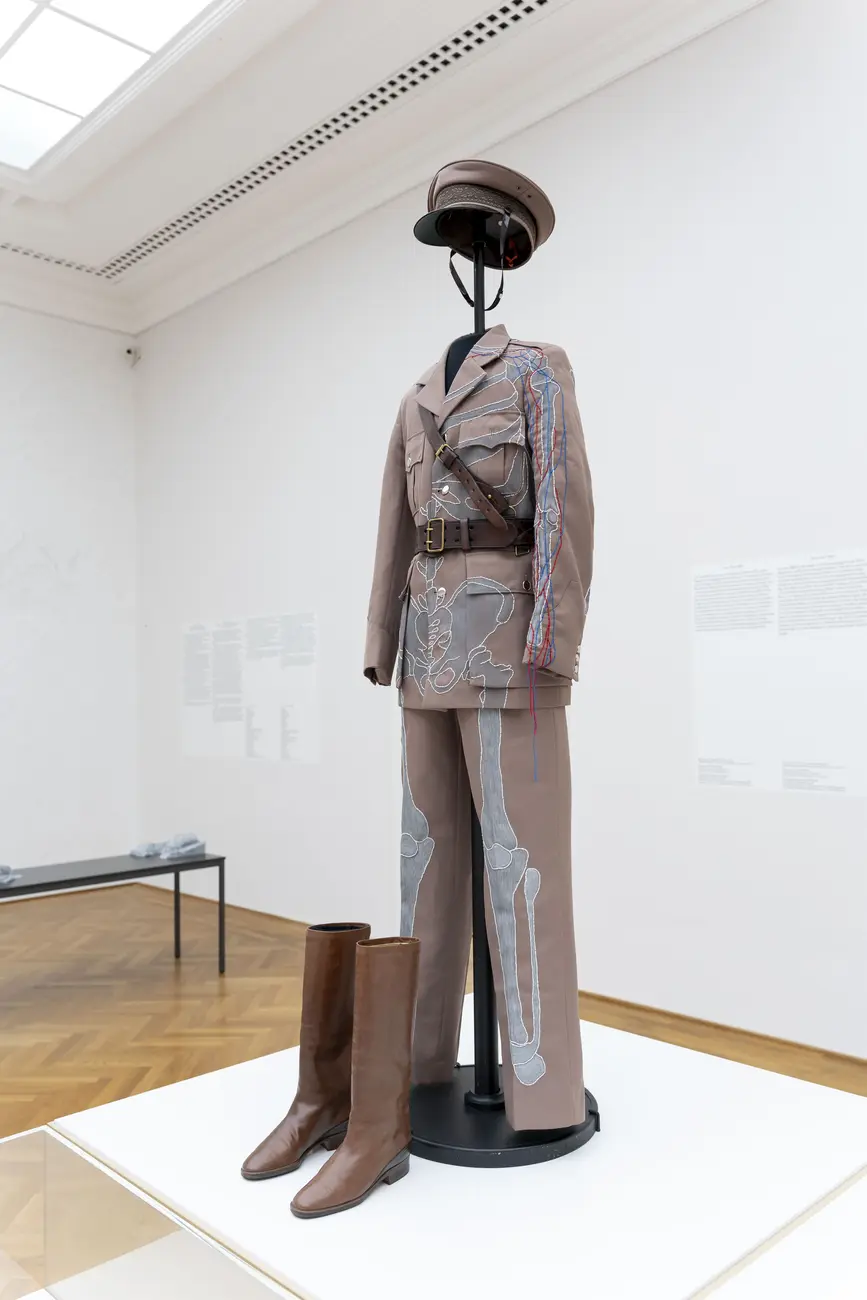
Tuli Mekondjo’s Schutztruppe (2022) stands beautifully as the only physical Namibian artwork in the exhibition. It consists of a faceless German colonial uniform, later reclaimed by Ovaherero men, and offers a tribute to the over 3000 prisoners killed in the German colonial concentration camp of Shark Island. Overall, estimates consider that between 50,000 and 100,000 people from both communities died in the genocide. Mekondjo, who grew up in refugee camps in Angola and Zambia during Namibia’s War of Independence, stitches the pop-art drawings of human bones and organs over the fabric, the first so lively and vivid as in defiance of the settlers’ dull uniform colors.
Quite striking is The Drum and the Bird (2024) by Forensis. Commissioned by Berlin Atonal, the audio-visual piece reconstructs the extent of the loss of botanical species in the terrains we have historical pictures of. The resulting data and imagery are then turned into a generated wind sound, showing that a century-long ecological loss has its unsettling melody of emptiness. The work pairs with Soundscape: Season 1 (2024), created by Forensis, Marco Freivogel, and Nesindano Namises, an audio-testimony consisting of field recordings of Namibia’s biome, including bugs and rustling plants.
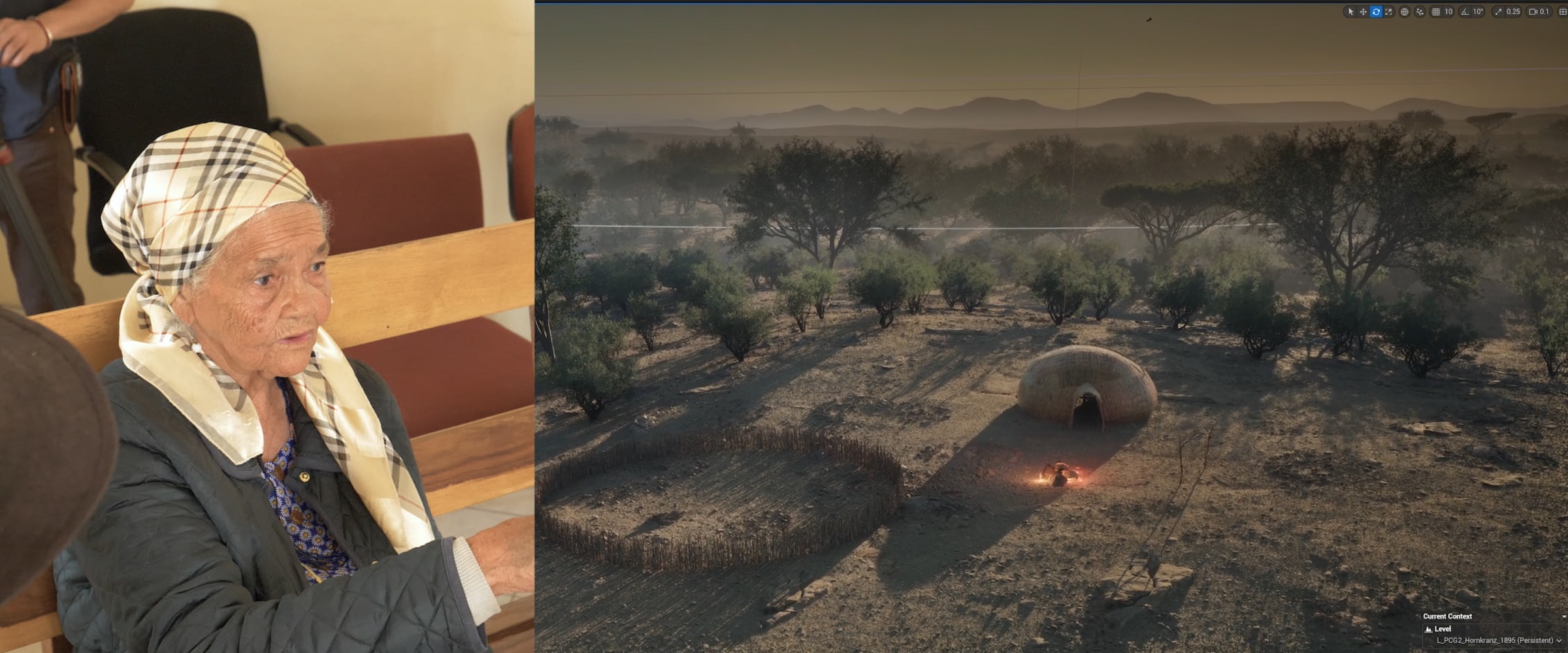
A nearby screen shows by Forensis and Forensic Architecture's video documentary, The Hornkranz Massacre (2023), centered on retracing and rebuilding the townscape of the settlement of ||Nâ‡gâs, or Hornkranz, which German colonial forces destroyed in 1893. This was made possible by working closely with the descendant communities who shared their inherited oral testimonies. Today, the stone remnants of the houses lie desecrated on a private farm. The documentary already debuted at Berlin’s Haus der Kulturen der Welt in 2023.
The digital archive provided by Fractured Lifeworlds serves as the crystallisation of the memory of a disappeared past. In the view of its curators and experts, the testimony opposes that of the settlers, who took the only pictures we have of the pre-colonial landscape. As the curators note, photography anticipated violence. European settlers would use it to prepare future land grabs.
Fractured Lifeworlds: Ovaherero and Nama Claims for Intergenerational Justice is on view at Spore, Berlin from June 7 through April 30, 2027.