.jpg)

.webp)
“Thucydides Fever Dream” at Hill Art Foundation
Review
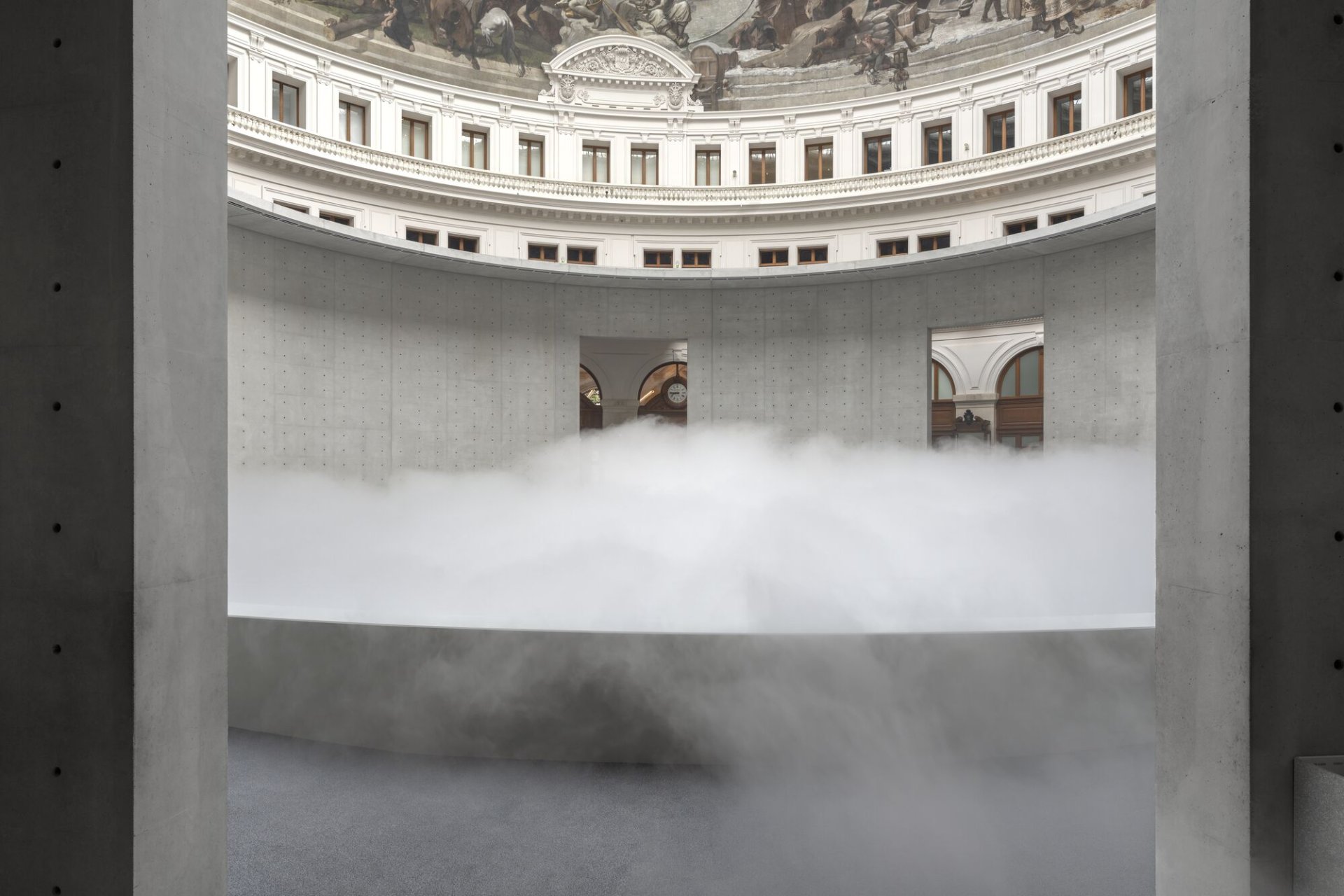
At the heart of Clair-obscur, the exhibition currently on view at the Bourse de Commerce in Paris, Fujiko Nakaya gives form to the disorienting in-between that sits between darkness and light. At the center of both the curatorial narrative and the building itself, twilight is explosive, dizzying, and then revelatory. For more than fifty years, the Japanese artist has been known for her “fog sculptures,” using finely pressurized water to produce ephemeral environments that respond to architecture, weather, and human presence. Here, she brings her mist technology to the museum’s rotunda with Cloud #07156 (2026).
Upon entering, Tadao Andō’s gray concrete rotunda appears strangely empty. Visitors are admitted in small groups and invited to step inside, though not to cross the space. Benches line the walls, and the more curious are free to get up and wander around, but never through the center, a square marked out on the floor by the grates from which water vapor emerges. An amusing game of cat and mouse soon begins: the more disobedient visitors cross the boundary, guards follow, and the offenders vanish into the fog, suddenly impossible to catch. For roughly ten minutes, this vaporous choreography takes over the space, and the architecture itself begins to vanish. Sunlight filters through the glass dome above, piercing what at first resembles a sky borrowed from the imaginations of the Romanticist movement. Nebulous and inherently mysterious, the fog carries its own art-historical ghosts, and Caspar David Friedrich inevitably comes to mind. But Nakaya reverses the familiar perspective: the wanderer no longer contemplates a sea of clouds from above, but steps inside it.
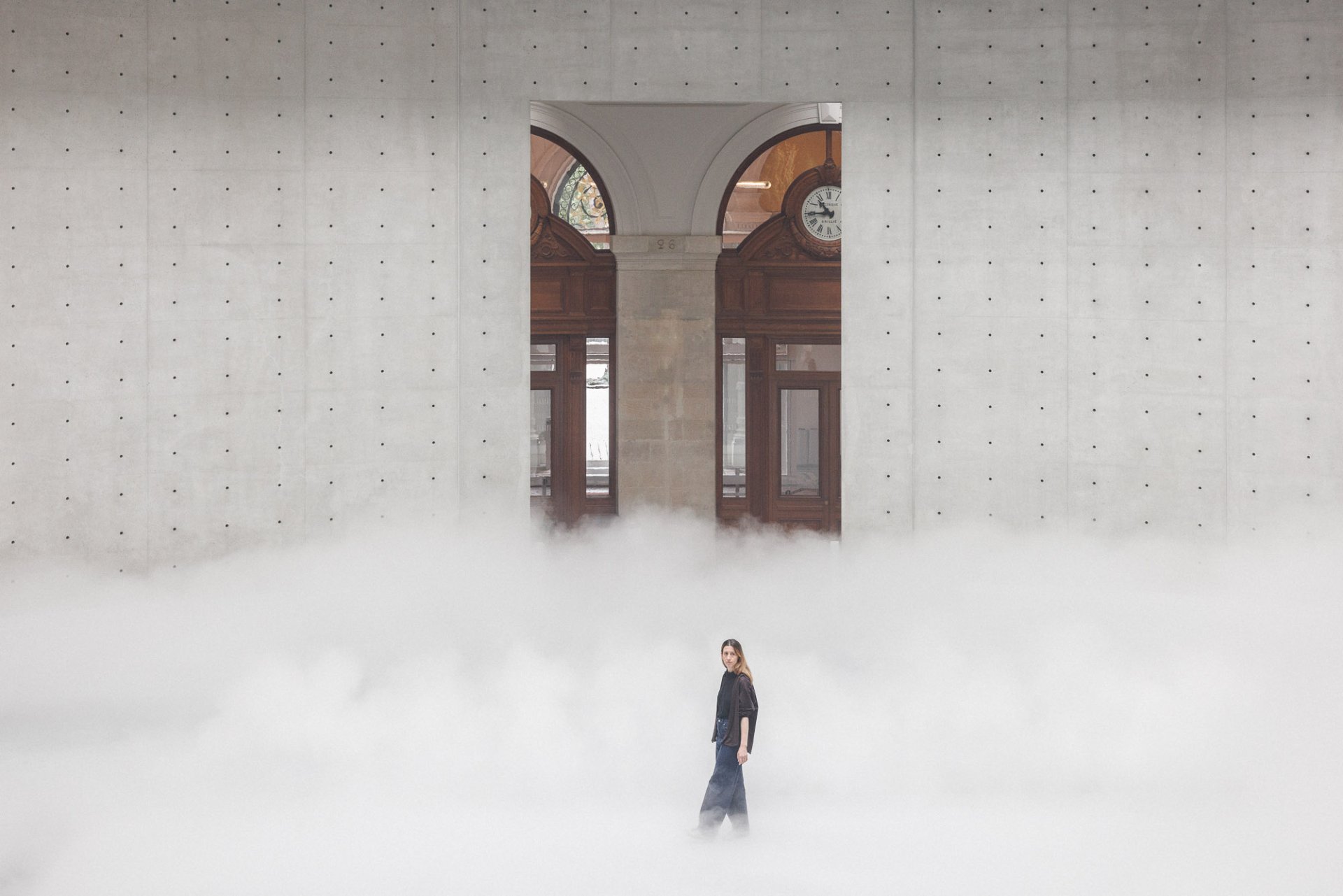
While Clair-obscur draws on the painterly technique of chiaroscuro, its conceptual framework takes its cue from Italian philosopher Giorgio Agamben, for whom “a contemporary is someone who, in taking a look at his era, surveys the shadows instead of the lights.” The exhibition embraces this tension between darkness and illumination as a way of looking at the present. Nakaya’s installation makes that tension tangible. Using artificial means, she recreates a natural phenomenon, giving the work an intrinsic paradox: we are asked to look at something whose very effect is to prevent us from seeing. The installation also contains a promise that is endlessly renewed—the promise of an aftermath that remains uncertain. As silhouettes appear and disappear across the rotunda and the walkway above, the installation continuously produces new images. None lasts for more than a few seconds. Although the experience repeats approximately every fifteen minutes, it is defined above all by its impermanence—the moment of the droplets’ release sets off their own demise. Nakaya initially explored fog through painting, but eventually abandoned a medium she found too static in favor of a practice closer to performance. Her work depends on a direct, embodied relationship between art and those who experience it: the viewers’ bodies are enveloped in the work, their movement altering the fog’s trajectory.
Nakaya begins with a meteorological process—an interest often linked to the work of her father, Ukichirō Nakaya, a physicist and science essayist credited with creating the first artificial snowflakes. But Fujiko Nakaya moves away from literalist tendencies and instead explores fog as a poetic and experimental medium. There's no scientific explanation or technical description that interferes with what the artist has described as “a space of relation between beings and things.” The work is defined by simultaneity, with no stable form outside the present tense, shaped by entropy, air, heat, architecture, and duration.
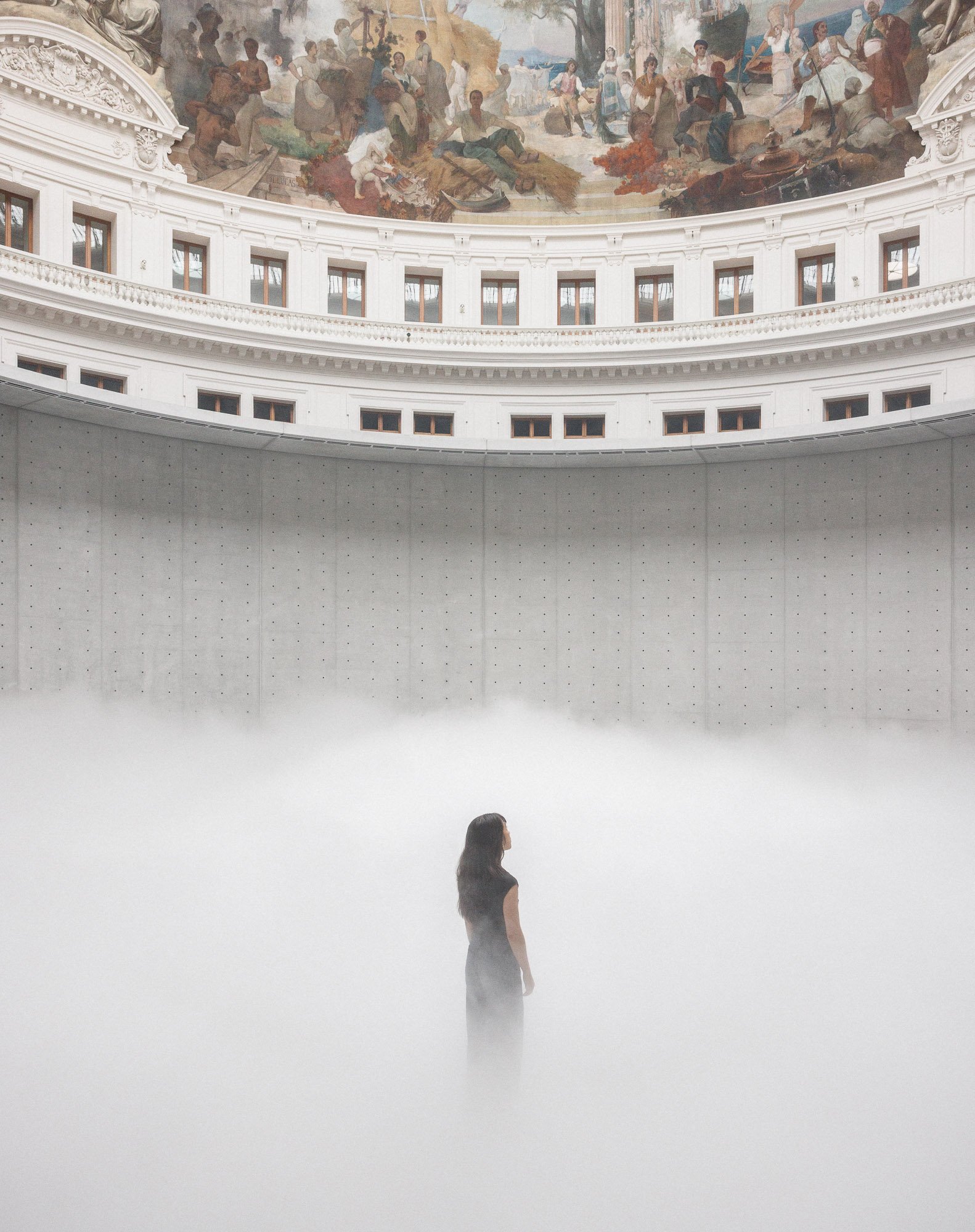
This instability is particularly striking within the Bourse de Commerce, a building saturated with architectural and historical weight. The nineteenth-century structure is circular, crowned by an immense glass dome; inside it, Andō’s concrete cylinder creates a circle within a circle, an opening that resembles an enormous eye. Through the fog's shifting density, vision becomes unreliable. Looking up toward the dome, sections of the vast nineteenth-century fresco depicting global trade disappear from view. We lose our bearings: the four cardinal points painted into the composition, dividing the regions of the world, fade away. Fog becomes both a source of disorientation and a new space to inhabit.
The surprise of encountering what initially appears to be an empty rotunda quickly gives way to the materialization of what is usually invisible. Emptiness begins to look less like an absence and more like a context temporarily stripped of substance. Fog reveals its contours, making perceptible movements we ordinarily cannot see: air flow and circulation. Outdoors, fog typically obscures our view of the world. Here, it reveals our presence within it. Nakaya transforms the Bourse de Commerce into an architecture of atmosphere, where aesthetic and natural phenomena become inseparable. Nakaya’s work is an experience in itself, but it also belongs to a larger narrative that reimagines chiaroscuro not only as an artistic technique, but as a philosophical ethic—a way of inhabiting the tension between darkness and light. Below the rotunda, Philippe Parreno’s videos occupy the “Nocturne” section of the exhibition, evoking an endless night made of sounds. Cracks, thunderstorms, tremors, and dripping water turn the space into a cave from which escape seems difficult. A voice addresses us: “How dare we compare ourselves to the creator, when everything we do has already been done?”
Upstairs, Nakaya’s twilight seems to offer an answer: what matters is not reinventing existence, but learning how to experience it through the senses. Recreating nature is not, here, the gesture of a demiurge seeking to reshape the world and rival its creator. Nakaya’s gesture is far more humble: she creates the conditions for an encounter, then allows the work to escape her control. Above the cloud, the galleries of the Bourse de Commerce lead visitors toward the exhibition’s final section, “Incandescence.” Light is more present here, but it offers no simple illumination. The paintings of Romanian artist Victor Man retain an uncanny quality: faces, yellowed by light, emerge from dark backgrounds, bringing glow and shadow together in the purest tradition of chiaroscuro. The exhibition’s progression from “Nocturne” to “Incandescence” inevitably recalls Plato’s allegory of the cave. In The Republic, the passage from darkness into light is not immediate or painless: the prisoner, dazzled by the brightness, is initially unable to recognize the reality before him. Plato describes this transition as a disturbance of vision, suggesting that learning to see differently first requires a period of disorientation. Clair-obscur proposes a similar trajectory. Yet there was something unexpectedly soothing and deeply moving about navigating Nakaya’s obscurity. To surrender one’s bearings can be unsettling, even anxiety-inducing, but here uncertainty also offers a strange form of relief. Between obscurity and illumination, Nakaya’s cloud points us to a renewed promise of seeing.
Cloud #07156 by Fujiko Nakaya is on view as part of the exhibition, Clair-obscur, at Bourse de Commerce, Paris through August 24, 2026.