.jpg)

.webp)
“B³” at Essex Flowers
Review
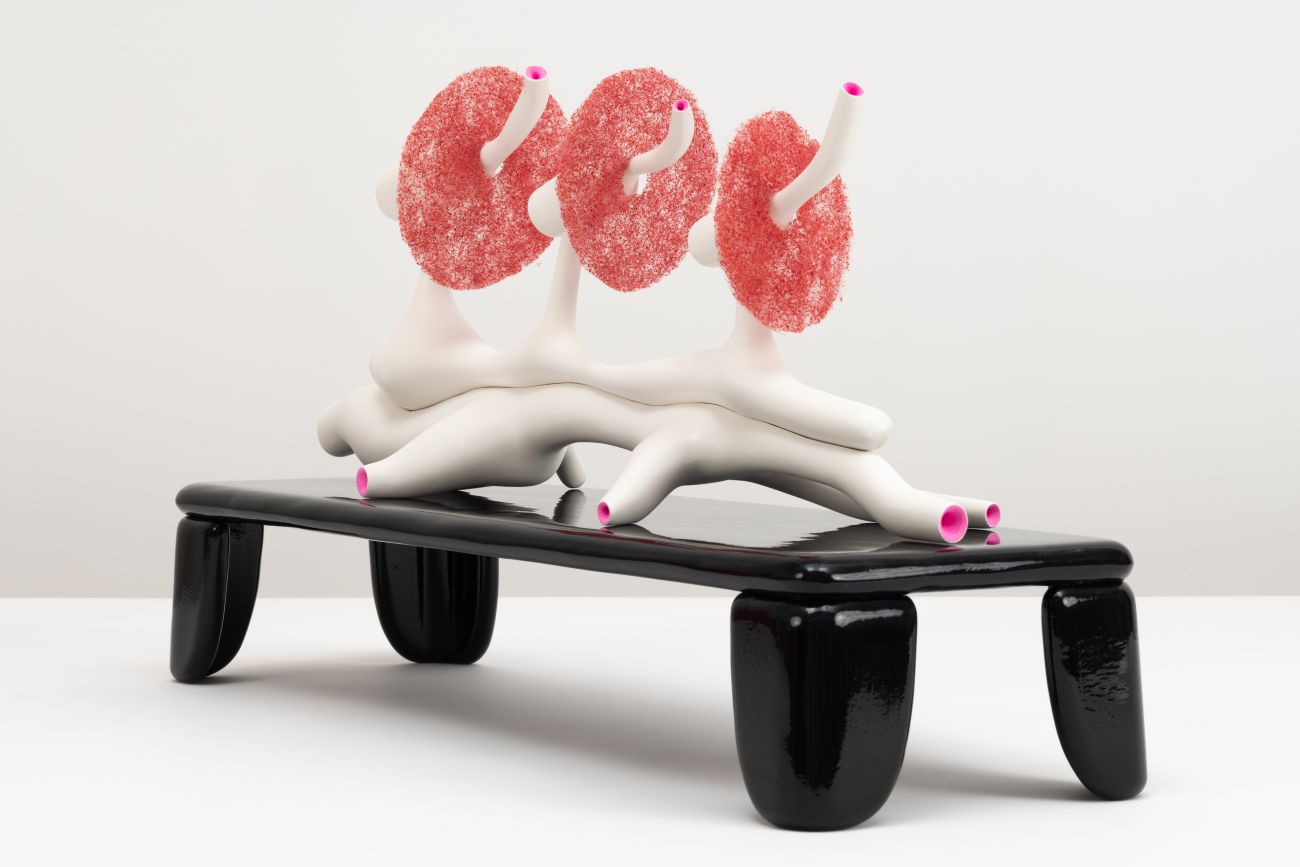
A feast of fleshy, intestinal reds and pinks first greets viewers when walking into Matthew Ronay’s Cold Meat, Cake, and a Variety of All the Finest Fruits in Season. There is an instinctive whiplash brought on by seeing the works in their abundance: bright, playful colors clash with unsettling biological shapes. Are they sculptures, or are they alive within a dense colony? Are we consuming these plentiful works, or are we in the stomach of a beast? Matthew Ronay’s confidence allows us to suspend any disbelief about their biological logic and accept them on their own terms.
At its core, the show’s main theme is consumption in all senses of the word, processing viewers through the gallery in a controlled way. The show’s title, a reference to an overwhelming feast described in Jane Austen’s Pride and Prejudice, emphasizes how much Ronay packs into the room.
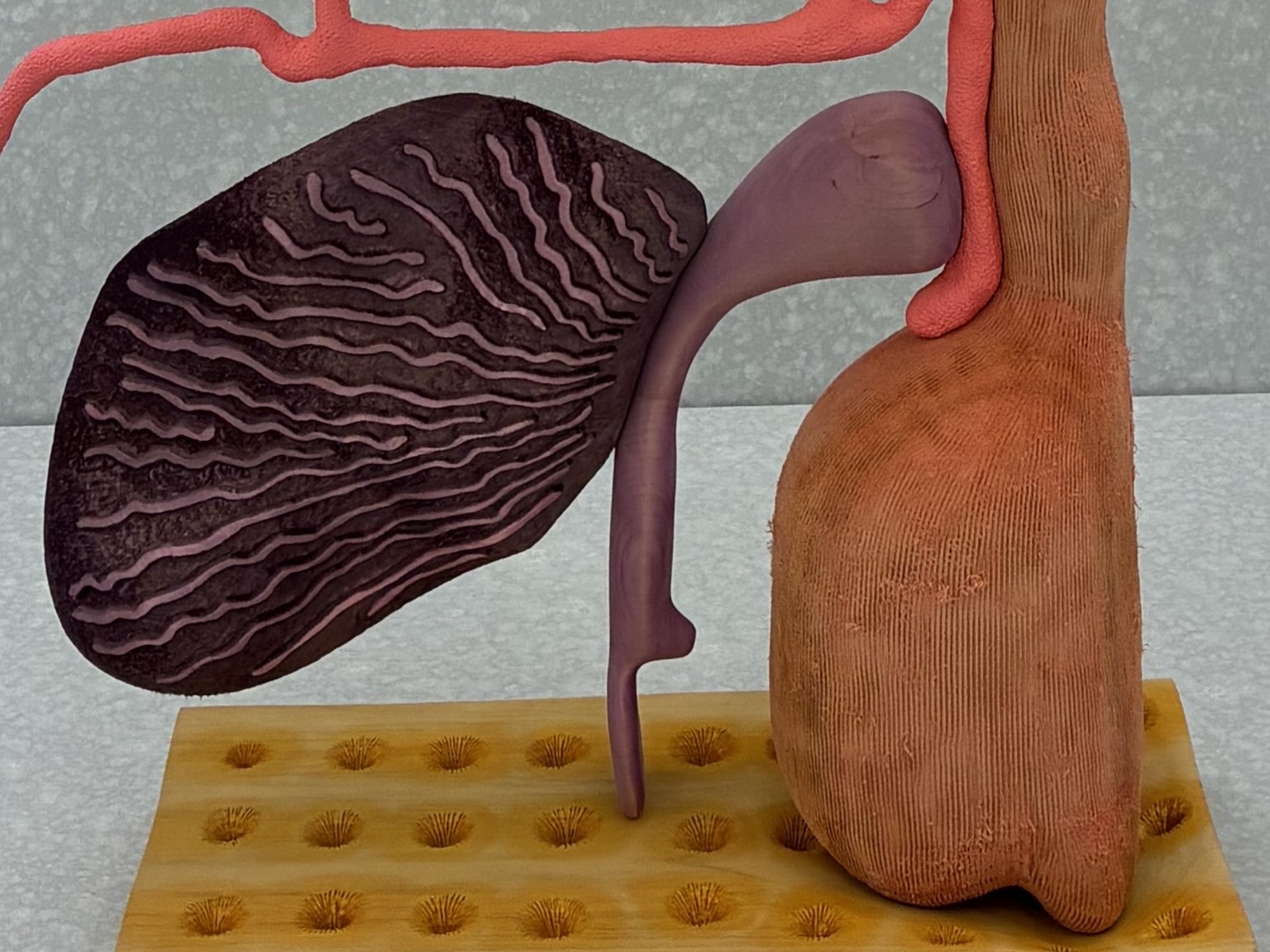
The works all play with balance and asymmetry in organic shape, anatomy, and nature. Forms that call to cellular biology, pink organs, and yellow muscle dangle, push, and squeeze against one another. Some droop over other extremities and shapes, while others seem to grow on their own, spindly and reaching out like branches of mold. The work feels clinical or pedagogical, like an anatomical chart or model in a doctor’s office, rather than gruesome. Hair follicles, muscle, tissue, bone, and even teeth emerge across the various surfaces. Color groupings are most notable in the fleshy pink and red entry, which acts as a great introduction to the show and its thesis of metabolism. As we move through the show, we also encounter a group of mostly blue works and a group of white sculptures. Through their sheer quantity and color-coded groupings, these objects suggest they have grown through some mitotic reproduction. As Ronay is quoted in the show’s press release: “This strange and violent year has to be dumped into the gallery. The basswood entered the studio, was chewed up, and must exit.” His own studio practice is framed as a metabolic process, with creation becoming a gastrointestinal tract, consuming the materials and outside world and expelling them as physical objects. In his 2022 e-flux article “Digestion: The Excremental Interior,” writer Mark Wigley details how modern interiors use white, clean, sealed surfaces to absolve us from biological contaminants and bacteria. Ronay subverts this idea by purposefully taking a clean white-wall gallery and lining it with these intestinal forms—housing the body’s interior and all its contaminants exactly where it is meant to be kept out. Here, we are left with the bacterial remains of Ronay’s studio consumption and digestion.
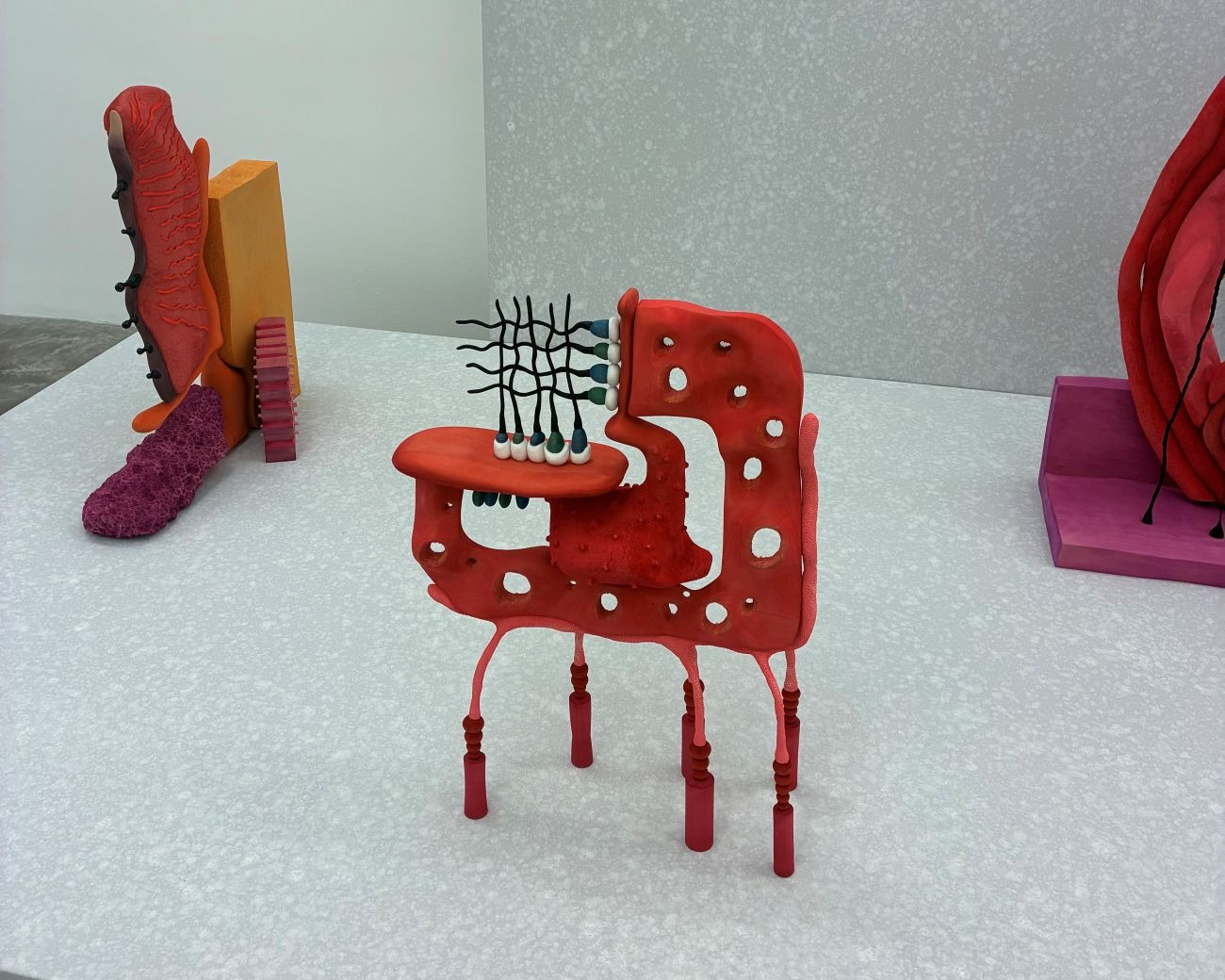
While these smooth, almost alien shapes appear to have spawned into life, they are mostly carved, sanded, and dyed by hand from basswood, and the saturated palette is all the more impressive knowing Ronay is colorblind. As Ronay plays matte finishes against glossy ones, the matte white forms come across as bone or molars, while matte orange shapes feel like skin or hands. In some areas, the wood feels like pinched polymer clay, its squishing and drooping contours feeling completely foreign to the original material. Even in places where the wood does reveal itself, such as frayed wood fibers along rough cuts, it circles right back to material deception by mimicking torn human tissue. Flocked surfaces, gouged divots, and porous holes look like natural coral or flesh. The imagined slow, analog labor of whittling wood strongly contrasts the futuristic finish he achieves. Only in a few functional-looking pieces, like the glazed clay and wood napkin holders, does the material state itself clearly without tricking the eye.
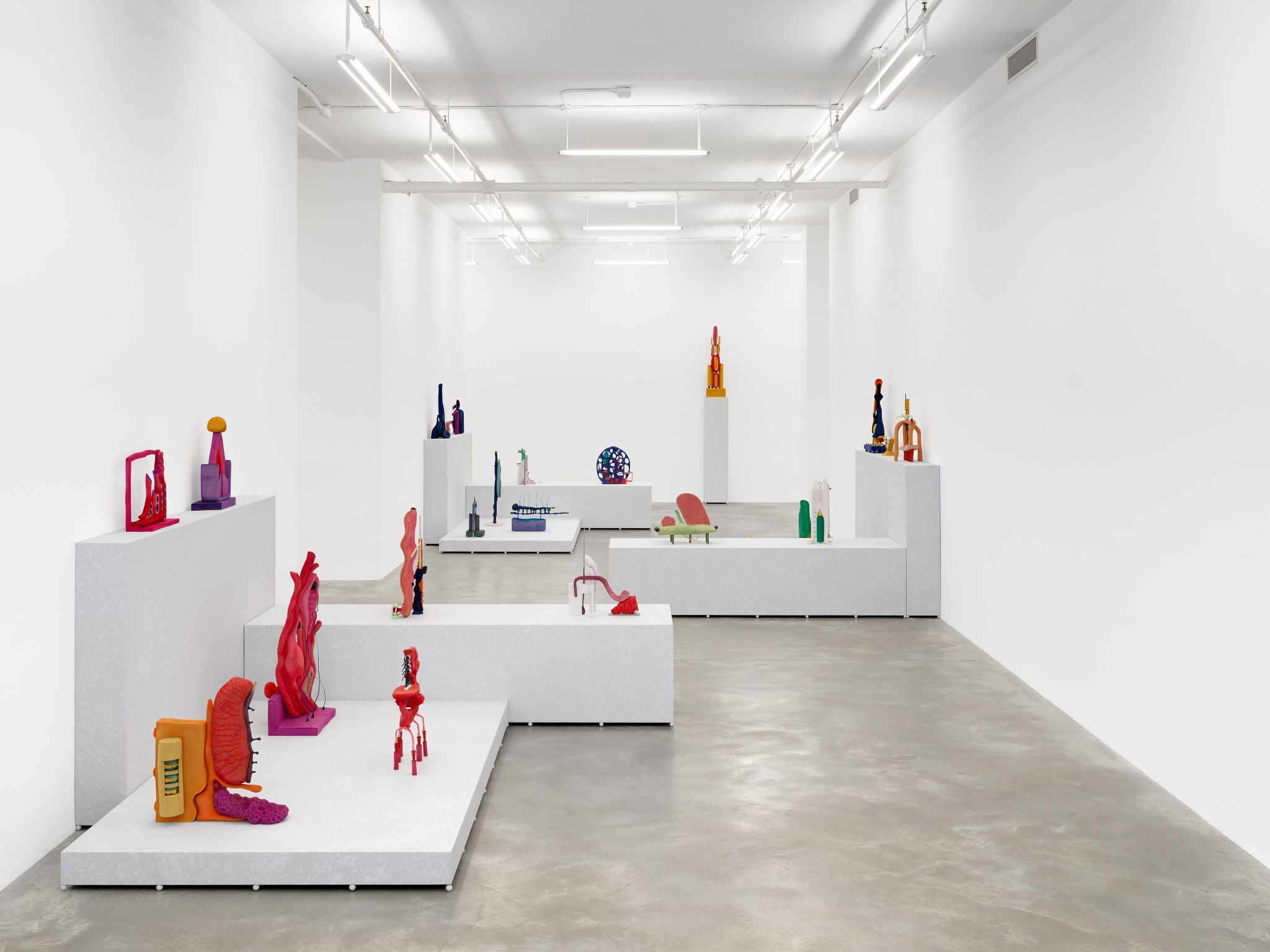
The raised, gray plinths holding these sculptures act as a track for digesting the work. Modeled after a fireplace at Frank Lloyd Wright’s Hollyhock House, these cement-like countertops force viewers’ eyes to wind up, down, and around rather than offering a straight line. Mark Wigley argues that architecture is an extension of our human digestive systems, even quoting Wright calling a house a “stomach that attempts to digest objects… The whole life of the average house, it seems, is a sort of indigestion.” These objects act as both organic material belonging to the body and objects in the process of our digestion as we curl our viewing through a guided tract. Yet because of the staging and sheer volume of objects, these foundations also read almost like a furniture showroom stocked with alien decor, mysterious tools, and forms that echo known, but now alive, domestic wares. Those clearer, more readable napkin holders lean into this consumption theme, not only by nodding to the dinner table, but also to the consumption of sellable, common household objects. At first, I wondered how these sculptures would stand on their own, or if the installation could push that commodification and feast staging even further. Anything more, though, would be too on the nose. With such strong colors and inventive shapes, Ronay knew the work didn’t need a heavy-handed thematic environment to sing. Instead, the immersion comes entirely through the sculptures’ immense quantity. They work because of their volume, a mass production of unique forms echoed in the accompanying printed book of drawings at the front desk, which favors sheer quantity over individual drafts. Isolated in a classic white-wall vacuum, a single piece would say something far different.
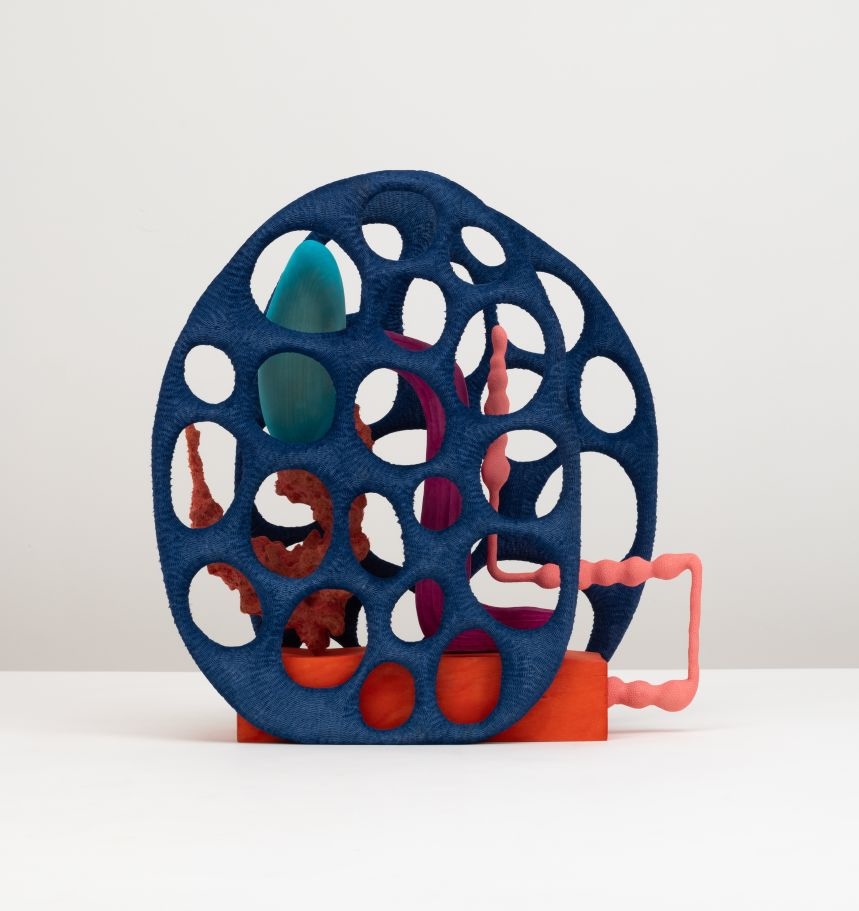
In such an intense era of optimization, both of the body and consumable goods, this show stretches that impulse to an extreme. Just like Ronay’s need to “chew up” his materials and this violent year, the show presents a gastrointestinal way of processing the world: a metabolic breakdown of our surroundings that grows past the point of our control and even utility. Our instinctual question of what these objects are for highlights the very point—any attempt to label the architecture, the tool, or the ligament referenced by the works is often to no avail. These things are growths simply because they grew; there's no utilitarian consumability here beyond looking and trying to figure them out. We can only partially digest these objects. Ends of muscles and limbs open up to reveal new colors and textures inside, hinting at layers of organic life. We are left digesting and contemplating all these different components, unable to fully stomach or understand it all. There is a real authority in Ronay’s use of instructional colors and semi-familiar forms, an assertion that all of this exists within our own shared imagination when it is actually coming straight out of his. You can pin down and collect what is familiar, whether hair follicles, building architecture, or teeth, but only through deep, patient search and consideration. In front of these very tactile and strange puzzles, the act of chewing them over is the whole point.
Matthew Ronay: Cold Meat, Cake, and a Variety of All the Finest Fruits in Season is on view at Casey Kaplan from September 10 to October 24, 2026.