
.webp)

To Touch the Sky: The Drone in Contemporary Performance
Voice
After opening at Aspen Art Museum’s AIR Festival in July 2026, Camille Henrot’s first live performance Commedia dell’arte had its New York City premiere this fall at Florence Gould Theater. The production honors its namesake, an improvised form of theatre that emerged in northern Italy in the sixteenth century. Historically performed by troupes across Europe, commedia empowered actors to freely define their performances without needing to observe the structure of scripts or consider the competing desires of playwrights, directors, or composers. Featuring basic plots, commedia performances staged encounters between three main archetypes: masters, servants, and lovers. Outfitted with highly exaggerated and distinct movements, vocal stylings, props, and costumes, each character type operated within a fixed hierarchy and represented specific class positions. In Commedia dell’arte (2026), Henrot transports classic commedia stock characters like Harlequina, Il Capitano, Pantalone, Pedrolino (aka Pierrot), and Pulcinella to present-day New York City, where they collide in an apartment building. Henrot uses this premise to appreciate commedia’s traditional emphasis on physical comedy. Her impulses as an animator create a show that gives precedence to action over text.
At the start of the play, the hapless Pierrot (Samori Etienne), an MFA Poetry student and delivery worker for the unfortunately named Urgent Transport International (UTI), arrives at 101 Vulture Street. However, after misplacing his final package of the day, he bumbles about the building, meeting its inhabitants and heroically reminding them of their moral responsibilities to one another. Pierrot first meets Pulcinella, a purportedly Marxist Pilates instructor from France whose classes cost $300 an hour. Performed wonderfully by Maya Margarita, Pulcinella’s blasé quips include: “You don’t need anything. That’s capitalism” and “Open your legs as wide as the class divide.” After getting roped into Pulcinella’s Pilates class, Pierrot belatedly realizes that his package is addressed to Dagmara (Irina Varina), a grasshopper and set designer behind on rent because of wage theft. Threatened with eviction at the hands of the lecherous, sycophantic landlord Pantalone (Alex Tartarsky), Dagmara tries to lay low, avoiding as many people as she can, including the now exceedingly delayed Pierrot.
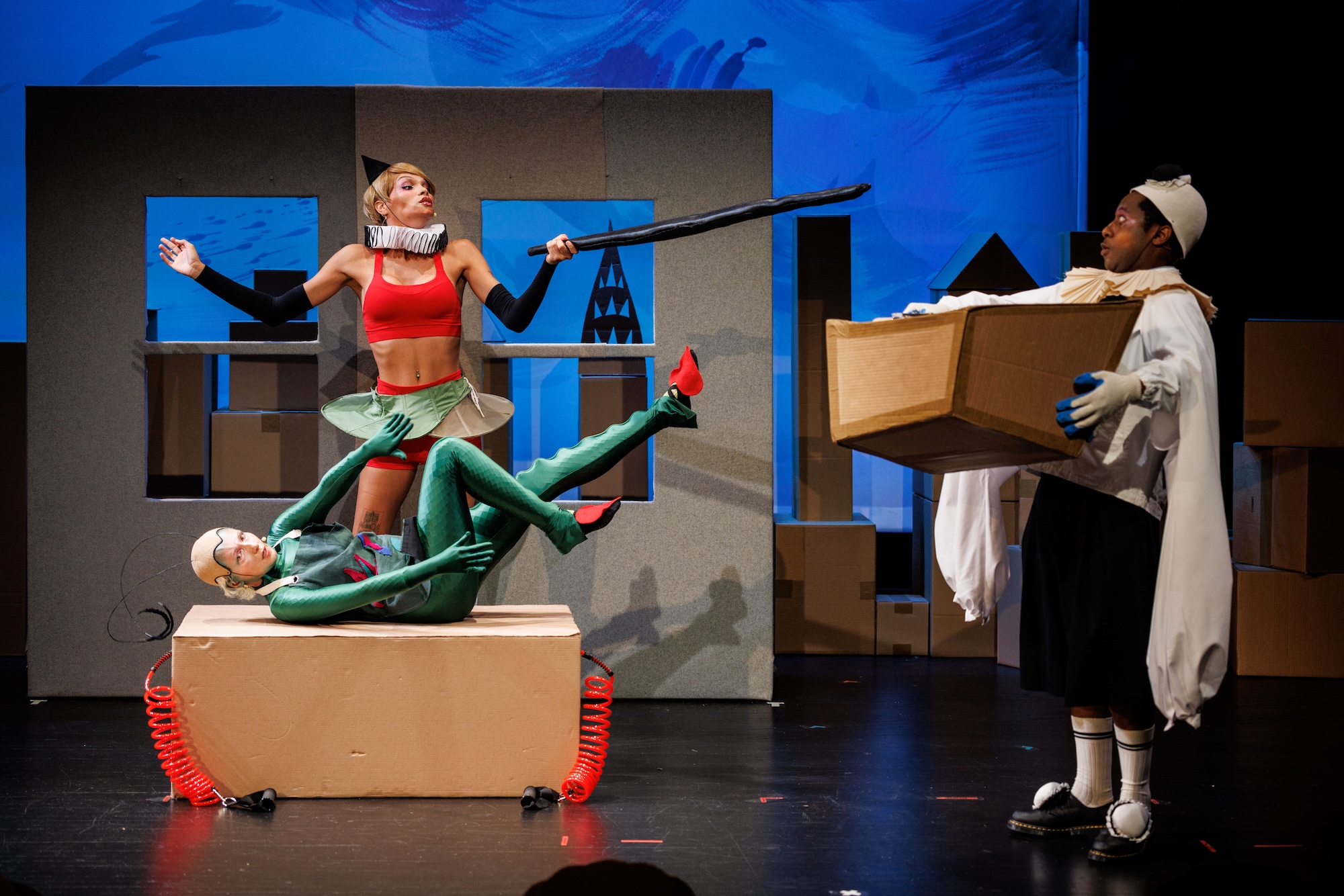
On his search for help, Pierrot stumbles across the inexplicably unclad Il Capitano (Isa Spector), a “crypto bro with DJ dreams” and Fidelity (Alex Tartarsky in a double roll), Capitano’s aggressively competent and ferocious business partner. As Fidelity, Tartarsky’s head is framed inside a mock computer screen mounted on a desk. Tartarsky’s thighs and legs remain visible, as they gyrate and strut across the floor on heated phone calls. Determined to both deliver his package directly to Dagmara and to prevent her eviction, Pierrot is eventually able to enlist the support of the ever-scheming and chatty Catarina “Cat” Harlequina (Christina Catherine Martinez). Cat thinks of a plan to thwart Pantalone by using the landlord’s greed to bring about his demise.
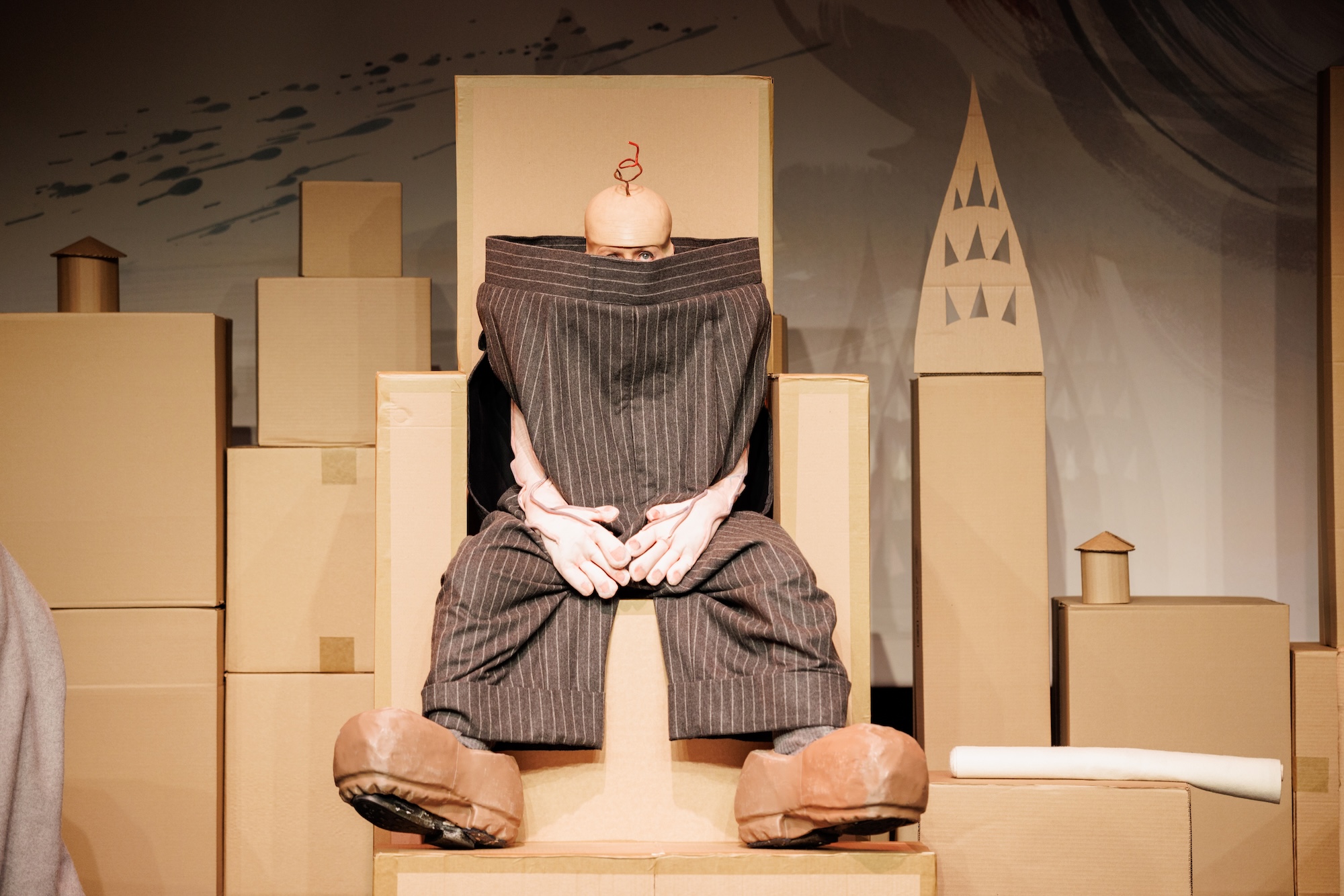
Sandra Berrebi’s costume design really shines through the absurdity of Pantalone’s character. As Pantalone, Tartarsky sits on a cardboard throne, swimming in immense gray trousers that come up to their neck and hide Pantalone’s skin, which resembles that of a naked mole rat. Pantalone gesticulates with revoltingly fleshy pink arms and stamps about in giant, clownish shoes. Save a single, stubborn curl, his head is shiny and bald. Tartarsky expertly embodies this rather despicable character, animating his shifty, darting eyes and overactive, fluttering tongue. Calling his tenants “parasites” and praising eviction as the ultimate form of “pest control,” Pantalone bemoans the fact that “broke people always think they suffer the best” (this gets some laughs from L’Alliance’s Upper East Side audience). Titillated by the prospect of evicting Dagmara, Pantalone delivers his own rousing rendition of “A Spoonful of Sugar,” the song originally performed by Julie Andrews in Mary Poppins (1964). However, Pantalone’s celebrations do not last too long. Having formed an alliance, the building’s residents work together to put an end to Pantalone’s abuse and defend Dagmara’s right to remain in her apartment.
True to the form of commedia, the play, co-written by Henrot, Estelle Hoy, and Justine Gelfman, is simple and often quite silly. Its moments of levity do not entirely mask or distract from many of the play’s real-world concerns: housing insecurity, eviction, and gentrification. The play, however, is not interested in addressing the degree to which artists reproduce gentrification through particular forms of cultural production and capital accumulation. Typically, when artists gravitate towards industrial, low-income neighborhoods, real estate speculation follows their arrival and convergence, quickly pricing out other residents. Although Commedia dell’arte has a clear-cut villain in the landlord Pantalone, it is not equipped probe the contradictions inherent in the building’s motley set of creative workers.
In Commedia dell’arte, assertions of class consciousness are instead delivered through exhaustive allusions to Mary Poppins: both the series of children’s books written by P. L. Travers and its various film and musical adaptations. While Pantalone jokes that Mary Poppins has a “chokehold on the human race,” Mary also looms large in the world of this play. The audience is quickly introduced to the fact that Dagmara is working on a production of Mary Poppins, and characters later mention “tuppence for the birds,” a reference to the Mary Poppins song “Feed the Birds (Tuppence a Bag).” Popular earworms like “Chim Chim Cher-ee” also appear and reprise throughout the play’s score. The reason for the play’s interest in Mary Poppins is clear. Set in Edwardian London at the beginning of the twentieth century, the fictional work follows Mary Poppins as she attends to the needs of the affluent Banks family. Teaching the Banks children Michael and Jane about generosity and industriousness while on various adventures, Mary re-introduces order to their lives and offers a simple moral to find joy and strength in community rather than hoard money or power at others’ expense.
Henrot’s training as a cartoonist and animator strongly influences the production’s choreography, costumes, prop design, and set design––all of which are injected with an air of whimsy. Sigrid Lauren’s choreography includes distinct staccato movements, as if the play’s characters were lifted straight out of stop-motion animations. Many of the ensemble’s costumes are saturated in color and buoyantly adorned with coils, curves, and polka dots. An abundance of faux fur, fishnets, and body suits favors a sense of delightful goofiness over grandeur, further exaggerated by Dan Stearns’s lighting design.
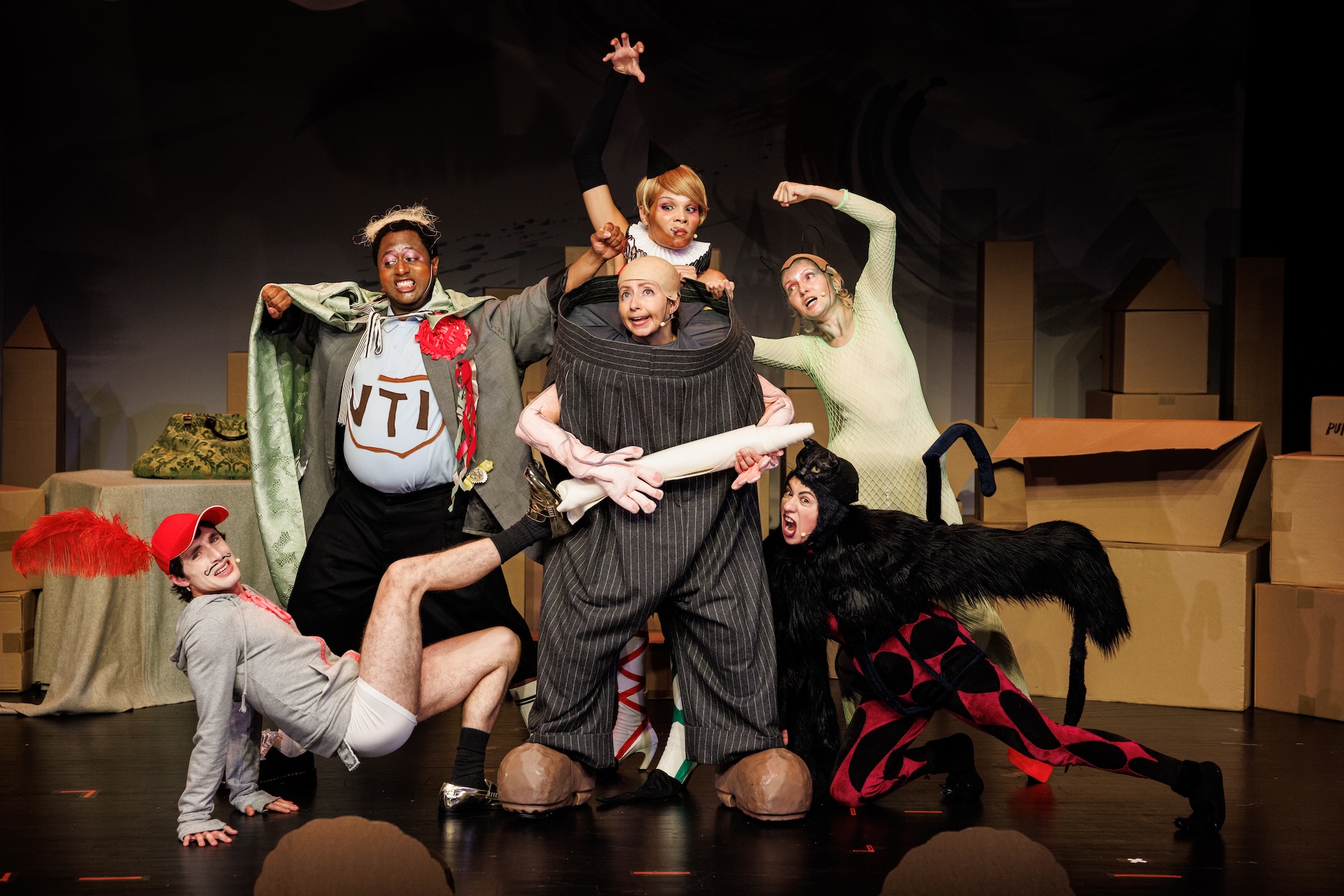
Impressively, everything on stage is either handmade or human-operated, a credit to set designer Adam Charlap Hyman (who worked with his firm Charlap Hyman & Herrero in collaboration with Henrot). The set, almost entirely constructed out of cardboard, transforms a stack of packages into a cityscape. A large building replica rotates to become an elevator, the play’s central set piece. During transitions, stagehands visibly enter and exit, pushing items across the stage and catching props that actors throw to them. The puppetry happening on stage and off in the wings is never masked or rushed, almost to a fault. At times, the play loses momentum during transitions, especially those that involve more complex sequences and changes. Additionally, the theater’s large red curtains occasionally open and close between scenes, slowing the pacing. Still, it is a relief to see theater that is purely human and not automated or digitized.
Composed by Mauro Hertig and Aaron Davis Ross, the sound design and original music in Commedia dell’arte emulates the style and form of cartoon soundtracks. With its prominent bass and alto saxophone lines, the opening groove recalls Harry Mancini’s iconic “The Pink Panther Theme” (1963). Accelerandos match flurried footwork during dance breaks and tussles, not unlike the lilting wind instruments that accompany Tom and Jerry’s scuffles and Wile E. Coyote’s flawed plans to catch the Road Runner. The pit orchestra includes foley artists who manipulate an assortment of props: a clear favorite being a red balloon. The ring of bicycle and service bells interrupts characters when they utter expletives or hint at anything uncouth, playfully recreating television censor bleeps.
The only element of the production’s sound design that borrows too heavily from the medium of TV is its use of laugh tracks. Though a clear nod to the canned laughter featured in American sitcoms like Friends, these frequent interjections can become distracting. Cued after one-liners and character bits, the pre-recorded laughter varies in pitch and style, mimicking the voice of a giggling toddler at one moment and a guffawing man the next. In a conversation with Camille Okhio for the Aspen Art Museum, Henrot says that, for her, “there’s no comedy without prerecorded laughter.” However, in live performance, the risk that audiences will not respond to a certain joke or bit is what precisely energizes the format. Actors need to have a degree of desperation. It is often when they are most open to completely “bombing” that they are able to elicit laughter. Equally, Commedia dell’arte must be willing to face the threat of silence and failure.
Camille Henrot: Commedia dell’arte is co-presented by Performa and L’Alliance New York’s Crossing The Line Festival. Commedia dell’arte is co-commissioned by Performa, Aspen Art Museum / Wheeler Opera House, and LYRA Art Foundation.