

.webp)
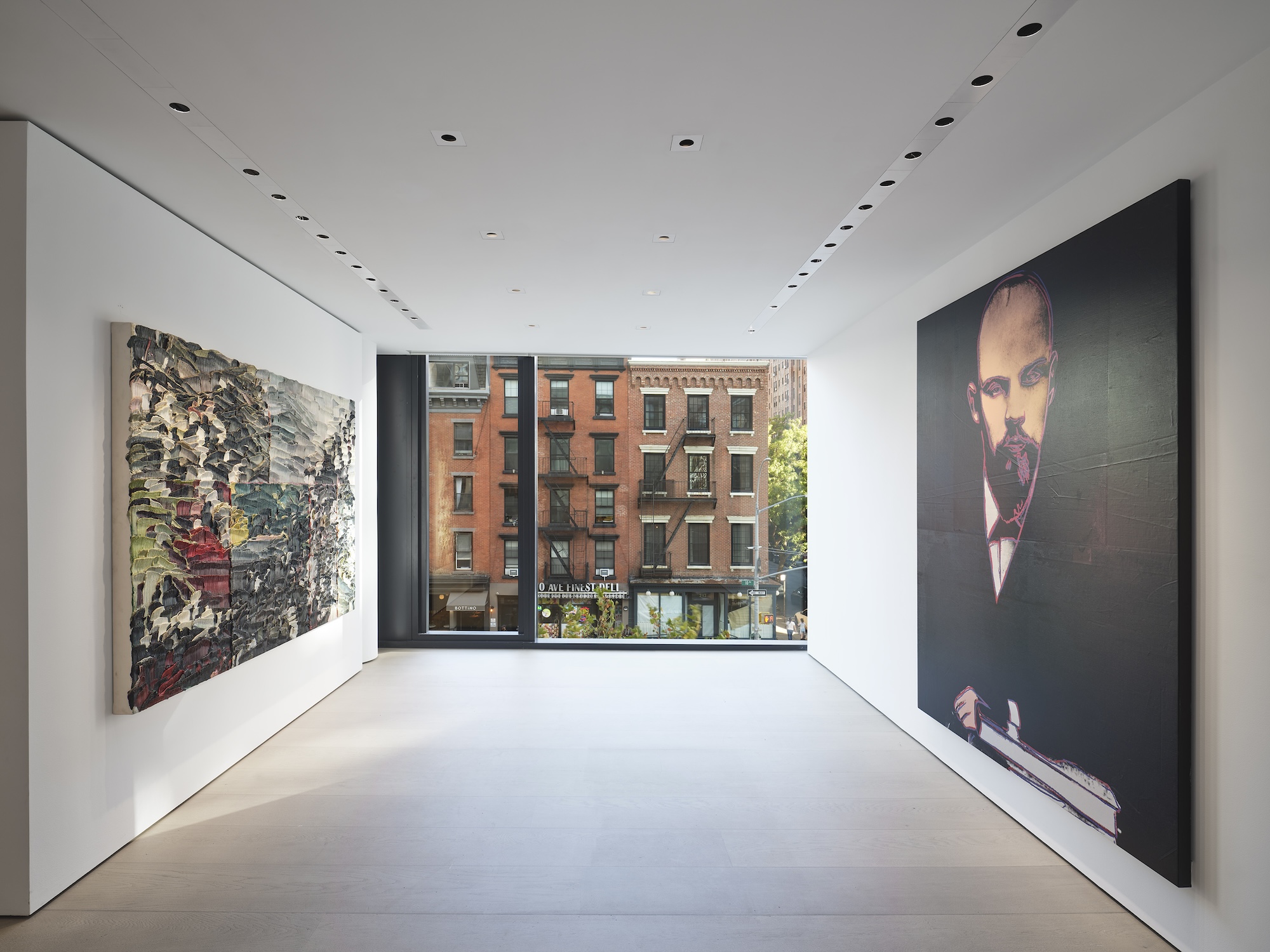
“Thucydides Fever Dream” at Hill Art Foundation
Review
This fall, following a run of exhibitions at Kunsthalle Wien, Lafayette Anticipations in Paris, and Fondazione Sandretto Re Rebaudengo in Turin, Diego Marcon presents his first solo museum exhibition in New York City at the New Museum. Yet for all their cinematic familiarity, Marcon’s films don’t really tell stories; they seem instead to hover at the edge of narrative. A boy hangs from a rope against a misty landscape (Fritz, 2024). A family sings its way through murder in The Parents’ Room (2021), while in Krapfen (2025), a child is surrounded by a chorus of garments insisting they eat an apricot jam doughnut. Marcon borrows the machinery of cinema—melodrama, musicals, slapstick, horror—and lets its codes and tropes run just long enough for their promises to become suspect. Seduction is part of the problem. His favorite film, he tells me, is Flashdance (1983), a movie he finds irresistible and calls, in almost the same breath, “an evil lie.”
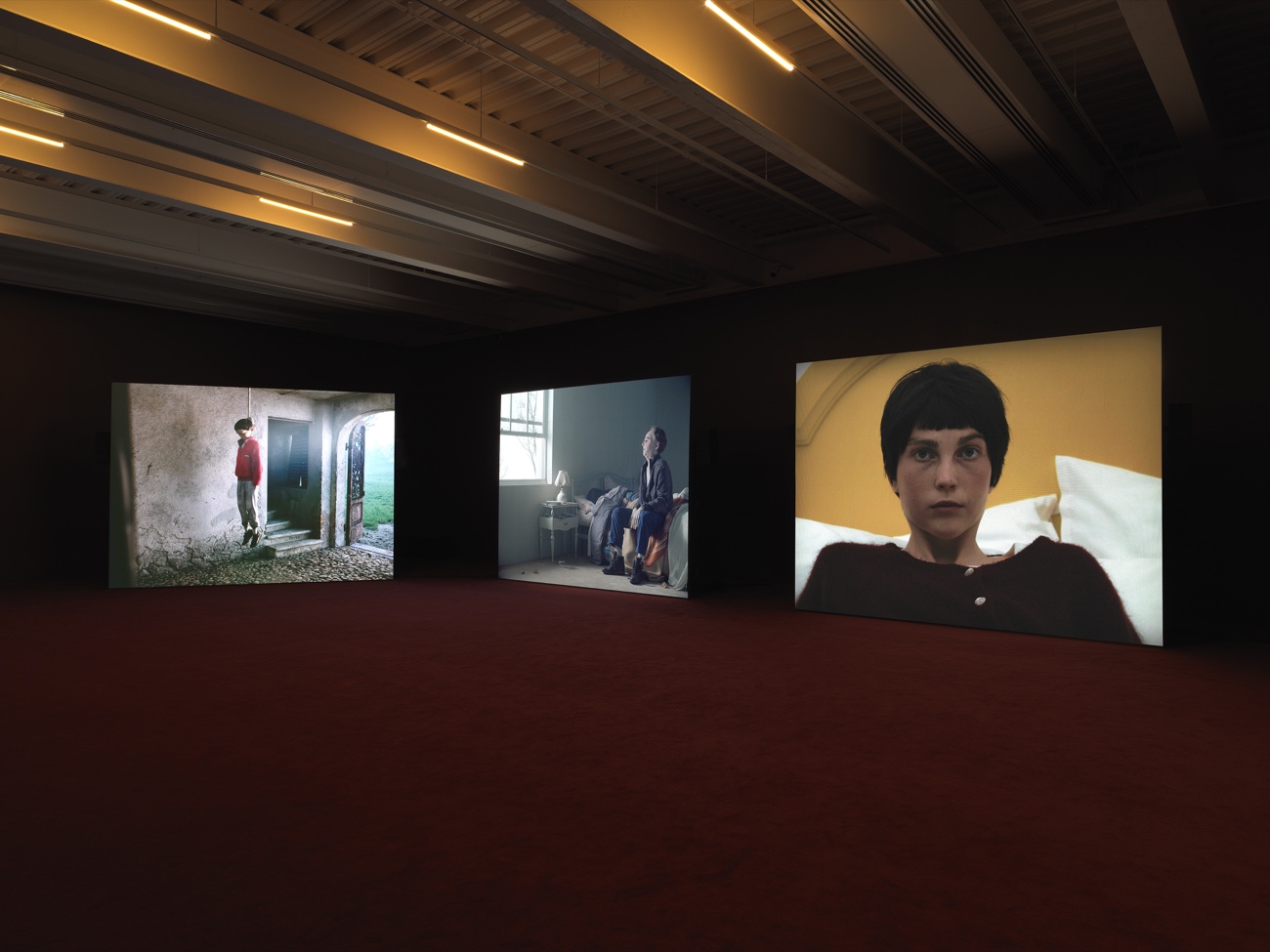
That uneasy pleasure carries into Arrivederci, Piggies!. Four recent films run simultaneously across the museum’s open second floor, re-edited so that only one speaks at a time. The exhibition is an extension of a conversation with Massimiliano Gioni that began several years ago and has since moved through some unlikely settings—a former marionette theater in Milan, a Baroque palace, a wooden house in the Swiss woods. Over that time, Gioni has watched Marcon’s work become “stranger and stranger.”
Beatrice Caprioli: Diego, it feels like your films don’t really have a narrative subject. Do you still think of them as stories?
Diego Marcon: In fact, no. They might be sketches, little gags, short acts, or vignettes. I am not interested in storytelling at all. My focus is the language, movie genres, their codes and tropes.
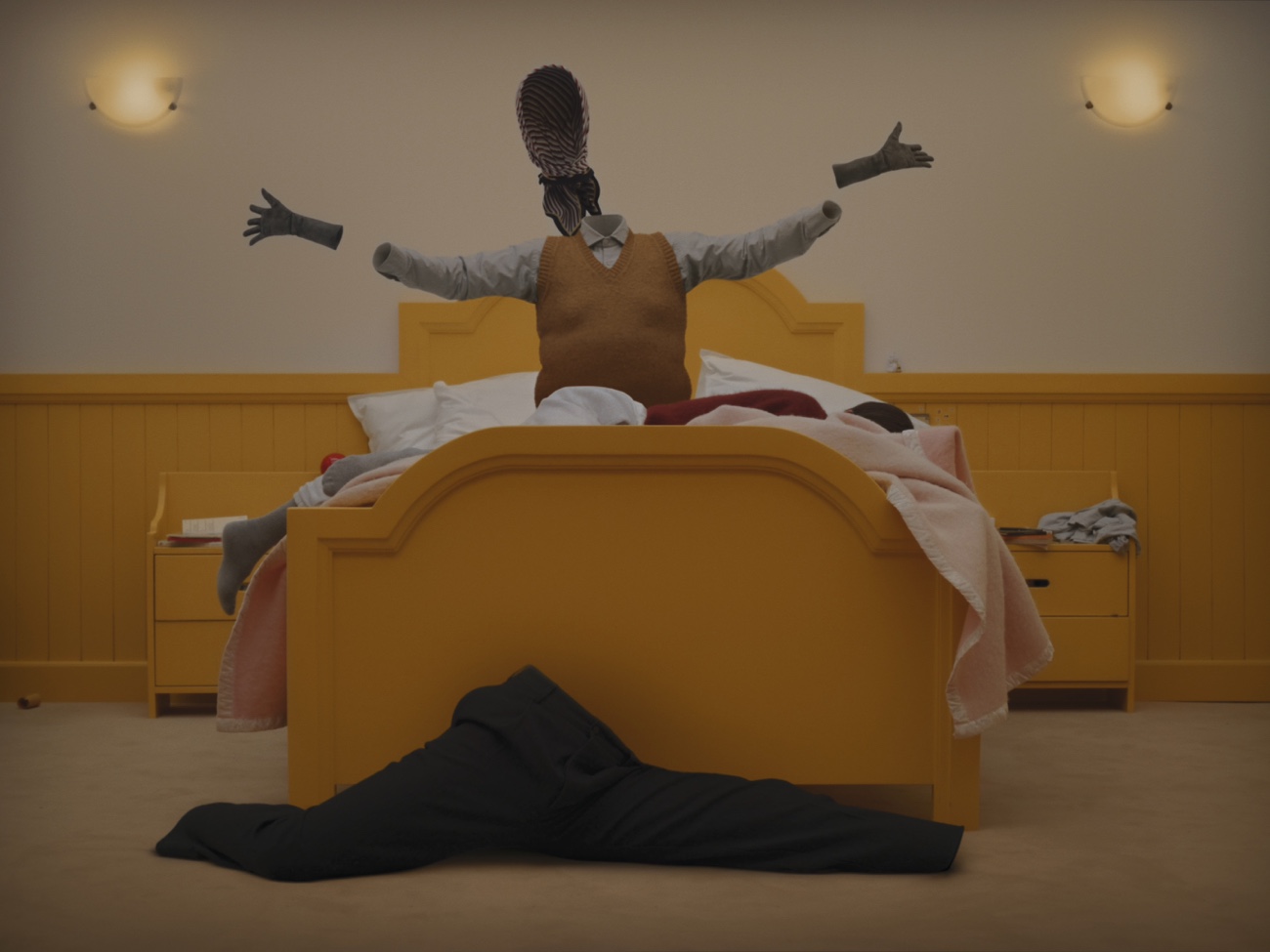
BC: You’ve mentioned Adrian Lyne and Paul Verhoeven among your cinematic references, perhaps unexpected ones in relation to your work. What did you find in their films?
DM: Lyne’s Flashdance (1983) is probably my favorite film of all time. Each time I see it, I can’t help but be completely seduced by it. I desperately want to be Alex: “In a world made of steel,” I want to dream such a dream; to desire such a desire; to feel such a feeling. But can I really “have it all?” No, I cannot. Flashdance is an evil lie. Within the movie lies both the desperate beauty of cinema and all its cruelty.
BC: How did the idea for Arrivederci, Piggies! at the New Museum come together?
DM: Massimiliano and I wanted to include in the show several of my recent films and videos that have never been shown in the US. When showing several videos at once, the problem is always sound bleed and overlap. I didn’t want to build walls or design a heavy architecture, but rather find a way to make the show into a single, open space. I then thought of re-editing the works so they could be displayed all together at once. In Arrivederci, Piggies!, they are all active at the same time, but each of them waits for the other to perform, playing one at a time. It’s a kind of choir, or a choreography.
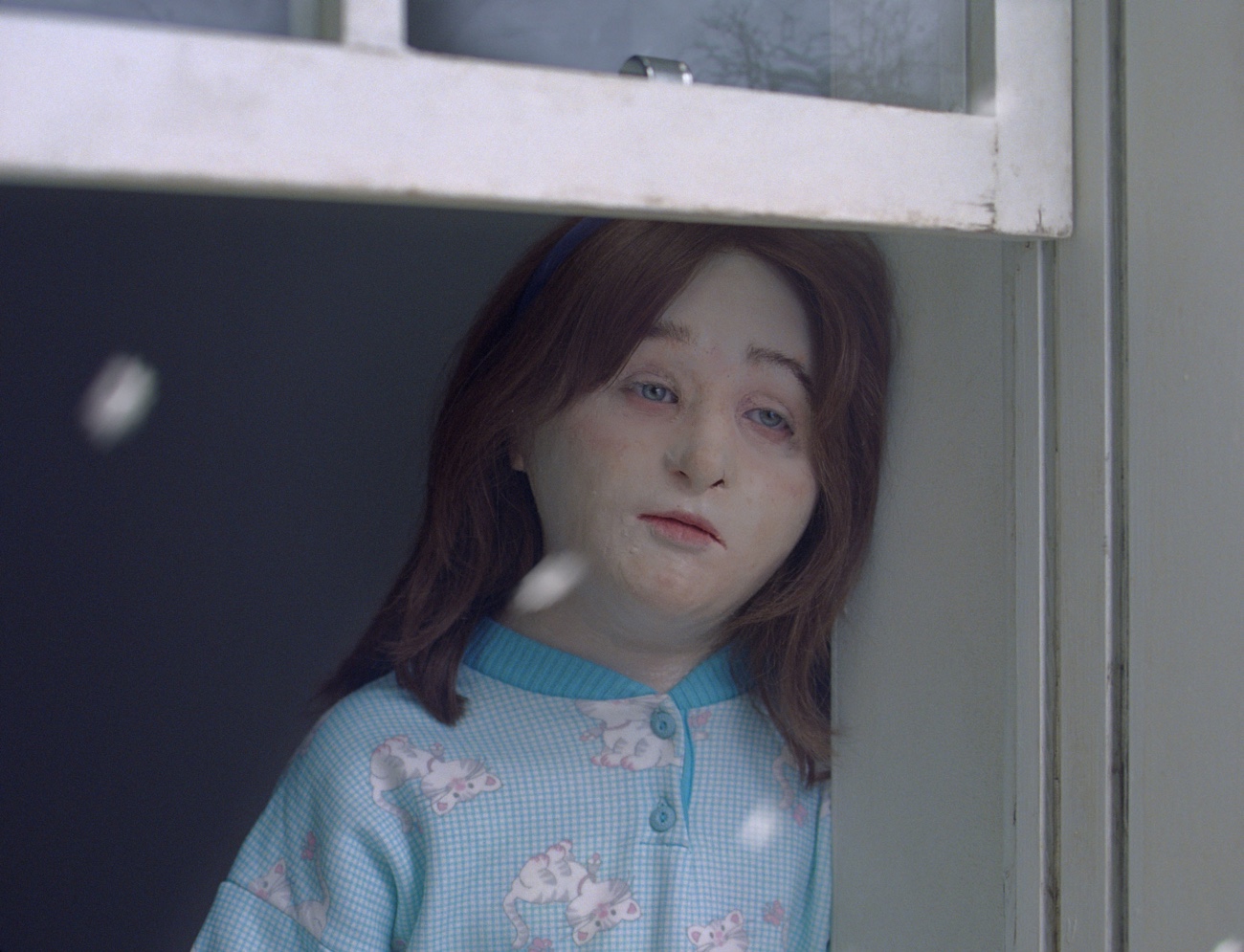
BC: Violet Savage is the first fully visible actor in one of your films. Why hadn’t you worked with a performer this way before? And how did Violet find their way into Krapfen (2025)?
DM: Among the different things that someone who works with cinema has at their disposal, I’ve never been interested in dealing with performers or acting. I had the idea of Krapfen—a kid harassed by several figures that insist that the kid must eat an apricot-jam-filled “krapfen”—in 2018, but I didn’t know what it had to be. In spring 2024, by chance, I met Violet Savage in London. While speaking, Violet told me they were a dance student. The day after, going to the airport, I thought that Krapfen would have been a dance movie, and that Violet should have been the kid. Their presence gave form to the kid. Violet embodies their ambiguity, looking simultaneously amused and bored, careless and bothered, sadistic and masochistic, passive and active.
BC: You’ve followed Diego’s work for quite some time. How has that conversation changed over the years?
Massimiliano Gioni: The very first time I included Diego Marcon’s work in a project of mine was back in 2020, during COVID, when, with the Trussardi Foundation, we created a quick digital project where we asked artists to take us on a journey around their rooms, as everybody in Italy was essentially confined to their homes. But it was after his participation in Cecilia Alemani’s Venice Biennale in 2022 that we started what has become an ongoing dialogue. With the Trussardi Foundation, we presented a beautiful solo show by him in a former marionette theater in Milan in 2023 and then presented one of his most powerful works, La Gola, in a Baroque palace in 2025. Just after his show in New York, we were together in Monte Verità in Switzerland, where we installed Dolle in a tiny wooden house in the woods. Marcon is incredibly precise about his work and its presentation, but he is also constantly curious and open. He is very focused, sometimes maniacal in the best sense of the word, but also very witty and entertaining, so it’s been a very rewarding conversation, I hope for both of us. And his work just keeps getting stranger and stranger. Krapfen, his most recent musical, which is a centerpiece of his New Museum presentation, is just such a marvelous and slightly perverse piece. It’s rare to find an artist whose work entertains so many interesting connections with so many other traditions and histories, ranging from the Baroque to the age of classic Hollywood cinema, via German literature and Victorian illustrations.
BC: What was the thinking behind the New Futures Production Fund with Fondazione Sandretto, and what did you want it to make possible?
MG: Patrizia [Sandretto Re Rebaudengo] has been an adventurous collector for many years, and what she has built with her foundation in Italy and abroad is just remarkable. She has been a friend and a supporter for many years, so she was the perfect accomplice to expand our program of commissions. The New Museum is a non-collecting institution: when we produce new works, they belong to the artists, so we really participate in building careers and support for artists. We are less interested in accumulation than in distribution, and that’s why our amazing network of international partners is so crucial. In this year alone, thanks to the collaboration of the Sandretto Re Rebaudengo Foundation and other commissioning partners, Marcon’s work has been shown all over the world, from Toronto—through another partnership with the Vega Foundation—to Paris and, of course, Turin. It’s a wonderful resource for the artist, and it confirms the New Museum as a very special platform: we are constantly connected to other institutions and presenting works around the world.
BC: Why did it feel important to begin with Diego?
MG: There are many factors: first of all, he hadn’t shown in New York yet, and only one piece of his was ever presented in the U.S., at the Renaissance Society in Chicago. We felt the timing was perfect to introduce his work to American and international audiences in New York. He has also been on an amazing trajectory of shows in some of the most exciting institutions around the world, so the show in New York comes as a culmination of a very active sequence of shows. And he is the rare Italian artist with a growing international presence, which also made perfect sense for the Sandretto Re Rebaudengo Foundation. But the beauty of Marcon’s work is that it remains strange and somewhat foreign to any audience.
This interview was edited for clarity and length.
Diego Marcon: Arrivederci, Piggies! is on view at the New Museum from September 24, 2026 to January 31, 2027.






.jpg)