Editors' Selects: September 2026
Review
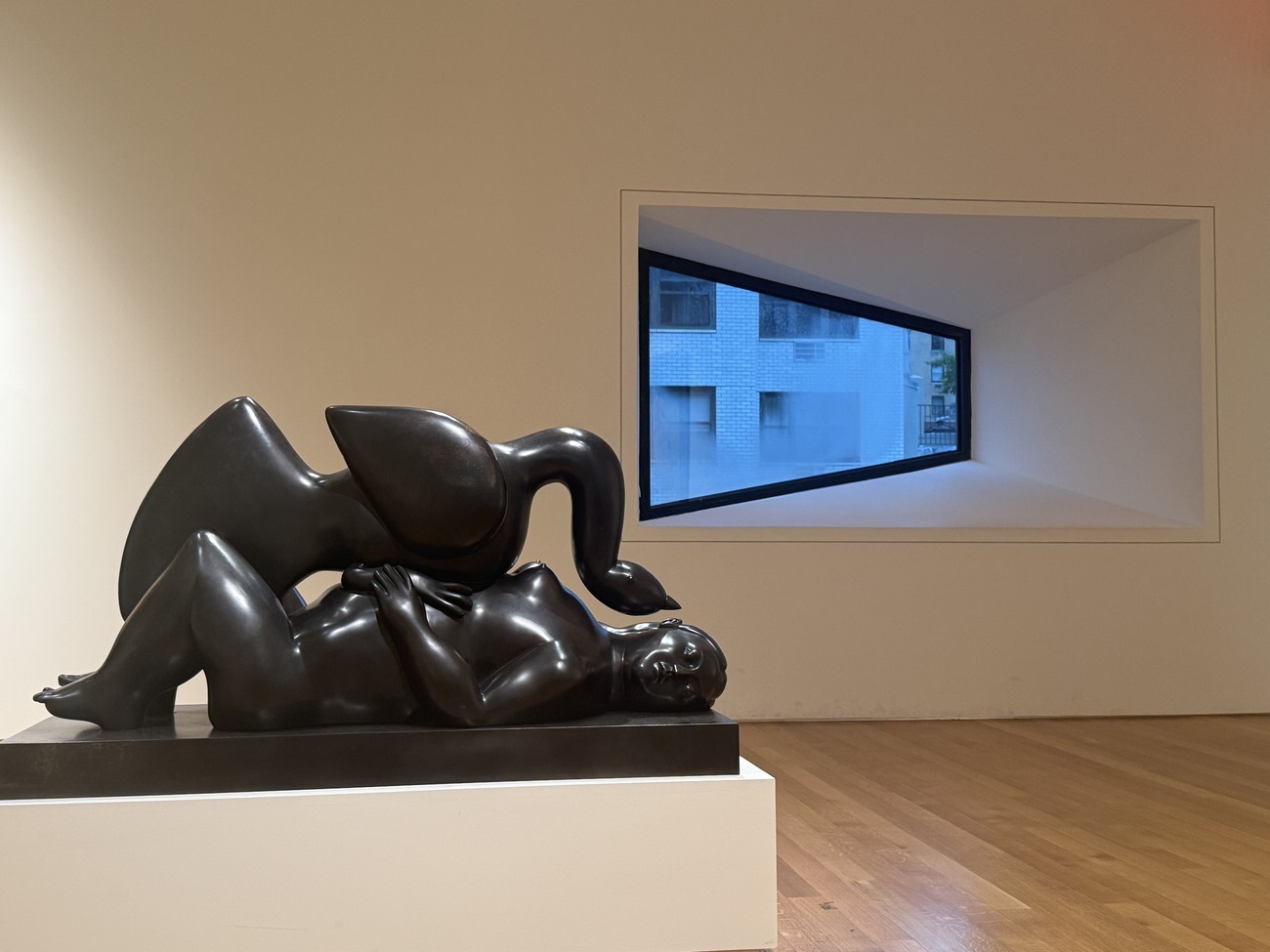
Sotheby’s selling exhibition Botero in New York takes the entire fourth floor of Marcel Breuer’s brutalist landmark on Madison Avenue. Botero’s work is generously placed; the round bronze Leda and the Swan (2006) stands against one of Breuer’s narrow horizontal windows overlooking the city, creating a strange equilibrium. It is the building's first single-artist exhibition since Sotheby’s acquired it, organized in partnership with the Botero Foundation. Here, Sotheby’s acts like a gallery: of the forty works on view, around thirty are for sale through private sale rather than at auction, and ten are on loan from the Foundation. Botero lived in New York from 1960 to 1973, a period Sotheby’s describes as pivotal, in which he reached artistic maturity and honed the style that set him apart from the movements looming large in the city—abstract expressionism, pop, minimalism, and later, conceptual art—all of them aggressively dismantling traditional pictorial values.
Botero’s career took a dramatic turn in New York; he started as a struggling young artist, and one day in 1961, the legendary curator Dorothy Miller was visiting an artist who told her she had to see the Colombian next door. She did, and she brought Mona Lisa, Age Twelve (1959) to MoMA the following day—the only figurative work the museum acquired that year. The voluminous figure was the first thing people noticed, yet Botero insisted that fat and volume are two distinct ideas. “I don’t paint fat women,” he told the Spanish newspaper El Mundo in 2014. “What I paint are volumes. I am interested in volume, the sensuality of form.” Boterismo, a term derived from his name, gave volume to almost everything that entered his work: figures, animals, flowers, fruit, cakes, vases. He was indeed obsessive about the Renaissance’s rediscovery of perspective and volume. Botero read Berenson at eighteen and said the critic gave intellectual clarity to an instinct he already had. Berenson made his case through Giotto and the Florentine school, arguing that the painter must “do consciously what we all do unconsciously,—construct his third dimension,” and accomplish this “only as we accomplish ours, by giving tactile values to retinal impressions."1
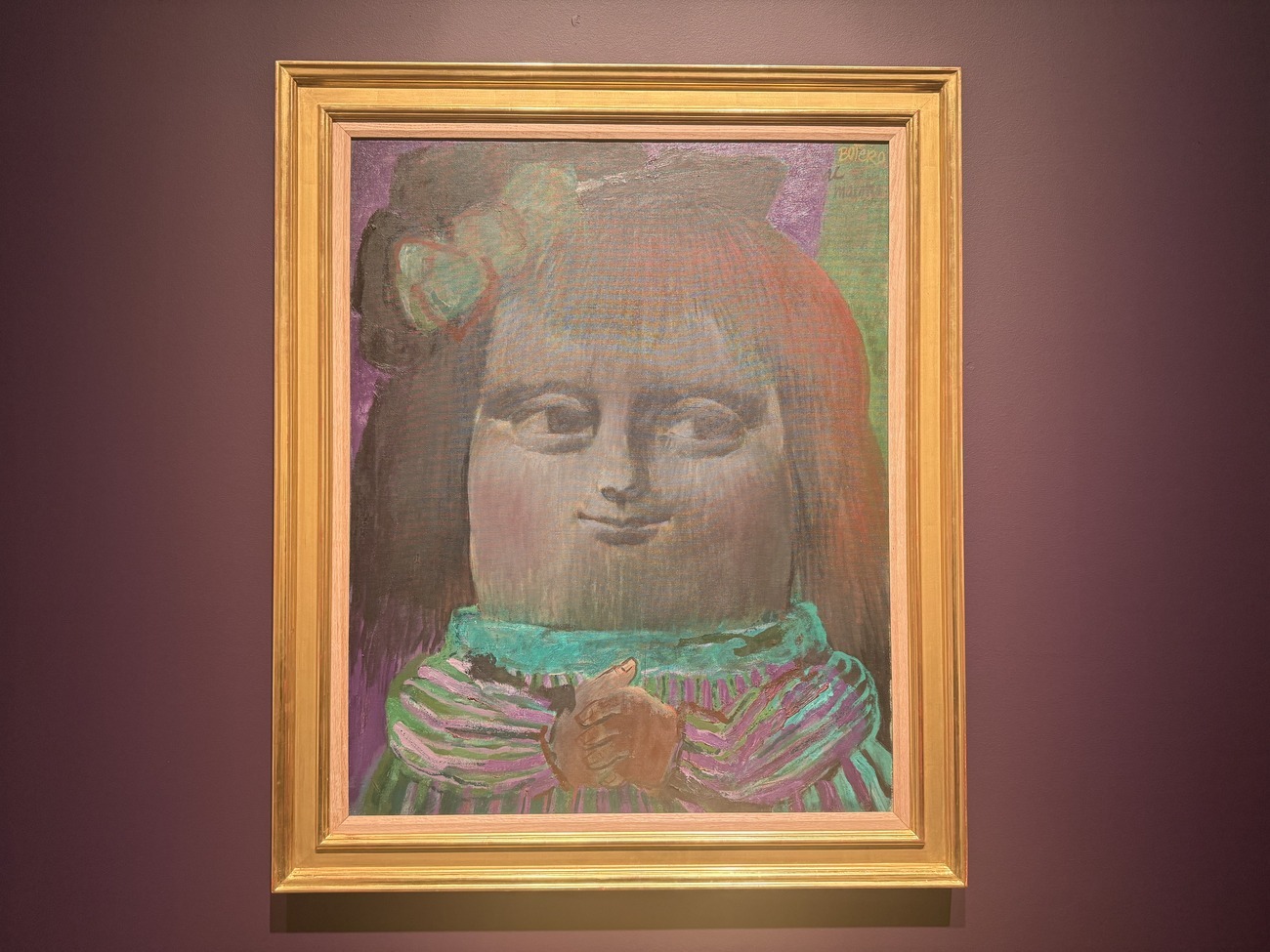
From the same series as the Mona Lisa, Age Twelve, Mona Lisa (1959)—also on view at Sotheby’s—imagines Leonardo’s sitter inflated in every direction. Her face and head swell almost into a cylinder, so large they dominate the entire composition. The famous smile still lingers at her pressed lips, and beneath the nearly erased eyebrows her eyes look distracted as if fixed on some distance far beyond the viewer. Botero’s sitter is noticeably younger than Leonardo’s.
Still life has always been walking on unstable ground between sensual pleasure and the inevitability of mortality. The term nature morte literally translates as dead nature: things can no longer move. The genre flourished in the seventeenth century, when Dutch and Flemish painters celebrated abundance and material luxury while still reminding a viewer of their transience. Botero’s Naturaleza muerta colombiana (1969) crowds a fiesta patria table: a large pale blue tureen crowned with an ornate lid, a slice of pink cake studded with candied cherries, a towering brown chocolate cake with a small figure standing on top, holding a flag. A peach cloth beneath them carries the same sense of mass as everything piled on it. A Naples yellow backdrop bordered in blue, and gold hangs against red drapery, with ribbons in the Colombian tricolor. Six ants have crawled in, three on the backdrop and three on the cloth: a sign of the decay that always follows the peak of flourishing. A half-peeled orange sits to the right, a recurring motif borrowed from seventeenth-century Dutch still life. Here, something might not belong to the vocabulary of abundance: a needle trailing blue thread lies on the cloth. Look closer, and the table turns out to be a desk, another thread hanging from its open drawer.
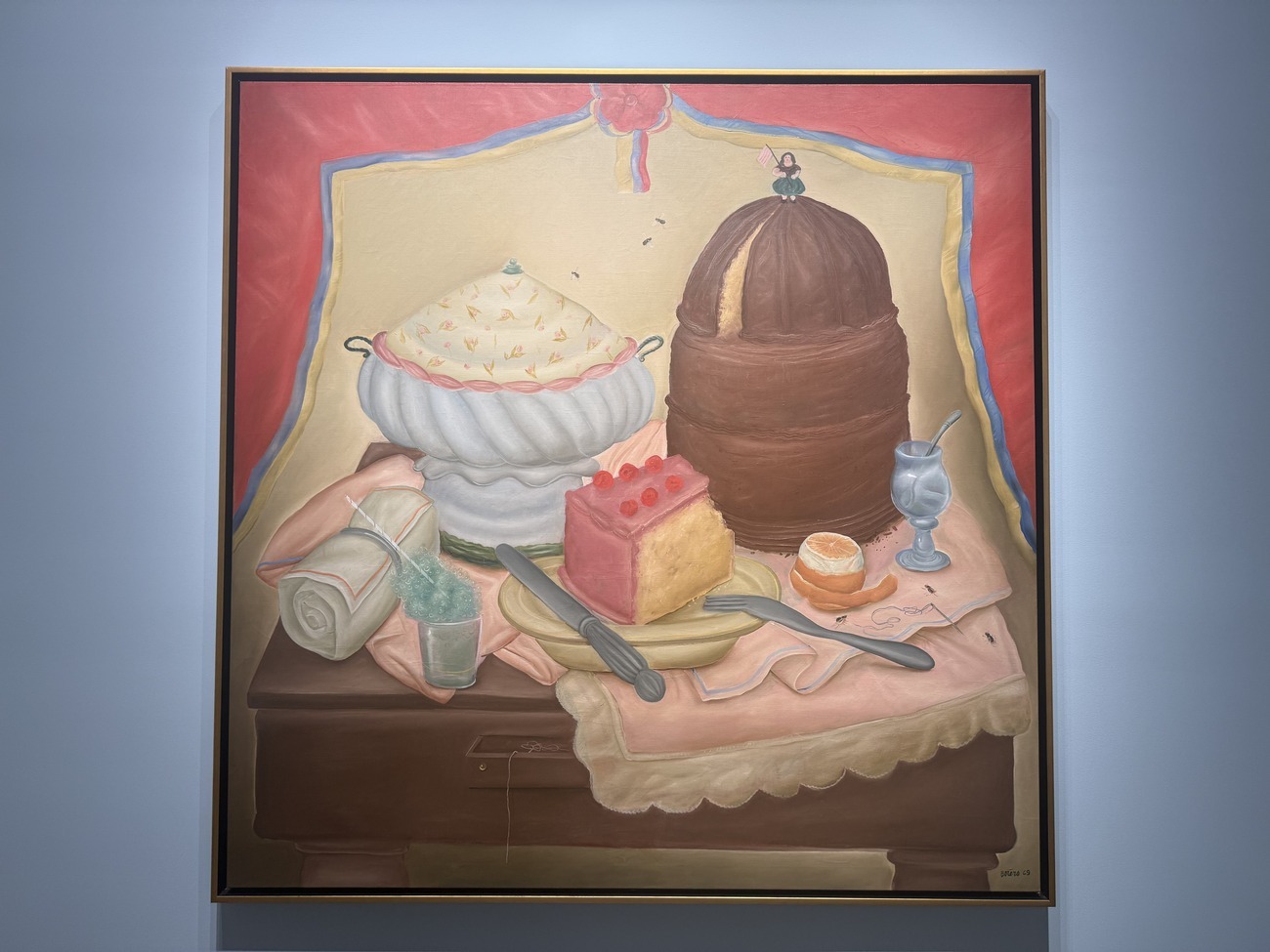
Botero’s father died when he was four, and his mother worked as a seamstress to raise her three sons. Botero has said his impoverished childhood in his homeland was always present in his work. In his conversation with this centuries-old genre of still life, he sewed his poignant childhood memory into a playful, sugar-saturated picture. In fact, the two sides of his work—levity and poignancy, European and Colombian, personal and national—appear in his later and far graver subjects too: the Colombian drug lord was depicted as round and less intimidating than people expected in his 1999 painting The Death of Pablo Escobar. Scholar and critic Sianne Ngai suggests that "cuteness," as an aesthetic experience, also encompasses cruelty: innocent subjects can become cuter when they appear injured or damaged.2 In Botero’s case, subjects compel because they penetrate deeper into the shared memory of what is behind the picture.
Ngai also defines cuteness as "a commodity aesthetic, with close ties to the pleasures of domesticity and easy consumption."3 In the building that once housed the Whitney, the Met, and the Frick, and that stands as an architectural pinnacle of twentieth-century America, Sotheby's curatorial focus on Botero's New York years takes on an ironic resonance with the commercial function it now embodies. Botero is considered one of the most successful Colombian artists, and his work can easily command seven figures at auction. At Sotheby's, he appeared in a somewhat discreet selling exhibition. A thin line between marketing strategy and historical significance shows up again in his work. Botero once told The New York Times that "art was created to give pleasure." Like a Trojan horse, the pleasure of looking lures you in with its cuteness, humor, and abundance, then confronts you with a much more unsettling reality.
Botero in New York was on view at Sotheby’s from July 22 through September 7, 2026.
1 Bernard Berenson, The Florentine Painters of the Renaissance (Putnam, 1909), 4.
2 Sianne Ngai, Our Aesthetic Categories: Zany, Cute, Interesting (Harvard University Press, 2015).
3 Sianne Ngai, interview by Adam Jasper, Cabinet no. 43 (Fall 2011).