
"Savdie / Soutine" at NORR COHAN
Review
In 2019, the last bell ringer who had rung church bells for 50 years in South Korea retired. Twice a day, every day, he climbed the 120 steps of the bell tower to ring the bell. He said that during those years, he was never really able to make evening plans. One time, when he went on a pilgrimage, someone else rang the bell instead of him, and then complaints were made that the sound of the bell was strange. After his retirement, the church replaced the bell with an automated system. The sound of the bell that once echoed through the daily lives of people in the city became a sound no longer produced by human hands.1
For twenty years, Aki Onda has collected a wide variety of bells—made of brass, ceramic, glass, and other materials. While participating in the 2026 Whitney Biennial, he also presented a performance titled Spirits Known and Unknown in collaboration with Zach Rowden at e-flux on March 6. This was a continuation of a performance he previously staged at the Tufts University Art Galleries (2025) and the Miller ICA (2023), in which he activated the bells he gathered over the years. The bells ranged in size from ones as large as a child’s head to ones as small as an adult’s little finger. Slowly, he moved his gaze across the bells as if calling each of them by name, before first picking up a large bell. Bending and stretching his arm, he made the clapper inside to strike the lip, filling the interior of the bell with sound that then spread outward. He then moved to a medium-sized bell, and finally to the smallest one. Over the course of an hour, the performance unfolded continuously—from a single, composed bell tone to harmonious resonances, to something akin to chaos: a violent, almost physical collision of multiple bells, evoking the intensity of a bodily struggle.
Today, people no longer ring bells by hand for an hour in this way. Yet there was certainly a time when ringing the bell was human’s work—the labor of the bell ringer. From antiquity through the Middle Ages, bells were found in tombs and sacred sites, and were understood as entities that connected humans to deities who governed the time of fate. There have been numerous theories about the function of the bells, ranging from simple animal bells to apotropaic objects. Bells have been mentioned in Greek and Roman literature from as early as the fifth century B.C., when Aeschylus describes in detail Tydeus’s shield, which contained many bells to cause terror among his enemies by their sound: “and at his shield’s rim, terror in their tone, clang and reverberate the brazen bells.” Bells could also be used to sound a warning; for example, sentries carried bells while on duty in order to let their comrades know that all was well and to give warning if anything was amiss. Bells were also used to announce the opening and the closing of the baths and markets.2 Later, bells developed primarily in churches and monasteries, and bell ringers emerged to alert people the events governed by God—such as Mass times, prayer times, funerals, and wars. (I will focus primarily on bells with clappers. In contrast to the internally clappered bells common in European ecclesiastical traditions, many monumental East Asian temple bells were designed to remain stationary and be sounded externally by suspended wooden strikers.)
Even after the introduction of mechanical clocks dating back to as early as 1386 (found in the Salisbury Cathedral in England), the act of ringing bells in most cathedrals still relied on the physical labor of bell ringers. While clocks could indicate numbers and calculate time, it was the bell ringer who realized time. The modulation of force in pulling and releasing the ropes, and the rhythm that emerged from it, constituted time. Time did not simply exist automatically; it was channeled by sound and materialized through labor. As cities expanded and industrialization progressed, this daily act evolved into a system that structured the routines of entire urban populations to the extent that Lewis Mumford argued that the clock—not the steam engine—was the key machine of the Industrial Revolution.3
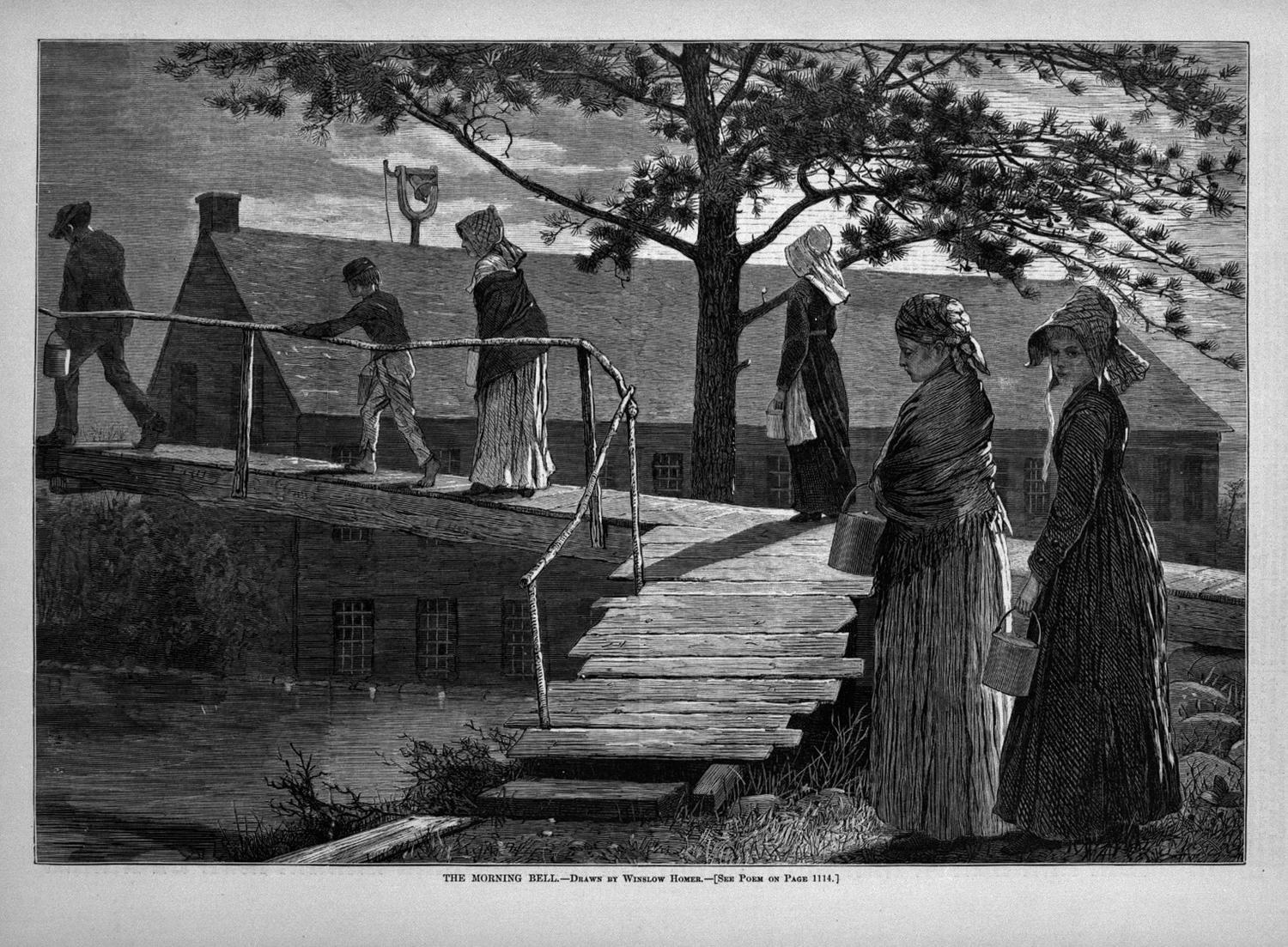
This is well depicted in the works of illustrator Winslow Homer who often portrayed figures within rapidly industrializing landscapes in Boston and New England in general after the Civil War. In several of his works, a distant bell tower appears behind workers carrying lunch boxes on their way to work. Within the upheaval of industrialization, their daily routines were regulated by the sound of bells to such an extent that one can almost hear the ringing simply by looking at the painting. This resonates with depiction of alienation: the moment when bell ringing ceases to be a human act distancing from autonomy. Amid this transformation, the exact moment when bell ringing first became automated remains unclear. However, the 19th century can be understood as a period in which technologies for maintaining increasingly precise and standardized time—while simultaneously reducing the need for human labor—became widely consolidated and institutionalized. This shift is evident in cases such as Gillett & Johnston, a historic British manufacturer of church and civic bells which expanded into the development of automated clock and bell-ringing systems, as well as the automation of bells in Vatican City in the 1930s during the papacy of Pope Pius XI, who promoted technological modernization across the city. Likewise, Notre-Dame Cathedral, which has famously associated with the fictional bell ringer figure of Quasimodo, underwent the automation of bells during the same period.
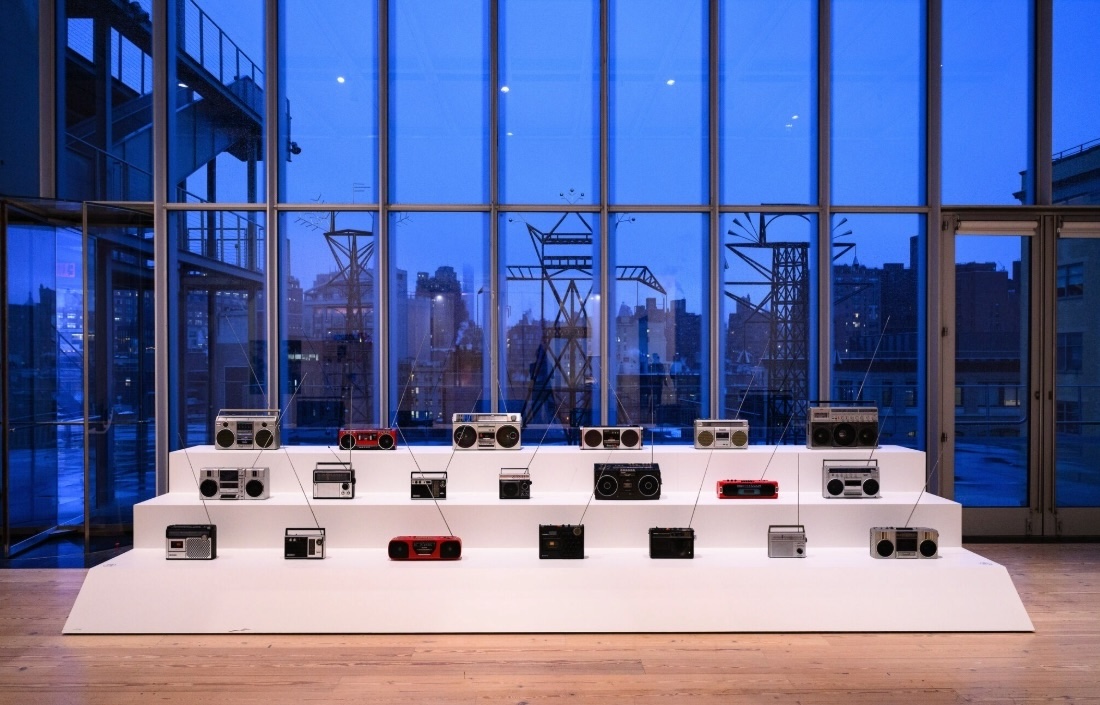
The radio work Ugnayan (2026), currently presented by Aki Onda at the Whitney Biennial, is a reinterpretation of a 1974 composition by the Filipino ethnomusicologist and composer José Maceda. Originally created for 20 radio stations, the 51-minute piece consists of 20 separate audio tracks. On January 1, 1974, at 6 pm, the work was broadcast across 37 radio stations in the metropolitan area of Manila. It functioned as a participatory event: anyone with a transistor radio could tune into a designated frequency and join the collective listening experience. 142 meeting points, which he called “Uganayan Center,” were established, and at one of the locations, 35,000 people assembled with radios to listen simultaneously, creating a dense sonic field that enveloped the entire city.4 In this sense, the work can be understood as a form of performance that parallels the historical role of bells: a single sound organizing the collective movement of an urban population. Within certain boundaries of the city, bells once functioned as a local community’s clock, and the fact that the medium of radio could independently select and broadcast content rooted in regionality symbolized the autonomy of society. Yet the reason people no longer seek out bells or tune into region-specific radio frequencies—now regarded as an outdated medium—as they once did is not simply because they are no longer needed or in demand. Rather, it is because the very infrastructure of autonomy once embodied by these media has been obscured by technologies that externalize and automate human capacities, alongside human alienation too often mistaken as progress—leaving them suspended as images detached from both past and future, as though they exist outside of time itself.
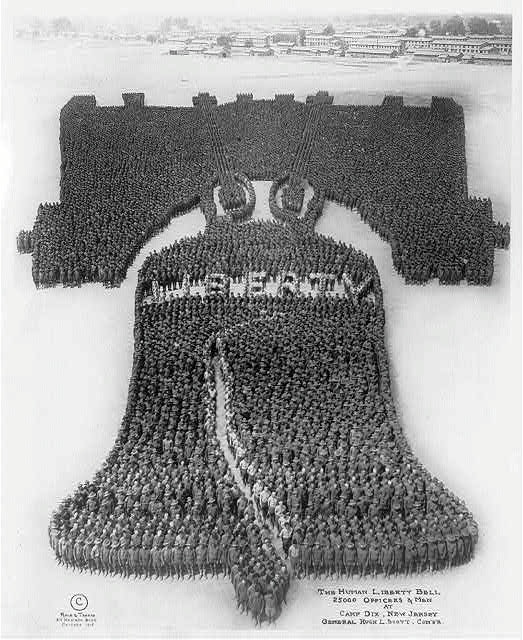
The autonomous time once shaped through the labor of citizens has become hidden, like the clapper inside a bell, leaving behind only vibrations that can no longer be distinguished as either time or command. It is much like the so-called “living photographs” created by the British-born photographer Arthur Mole and his assistant John Thomas, commissioned by the U.S. military during the WWI to boost morale among American camps: mass formations of soldiers arranged into the silent image of the giant Liberty Bell. Notoriously authoritarian regime of Ferdinand Marcos sponsored José Maceda’s project as a “special socio-political musical event,” while the United States, in the process of emerging as one of the greatest beneficiaries of the WW1, produced unique artistic achievements, then it notes that creation and destruction, freedom and repression, war and reconciliation exist as inseparable front and back surfaces of the bell, much like the pharmakon of technology described by Bernard Stiegler. However, the question that must follow is who governs the inside and outside of the bell, what purposes remain concealed beneath these quiet frequencies and oscillations, and ultimately, who benefits from them.
The fact that we no longer need alarming bells by human hands today is evidence and a symbol that society’s autonomy no longer needs to be marked through human movement, while the individualization and fragmentation of labor have facilitated producing the 24/7 working environment. The bell-ringer’s timing, despite its existing under certain social conventions, remained inherently imperfect. It had its own traceable tones and errors. Yet, precisely because of this, a sense of vocation and responsibility and the romance and expectation with stories could exist in their actions. If we call the act of dividing time which is granted equally to all, “individual freedom,” then who is the bell-ringer of time today, slicing and dispersing this invisible bell into imperceptible oscillation? When the feeble sounds of small bells and the heavy resonance of large bells collide all at once, building into a noise, or even a roar almost similar to vacuum exploding the head, how can the sound and the movement of each individual bell fully exist within such chaos? Positioning myself as one among the many bells he had gathered, each carrying the residue of an obscure and uncertain history, I began to ask: even if my sound is clouded and rusted, am I still ringing my bell with my whole body, living with a responsibility with warmth and producing the sound of a time that is truly my own? Everyone carries a bell they must bear throughout their life, then we are all bell ringers.
Aki Onda's work is on view as part of the Whitney Biennial from March 8 to Augst 23, 2026.
References:
1 Kyunghyang Shinmun, “The Last Bell Ringer Who Rang the Bells for 50 Years at a 100-Year-Old Church”, October 20, 2019, https://www.khan.co.kr/article/201910202110005.
2 ECKARDT, HELLA, and SANDIE WILLIAMS. “The Sound of Magic? Bells in Roman Britain.” Britannia 49 (2018): 179–210. https://www.jstor.org/stable/26815338.
3 Lewis Mumford, Technics and Civilization, chap. 1, “The Monastery and the Clock,” in Technics and Civilization (New York: Harcourt, Brace and Company, 1934).
4 Aki Onda, “The Musical Atmosphere That Covered the Megalopolis.” https://akionda.net/Maceda-Ugnayan.