
.webp)

Hou Yijie: “The Pulse and the Pause” at He Art Museum
Review
At nuun, a Brooklyn-based apartment gallery, curator Colleen Dalusong brings together three Asian artists who grew up in different regions of the United States and eventually found themselves in New York City. The exhibition explores collective experiences around home, immigration, nostalgia, and a sense of belonging, including the curator’s personal story.
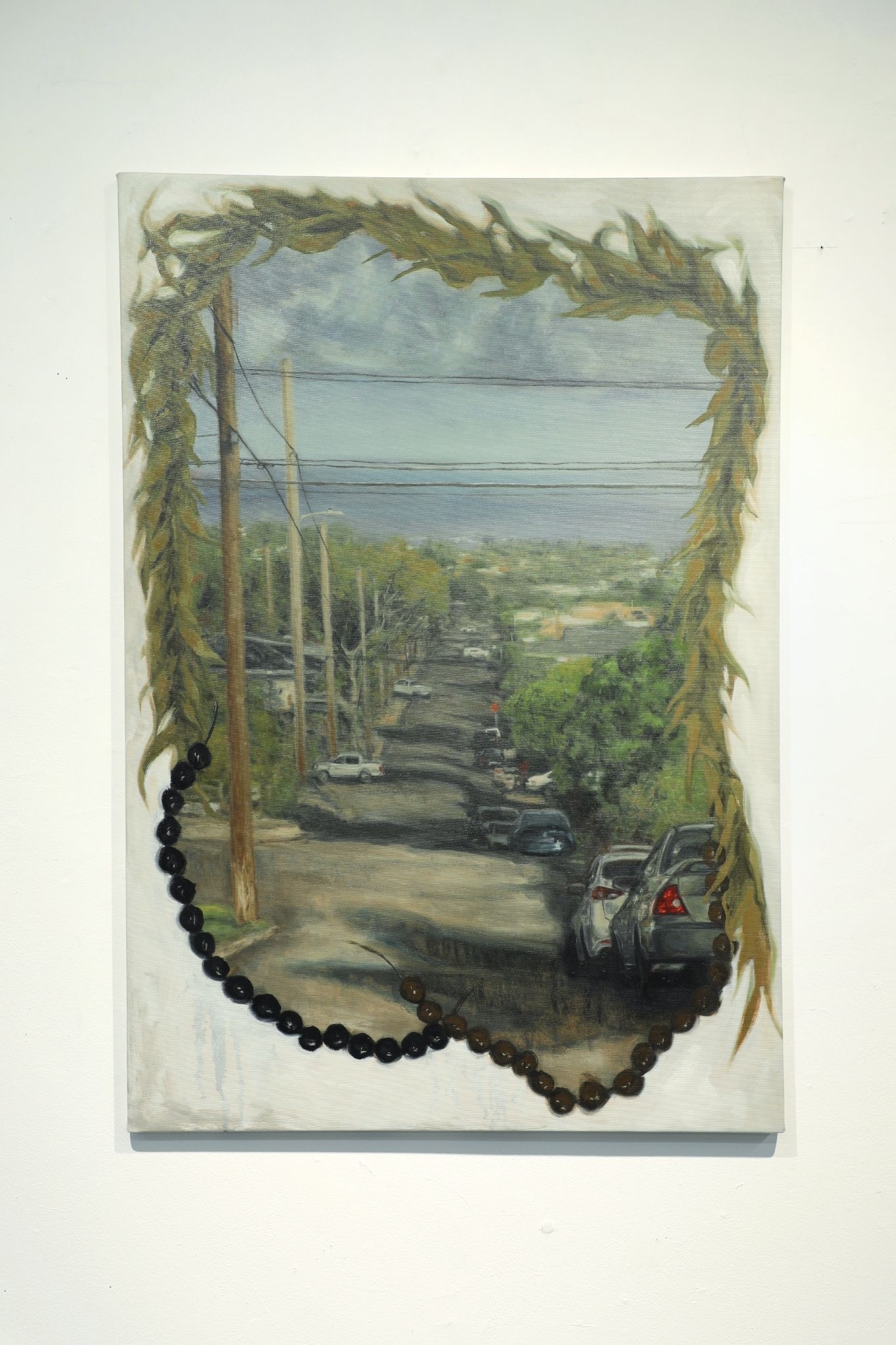
Initially inspired by Eduardo Joaquin’s Portal (15th Ave) (2025), a painting that depicts the last photograph he took of his neighborhood in Hawaii before moving to New York, Dalusong wanted to put together a show that allows us to look at ourselves and ask: What is home to us, and where are we coming from? The painting is intentionally placed behind a staircase, requiring the audience to observe it from a distance. What was previously a familiar image now becomes a portal onto something untouchable and no longer accessible.
Joaquin’s other paintings also capture this subtle, nostalgic, and melancholic sentiment of searching for identity or trying to hold on to something. Window (Atlantic) (2026) is a diptych depicting the blurred view from a New York City subway window. The realism of the image reminds you of the noise, instability, and emotional restlessness of being on a train while the whole world passes by. And when you try to figure out what is outside, you can only see your own tired face reflected back. It perfectly captures a transient feeling that perhaps every New Yorker understands.
%2C%20Eduardo%20Joaquin%2C%202026.jpg)
String Game (Blue) and String Game (Red) (both 2026) seem to be the artist’s way of connecting to a past that no longer exists. Drawing inspiration from Polynesian star maps and the children’s game cat’s cradle, both works depict hands holding up strings that form a star. Evoking a sense of wonder, they feel like both an invitation to join a childhood game and an invitation to look up at the sky together, searching for answers about ourselves through the deep void above. Joaquin’s paintings are about holding onto transient moments in the search for a stable definition of home. While the query is oftentimes inconclusive, the artist’s works open up possibilities in which homecoming can manifest in ways that are tender, intimate, and personal through memory.
Noelle Payongayong, on the other hand, offers a more material and tangible depiction of home, one that feels as if it can almost be held. Most of her works combine cyanotype photography with ceramic sculptural forms, paying homage to the altars her family created for her grandparents. roof with a hole in it (2026) and Spire (where we used to play) (2026) both feature house-shaped ceramic pieces with archival family photographs and records on film transparency. The pieces feel simultaneously solid and fragile. The substantial ceramic body suggests the foundation of a past that truly existed, while the delicate, ghost-like imagery points toward memories that have vaporized, blurred, or become harder to touch.

There are also many delicate thread elements that recur throughout her works: the roof of the house sculpture is sewn together, reiterating the contrast between the solid, substantial sculpture and the melancholic memories that feel too fragile to remain intact without extra care. Spire (where we used to play) is cleverly placed next to the balcony of the space, where it becomes part of the New York City skyline view. It makes you wonder whether we, too, will someday become like a film negative that once existed in this concrete jungle.
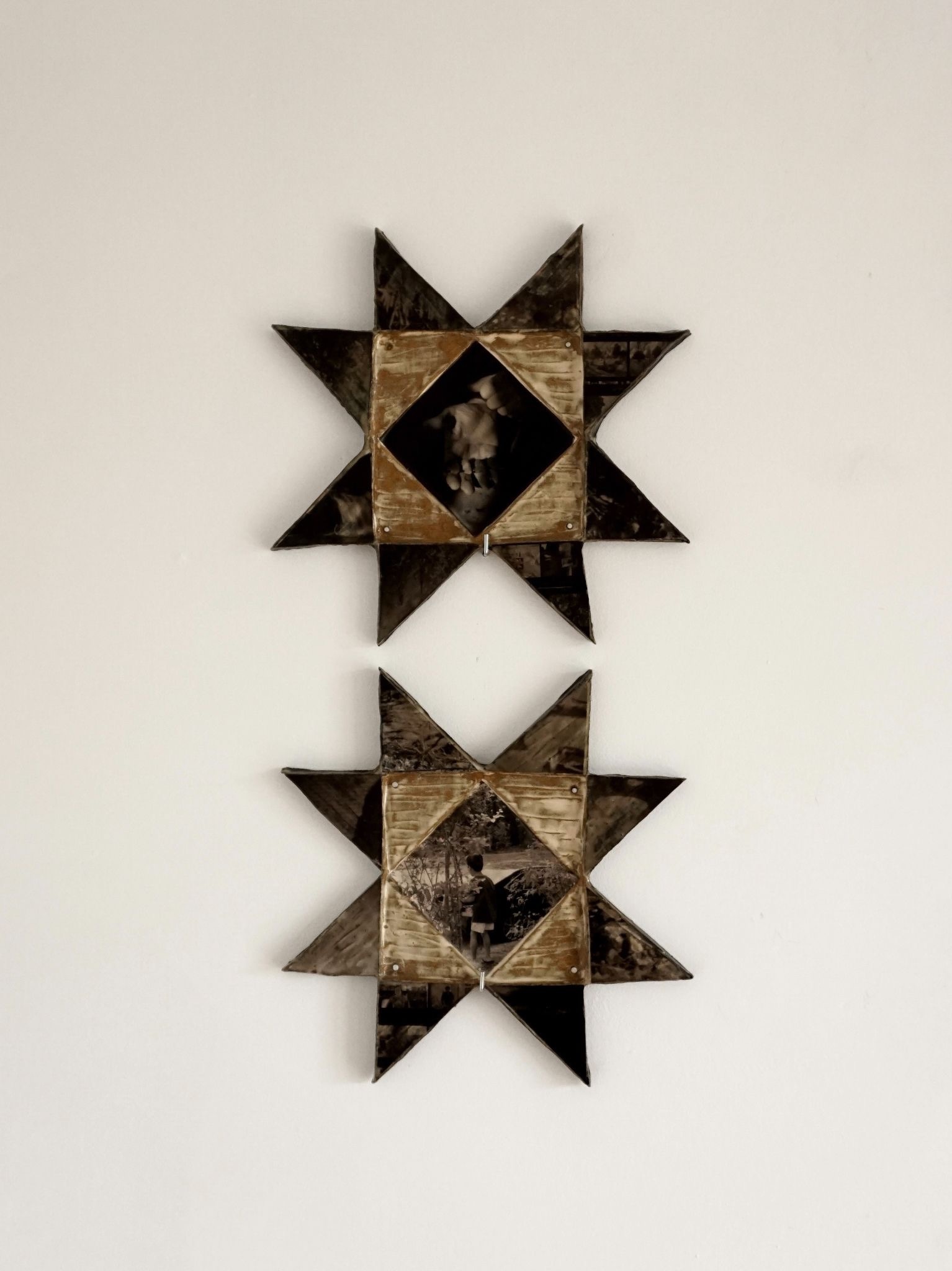
Ohio star (2026), a ceramic-and-photography diptych collaboration between Noelle Payongayong and Dustin Lin, is inspired by the quilt block pattern both artists encountered repeatedly during road trips across state lines. The exhibition text points out that the work pays tribute to Mary Leary Langston of Oberlin, Ohio, who utilized the iconic quilt block pattern to honor her late husband and activist Lewis Sheridan Leary. The quilt pattern becomes a nuanced metaphor for the artists piecing together their own identities on the road, holding onto their core while also learning how to find their own path through unfamiliar places.
The star pattern coincidentally echoes Joaquin’s paintings, but perhaps it also unconsciously references the stars on the U.S. flag, especially as the exhibition opened leading up to the festivities of America’s 250th anniversary. Through this quiet repetition of stars, the show begins to ask not only where home is, but also what it means to belong to a country, a city, or a history that is still being pieced together.
Maybe the curator is also reflecting on what it means to be American while growing up with immigrant parents from completely different backgrounds. Yet being in New York adds another layer. It seems like we belong in New York, but does New York truly belong to us? Instead of enforcing a resolved interpretation of home and belonging, the show takes its time weaving a poetic riddle, prolonging a perennial inquiry: What is home to you? Where do the stars lead you, and what does moving forward mean?
A Room with a View is on view at nuun, Brooklyn, from June 18 to July 9, 2026. The show is curated by Colleen Dalusong and features artists Eduardo Joaquin, Noelle Payongayong, and Dustin Lin.