

.webp)


Wenfei Quan: “Contemporary Hominin” at TaThaTa
Review
At The Gallery’s “De(Generates),” a screening last month of time-based works made between 2014 and 2026, optimism’s heyday was in the foreground. The curator’s brief preface glossed the co-pubescent relationship between millennials and the internet, noting how the selection of works might reflect what it felt and feels like to make art and be online.
Of the ten works shown, the earliest five indexed an Obama-era buoyancy rooted in the collage capacities of digital tools. In Jennifer and Kevin McCoy’s Discovery of Freedom (2014), footage is broken down and rearranged into parts that collide with each other; David Muenzer’s Over the Edge (2014) records the construction of animated scenes in rudimentary photo editing software. Meanwhile, Carla Gannis’s The Garden of Emoji Delights (2014) turns Bosch’s triptych into a psychedelic scene of bright, flashing emojis competing for viewers’ attention. Watching the fascination with photo editing unfold, an optimism about maker tools and DIY culture felt as spirited as it did nostalgic.
More recent selections seemed to battle a sense of ambivalence about the immersive capacity of time-based works that once felt exciting, even aesthetically liberatory. Sean Morgan’s Running in Love, With Scissors (2026) presents a strange and surreal rendering of medallions that shimmer, mute to the question of their significance. In an excerpt from Adam Basanta’s generative work, Hope Finds Well (2024), chatbots go back-and-forth with increasingly nonsensical variations of “I hope this email finds you well,” an accumulation of language without resolution.
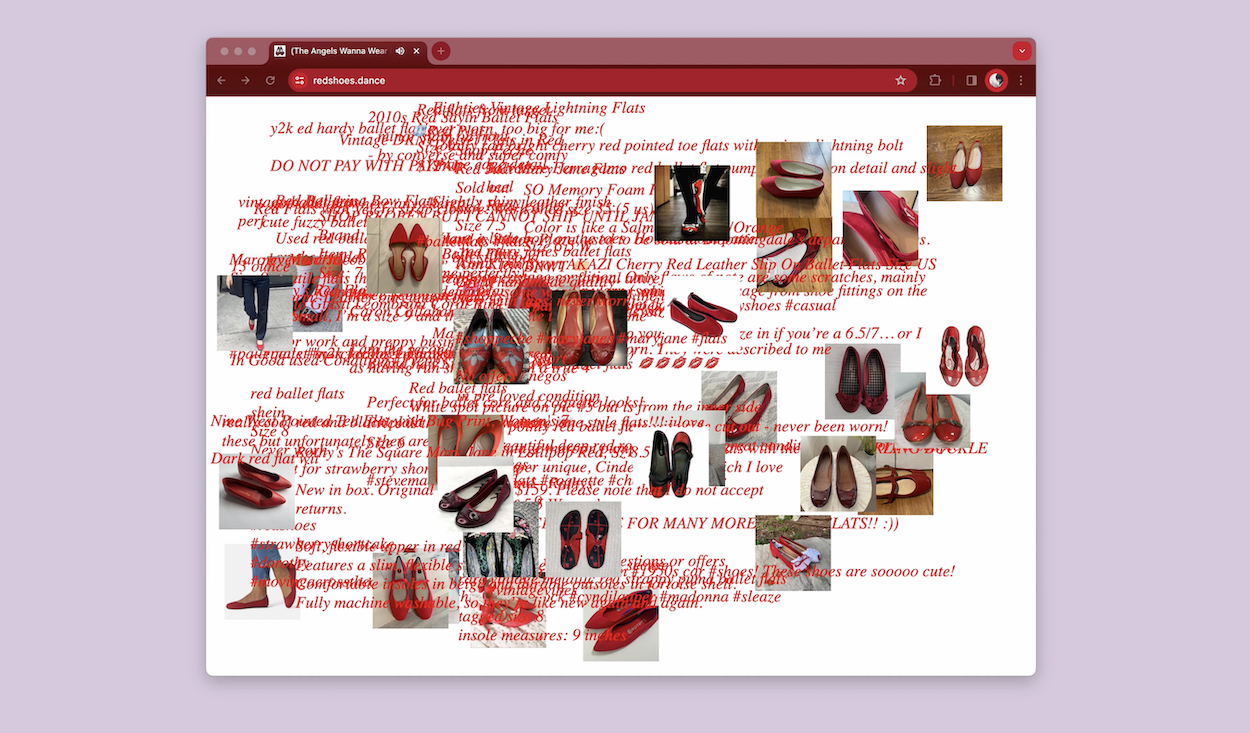
That “making” is less a process of amateur creative agency and more a process of automated reproduction was exhibited in another generative series, Maya Man’s (The Angels Wanna Wear My) Red Shoes (2024–), in which pictures of red ballet flats listed on resale sites accumulate alongside the descriptive sales text written by users: “Shein,” “Never worn,” “#coquette,” “#authenticleather.” Man’s work absorbs that form of an infinitely recurring sequence in its aleatoric software and massifying layers of text–: a connotation of how the internet encourages commodities to be both a copy and an original, how coding enables automated proliferation, and how time-based art captures the temporality not of nature but of its own reproduction.
2StarQuest (2025–), another software project by Maya Man, was part of “Rendered Instant,” a one-night installation and screening programmed by Blade Study and hosted at Electronic Arts Intermix last month. The evening surveyed a half-century of film and video work, and StarQuest was one of the newest components, having debuted alongside a performance-lecture (absent from this iteration) earlier this year. Showing young AI-generated dancers preparing for competition, StarQuest implies an analogy between the training native to competitive dance and the model training necessary for generative AI programs––not only that both are based on feedback but that both are performative and time-based media. If television had to assert itself as a performing medium and not merely a transparent vessel for communicating other media, the long duree of video presented in the program indicates a prolonged examination of the medium’s genesis.
Several films metabolized the exhausting and incoherent affect of how content accumulates, becoming both unique and not––both an original and a copy. In Nick Vyssotsky’s Mnemosyn.net, a web-scraping-cum-aesthetic venture, meaning dissolves in a proliferate collection of screenshots from TV shows and news channels, medieval portraiture and mugshots, and images of quantum warfare diagrams and Marco Rubio.
The anti-narrative and free associative form doesn’t just belong, though, to the infinite scroll. In Takeshi Murata’s Infinite Doors (2010), clips of prize unveils from The Price is Right are digitally edited to succeed each other like concertina doors; Kristin Lucas’s Background Story (2010), includes a short story generated through Amazon’s Mechanical Turk in response to her arrangement of background images. And in Alix Pearlstein’s film Pet, Fluffy, Cheezy, Bunny (1993), symbolic objects are ordered according to their loose relation––a fire hydrant unto a toilet bowl, for instance—“a free-associative, run-on sentence that circles around to end at the beginning,” per the artist.
Any multi-generational appraisal is bound to evoke what of film is lost in video, what of video is lost in the internet, and so forth. The evening’s story of the moving image begins with Gary Hill’s Electronic Linguistics (1977) and Stan VanDerBeek’s Poemfield No. 2 (1967), both formal experiments in computer graphics and animation, and ends with Jacob Hurwitz Goodman’s Panera’s Basilisk, in which a man skips into a suburban Panera for a blueberry muffin before pondering his genesis––because he is an anthropomorphized AI––with overaffectation, oscillating manically between threats of murder and gestures of affection. Watching Mark Dorf’s A New Nature (2021), too, in which a hyperreal forest is outfitted with navigation buttons and filters, it appeared quite far from VanDerBeek’s PacMan-esque shapes dancing around the screen. It’s not hard to wax wistful for Vanderbeek’s animated shapes, which despite their noir-esque soundtrack retain a formal technophilia made all the more troubling by the stakes that Goodman’s film renders darkly comic.
Another work from the Poemfield series, Poemfield No. 1 (1967), is currently playing on a CRT television at Magenta Plains. The blue and white hues are far more playful than the hardboiled No. 2, but still the words and patterns blink, dissolve, and rearrange themselves. The screen is still a virtual and otherworldly site, the shapes circling each other with the frolicsome spirit of stop-motion animation.
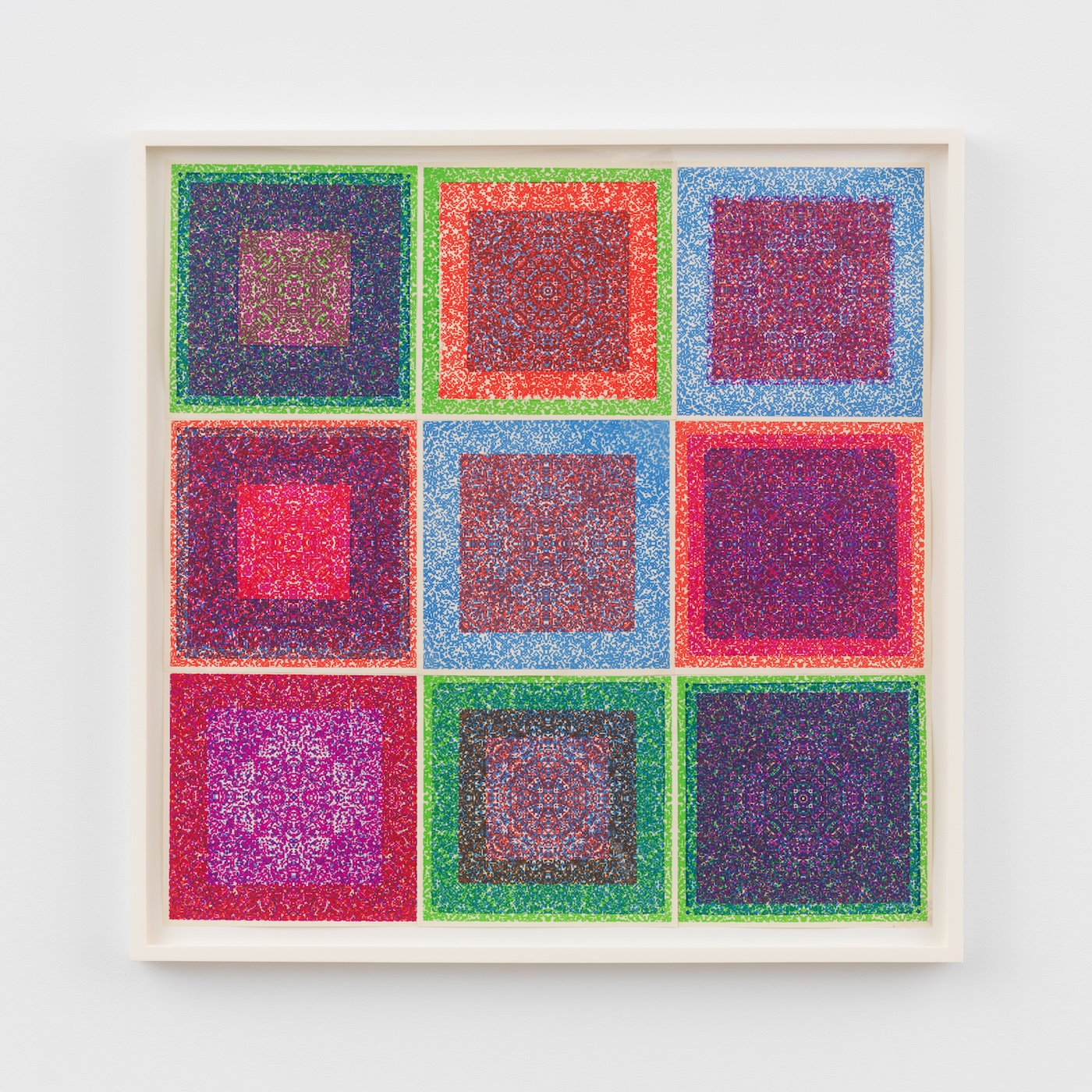
Nearby, single film frames are isolated in 3x3 arrangements in Moveable Mandala I and II, both from 1976. Suspended in a still image, the graphics seem to ask more of the viewer––in their inert condition, the implication of movement is outside the frame, outside the medium of their presentation. Is that not an older experience of “immersion”?
If identifying beginnings implies the finality of their culmination, these surveys try to find something workable in what could otherwise be an autopsy. It’s curious, then, that an expanded timeline releases some of the pressure on film––a half-century span makes contemporary video the latest iteration of how artists negotiate the structural versus synthetic, while the compressed agenda at The Gallery might inspire some medium homesickness.
But VanDerBeek worked on the Poemfield series with Bell Labs programmer Kenneth Knowlton, who once commented that as computers were used more extensively in the design of “static and dynamic” images, “our visual experience will thus be enriched.” Where multiple decades of work convene is not in a naive sense of enrichment as a mere enhancement of beauty, but as a layering of perception. That the moving image’s capacity to enrich our visual experience has, in being furnished by generative algorithms, turned out in fact to alienate us from what is real, while turning visual culture into a stupefying accumulative experience, may seem unfortunate. But imposing any kind of lineage asks that viewers not insist on hysteria. The temporal operation behind the screen always comes to the foreground––this is plenty to consider. The best of it all holds in its palm the very question of what enrichment has done: where it has gone wrong, and what it looks like on screen now.
That the acceleration of immersion has made that visual experience more dizzying seems to be a contingent detail in these multigenerational programs––that the temporal operation behind the screen always comes to the medium’s foreground is plenty to consider in making a lineage.