“Wetware” at RAINRAIN Gallery, Curated by Spine
Review
As AAPI Heritage Month comes to a close, FOCUS Art Fair spotlights Asian artists across the globe at Chelsea Industrial for its fourth iteration in New York. As the city's sole Asian-focused contemporary art fair, FOCUS places the theme “Human-Technology Coexistence” at its center this year, with the sprawling space hosting over 40 booths. The fair is divided into categories such as Emerging Galleries, Diversity in Asia, Digital & AI, and Craft, although the volume of mixed media across the featured artists' work blurs these lines.
The standout artists featured below weave the fair’s themes with personal narrative. Other thematic throughlines include child-like wonder and nostalgia alongside transmuted materials. The fair as a whole presents a utopian vision of an arts ecosystem, where art created from elementary materials can coexist alongside art generated from artificial intelligence and ever-evolving technology.
Kento Senga: FiNGAiSM (B18)
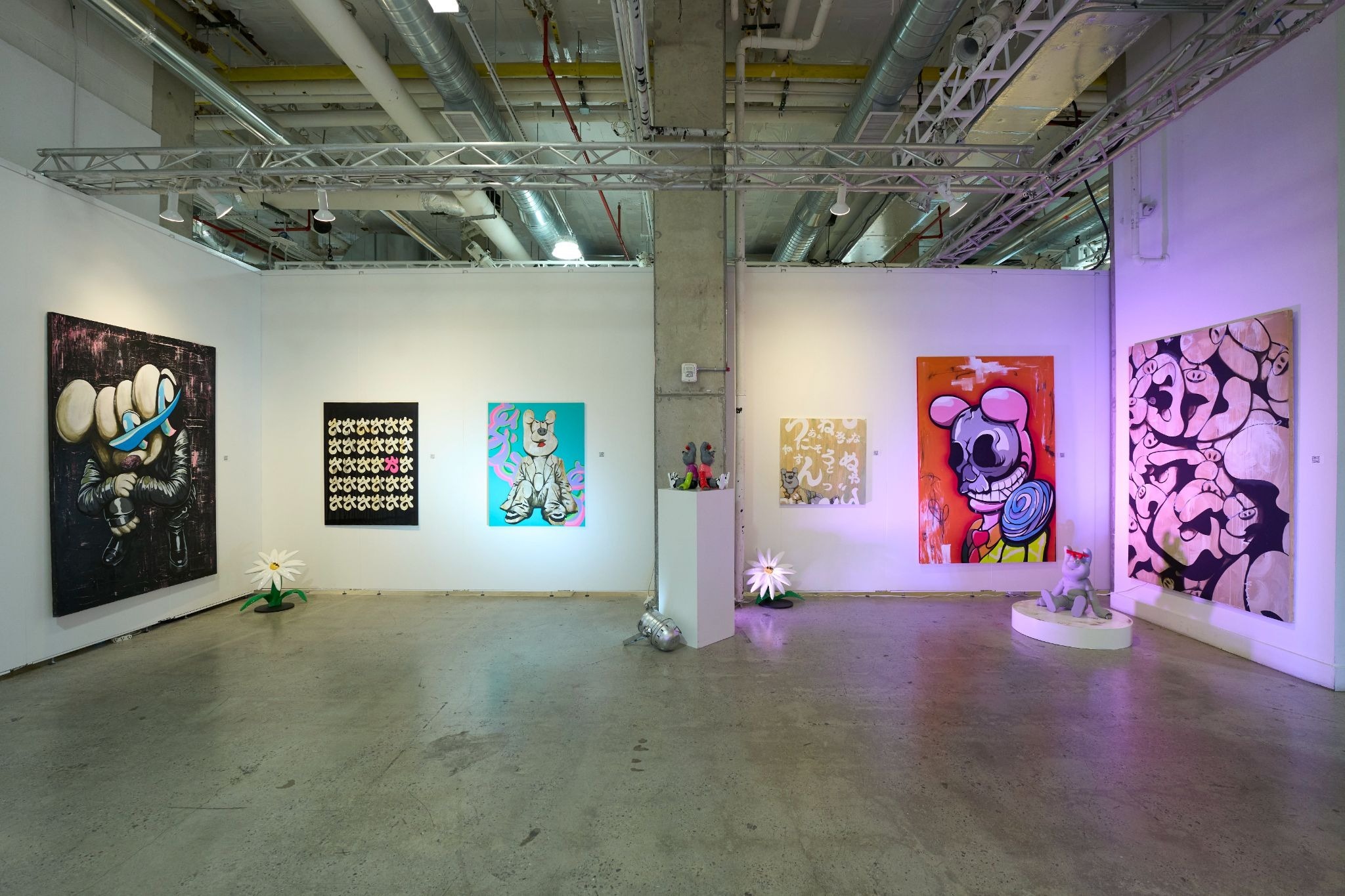
A commanding voice in the space is Kento Senga’s FiNGAiSM. Widely known as a Japanese Pop Idol from the group Kis-My-Ft2, Senga has used his pop influences to cross over into the visual arts. Anthropomorphic characters Milo and Aimee are at the center of the work, with their heads formed by a hand gesture—middle and ring fingers flush to the palm with the thumb, index, and pinky fingers raised with a slight bend, creating rabbit-like ears.
The muse for his FiNGA series? Senga’s grandmother. The character’s plump stomach and shy eyes were her defining features and served as homage to the artistic influence she placed on Senga during his adolescence. During our visit, Senga gets emotional discussing the gallery wall that became his grandmother’s room after he would draw for her every day. When she developed Alzheimer’s later in life, his art played a vital part in her memory of him. Her influence now lives through Senga’s work in larger-than-life pop art, defined by these joyful characters duplicated through hundreds of contrasting colorways, vinyl sculptures, and scenarios sprawled across canvases.

Kim Hee-Yeon: Time-Play (Ikseon Arts Center) (B21)
Senga’s themes of rudimentary artistic foundations in childhood remained at the top of mind alongside Kim Hee Yeon’s Time-Play. The pastel, multidimensional florals in this mixed-media work are dominated by Hee-Yeon’s use of traditional Korean hanji paper. The large florals and cyclical shapes are focal points of the work, with small, white, popcorn-like pieces of paper that serve as the primary texture of the works. Paint is brushed and poured across the canvas, creating a gritty backdrop for the three-dimensional floral structures accented with sequins.
The use of cyclical shapes represents the passage of time and explores the idea of “flower paths.” Kim outlines the philosophy of flower paths in her artist text: “Through the symbolic passage of a road, it portrays a journey toward discovering one’s inner flower path and recognizing the most precious elements of nature that often go unnoticed despite always being beside us in life.”

Taezoo Park: Digital Being: A Thousand Plateaus (B26)
Taezoo Park’s use of repurposed technology in Digital Being: A Thousand Plateaus juxtaposes the presence of nature and elementary material. Featured in the large back room of the fair is the U-shaped cluster of hollowed out CRT televisions, monitors, along with PCs, radios, wires, VHS tapes, and more. “Digitology” is Park’s conceptual theory used to describe his practice of repurposing these found materials through archaeology and ontology. Within this framework, he brings new life to the musing sensors, open-source, and AI-generated code to create interactive elements within the installation.
Red, green, and yellow traffic lights create a subtle glow throughout the collection of media. At a closer glance, LED flames are dispersed within hollowed-out screens and are a defining feature of the responsive systems Park uses in his work. One of these flames sits in the center of the tallest point of the structure within a radio, and can be “blown out” with a visitor’s breath. The responsive effect is a crowd favorite. In his artist statement, Park concludes, “Obsolescence is not an end—it is a condition of possibility.” This statement feels all the more present as I think of the role that waste plays in the urban nature of New York City.

Venjhamin Reyes: Wings & Ultra Vessel (B9)
Technological development has soared since the creation of the PCs and monitors used in Park’s installation, especially in New York City, as luxury real estate developments like Hudson Yards and the World Trade Center continue to redefine the city’s visual identity. Structures like the Oculus and the Vessel have become premier tourist destinations. Architectural Digest photographer Venjhamin Reyes’s booth displays pieces derived from photos captured during his work travels. Standout works from his booth include Wings and Ultra Vessel, pieces that feature his photography on acrylic vinyl that transmute the photos into larger pieces that pay homage to the original structures. The printing process for brushed aluminum in Wings creates a mother-of-pearl-like sheen, matching the visual identity of The Oculus itself. Ultra Vessel displaces the focal point of The Vessel from the open gaps and staircases to the corners and edges of the structure. Through his work, Reyes invites audiences to approach these commercial, architectural ventures through a different geometric lens.
From hanji paper to Raspberry Pi, FOCUS Art Fair spotlights wide-ranging resources used to make art that engages with the current visual arts ecosystem. While the fair does not offer a clear path forward for the industry’s engagement with evolving technology, it spotlights a diverse range of artists and emphasizes the importance of a community gathering that approaches the theme from all angles. The cultural hub of New York City is a fitting destination for a melting pot of Asian artists and patrons alike, and offers a compelling backdrop for work that is critically engaging with development and progress.
FOCUS Art Fair was on view at Chelsea Industrial (550 W 28th Street, New York) from May 21 to 24, 2026.