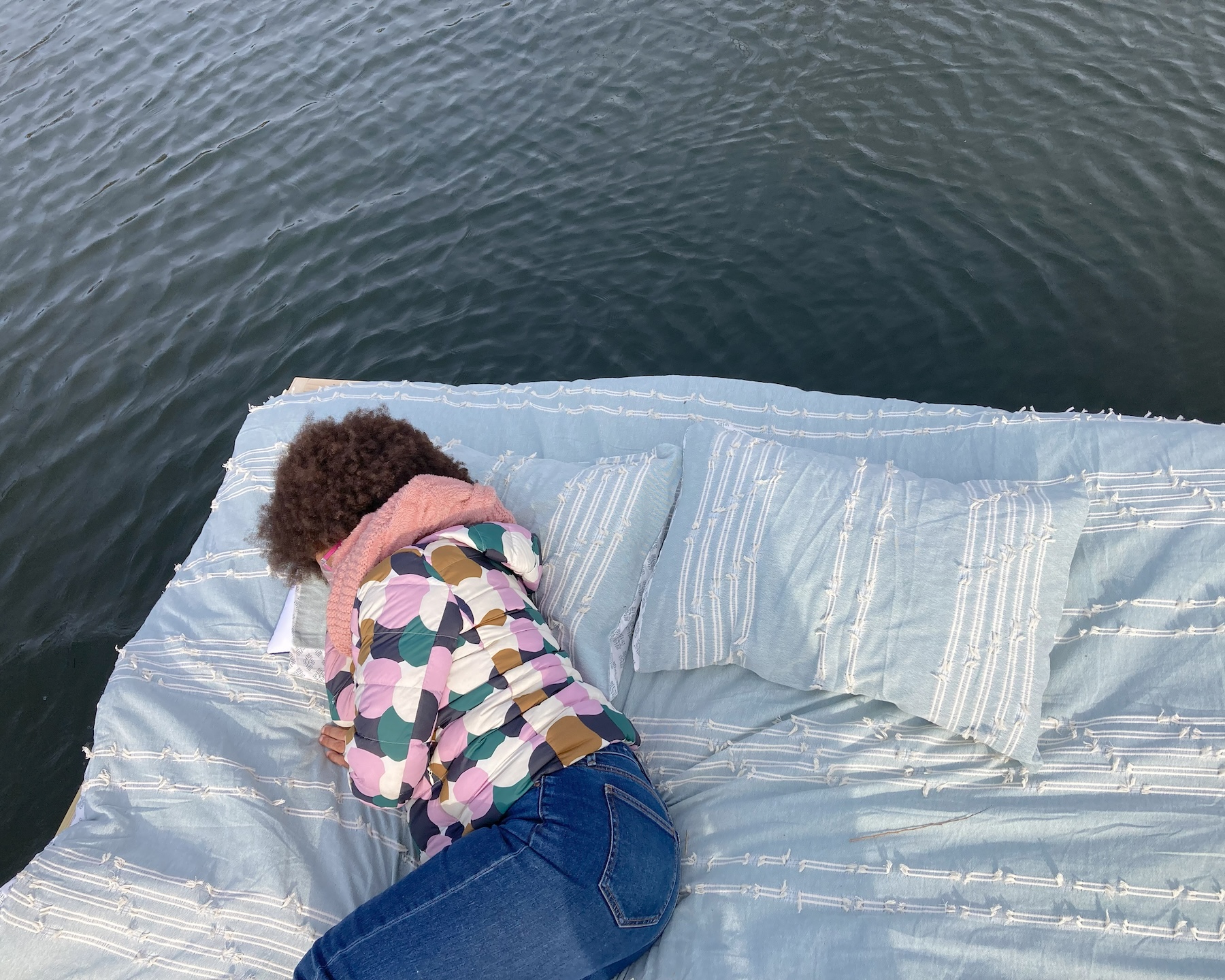
In Conversation with Yvonne Shortt
Interview
In February, Work In Progress took shape for the first time. Sprawling across 5 neighborhoods in Mexico City and featuring 60 artists, the show achieved resounding success in its goal: to create an art fair that is rooted in showcasing process rather than product. This June, Work In Progress returned for its second iteration, this time in New York City. Held across four floors of The BLANC, this month's fair featured 53 installations with artists working and collaborating with visitors in the space. Below, five of NYC's participating artists reflect on what making means to them.
Interdisciplinary and experimental textile artist Freda Xia presented the fabrication of a garment similar to those in her body of work Negotiated Skin, a series exploring how material and bodies interact. Xia explains that these pieces, in their development, form “membrane-like systems" responsive and reflexive to the bodies they adorn. Built of a variety of biomaterials, each piece has its own life unfolding between Xia’s hands.
Ruby Alexander: Do you have a ritual when working at the studio?
Freda Xia: My studio ritual usually begins with a warm matcha latte. Since much of my work is connected to the body, I also care about how my own body enters the studio. For me, this small drink feels like a gentle physical warm-up before making.
After that, I usually begin by organizing materials. I especially love winding hand-reeled raw silk threads in the morning and sorting them by the rhythm of their natural-dyed colors. This process helps me build a palette for the day while opening a quiet dialogue with the materials. Through touch, rhythm, and attention, I slowly enter the state of making.
I tend to begin the day quietly, listening to the materials in my hands. Around sunset, I often turn on music, usually Debussy, which helps me relax, soften, and stay immersed in the studio.
RA: What’s your favorite part about being an artist?
FX: My favorite part about being an artist is that there is always surprise and the unknown. It allows me to keep a free spirit and a warm soul, to stay connected, stay sane, and stay alive.
Art is like a membrane for me. I see and sense the world through it. It is transparent and cannot hold anything false. It can be tender, but also sharp like a blade. I enjoy this intimate relationship with art because it continues to ask me to be honest, sensitive, and real.
Being an artist also allows me to move between body, material, memory, and environment, where they can remain fluid and connected. Something internal can become touchable through fiber, membrane, structure, or space. For me, making art is a way of staying with vulnerability while transforming it into care, tension, and strength.
RA: Name three living, local artists who inspire you.
FX: Three living artists in New York who inspire me are Deborah Morris, Gabi Asfour, and Anicka Yi.
I first encountered Deborah Morris’s work through her combination of ceramics and fiber against a soft flesh-toned background. I remember standing in front of it for a long time, touched by how gentle and moving it felt. Later, I was very fortunate to have Deborah as my mentor. Through knowing her more closely, I came to understand that the warmth of art cannot be performed. Her work, like her presence, carries care, sincerity, and emotional openness. Her approach to multiple materials also gave me confidence in my own path of moving between different media.
Gabi Asfour inspires me through his boundary-breaking approach to fashion, body, geometry, and experimentation. In our conversations, I often feel a resonance between free spirits. He has encouraged me to allow myself to stay within the void, where the most abundant creativity can exist. His way of moving across garment, performance, technology, and imagination gives me more courage to move freely between installation, wearable form, and body-based practice.
Anicka Yi inspires me through the way she treats material as something alive, unstable, and intelligent. I am especially drawn to how she works with scent, microorganisms, and living systems, allowing invisible or overlooked forms of life to become physical, sensory, and spatial. Her practice encourages me to think about biomaterials not only as sustainable alternatives, but as sensitive systems that carry memory, environment, and bodily presence.
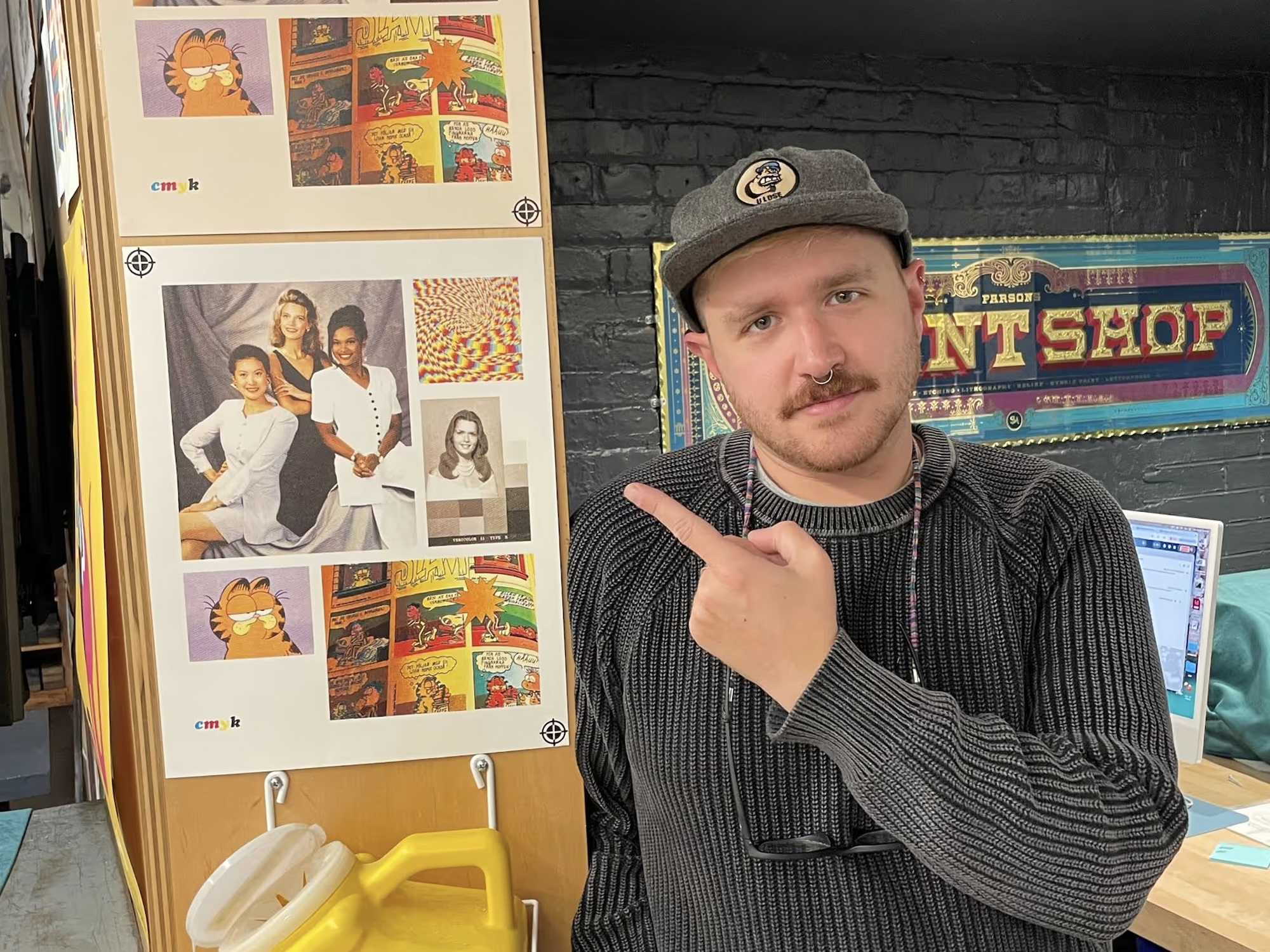
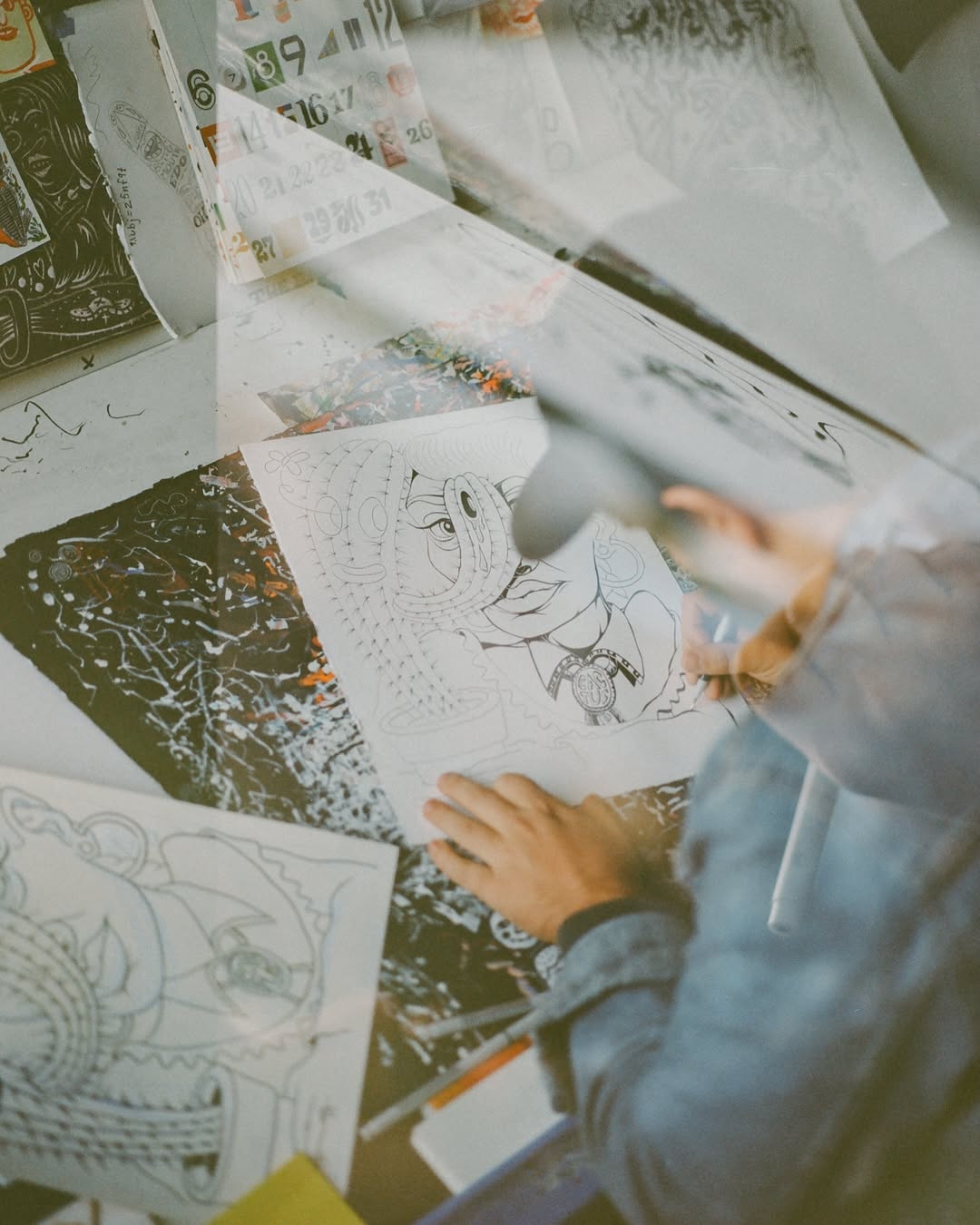
Teke Cocina, a printmaker and book artist by trade, presents an interactive project blending screen printing with found images and alternative forms of markmaking. Surrounded by a wall of his prints, his station draws the eye and then invites the hand to join in on his interactive making process. Pulling each layer adds to the dimension of the piece as it grows with every visitor stopping by.
Ruby Alexander: Do you have a ritual when working at the studio?
Teke Cocina: It’s a bit on the practical side, but as a screenprinter I’m always running through a mental checklist of preparedness- do I have everything I need? Do I have enough ink? Did I register my paper properly? Things always go wrong, but as long as I run my two mantras in my head (one borrowed, one mine) –“be prepared” and “where’s my margin of error?”– the latter being the je ne se quois of relying on a fickle process like print.
RA: What’s your favorite part about being an artist?
TC: My favorite part of being an artist is research. I love the excuse I get to learn about a really wide variety of topics in the name of my practice, even if not all of it makes it in. It’s amazing the places my research has taken me, and the joyful part is that no one expects me to write a paper on it, I can work it into my practice how I see fit.
Finding images that I respond to from pop-culture and art history gives me a reassuring feeling, especially when I see aspects of myself in art-history, even if that wasn’t the original intention of the artist.
RA: Name three living, local artists who inspire you.
TC: Aaron Krach. He is clever + smart (a good combo), generous, and has quite possibly the best collage sensibility I’ve ever encountered in another artist.
Butt Johnson. He’s a mesmerizing drafter, has an incredible sense of color, plus compositions and subject choices that always delight me. Makes excellent prints too.
Tomashi Jackson. Her multi-disciplinary application of printmaking always fills me with awe, especially her manipulation of photographic imagery with the layering of color and different media to create engaging and powerful work.
And for a bonus, I can’t help but throw in a shout-out to Hendrick Goltzius, who is neither living nor local, but whose work from 450 years ago has had an irreversible impact on my practice.
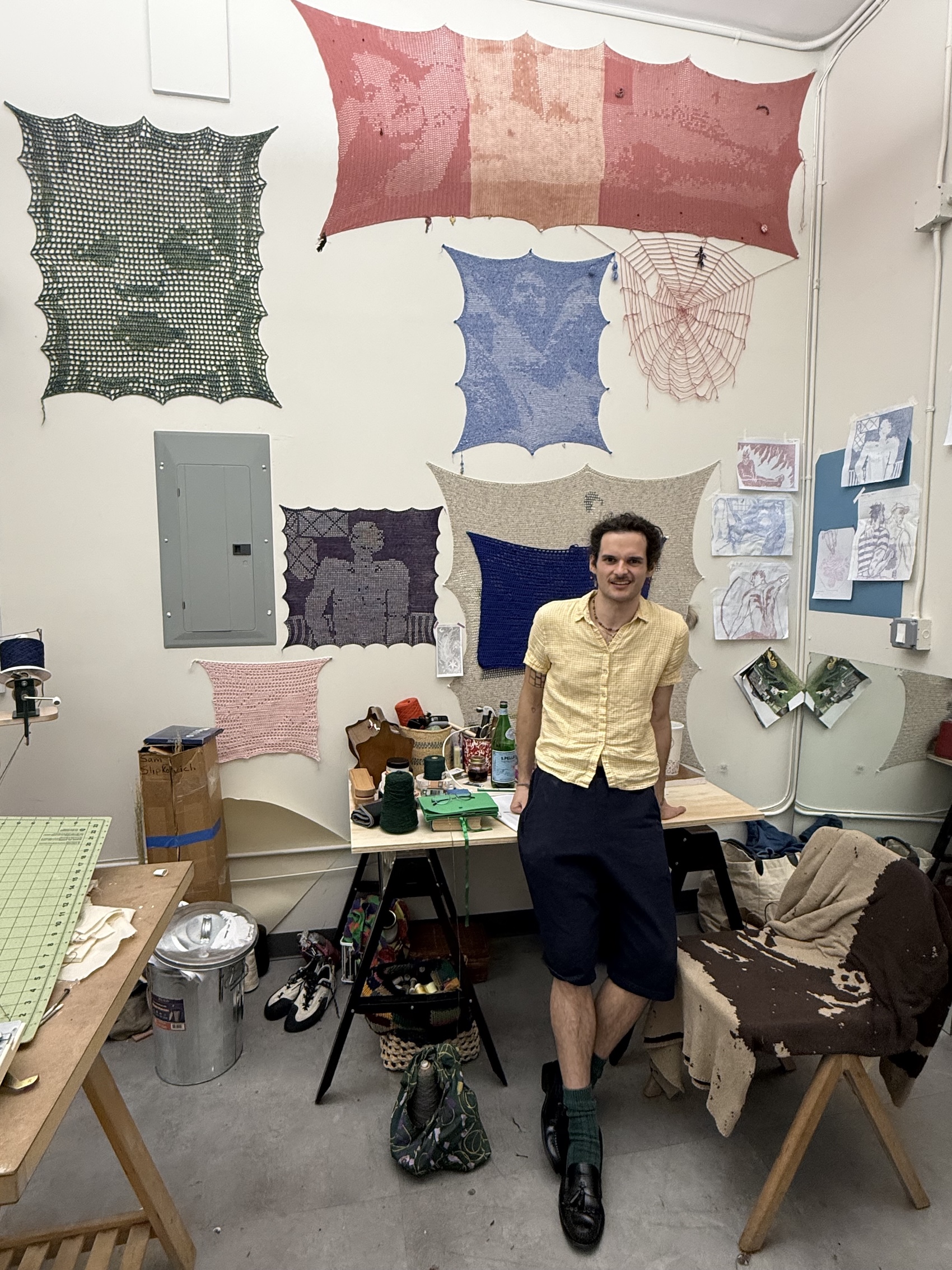
Stretched across the wall like great webs, Sam Slipkovitch’s crochet pieces draw the eye through color and form, presenting distorted bodies, faces, and objects rendered in yarn. A life-sized assault weapon hangs next to a larger-than-life abstraction of an infant face, their forms in a distorted dance with one another. As a fiber artist, Slipkovitch’s practice engages with the tension between material and subject, rendering explorations of often painful, fraught topics through material softness.
Ruby Alexander: Do you have a ritual when working at the studio?
Sam Slipkovitch: The practice itself is the ritual. I at least think it’s pretty magical in many ways. The repetition of the same crochet stitch to form a bigger image begins to feel incantatory after a while. It feels like your binding hopes, dreams, and faith in knots while in a deep meditation.
RA: What’s your favorite part about being an artist?
SS: I love everything about being an artist. I'm so grateful to be able to pursue anything piquing my interest as research for my practice. I love using it as a foot in the door to things and places I wouldn’t normally have access to like esoteric late night performance art gatherings or rich people’s private collections.
RA: Name three living, local artists who inspire you.
SS: Jamian Juliano Villani, Raul De Lara, Wells Chandler
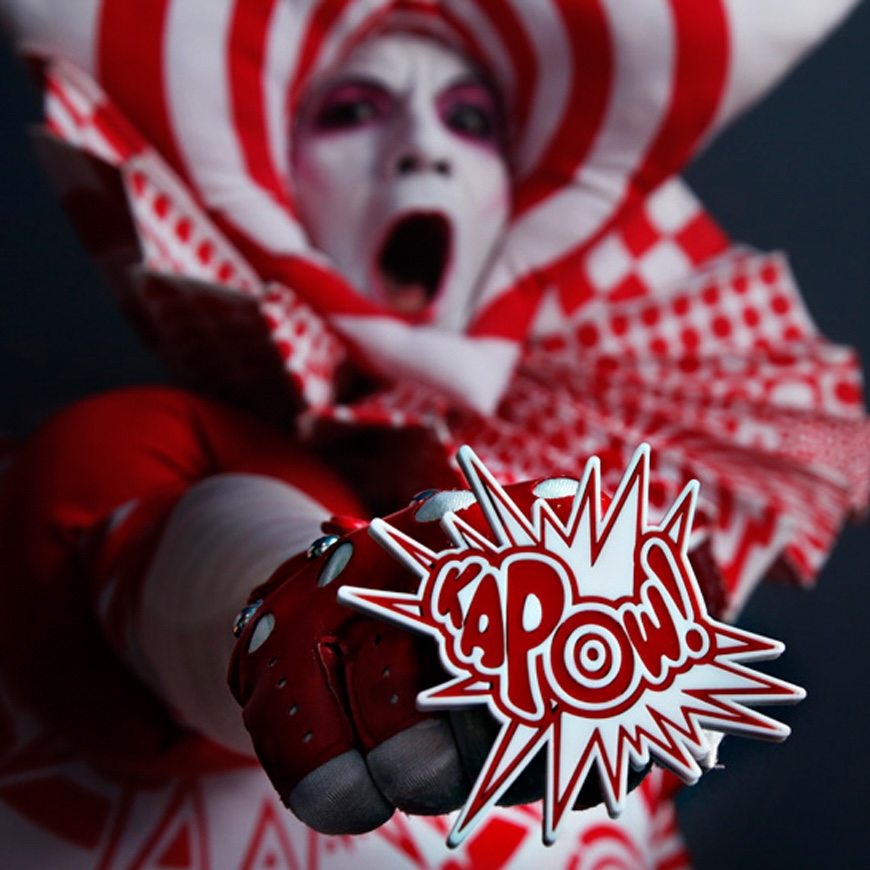
Describing themselves as a “performance absurdist,” Muffinhead presents an activation of one of his pieces. Dressed in an outfit entirely made of magic balloons, he takes the form of a bouquet and passes balloon flowers to visitors throughout the space as they pass by, offering a warm and absurd welcome to the space.
Ruby Alexander: Do you have a ritual when working at the studio?
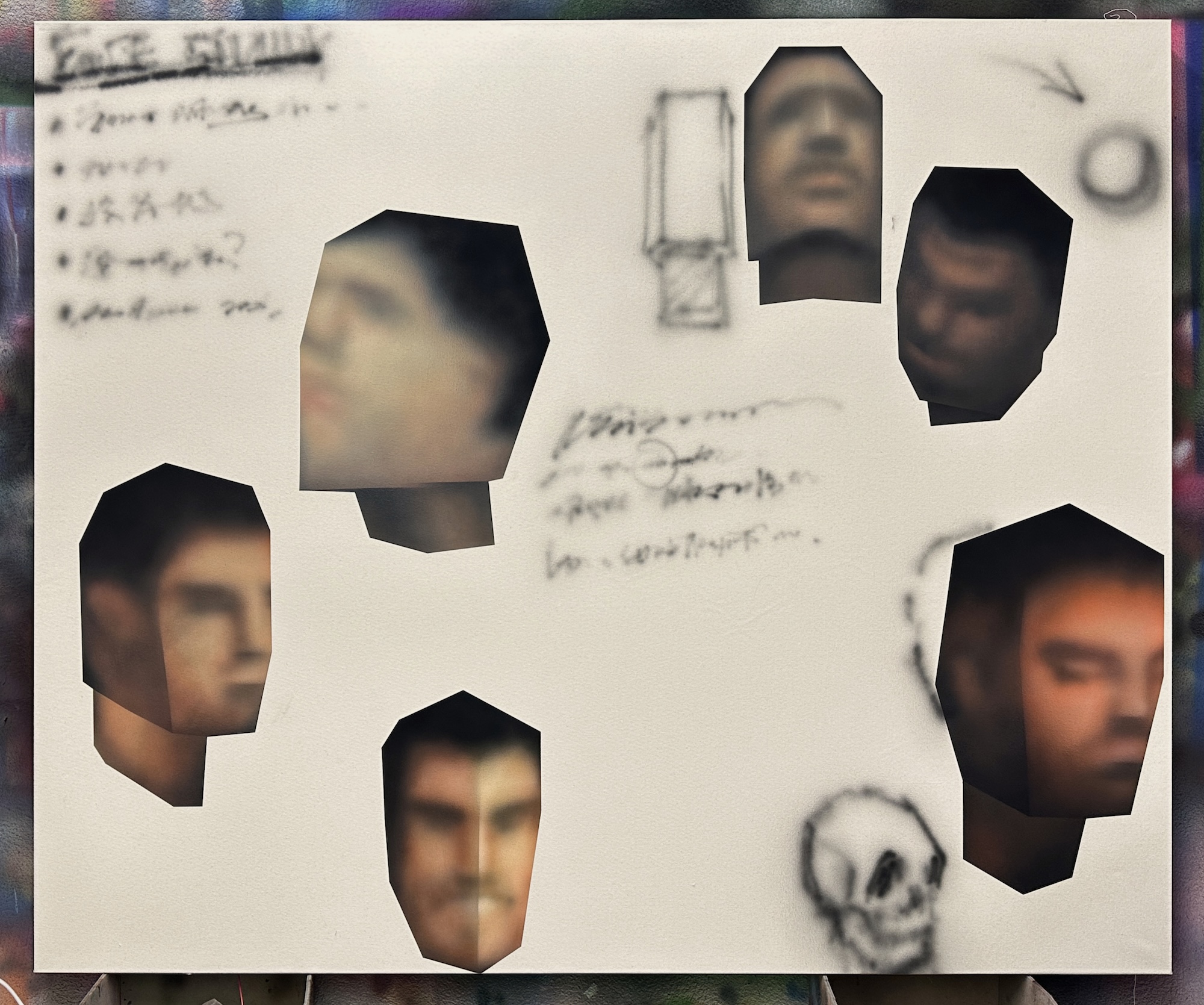
MUFFINHEAD: I don't have too much of a ritual when I work other than an initial pencil scribble or Photoshop "Frankenstein" mock up of whatever I'm doing to begin with.
Often I can tell from the first doodle how the project is going to go-and if it makes me laugh then I know that I really have something.
RA: What’s your favorite part about being an artist?
MH: I enjoy the mad diary that art is-I know very well the quiet inner-garden where the work is coming from and I know the message that I'm trying to send will be received by someone, somewhere...and that freedom of vision is something that I find to be both intoxicating and addictive.
RA: Name three living, local artists who inspire you.
MH: Ryan Burke (NYC), Narcissister (NYC), and Esosa (NYC)
Edo Rosenblith, a multi-media artist, presents a live, interactive re-making of a previously destroyed mural of his own. Among his many art forms, he creates sprawling, “cartoon-style” murals in black and white. During the show, one of these is rebuilt throughout the length of the day as each passing visitor adds their own mark. At the end of the day, a collective piece is born from the death of a former.
Ruby Alexander: Do you have a ritual when working at the studio?
Edo Rosenblith: For about seven years, I saw a shrink named Roy. He served in WWII but by the time I started seeing him, he was a very old Jewish man who dressed like Mr. Magoo. I was one of his last clients before he died, so I went to his funeral and asked his daughter (who was also my chiropractor) what she was doing with her dad’s classic psychoanalytic leather couch he had purchased for his practice fifty years earlier. She said nothing, so I asked if she would trade one of the paintings I made of him (I had done a whole series of paintings about Dr. Roy) for four chiropractic sessions and her father's couch. She agreed, and I’ve had it in my studio ever since 2015. Instead of shrinking heads, I now take naps on it. Usually in the middle of the afternoon.
RA: What’s your favorite part about being an artist?
ER: Whenever I get down in the dumps about my “career,” I force myself to remember all the places and people I’ve met over the years because of my art practice. Because I am an artist, I’ve gotten to live for extended periods of time through artist residencies and other projects. Places like (in no particular order): Providence, Rome, Paris, Vermont, Berlin, Wyoming, Chicago, New York, Memphis, Ferguson, Bogota, Oakland, San Francisco, Kansas City, Buenos Aires, and Copenhagen.
Through art, I was able to forge all my closest friendships and meet so many other amazing people connected to various art communities around the world.
RA: Name three living, local artists who inspire you.
ER: I live and work in St. Louis. A lot of people don’t realize we have an amazing art community right here in the Midwest. Many artists in my community inspire me; these three first come to mind:
Chloe West: Besides being one of the best painters on the planet, Chloe also recently became my studio mate a few months ago. She is an amazing person to share a space with because she is there basically every day (9 to 5), has made various improvements to the space (like getting our building manager to finally fix various lights), and has climatized the space with two massive humidifiers. Her setup is also super professional and inspires me to someday get my act together and work as hard and proficiently as she does.
Peter Pranschke: I often introduce Peter to strangers as “St. Louis's best artist”. And I’m not being hyperbolic. Peter was born and raised in St. Louis, and his work is decently informed by that city's unique sensibilities. If I had to compare his work to another artist, it would be fellow Midwesterner Chris Ware, but funny instead of melancholic. Peter should be as famous and successful as Ware, but chronic health problems prevent Peter from taking on larger long-term projects. Three times a week for four-hour sessions, Peter is on Dialysis because his kidneys don’t function properly. To pass the time, he draws on anything he can get his hands on. Old receipts, medical documents, sheets from yellow legal pads. I feel like Art literally helps keep Peter alive. Besides being an amazing draftsman and cartoonist, Peter is also a woodworker and sewer who makes his own furniture and fiber sculptures. At the same time, he can’t drive and uses a flip phone, and his artist website is just his personal Flickr account. I’ve curated shows of Peter’s drawings in the past, and I’ve wanted to do more curatorial projects with Peter, but lately he’s lost a lot of motivation to exhibit his art. So for the love of God, someone get this man a show anywhere but St. Louis.
Rachel Youn: I’ve already written too much, and I probably have run out of room for this article. Luckily, I don’t need to say much about Rachel because Rachel is already a great success in the Art World. Rachel is inspiring. Despite their success, they remain the same wonderful, humble person I first got to know while we were both just art students. So be like Rachel and be a nice person.
Work in Progress took place in New York City June 18 to 21, 2026.