.webp)

Tim Kent: “Sojourn” at Hollis Taggart
Review
SPLIT LEVEL, open through Saturday, October 3rd, is a refreshing respite to round out the Armory Week calendar in New York City. Only in its second year, the art fair makes good on its promise of an unconventional approach to the market model. Activating the grayscale and pale wood backdrop of mid-century-modern furnishings in Rimadesio’s open-plan showroom, this year’s cohort of seventeen exhibitors leads visitors from one “booth” to the next in a fluid experience more akin to a large group exhibition. Memories of NADA's brief foray at Foreland in Catskill, NY come to mind, especially given SPLIT LEVEL’s parameters of only solo or two-person presentations. The result is a focused collection of works displayed across floor-to-ceiling bookshelves, within closets and drawers, in front of cabinets, on dining tables, and more.
Over the past few years, the “alternative fair model” has taken the emerging art world by storm, corralling art-enthusiast crowds beyond three-walled booths and sterile convention centers into a grand historic house, hip woodland motel, Art Deco post office, and even your friendly neighborhood moving truck. What makes this shift so enticing is seeing how exhibitors navigate unique layouts, surfaces, and infrastructures to install their artists’ works as both venue-congruent and collector-friendly. This year’s SPLIT LEVEL exhibitors commendably avoid a painting-heavy inventory typical of fairs, trending in favor of sculpture and textile. Jaqueline Cedar, the fair’s founder, praised the exhibitors’ applications this year: “The range of materials, styles, installation, and playful experimentation [of artworks] is much in the way I hoped it would be.” Some delightfully successful examples include the beaded, furry Green Cat by Jenny Day (with Kelly McKenna), which sits in repose across the aisle from Cait McCormack’s Slow Blink (with Cara Marsh Sheffler)—a crocheted feline loafing on a window ledge. William Corwin’s cast aluminum sculpture Artemis Ephesia (with Geary Contemporary) is cleverly shelved between prop books, as its scale mirrors that of a bookend. A jib door is propped open to display Sophie Kahn’s Portrait of A. 6 (with Good Naked), illuminated brilliantly by the hidden closet’s lighting design.
Across the venue’s two floors, a few artworks in particular make for standout examples of the fair’s emerging nook within the market ecosystem.
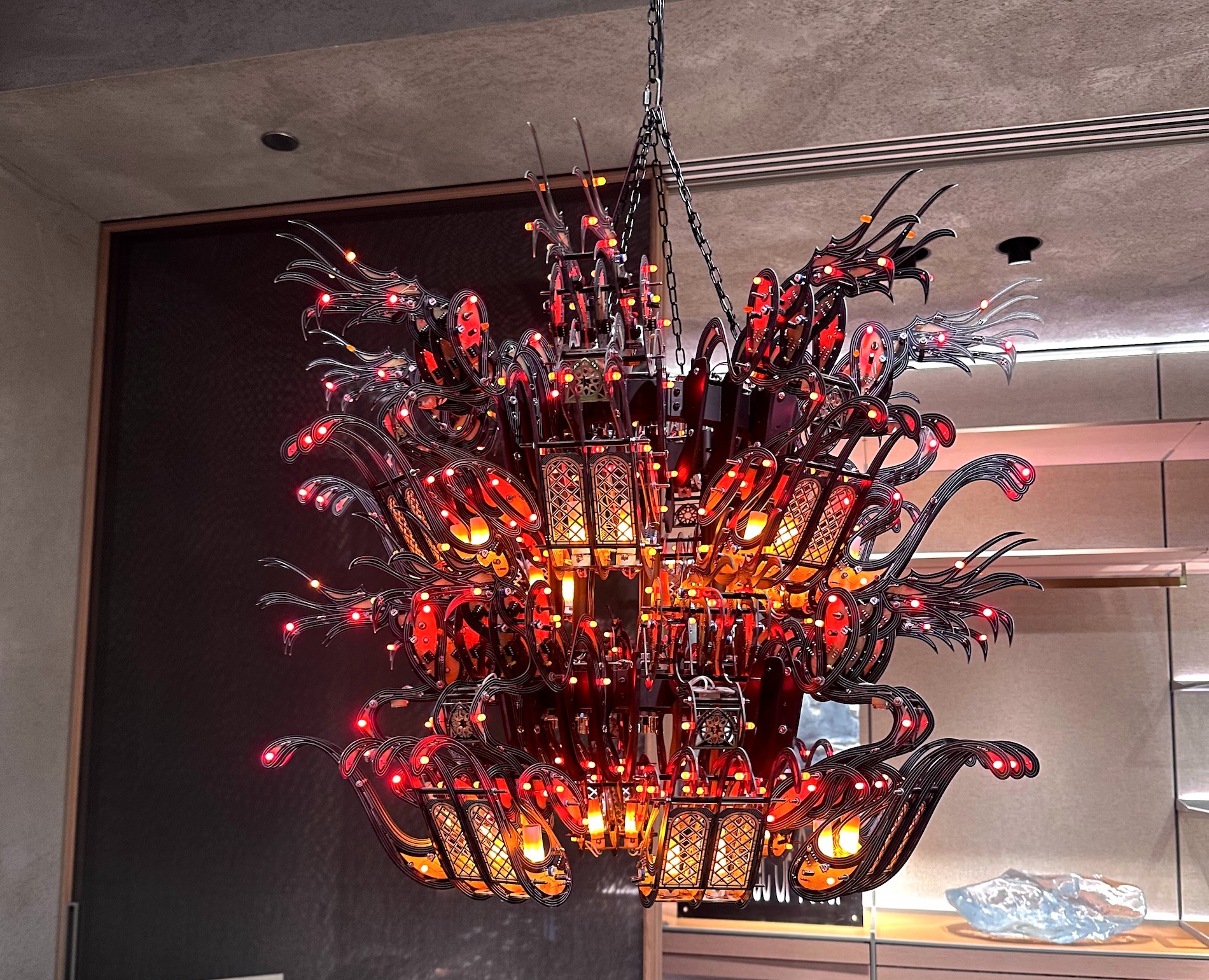
Brian Oakes, Vessel 10 (Flatline Gallery)
Vessel 10 (2025) by Brian Oakes might seem flashy, but it's a genius marriage of decorative histories and modern technology. Encapsulated as a futuristic lighting fixture, it is as much a chandelier as it is an amoebic being transmitting communications via patterned lighting. Made largely of 3D-printed circuit boards coded with a custom light-flickering pattern, this work, presented by Flatline, is particularly alluring in its stylized dressing shaped like cathedral windows. With a seductive aesthetic that draws its forms as much from Baroque and Gothic architecture as it does from tree branches, organisms, and post-punk design, Vessel 10 sits squarely within the technocraft movement as both highly fabricated and highly hand-hewn.
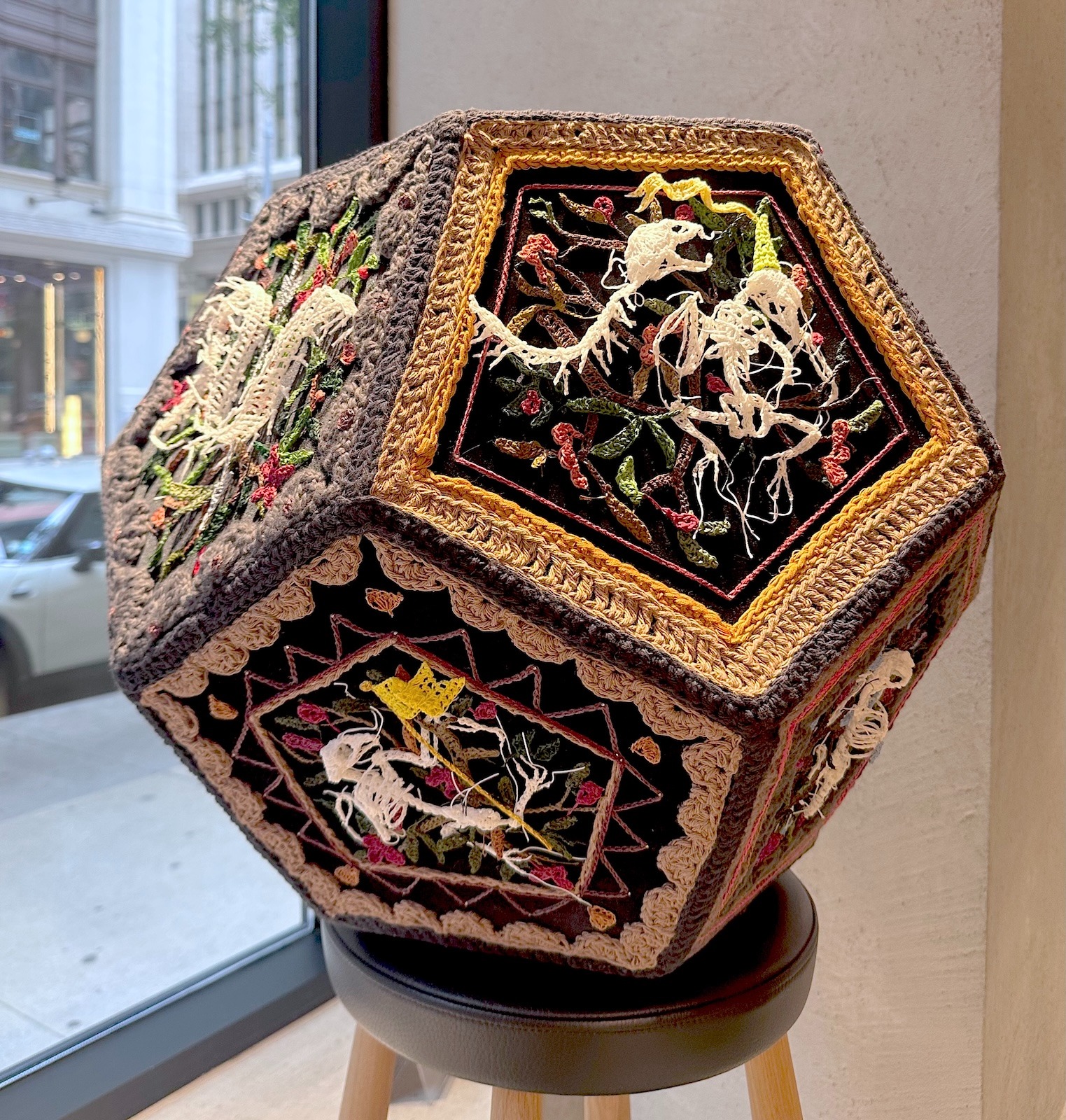
Caitlin McCormack, Let’s Get Demonized (Instructional Polyhedron) (Cara Marsh Sheffler)
Propped on a stool at the front of the venue is one of Caitlin McCormack's newest works, continuing their exemplary use of crochet as a storytelling material. Let’s Get Demonized (Instructional Polyhedron) (2025) is a twelve-sided fiber sculpture reminiscent of role-playing game dice that depicts vignettes related to different events in the artist’s life. Each of the 11 tableaux (the twelfth side acts as the base) employs layered symbology using their typical motifs of skeletons, plants, and flowers to condense the artist’s assumingly complex, emotional events into archetypes that could be reflected on, say, a divination device. The polyhedron shape signals to gameplay: an interesting choice considering the die as a gaming object evolved from early forms of divination using animal bones. The recent resurgence in astrology, tarot, and magic—TikTok witches-for-hire come to mind—reflects a broad quest for answers in a growingly unpredictable, dangerous, and straining world. McCormack’s sculpture arrives as both a tender memory keepsake and a tool for seeking clarity and guidance in the unknown.
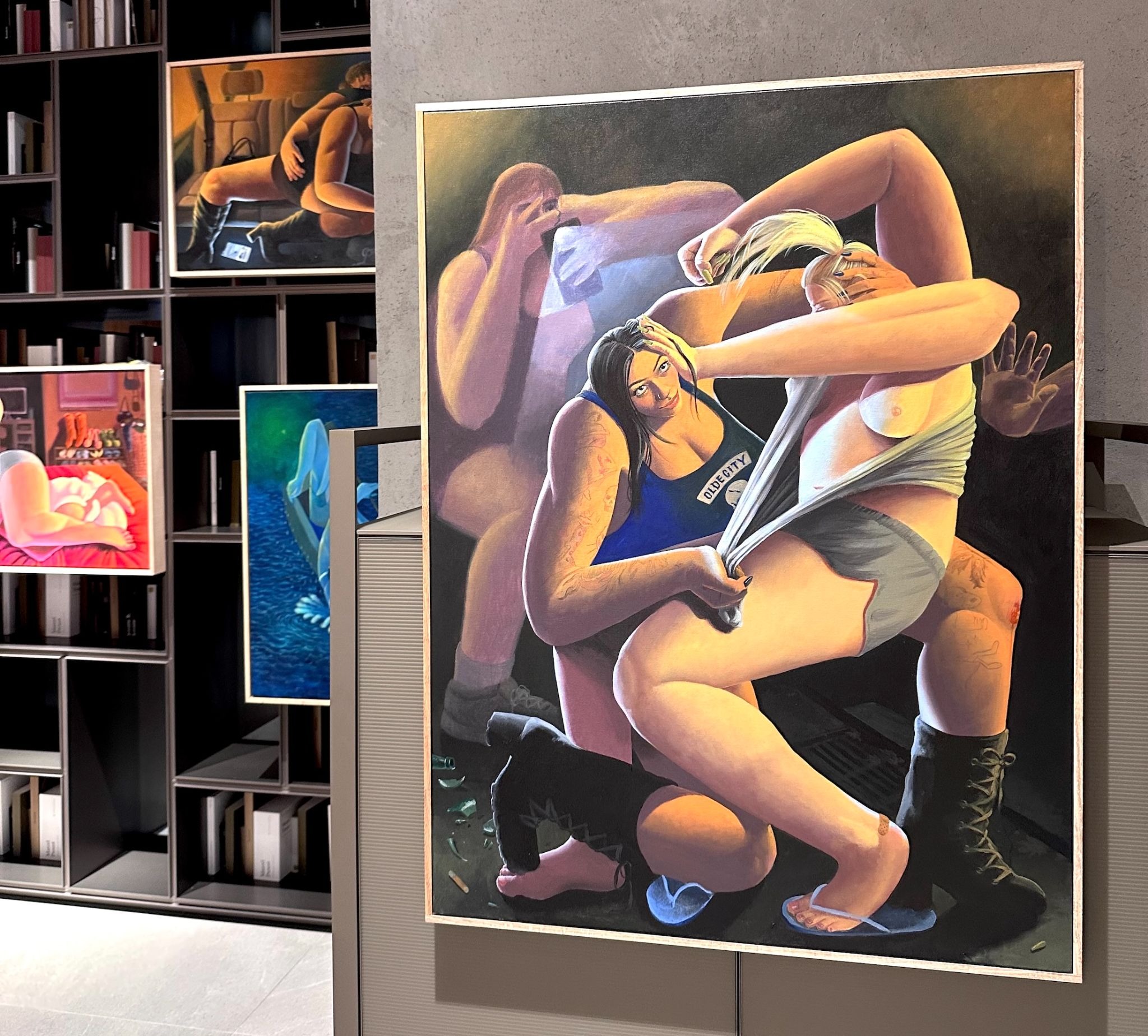
Ariel Posh, Beat Down of Pony Tail Girl (Blah Blah Gallery)
If bar fights are broken glass and bloody knuckles, and girl fights are broken nails and ripped hair, Beat Down of Pony Tail Girl (2026) is a grotesque thing of beauty. Calling to mind artists like Diego Rivera, Peter Saul, Beryl Cook, and early Dana Schutz, Ariel Posh’s painting is a cinematic moment of limbs and fists impacting on the canvas with grace, grimaces, and textbook compositional prowess. The dramatized figuration in Posh’s works is often a puzzle of entangled bodies that transform her characters into abstract color studies, and while others in Blah Blah’s presentation may better exemplify this, Beat Down of Pony Tail Girl evokes a story that piques curiosity. The viewer becomes like the phone filmer at the corner of the painting: sucked into the drama that has erupted out of the mundane and unable to escape until the scene passes.
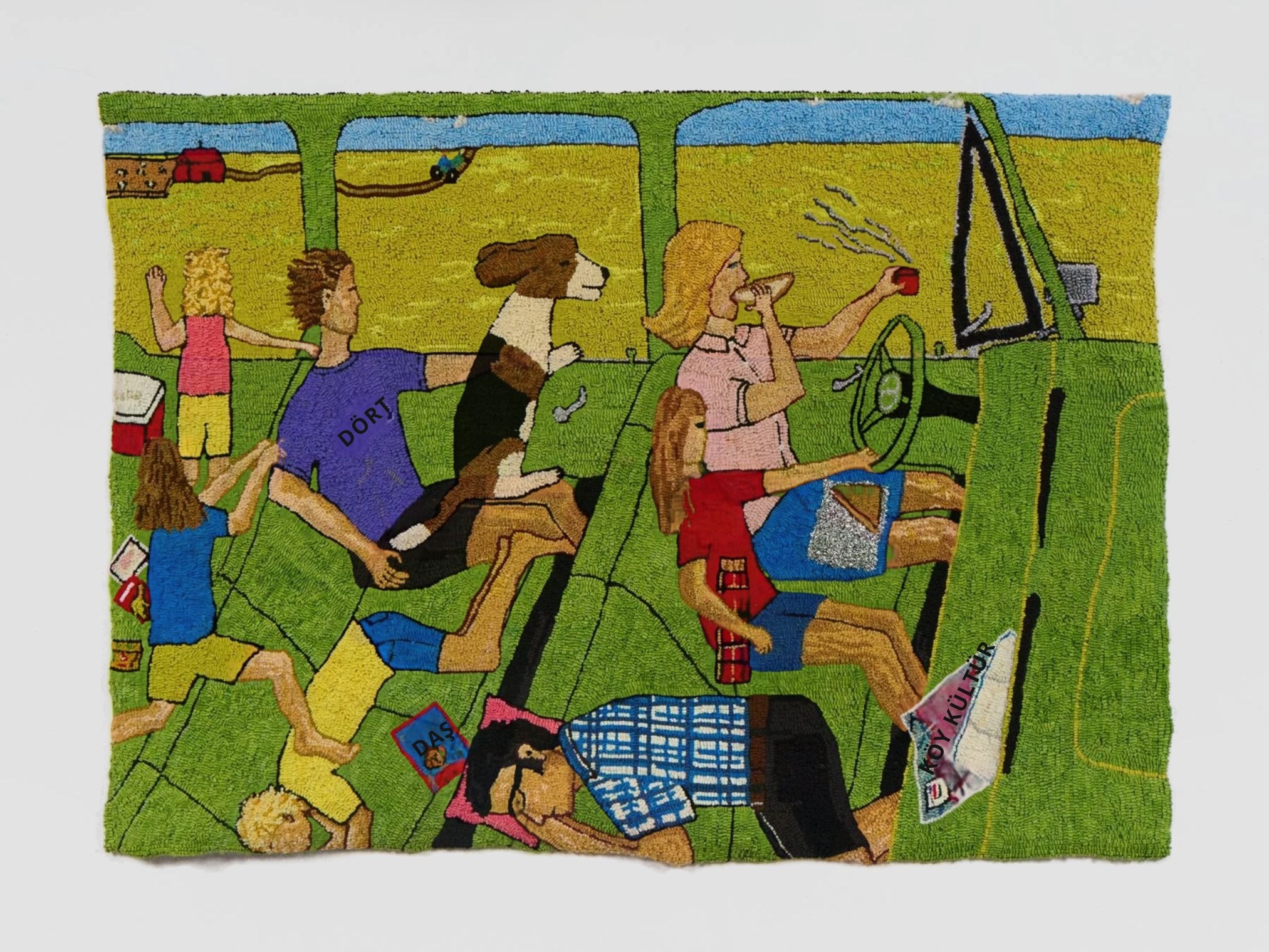
Mary Tooley Parker, Hold the Wheel (Good Naked Gallery)
The joyful lime greens of the car and landscape that envelop the people and objects in Hold the Wheel (2026) are immediately striking. As always in Mary Tooley Parker’s textile works, her latch hook weaving method gives a fuzzy texture to the flat swatches of color in the background of her scenes. This tableau is a lively, nostalgic depiction of family, friendship, and quotidian life, rendered even more darling by the work’s craftsmanship and materials. A teen steers from the passenger seat while the mom eats lunch; kids play across the back seats of the car; the dad naps in the front—it’s parallel moments of exhilarating autonomy and respite from exhaustion, compacted into a single scene. That dichotomy is echoed in the artist’s making process, which is, by choice, devoid of electric tools. As a result, the work is labor-intensive, true to historic techniques, and deeply rewarding to create. Hold the Wheel particularly captures the folk aesthetic of tapestry in both process and content, while also inviting the viewer in as a more active participant.
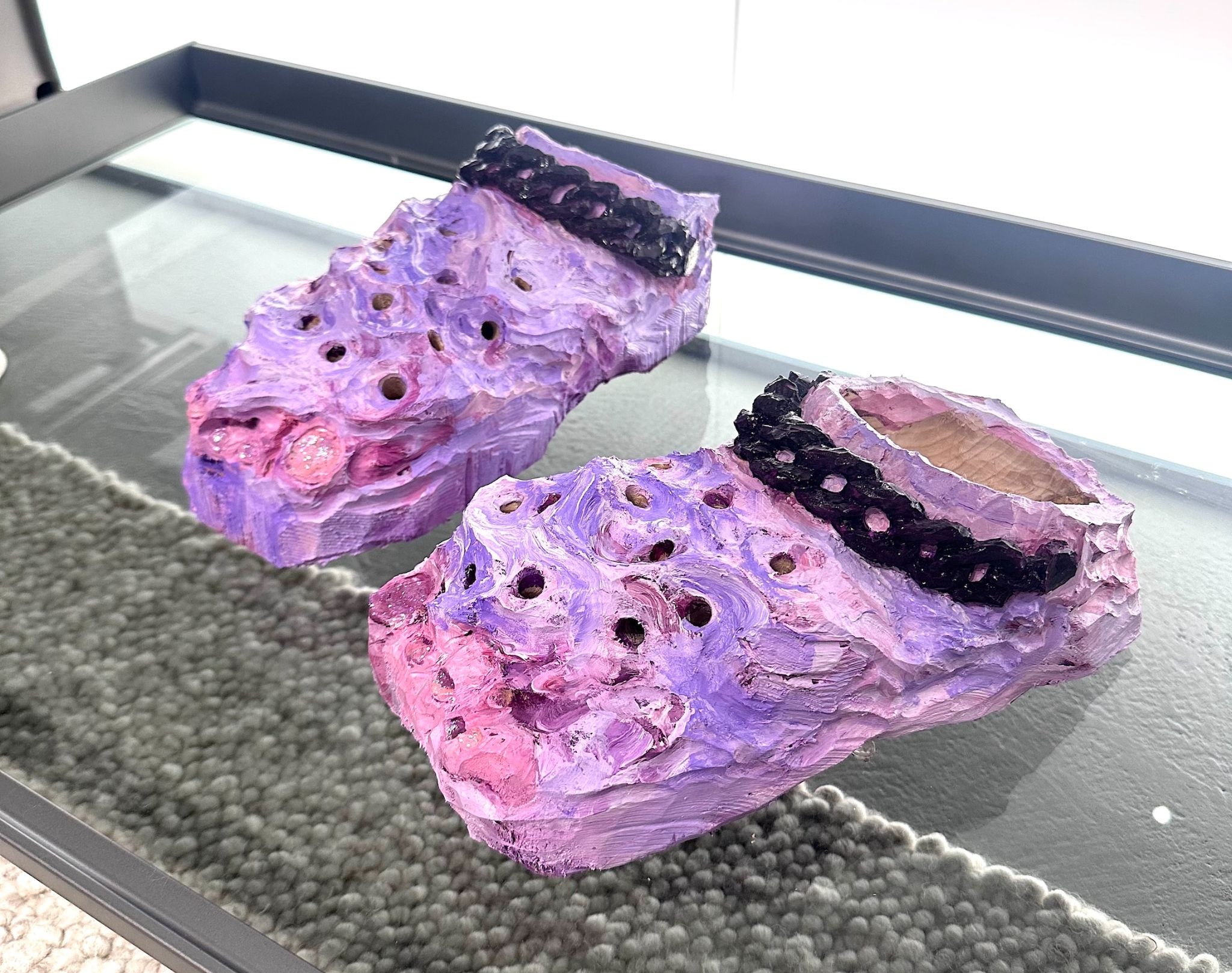
Brent Owens, Royal Crocs (Alex Stoller)
Tucked into the bottom shelf in the walk-in closet system of exhibitor Alex Stoller’s presentation is Brent Owens’ Royal Crocs. The artist made the pair after finding out the booth’s structure and, like for most of his sculptures, he looked to what surrounded his home and studio. Owens’s carved forms are always chunky and a bit wonky in their mimicking of real things; this footwear piece is no exception. Taking a closer look, however, reveals a strange detail: jutting out from what seem to be worn-down tops of the shoes are glittery, nail-polished feet. It’s quickly obvious that Owens imbues a lot of humor into his practice (something about literal wooden clogs looking like foam clogs), and with this piece he dips deep into the uncanny valley. Royal Crocks is a particularly enjoyable moment where an artwork and installation choice successfully activates the alternative venue.
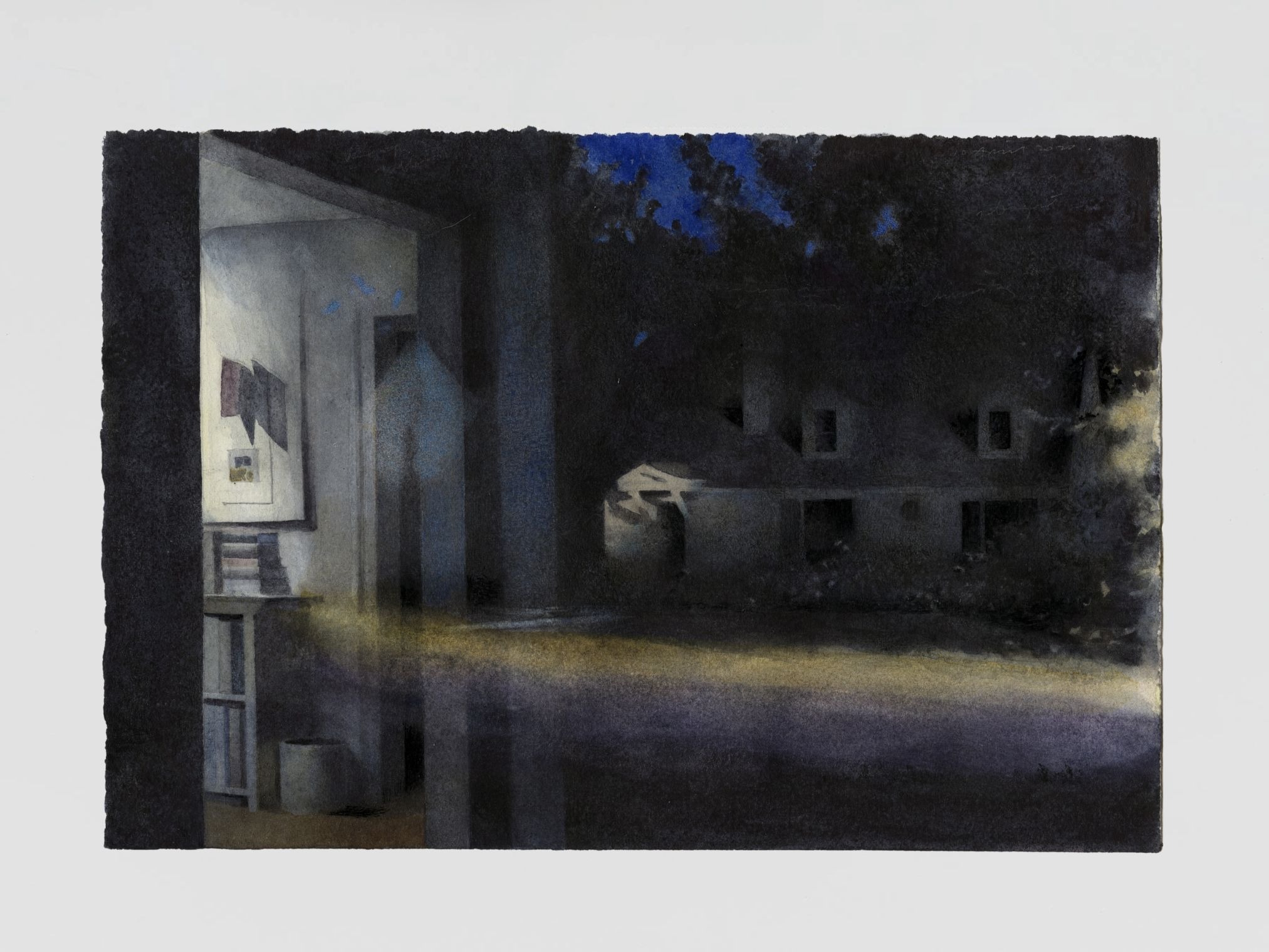
Charles Ritchie, Doorway and Darkness (Kathryn Markel Fine Arts)
Discovering Charles Ritchie’s drawings displayed across a glass-top table elicits a mix of awe, delight, and reverence. Any of the available selections are a treat when the realization hits: they are not photographs, and a gallery representative shares this fact as soon as a visitor walks up. Rightfully so, as it could be easy to write off the collection of small images as quaint photos of home interiors. Ritchie has been committed to the methodology and subject matter of his drawings for nearly 47 years, which likely adds to their enrapturing effect. He makes his representational, observational drawings from his dining room table, so he depicts only views from any angle of this place in his home. The narrow parameters that define his subjects render the drawings as almost obsessive character studies; it's not hard to make conceptual parallels to the 1954 film Rear Window. Many of the works on display are toned in the same moody cobalt blues and rich graphite grays, but Doorway and Darkness simultaneously captures the delicate dance of light and shadow across the interior of his home’s walls, the exterior of the home across the street, and the liminal space in the glare of his dining room window.
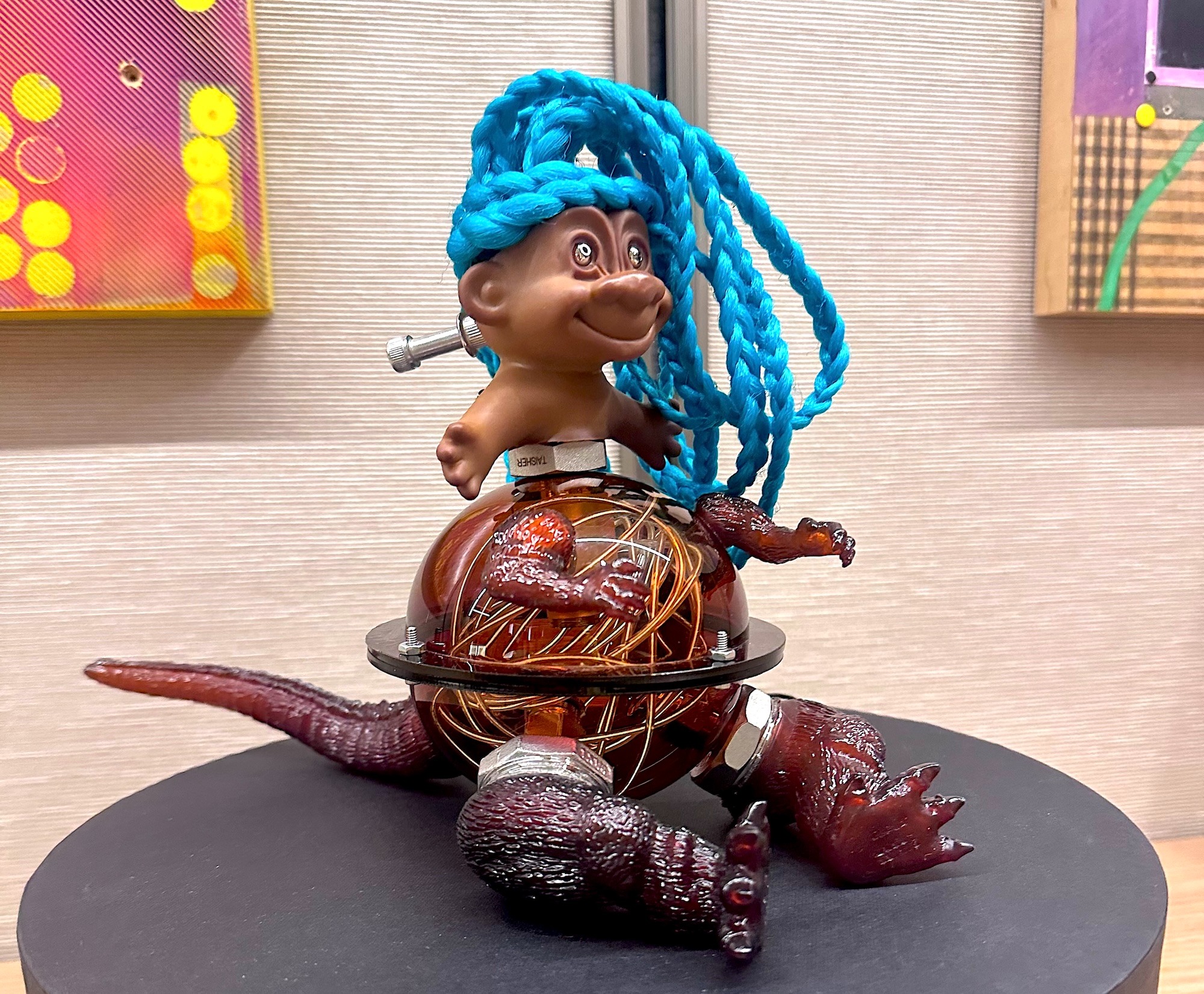
Terrence James Jr., #013 (Below Grand Gallery)
#013 (2025) is one of the numerous chimeric sculptures from artist Terrence James Jr. that dissect Russ Troll Dolls and reinvent them using other toys and commercial mechanical objects. This piece is split between a Troll Doll half and plastic dinosaur limbs, hollowed in the center by a translucent plastic orb. Terrence James Jr.’s use of toys in their work is a motif that links play with social adhesion and acceptance of the self. #013 is an evocative example of the artist’s reflection on the queer Black experience, and interrogation of such experiences through the objects of youth—when identity begins to codify alongside not just the self, but the world around us. The artist’s relationship to readymades, as an adoption of identity through transformation of products, is also most intriguing in this work. The strength of #013, however, lies in the subtlety of its materials as a message. The stark contrast between the malleable rubber and hardened plastic “flesh” of the figure inverts otherness into built beauty, and places power in the freedom of construction and play.
SPLIT LEVEL runs through Saturday, October 3rd, 2026. Public hours are Friday and Saturday, 12 pm to 6 pm. SPLIT LEVEL is hosted at Rimadesio, 102 Madison Avenue, New York, NY, 10016. Tickets can be purchased at splitlevelfair.com/visit2026.






%20.jpeg)