
Allison Katz: "Jeu d’esprit" at the Montreal Museum of Fine Arts
Review
The coastal walk to Turner Contemporary is interrupted by a narrow facade that cuts abruptly into the Kent skyline, the word “Dreamland” stacked on it in yellow neon tubing. It is a hollow, malleable mirage—the kind Lauren Berlant wrote about in Cruel Optimism, in that most often the objects of our desire are really a “cluster of promises” that we want to be made possible to us.1 But the appeal often lies in its unreachability, for the closer we get, the more the fantasy becomes compromised.
Such is the axis of Something Missing? In many ways, it addresses the implication of dreams and desire as much as language, of which Calle, over five decades, has made a vocation of tracing the lacuna between. Her first UK institutional show in over fifteen years marks her return with a timely, assiduously assembled body of work that argues itself as a sophisticated repository for memory as living material that expands and contracts with tentative restraint and complete abandon. This Freudian gesture toward the self is not new; Calle has always postured the archive and mind as twin sites, inextricable in their inherent politics.
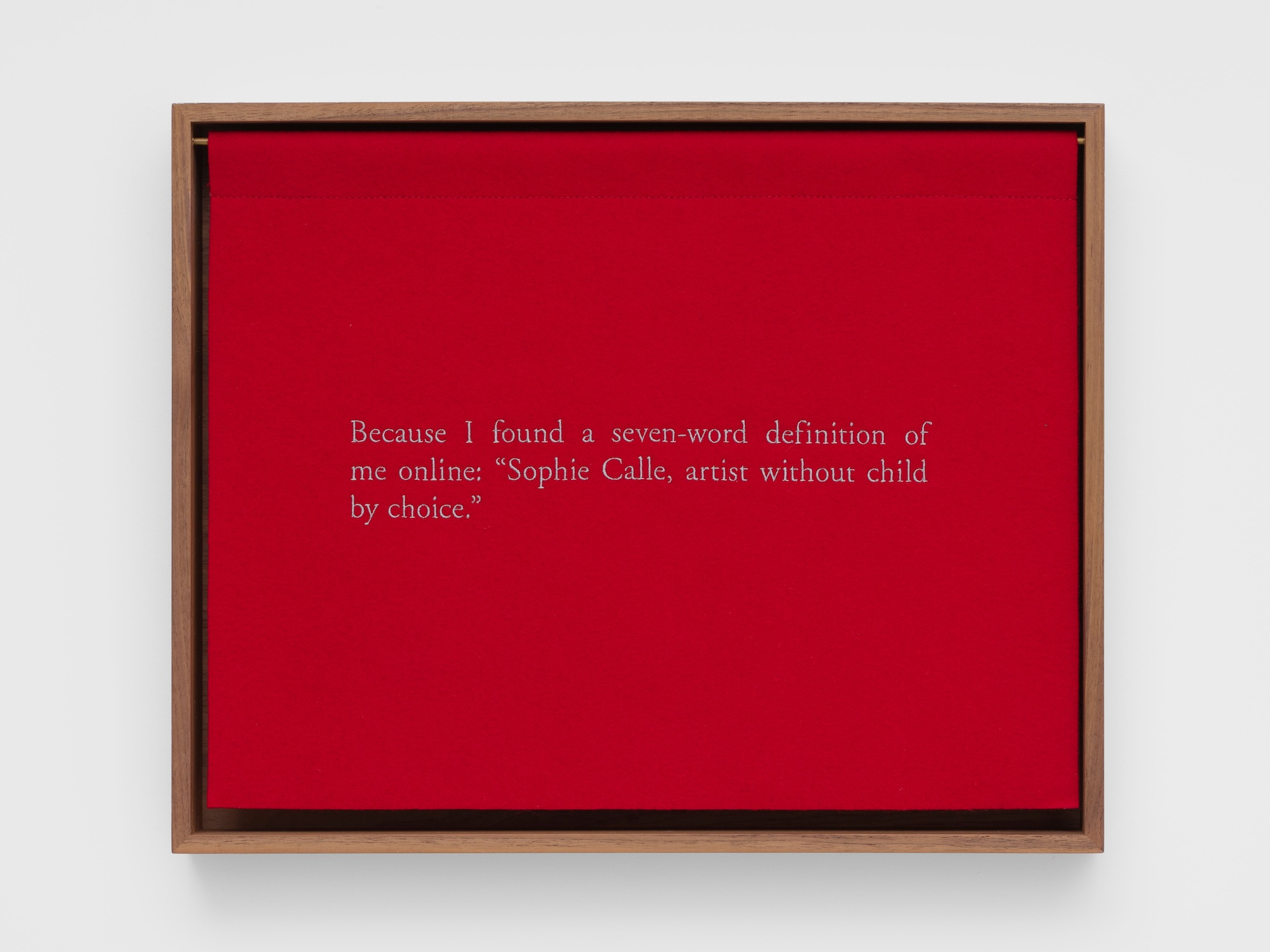
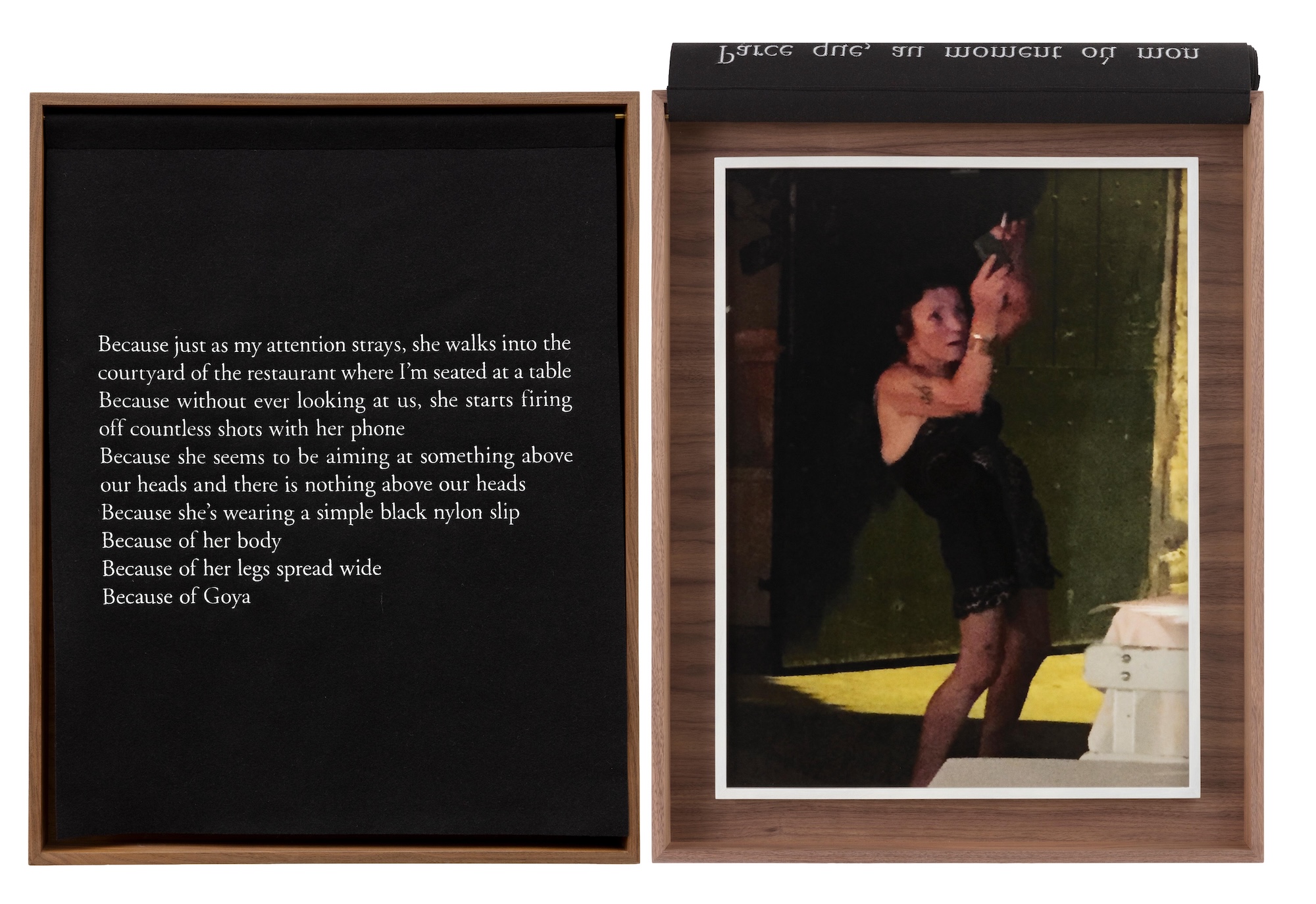
For a conceptual artist seemingly so unburdened by the great beast of subjective interpretation—“I am not here to do therapy with you,” she replied when recently probed on her obsession with absence—What do you see? (2013) and Because (2018–26) make for a pair of disarming openers, the latter of which is a series of photographs preceded by their own impulses. Felt curtains looped upon brass rods conceal them like touch-and-feel books; embroidered in silver thread are the reasons they were taken—maybe the reasons one does anything at all: “Because it is simple,” “Because you never know,” “Because I can’t resist.”
But like the mind, the archive can buckle, be troubled by what is missing. What do you see? attests to this fragility by highlighting how the preservation and destruction of memory might be two sides of the same coin. After thirteen works were stolen from the Isabella Stewart Gardner Museum, the team rehung four of the abandoned empty frames, and Calle asked what they saw in their absence. The results produce something of a recursive encounter that destabilizes the intense solitude of looking: our gaze is pulled between the backs of heads that observe nothing, and the stream of varying responses in gilded frames below. But Calle’s ambition is not to assemble an accurate recollection of a work removed of its physicality; rather, to investigate the conditions by which memory is swayed by emotional attachment.
This modernist reflexivity tugs throughout, suspending that tension between material and the truth it attempts to represent. Then we arrive at The Blind (1986), to linger at the threshold of the unreachable, with its array of floating shelves installed at varying heights that yield a more embodied way of looking. Calle asked those who have never seen to describe what they believe to be beautiful. Only the viewer can see their references. To do so requires moving around the space, occasionally craning up to a strand of sharp gold tinsel that cracks against cobalt like lightning. Or the humbling image of Saint Lucie, holding a tray of eyeballs that peer back at us. Lush chartreuse grass. Jagged, chalky Riviera mountains reflected in the Mediterranean. How resolute would our convictions be if we could not anchor them by means of our senses? What does it mean to believe in the intangible?
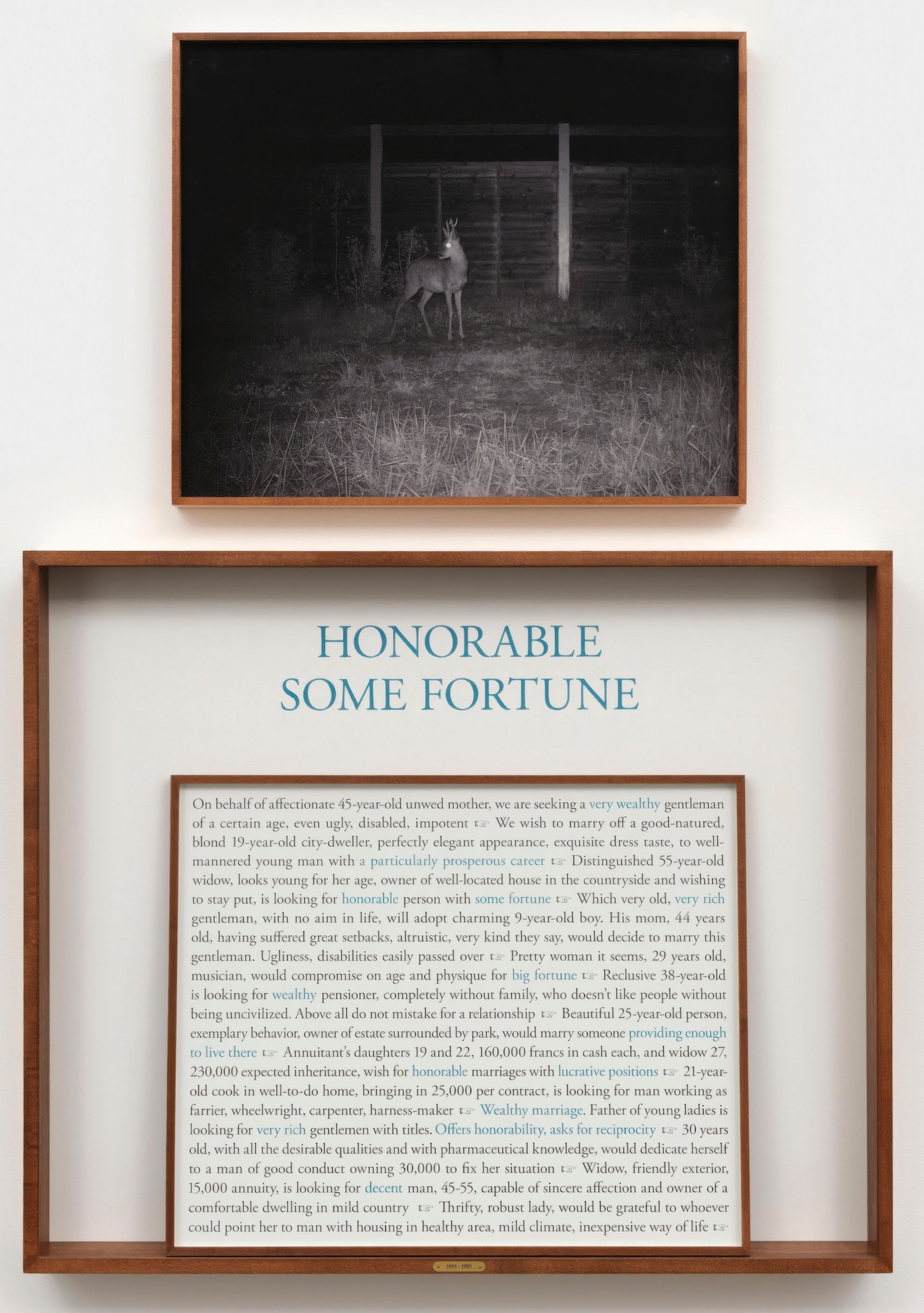
In the South Gallery, Catalogue raisonné of the unfinished (2023) fixes 25 incomplete works as the show’s centrepiece. Sprawling, compelling, and tender in its vulnerability, the collection implicates us in the scrutinizing yet oftentimes droll tangle of an artist’s inner dialogue. The abandoned work is regarded as an iteration of the abandoned self, resurfaced in order to dignify it with a finality. First Love – Too Late (2023) depicts a modest, weathered wooden door—once the entrance to the hamlet Calle lived with her first great love—later upon which he announced his departure. She returned after 25 years to a state of ruin; only the door and its message were still upright in the rubble. “For a quarter of a century,” says the accompanying text, “Gégé had never stopped leaving.” Stamped in the unforgiving red of an overdue bill: “TOO LATE.”
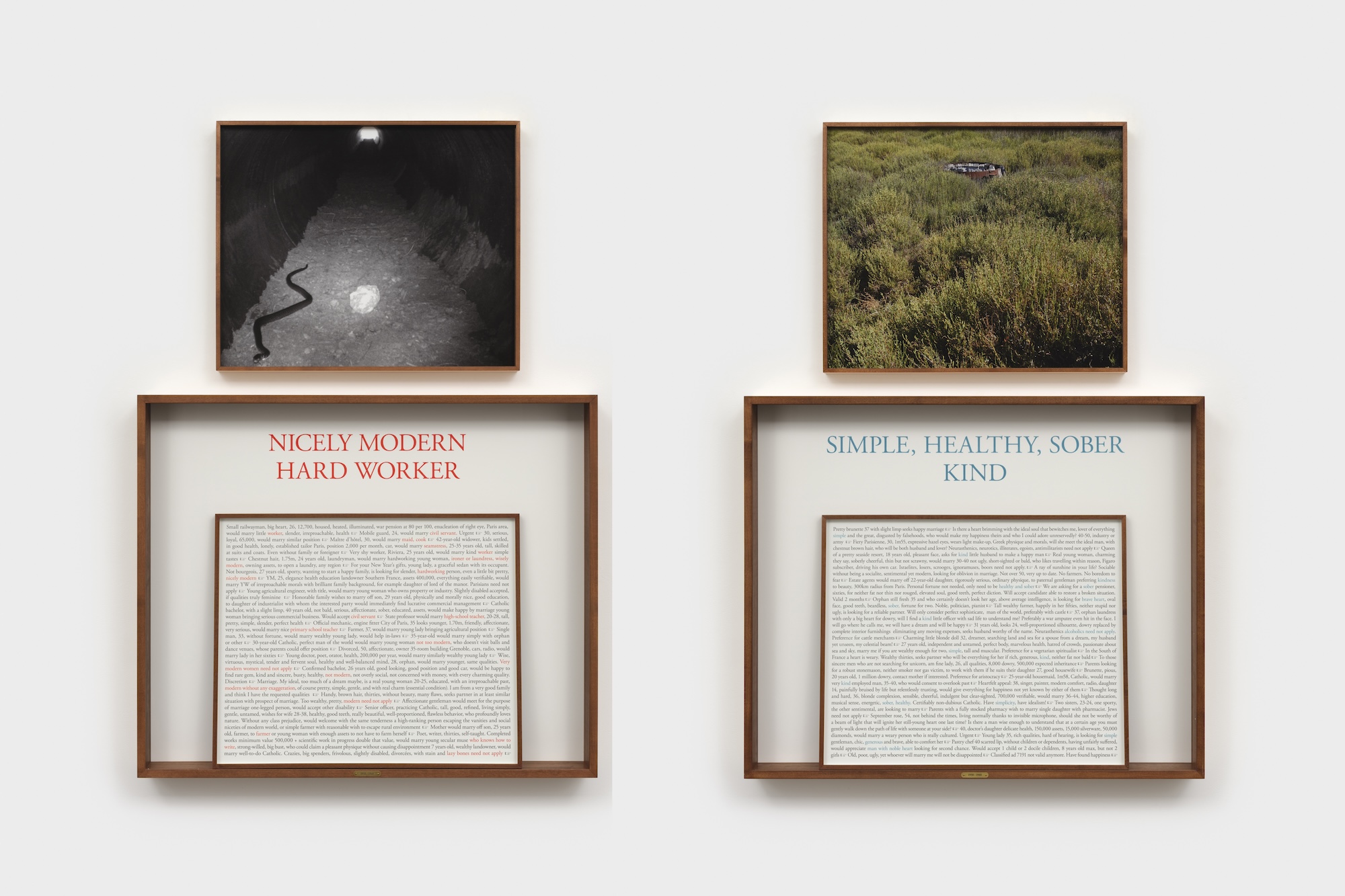
The room is charged with an affective quality that breathes in the proximity between visitors (picture Lygia Clark’s relational objects scattered and dissolved of their material specificity, leaving only diffused micromovements and a gauzy awareness of the other as you amble between interstices and wait for your turn with a headset). These degrees of intimacy are engineered in a way that feeds our curiosity for the fantasy that is entering someone else’s life—I catch myself trying to defy physics to read a disturbing confession obscured by two bricks—yet does not violate what Berlant calls our “fundamental relation to the world” due to its one foot in the real.2 Calle’s most famous works sought to outsource meaning during periods of her life that felt lacking, such as asking over a hundred women to interpret a break-up letter, or following strangers by virtue of her own want of direction. Purpose, too, is an object of desire.
Something Missing?’s central thesis is constant but intrinsically paradoxical, evoking more questions than it resolves. Even the gift shop boasts an array of caps, neckerchiefs, and posters flagged with solitary question marks, asking upon exit whether you left something behind just as an online retailer emails if you forgot your basket. But that concern—to return to that infernal insufficiency of language and dreams—of how an absence might constitute the heart of something is steadfast. What to do with it? Calle reconciles to elaborate on the affective matter around it, then steps back to see what it conjures, asking only what you want to see in the ambiguity. Whether you leave broken or made whole is up to you; that is not her concern.
Sophie Calle: Something Missing? is on view at Turner Contemporary until January 24th, 2027.
1 Lauren Berlant, Cruel Optimism (Duke University Press, 2011), 23.
2 Berlant, 37.