

Sophie Calle: "Something Missing?" at Turner Contemporary
Review
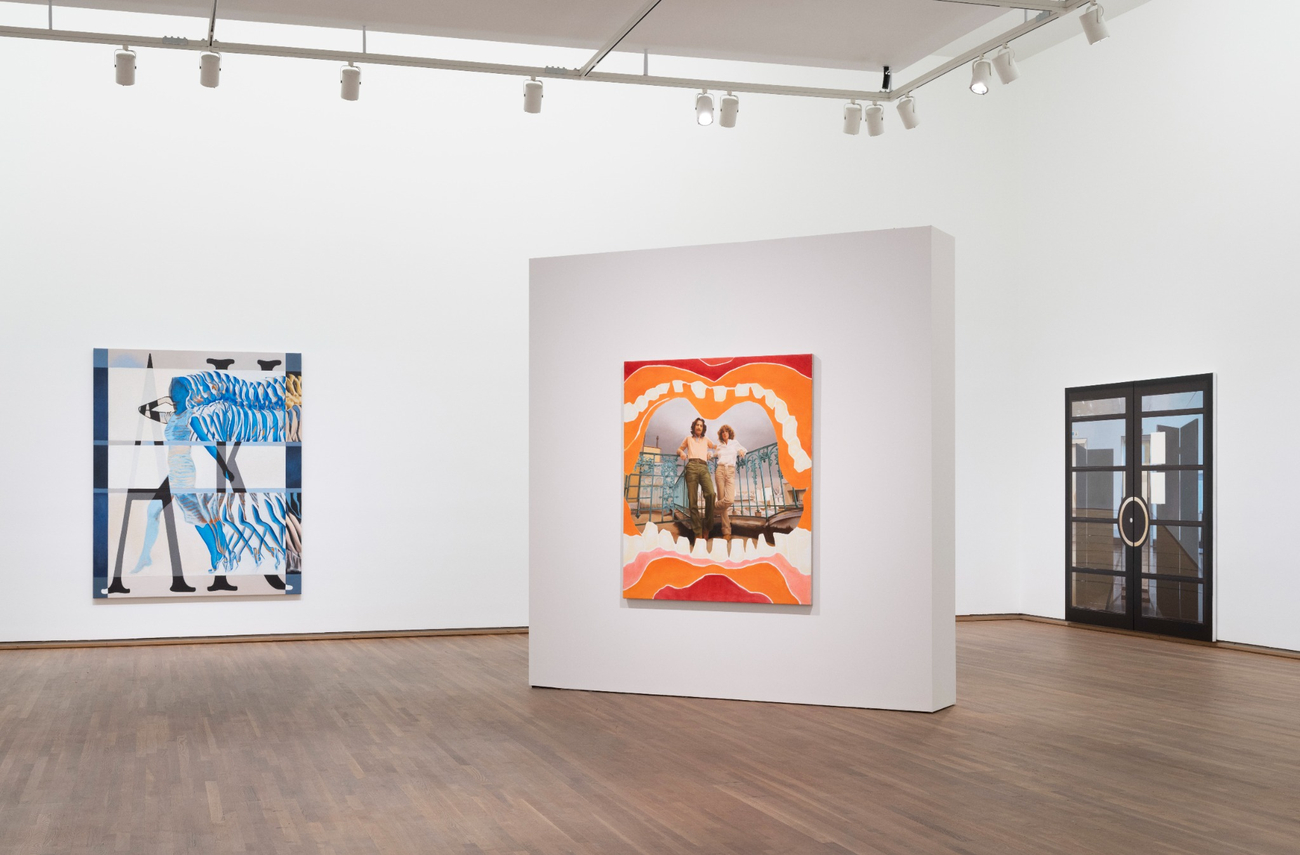
In Mom and Dad (2026), Allison Katz eyes a moment before she existed. Her parents, newlyweds in Paris in 1978, gaze down at us, framed from within a cavernous and toothy mouth. Her father, an avid photographer, staged the original with a self-timer, the camera set below the pair. With his brushed curtains of coiled hair and languid expression, he passes for Jim Morrison, a coincidence that an exhibition preoccupied with doors and their obstruction is happy to pocket. Nearly half a century on, the daughter takes up the position of a child not yet conceived, peering up from inside a mouth borrowed from a 1943 woodcut by André Derain. The image appears to devour its own origins, but whose appetite figures? Katz wedges herself into an encounter that only their photograph could have licensed, while the painting stages the impossible exchange with clear distance between its desirous participants.
Such pas-de-deux animate Jeu d’esprit, Katz’s first institutional solo exhibition in Quebec at the Montreal Museum of Fine Arts. Born in Montreal in 1980 and now based in London, she returns with fifteen paintings, eight made for the occasion. Personal photographs and art-historical images supply the material, often through coincidences that tempt autobiographical readings. More compelling, however, is how the paintings expose memory as something assembled from representations that precede or exceed our own experience. The image offers a way of imagining one’s place in the world, though it remains stubbornly separate from the experience it claims to recover.
The architecture rehearses this gap in space. Four freestanding walls, set diagonally around an octagonal bench, form a porous iris around a pupil that visitors can actually occupy. Paintings face inward and outward, so no single vantage takes in the whole. Jacques Lacan would recognize the arrangement. The eye and the gaze, he held, never coincide, the gaze being not what we aim at an object but what slips our command of vision. Katz seats the spectator at the center of an enormous eye, then withholds the one thing an eye is for. Our hunger to see inside an image is flattered, then fed, in the paintings’ favorite manner: with a flat refusal.
The show opens with Birth Canal (2022), a view of Montreal’s Lachine Canal that the title transfigures into a passage before birth. Curiously, the densest paint sits in the water, not the landscape. Buildings above are thin washes, while their reflections thicken, strokes piling where forms ought to dissolve. The inversion is subtle but not innocent, as the reflection, already once removed, outweighs the thing reflected. What might pass for an autobiographical landscape suggests instead that the image through which we apprehend a place can prove more tangible than the place itself.
Her surfaces reward the oscillation between distant recognition and close inspection. Pencil pentimenti web across passages of paint as a filigree through which the underlying image can be glimpsed. Translucent washes pool around thicker deposits of pigment, bringing different moments of making into one field. From afar, the images evince an air of almost casual legibility, but up close, their coherence frays and the decisions that assembled the illusion step forward. The eye is invited to retrace the hand’s movements, though it never recovers the act.
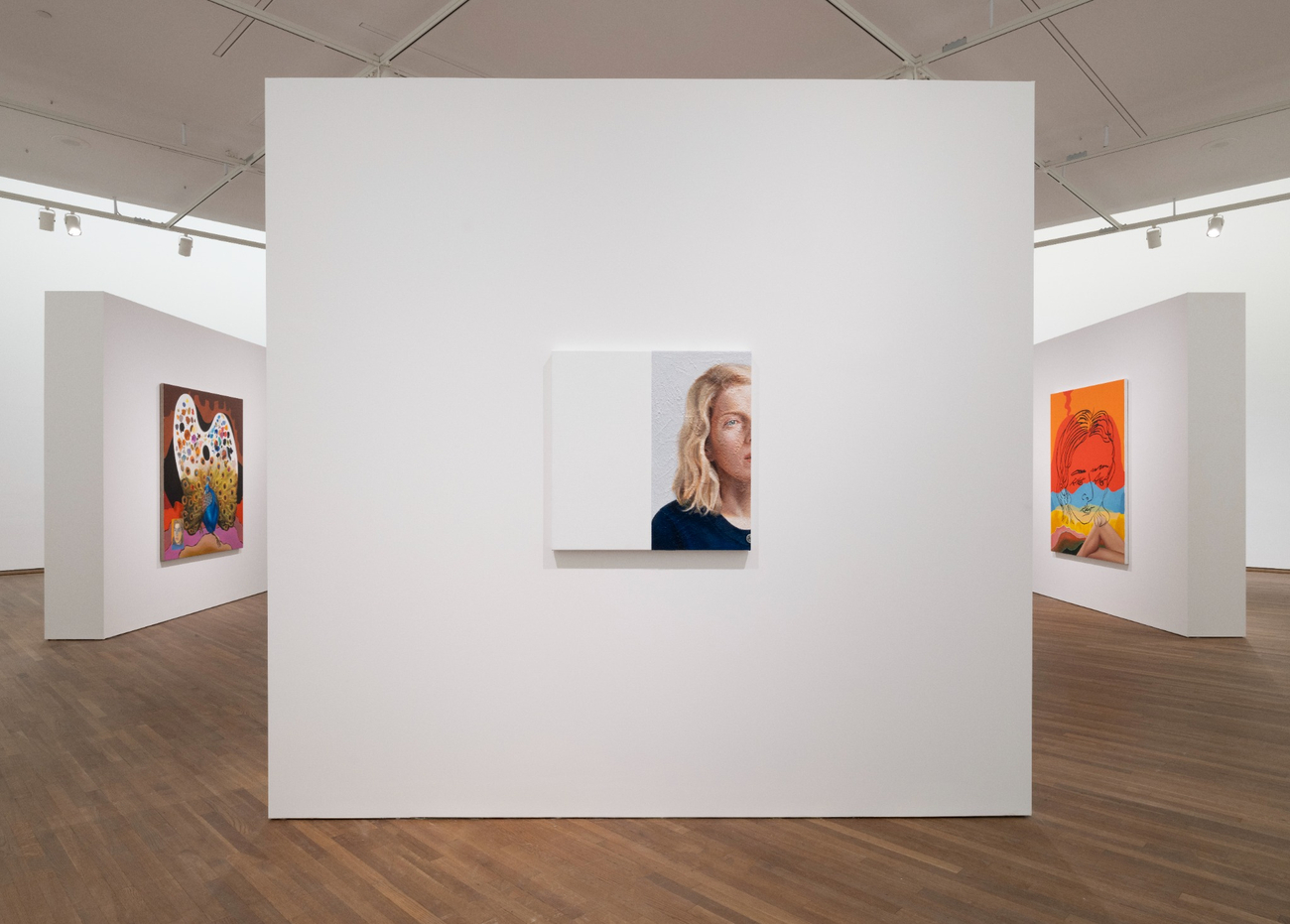
The self-portraits complicate the exchange. A Tad Naive (2023) begins with an adolescent headshot, taken when Katz hoped to act, then detours through tadpoles she watched sprout legs in a pond near her English studio. A young performer, already offering herself to an imagined audience, undergoes a second metamorphosis. In Pause (2026), a recent institutional portrait is painted on only half the face, the remainder left as blank linen, the mouth severed just where speech might emerge. Sand embedded in the painted half gives it a tactile presence the bare canvas declines to share. The photograph existed to make the artist recognizable. Katz makes that demand conspicuous and then, rather pointedly, pauses.
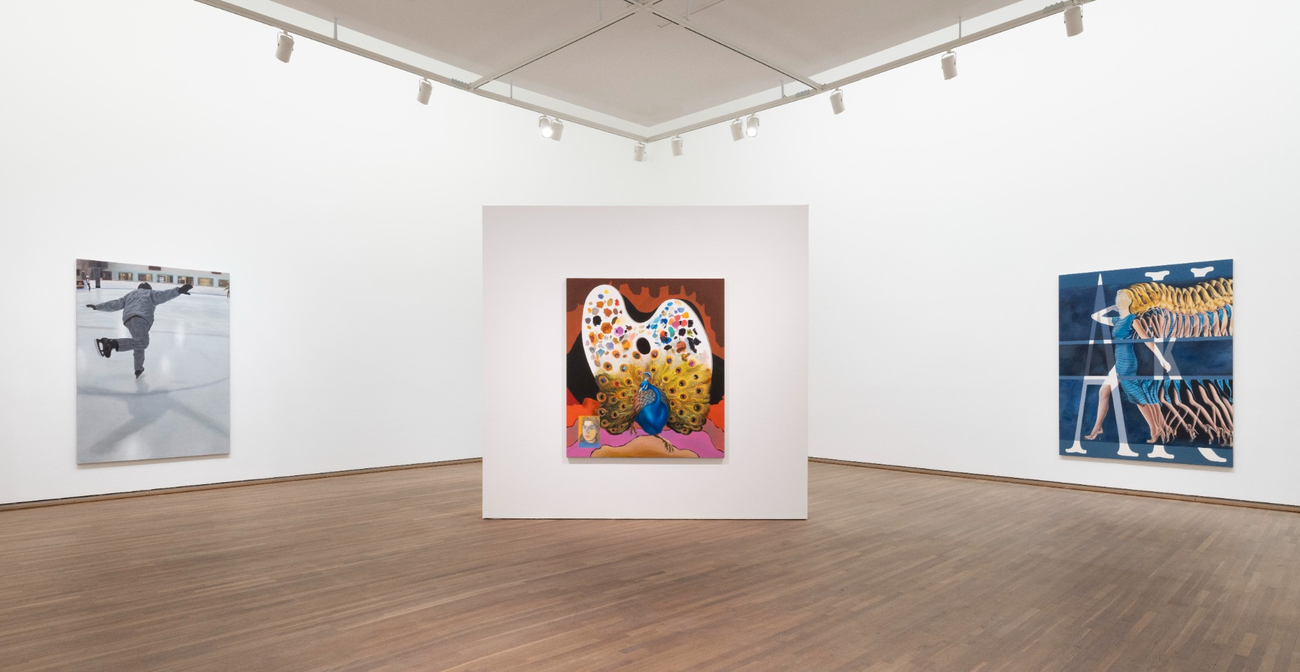
Who makes the image and who becomes its object grows more pressing in P-Cock with Portrait II (2026). Katz’s recurring rooster fuses with an artist’s palette, its open form reading as a mouth, the instrument of painting turned organ of taste. At lower left sits a life-size reproduction of a portrait of Katz painted by Susannah Phillips in Montreal in 2003, in the years Katz worked as an artist’s model. The composition threatens to swallow it. Palette and palate: the pun is more than wit. Katz cannibalizes an image in which she was once the passive subject, reclaiming it through the very activity that made her available to another painter’s gaze, though who is eating whom depends on which end of the brush you stand.
The voracity belongs as much to the viewer. Katz’s images solicit recognition through familiar conventions, then make recognition insufficient. Admission (2026) reimagines the door Marcel Duchamp designed in 1937 for André Breton’s Surrealist gallery Gradiva in Paris, a doorway cut from the intertwined silhouettes of Breton and his wife, through which visitors physically passed. Katz substitutes herself and her husband, Philip, and transfers the passage to canvas. Small marble chips embedded in the surface evoke classical sculpture and lend density to what otherwise should be an aperture but is available only to the eye.
A second pair of doors, painted from a photograph Katz took on her first visit to the museum, introduces a subtler obstruction. In Doors (The Montreal Museum of Fine Arts) (2026), the glass reflects the space behind the photographer while tantalizing us with what lies ahead. Screens and temporary barriers interrupt the view, though fragments of the hidden space survive, including a strip of what looks like an elbow poking beyond the partition. In the sharded reflection, deciding what belongs to the room beyond the glass becomes difficult to disentangle from what has been cast onto it. Hung in relation to the gallery’s actual entrance, the paintings repeat a passage that can be crossed on foot but not resolved by eye.
Uncertainty reaches its fullest expression in Katz’s serial readings of Gradiva, the walking woman of an ancient Roman relief who inspired Wilhelm Jensen’s 1903 novella and Freud’s reading of it. Jensen’s archaeologist, fixated on the sculpted figure, imagines meeting her in Pompeii, only to find his fascination has displaced an attachment to a childhood companion. The Surrealists later adopted her as a muse who could pass between dream and waking life, even naming their Paris gallery in her honor. A fragment of Roman sculpture thus acquired a literary biography, a psychoanalytic case history and, eventually, an address. Gradiva became more than her source through the fantasies of those who borrowed her. Katz, who met the figure during a research fellowship in Pompeii, enters the line as one more interpreter, and as a woman who has herself stood in the muse’s place.
Three paintings pursue her. In Catwalk (2023), a striding woman crosses a dark navy ground beside Katz’s monumental initials, A and K, set in Times New Roman, their serifed feet echoing her stride though the letters stay put. Two portraits of the artist compete: a body that may or may not be hers, and initials that identify her unequivocally while resembling nothing human. Her skin shows between the pale letters but, where they cross her, is stripped to a tabula rasa white. Behind her, the stride has already begun to multiply.
Gradiva (2024) returns to the composition through something like photographic solarization, turning colors inside out. The navy ground goes white and the pale letters go black and grey. Her skin turns electric blue, her face is nearly blotted out, and the copies trailing behind her, hair above and heels below, swell into an almost animal mass, their contours traced in shocks of orange. The body gains exaggerated visibility, while the initials, where they overlap, blacken as if oversaturated with signs.
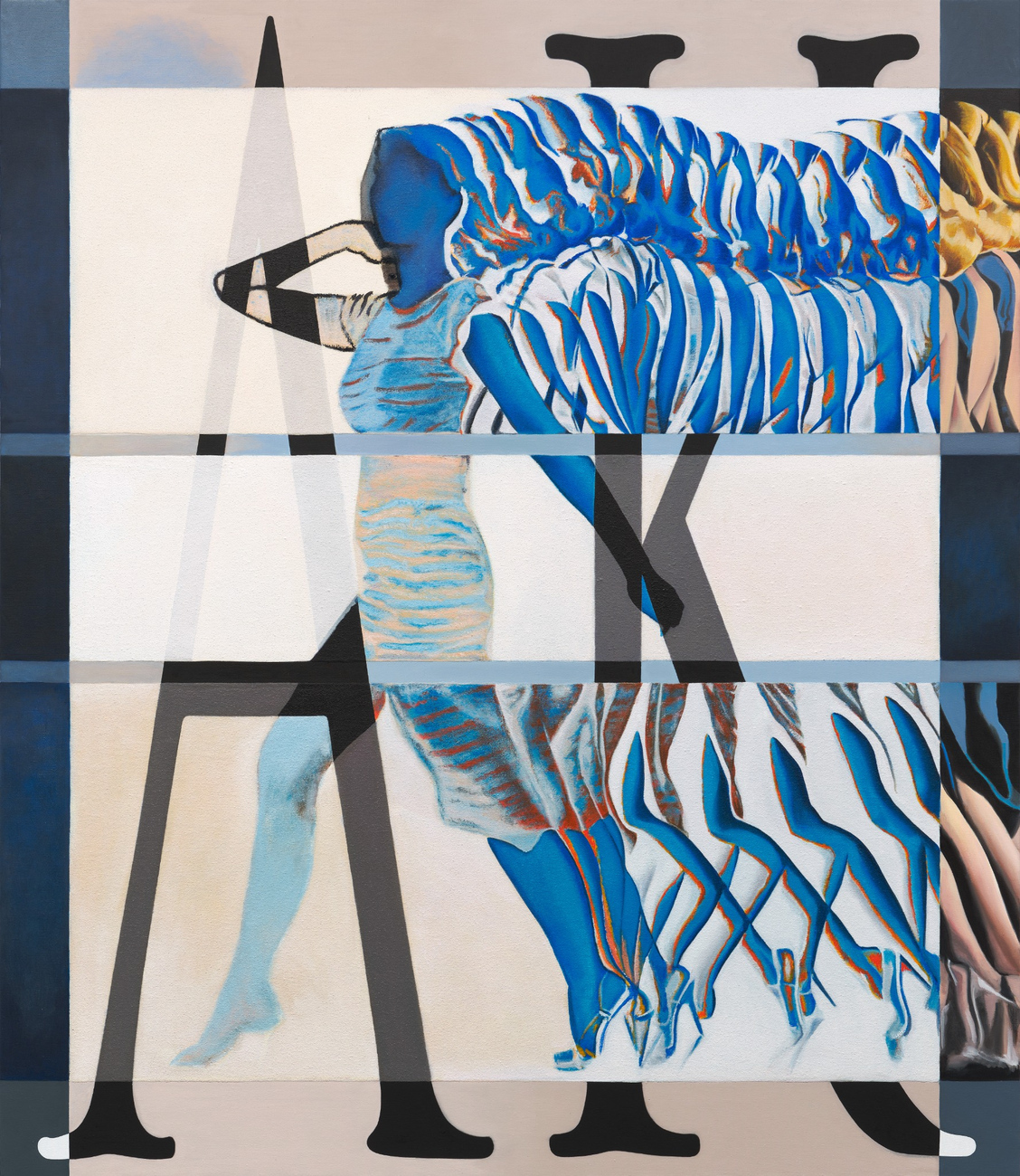
Rediviva (2026), the third, resists pinning. The ground drifts to a lilac grey and the letters to a duller one, and the figure, her blue and orange still faintly alight, seems to have slipped the opposition between the first two versions and settled somewhere between. Her repeated stride and more muted grey palette recall Duchamp’s Nude Descending a Staircase (No. 2) (1912), with the body dispersed across successive instants. Against all this grey, a raised elbow pierces the letter A in flesh tone kin to that of the elbow glimpsed beside the partition in the museum doors, as though one body had wandered from painting to painting. In both, there is enough information to infer a presence, though never to meet it. The grey is more than a diplomatic compromise between earlier versions. Of the three, it does the most justice to Gradiva’s complexity, because it concedes that representation is only that. The color has been drained of any claim to be her skin or her light, and what remains is an image of an image, bands and all.
Fittingly, it is this Gradiva who has left the exhibition’s central arrangement, reappearing elsewhere in the museum’s permanent collection, past painted doors whose tones echo hers. It looks like a passage through the imaginary doors Katz has installed, though no route can be physically traced. In Katz’s account, the muse of writers and psychoanalysts has become an artist, free to move past the images that defined her. Her autonomy, however, depends on yet another representation, as Gradiva escapes the exhibition’s eye only by walking into a new picture.
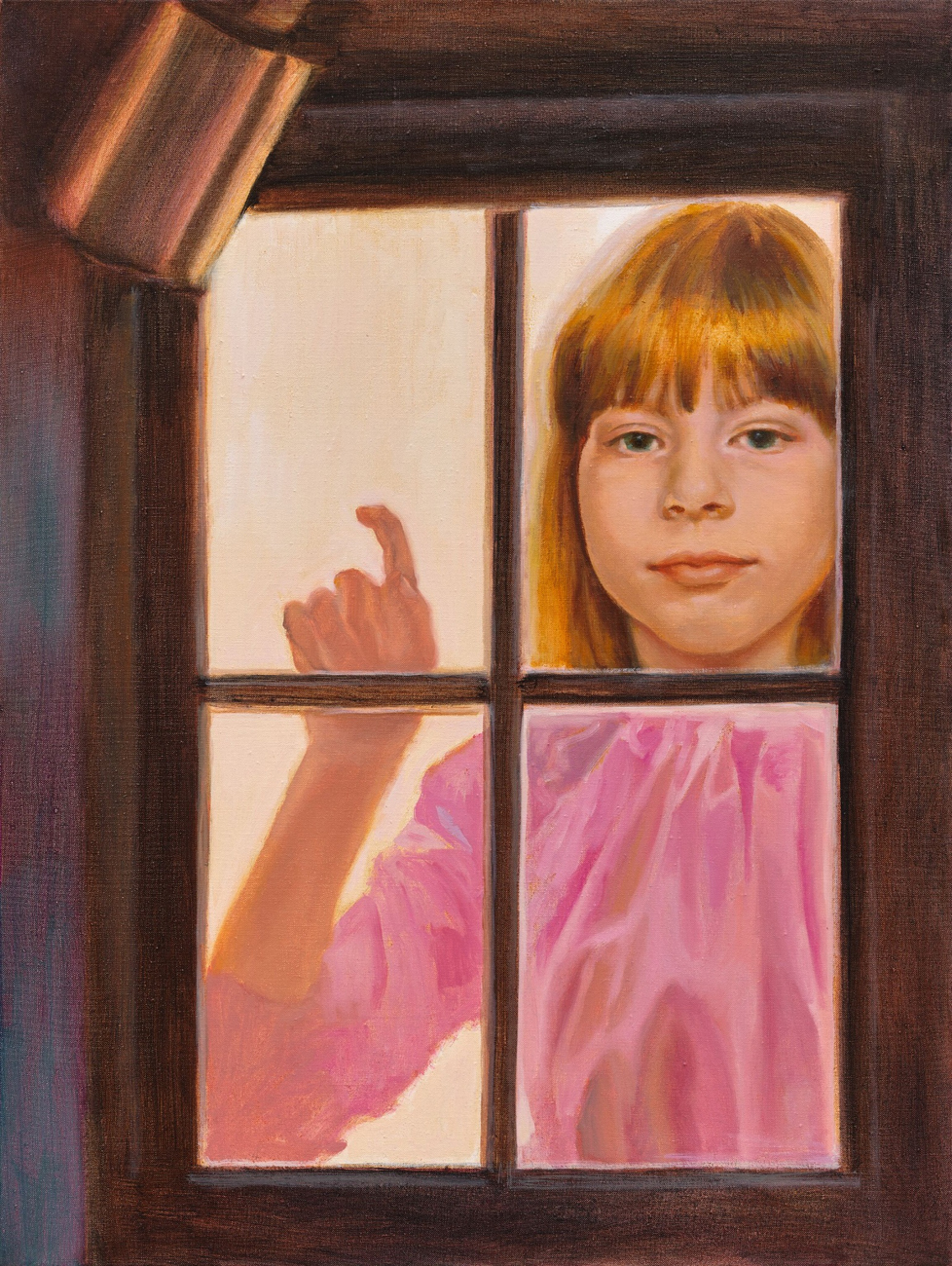
Knock (after Bloch) (2026) turns the doors around. A girl stands in a four-pane window, one hand raised to the glass, finger hooked, mid-knock. Her face, composed and faintly amused, is the most resolved passage in a painting otherwise built from loose, gestural bands of wash, the top one carrying a door hinge that echoes her copper bangs. But she looks obliquely at a reflection rather than at us, and the exchange we hoped for is deflected back onto the glass. Katz comes home, as the show keeps doing, by way of a threshold, and the knock, it seems, is not meant for us.
The appetite driving Jeu d’esprit belongs to neither artist nor spectator. Katz cannibalizes images made by others, including photographs in which she is absent or on offer to another’s gaze, and invites us to do the same through our own attempts at recognition. The paintings promise the sensation of approaching something behind their surfaces, then send us back, still hungry, to the images where the desire began.
Allison Katz: Jeu d’esprit is on view at the Montreal Museum of Fine Arts from October 9, 2026, through March 14, 2027.