

.webp)

“Thucydides Fever Dream” at Hill Art Foundation
Review
Privacy Index—a group exhibition focused on the topic of surveillance—is paradoxically situated in a storefront with large windows on a highly trafficked street in Shoreditch. Cortney Connolly, the director of LUmkA, who curated this exhibition together with Mila Rae Mancuso, described the gallery as a “fishbowl.” The structural transparency of the space invites intrusion, providing the ideal context for a conversation about contemporary ways of seeing and being seen. This exhibition, the gallery’s inaugural show after relocating from New York City to London, brings together six artists working across installation, photography, collage, and performance to explore the ever-blurring line between private and public domains.
There’s limited information about this exhibition on the internet, given that LUmkA decided not to post any high-resolution installation shots to resist data mining. This is a rather bold choice for any gallery, but especially one so new to the local art scene, when so much promotion today happens on social media. This unconventional approach redirects the audience’s attention back towards real-life interactions, while questioning the necessity of an online presence in the so-called “Information Age.”
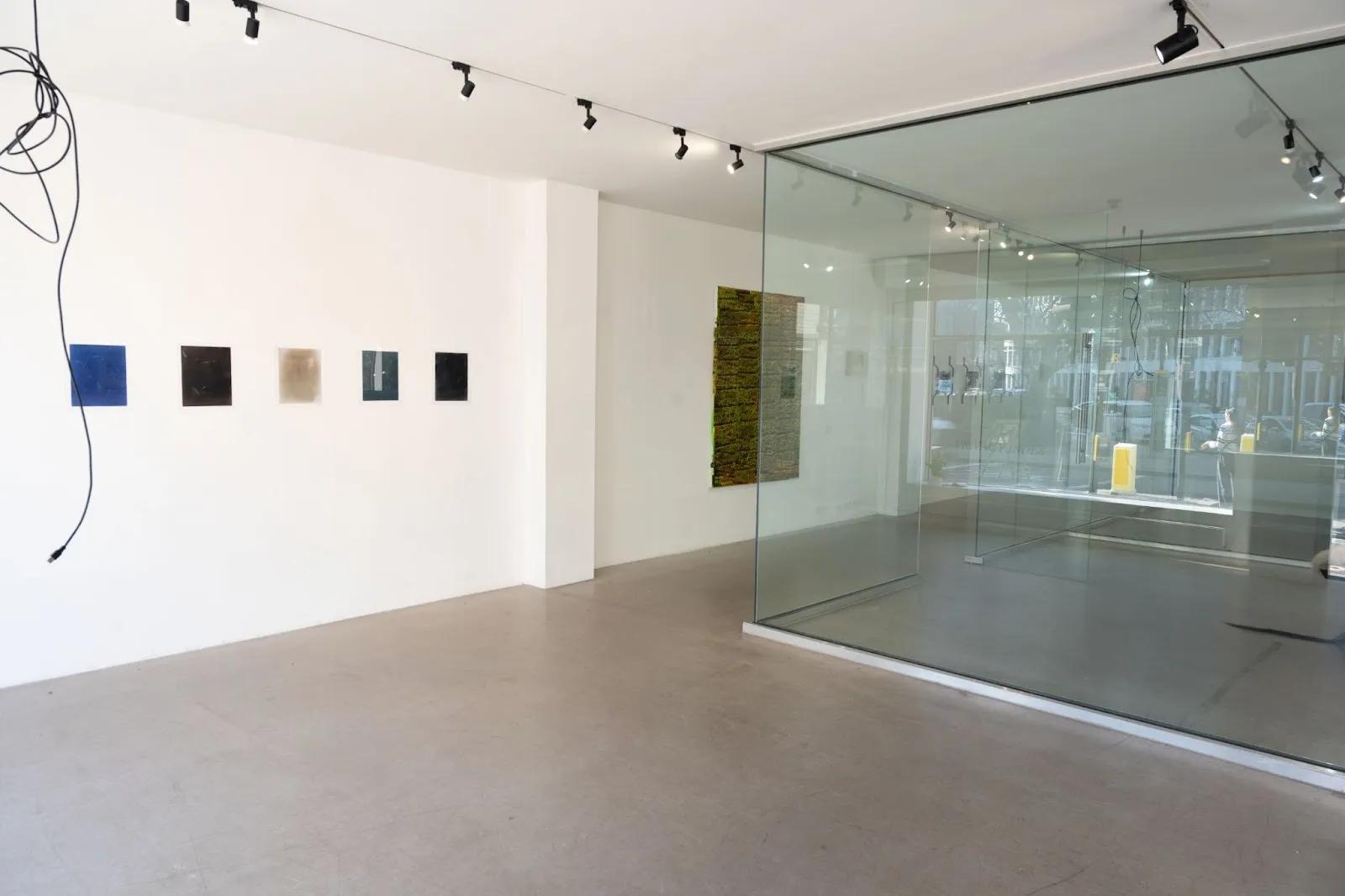
Discussions of surveillance often center on lens-based technologies. Ivo Nagel, however, thinks of himself as a photographer working without a camera. For Obfuscated (found) (2025), he sourced discarded analogue films, which he repeatedly reprocessed until the original images faded to the brink of disappearance. Through the rejection of narrative content and the embrace of chance, Nagel complicates the fraught legacy of photography as a tool of taxonomic capture. His insistently abstract visuals revel in illegibility, resisting the extraction of discernible data.
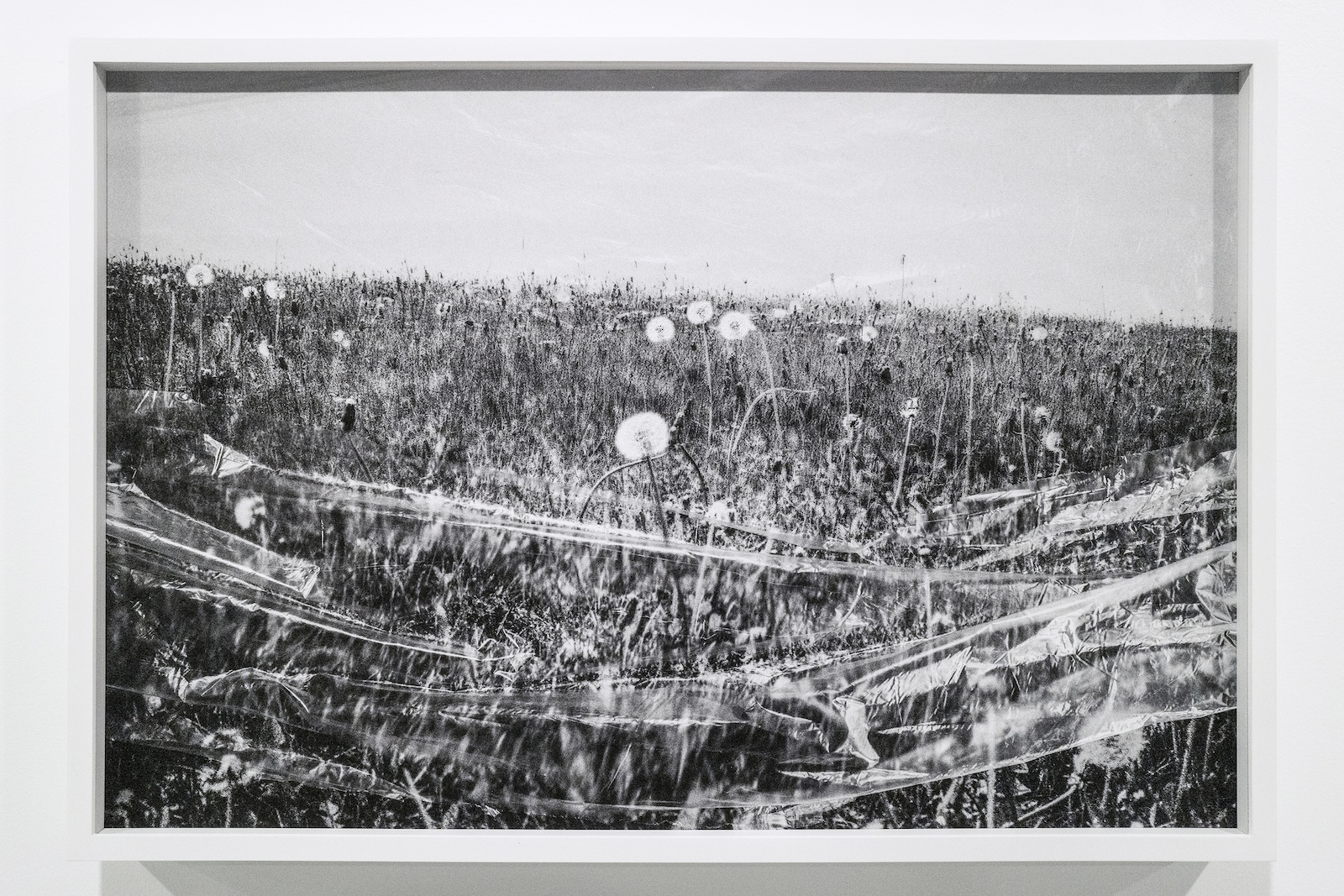
Like Nagel, Miles Scharff reengages outdated photographic techniques through his adaptation of a camera obscura for Gradient Superposition (2026), a series of black-and-white images of sparse landscapes. Drawing on his physics studies, Scharff created this contraption that passes light through one of his Magnetic Exposures—processed acrylic sheets generated by pulsing steel particles with deconstructed microwave magnets—before reaching the photographic surface. Scharff’s insistence on slowness through his durational process serves as a rejection of immediate production, circulation, and consumption of information. The resulting visuals recall that process of image-making, given how each contains a concentric rectangular frame reminiscent of a viewfinder.

Throughout the exhibition, artists challenge the authority of the camera as an ideological weapon premised on seeing as knowing. Like Nagel, Nicholas Cheveldave incorporates found images, specifically in collages that explore aerial photography as a militarized practice associated with empirical accuracy and neutrality. From afar, Summer Breeze (2023) resembles a satellite image of a green field; moving closer, though, the dense layers of the composite visual become apparent. Through collage, Cheveldave disrupts the format’s encoded promise of visual accessibility and, therefore, control.
The inclusion of not just photography but a range of media lends crucial dimensionality to this exhibition. James Hoff presents three of his “USB Dead Drops,” each an installation consisting of a USB cable hanging from the ceiling that connects to a hard drive containing breached password information. Visitors are invited to connect their devices and access this information, though many without USB-compatible devices are unable to partake. This limitation functions as commentary on technological obsolescence. The use of physical cables simultaneously serves to bypass potential surveillance and safeguard information, while calling attention to data mining.
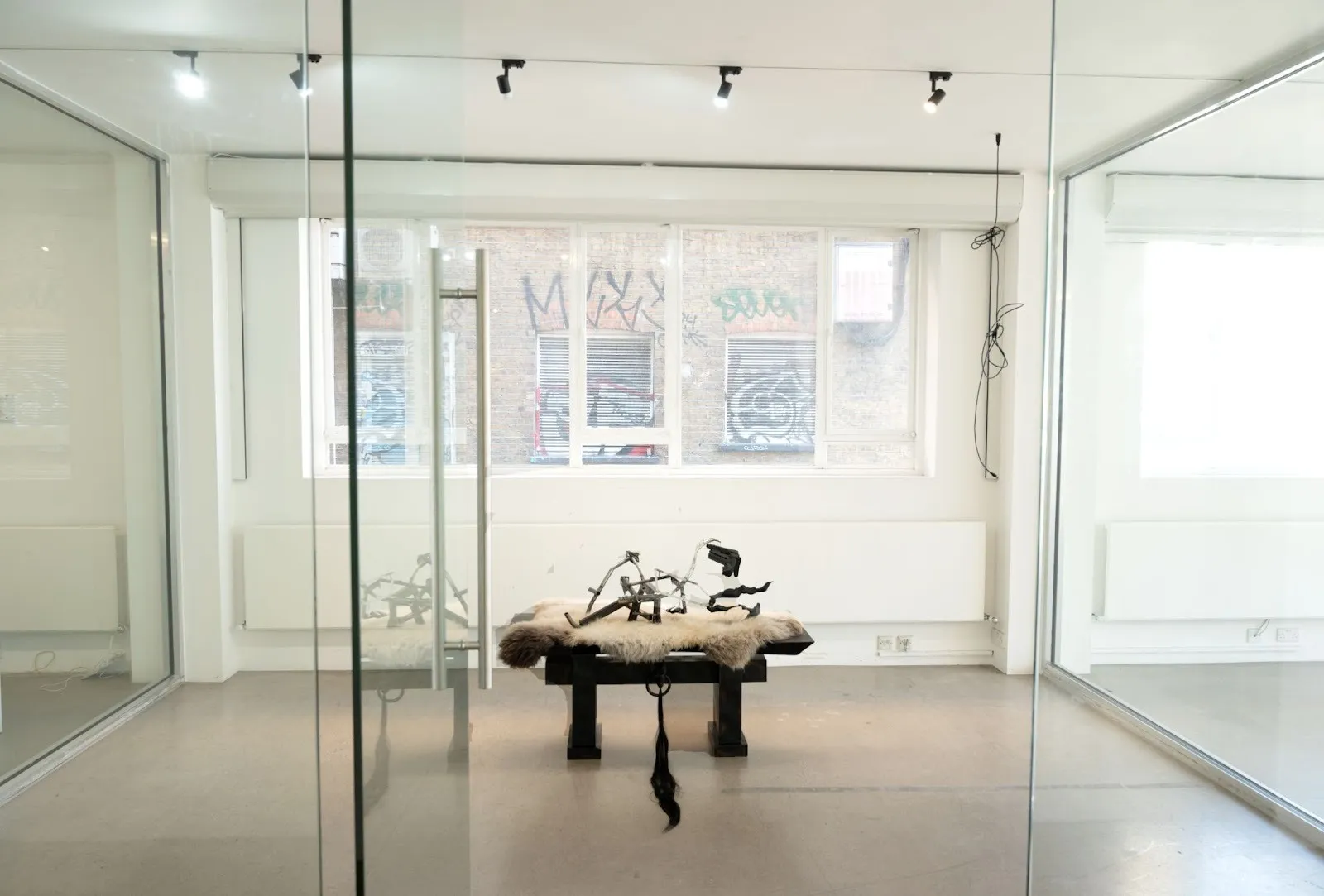
Where most works in this exhibition underscore the external imposition of surveillance, Ruby Chen’s kinetic installation explores the internalized monitoring ingrained by a panoptical society. Archive Fever (2026)—which recalls Jacques Derrida’s book of the same name—is situated within a glass-walled room, a sort of smaller, concentric fishbowl within the fishbowl-esque gallery space. On top of a steel table modeled after a Japanese Torii gate, a mechanical arm rests on a fur blanket like an animal skeleton on its skin. The bionic form is programmed to perform a looping motion, as if crawling inward through its own remains. The installation is reminiscent of an altar enacted within a transparent temple, providing a sense of ritual. Chen offers perspective on the piece in an interview included in the exhibition catalog, emphasizing how the awareness of observation leads to the performance of manufactured identity. Through this compulsory, repetitive digging motion of the mechanical arm, she attempts to recreate the intense experience of being watched, and the accompanying pursuit of authenticity. By Chen’s logic, once self-surveillance is ingrained, it becomes very hard to abolish. Therefore, the inward digging simulates a search for an elusive, unrecoverable state.
Privacy Index is ambitious in tackling the endlessly vast and progressively complex topic of surveillance. This exhibition offers up a rich entry point, inviting the audience to re-examine the various forms of seen and unseen surveillance that shape contemporary life, engaging conversations that have become increasingly urgent.
Privacy Index is on view at LUmkA, London, from March 19 to April 11, 2026.