.jpg)

.webp)
REACH OUT, TOUCH GRASS
Voice
I’ve frankly never cared for LEGOs because I don’t understand the point of making something that already exists. The marketable LEGO object is not primarily an MOC (a packaged acronym that stands for “my own creation”), but a predictable reproduction of what’s on the box: a small simulacrum of an architecturally significant building, a scene from a movie, a landscape, an animal, a toy, or even a famous work of art. For the most part, it seems, that’s what people want to see.
This premise maps onto what many critics bemoan as the sad state of the contemporary art world; everything has supposedly been done, with Hilton Als’s “anxiety of influence” wielded in the New Yorker like a cudgel against a younger generation’s purported unwillingness to engage with “the Borgesian labyrinth of perception and history.” Well, the stereotypical territory of maturity is a certain resigned melancholy—Als is right about that.
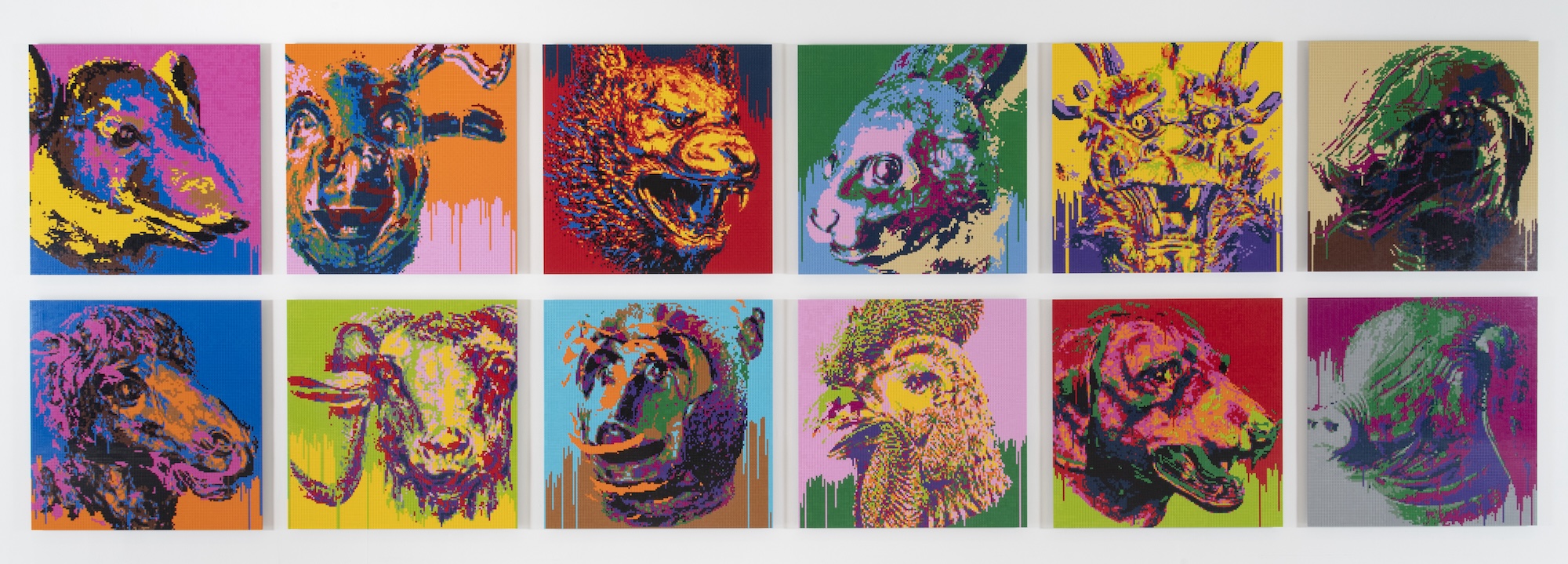
In Ai Weiwei LEGO Story at CART Department, the medium of the brick proves particularly plastic in an innovative, unconventional environment. A graphic Zodiac series first exhibited in New York by Jeffrey Deitch at the 2019 Armory Show references the artist’s own bronze Circle of Animals/Zodiac Heads (2010), recursively engaging the 18th-century fountain—a commission from Giuseppe Castiglione for the Qianlong emperor’s gardens that was partially looted by Anglo-French soldiers in 1860, about a century before Mao Zedong’s Red Guards would go on to commit similar destructions of cultural history in a bid to eradicate the “Four Olds” of feudal society—upon which Ai’s 2010 sculptures were based just as it replicates 1990s glitch aesthetics through analog matrices. These colorful, digestible, seemingly straightforward works are the sedimentary product of multiple layers of conceptual, historical, and personal information. Like the best pieces of Pop Art, they are simultaneously pleasant and subversive; altogether effective.
But Ai’s most affective LEGO “paintings” are explicitly “after” someone else. In Untitled (After Mondrian) (2020), Ai deftly connects LEGO-based exercises in physical pixelation with De Stijl spatial organization: the linear grids by which Rosalind Krauss defines modernity in her eponymous 1979 October essay. Though Krauss labels the modular screen a withdrawal from the “real,” it is the grid’s very retreat that enables its “impossible” integration of scientific precision with the ineffable spiritual dimension.
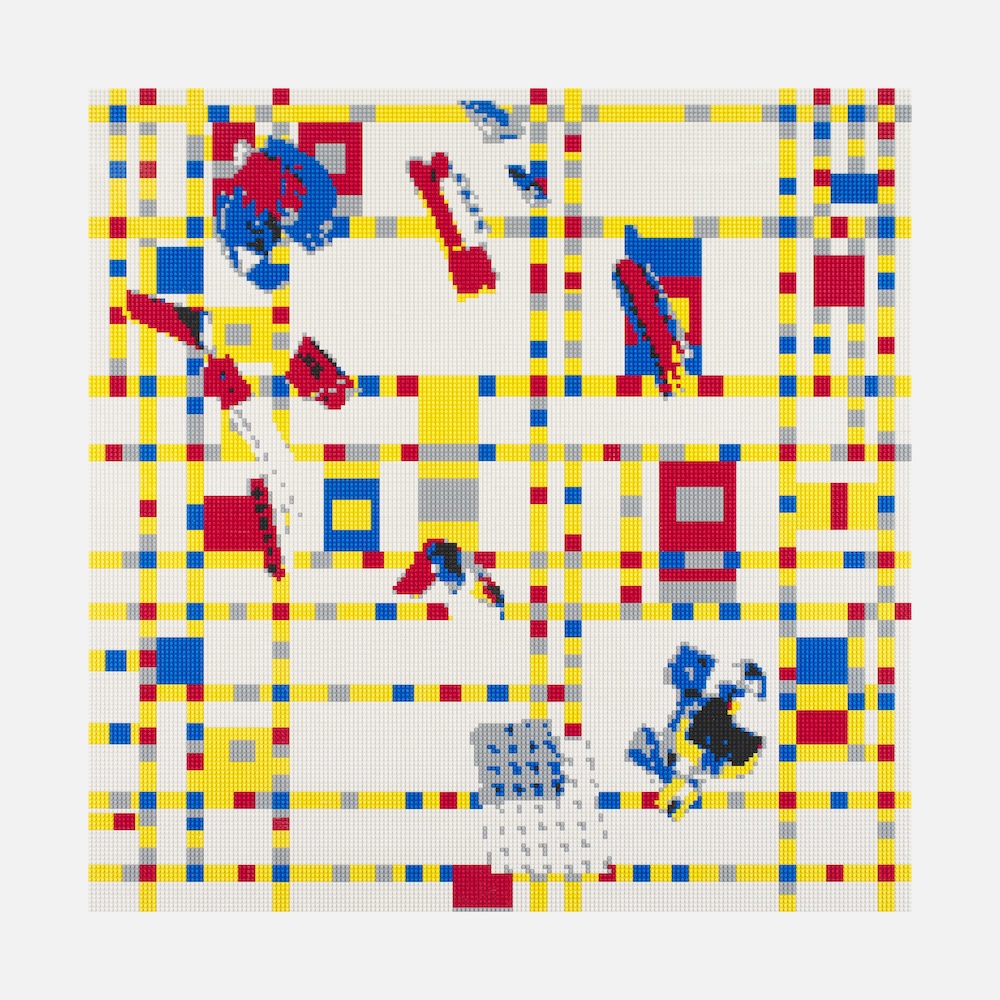
When Piet Mondrian landed in New York—fleeing the Nazi regime like so many of his contemporaries—he recognized his own geometric Dutch sensibilities in the architecture of a city once established as the center of New Netherland. But the improvisational, mathematical meanderings of syncopated blues that had travelled up from the Deep South pushed his work in a different direction: one more suggestive of motion, reminiscent of his earlier grayscale forays into Neoplasticism. The pulsing, blinking, proto-digital rhythms of Broadway Boogie Woogie (1942–43) guide the ruptures in the pattern of Untitled (After Mondrian), though the images of ambiguous objects that defy Ai’s Mondrian grid appear as if falling from the upper-left-hand corner of the composition: scattered, exiled, abject. The grid functions as a structure that enables hybrid systems of meaning; paradoxically, it does so through limitation and repression. It imposes horizontal and vertical parameters, borders, and obstructions.

The centerpiece of Ai Weiwei LEGO Story is LEGO Car (2015): a canvas-white BMW 5 Series sedan filled with disassembled LEGO pieces. In this setting, auxiliary piles on top of and beside the car establish an illusive effect of bricks spilling over. Though the vehicle functions as a successful container, it appears futile: a medium struggling to hold a message in the face of accumulated information.
“All of the world is in a kind of war. But I think none of it is hopeless,” Ai remarked on a panel launching this exhibition, shortly after expressing a certain apathy toward his medium’s capacity for communication. If we’re stuck in the doomscroll—the perceptual, terminal downward spiral—then so is art, and so is life. As Frank Stella said, “What you see is what you see.”
The year 2026 is certainly not the first time that “everything has been done.” It is far from the first time that governments have committed atrocities and limited expression. In the wake of World War II, similar feelings generated a series of avant-garde movements that would shape the face of modern and contemporary art.
In 1963, five years after the signature brick was formally patented, the Italian Neo-Dadaist writer-artist (and cofounder of Arte nucleare) Enrico Baj was among the first to work with LEGOs. Baj was Marcel Duchamp’s friend and collaborator; unlike the more detached Duchamp, he weaponized his freeform use of readymade plastic consumer objects in satirical salvos against established political and economic systems. Rendered in a LEGO-dominant collage mounted onto a slipcase, the cover of Baj’s artist book La cravate ne vaut pas une médaille (1972)—The tie does not warrant a medal—questions arbitrary applications of power, prestige, and authority.
Baj faced domestic censorship on the basis of his playfully anti-fascist work, which responded directly to then-current events like the death of Giuseppe Pinelli, a fellow Italian anarchist who met a mysterious end in police detention. Even at the time, however, this art was shown internationally.
Ai Weiwei, on the other hand, has been censored both in China and in the “free West.” In 2023, Lisson Gallery cancelled the artist’s London exhibition (only a few days prior to its scheduled opening) after Ai, a vocal advocate for Palestinian freedom, tweeted: “The sense of guilt around the persecution of the Jewish people has been, at times, transferred to offset the Arab world. Financially, culturally, and in terms of media influence, the Jewish community has had a significant presence in the United States. The annual $3bn aid package to Israel has, for decades, been touted as one of the most valuable investments the United States has ever made. This partnership is often described as one of shared destiny.” Ai deleted the tweet.
As an American of Belarusian Jewish descent whose ancestors once fled ethnic persecution, I don’t read that statement as anti-Semitic. The Jewish people do not constitute a monolith synonymous with the project of the Israeli state any more than we’re capable of the collective agreement—regardless of our cultural contributions, which are significant—necessary to pull off the massive financial conspiracy of which we’ve been accused by the far-right. Ai has become much less openly political since this incident. Who could blame him for a lack of faith in communication?
A current of self-negation—most apparent in the hybrid performance art/photographic triptych Dropping a Han Dynasty Urn (1995)—has always run through Ai’s work, which has also been characterized by a punk rock sense of humor and disregard for hierarchies. It is perhaps emotionally difficult for the artist to square that natural impulse with works that directly reflect the dominant imagistic texture of their time: smoothed, controlled, and optimized. Compared to lossier pieces like The Last Supper in Green (2022), in which Ai casts himself as Judas, the “paintings” in Ai Weiwei LEGO Story are more legible. The looming shadows of his personal history that appear in other LEGO works (e.g. the dugout to which Mao’s regime exiled both Weiwei and his father, the poet Ai Qing; Vincent Van Gogh’s crows swapped out for surveillance drones) are mostly absent.
Or are they?
The artist appears semi-nude in the background of Untitled (After Munch) (2020): a straightforward copy of The Scream (1893) that includes a lighthearted reference to his 2010 Chinese pornography charges. In bricks, it looks like he’s wearing a diaper.
But in Untitled (Van Gogh) (2020), Ai superimposes a news photograph of a 2019-2022 plague of locusts in Pakistan over a composition very loosely inspired by Van Gogh’s Le Semeur au soleil couchant (1888). Van Gogh was himself working in the vein of Japanese woodblock prints: available, exported images of a “foreign East” that technically simplified but conceptually complicated his painting as he flattened colors into planes and, downstream of the similarly Japanophilic Impressionists, compressed movement into brushstrokes—anticipatory gestures toward pixelation—rather than adhering to the academic realism of mainstream European rendering.
Le Semeur is a well-chosen model; Ai’s constituent images share a futile melancholy. Together, somehow, they produce a sliver of hope. Van Gogh’s original painting implicitly casts the artist as a dutiful sower toiling away under a setting sun. It is only due to his posthumous fame that we know the story of his painful life in poverty and obscurity: romantic in notion, brutal in reality. In my view, Ai has improved upon the original. Instead of copying it, he carries it forward. In his version, the sower-artist—trapped under a superimposed screen of geopolitical turmoil and environmental degradation—is blurred into a ghostly void: an absence, an erasure, a vanishing memory. Yet this absence is still “impossibly” present and beautifully visible.
The strongest “paintings” from the After series can best be described as poems in translation. As in Untitled (After Mondrian), the artist migrates the feeling of the original work across time, though the valences of its meaning change through his eye and in his context. Creating an artwork “after” someone is an explicitly dedicated exercise in empathy. The lineage of art history is that of human expression and emotion.
Ai, who grew up reading only the government-sanctioned comic books to which he had access, received his formal training in animation. It’s unclear if he deliberately designed his LEGO works to demonstrate the expressive potential of graphic and digital interfaces—which, downstream of Krauss’s fundamental grid, can easily and simultaneously display hybrid, even contradictory images of reality and simulacra alike—or if those visual vocabularies entered his lexicon through the osmotic realities of living.
Is it necessary for an artist to disclose their influences and intentions? Isn’t that discursive discovery process the job of the critic, the theorist, the art historian? The job of a patron, like that of a curator or a proper gallerist, is to steward the preservation of these surrounding narratives, the preservation of the artist, and—by extension—the preservation of a historical record communicated through the artist’s distinct and irreplaceable vision.
Ai Weiwei is not someone who doesn’t care. He cares deeply, often too much and at his own expense. He has spent decades putting his mind, body, and name on the line in protest of injustices around the world. He’s a political activist, but he’s also a person with a young son. Perhaps his methods are simply changing. Like his father before him, he’s sacrificed much of his life in service of his message; he has a lot, himself, to live for.
If you’ve seen me recently, you’ve heard me express my own lack of faith in the power of my primary medium: language, particularly the written word. As with many jobs, writing—especially the copy that proliferates across publications’ social media platforms—can be done for free by artificially intelligent chatbots. Fighting for the remaining scraps of readers’ tattered attention spans feels like a losing battle.
This is not an inaccurate view of the world, but it’s not particularly productive. So, more recently, I’ve reframed my perspective.
Lars von Trier’s experimental 2003 documentary The Five Obstructions follows the famously provocative, questionably ethical director as he alternately wheedles and psychologically tortures Jørgen Leth, his artistic hero-turned-muse, into remaking von Trier’s favorite film The Perfect Human (1967) five different times, under five different series of artificially imposed rules. (The remakes, often transposed into different cultural settings, are excellent despite—or as a result of—Leth’s occasional "failures" to obey said rules.) Von Trier was not a hypocrite in his strict application of guidelines; at the time, he made his own films under rigorous constraints as part of the Dogme 95 movement he cofounded, which aimed to democratize his industry by legitimizing accessible means of cinematic production.
Censorship, market demands, and the associated limiting containers of algorithms and attention economies establish their own kinds of parameters. As with the grid or the chessboard, these frameworks and pressures can produce instances of transcendent innovation (c.f. Baj, Duchamp). There are always new games to play. Still, in the art world and the real world alike, it’s important to remember that the rules are constantly shifting.
On April 12, 2026, Hungarian voters democratically ended Viktor Orbán’s sixteen-year far-right reign in the wake of a carefully visually curated campaign run by opponent Péter Magyar. (Magyar, a conservative liberal, referred to the changing of the guard as “absolute cinema.”) On April 30, 2026, the members of the Venice Biennale jury collectively resigned in protest of what late curator Koyo Kouoh termed “the spectacle of horror,” in accordance with their stated refusal to consider nations (Russia and Israel) whose leaders are currently charged with war crimes under the auspices of the International Criminal Court. The Golden Lion has been replaced with “Visitors’ Lions” upon which attendees vote. Like most institutional actions, these motions are imperfect (To what extent are silent artists—and civilians—complicit in the decisions of their state? Does verbal silence constitute political silence? Does this count as jury duty?) and image-forward, but they’re also not nothing. On May 8, a cultural workers’ strike for Palestine shuttered the Arsenale. As of May 9, almost half of In Minor Keys’ international artists and sixteen national pavilions have withdrawn themselves from awards consideration. One battle “after” another.
Art is not inseparable from politics, just as appearances are not inseparable from reality. Though images have the capacity to shape people’s minds, things only change if people care enough to change them. This is the kind of moral taught in children’s books and superhero stories, but it is also true.
In 2015, the LEGO corporation refused Ai Weiwei’s bulk order of bricks for Letgo Room, a site-specific installation at the National Gallery of Victoria plastered with self-captioned portraits of activists, on the basis of political neutrality. With the help of museums, galleries, and a social media campaign that inspired worldwide LEGO boycotts, the artist was able to crowdsource fan-donated materials—which, at various sites, were collected and transported in white BMW 5 Series sedans—that produced the collaboration Untitled (Lego Incident) shown at London’s Design Museum in 2023. (Ai ultimately constructed Letgo Room with knock-off pieces made in China as part of his own conceptual meta-boycott.) In 2016, LEGO’s vice-chairman labeled the rejection an “internal mistake” and implemented a “don’t ask, don’t tell” policy regarding future customers’ intentions. There really are INFINITE POSSIBILITIES™!
Is this the moral of Ai Weiwei LEGO Story? It’s “impossible” for me to know for sure, but I’ll tell you what I see. As with most of Ai’s conceptual experiments, these “paintings” reveal a fundamental truth of making art. In painting—as in filmmaking, writing, LEGO construction, and even life—under an artist’s hand, there are no mistakes, only happy accidents. You roll with the punches. In any case, you can tear it down and start again.
Ai Weiwei LEGO Story was on view at CART Department from April 23 to May 3, 2026.