.jpg)

.webp)

“Thucydides Fever Dream” at Hill Art Foundation
Review
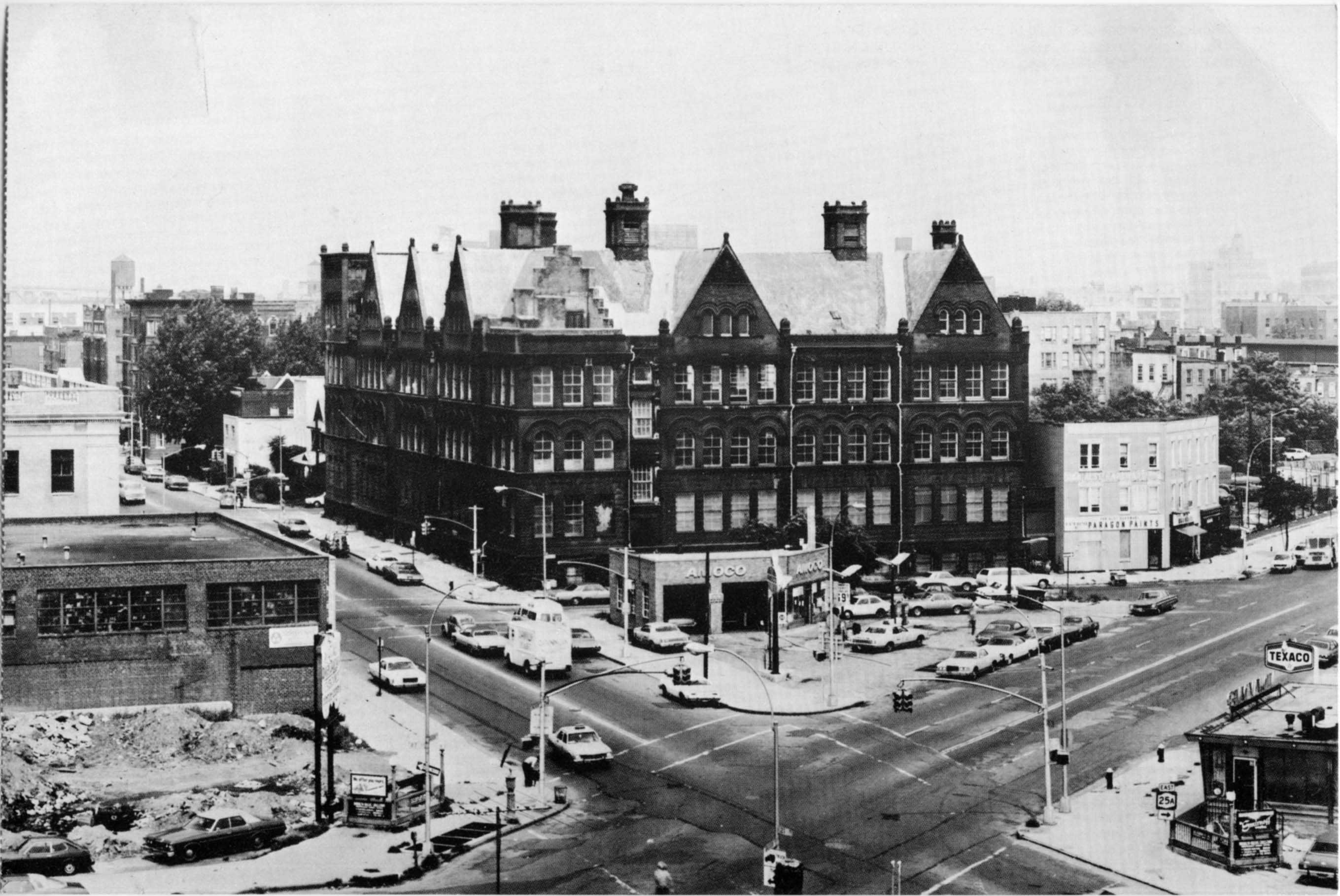
Mulberry Bend at Immigrant Social Services’ Storefront for Ideas, curated by Dylan Seh-jin Kim and presented by Protocinema, is an exhibition of process-oriented practices engaged in the history of development and labor in lower Manhattan, asking how an art exhibition can materially shape public life. Mulberry Bend refers to the curve of Chinatown’s Mulberry Street, made infamous by Jacob Riis, that developed atop the polluted remains of Collect Pond, where unstable ground and overcrowded tenements shaped successive waves of immigrant life alongside the notorious prison known as The Tombs. Today, 124–125 Baxter Street, directly behind the ISS Storefront, is the site of a new borough-based skyscraper jail, drawing protest from the Coalition to Protect Chinatown and LES. Appropriately sited in a community space, the show negotiates art’s impact on the neighborhood, both as a driver of extractive development and as a response to it. Canal Street Research Association (CSRA)’s provisional office space, constructed of wood planks and cinder blocks at the center of the exhibition space, conveys one core provocation of the show: it models a parasitic exploitation of liberal cultural politics that suggests art is most useful to political ends if understood as a network of resources to be mobilized, not an autonomous sphere.
CSRA occupies the exhibition space to stage a temporary redemption center for canners, offering double the standard five-cent rate set in 1982. With artist Siyan Wong and organization Sure We Can, they will hold a press conference to support the “Bigger, Better Bottle Bill,” currently in Albany with state lawmakers, to make this rate increase permanent. The project calls to mind Laurie Jo Reynolds’s “Legislative Art” for its being “art” only nominally.
Adorned with reclaimed wool “shoddy” and gestural pushpin maps of the historic Collect Pond’s waterways that link sedimented histories of the neighborhood’s informal economies, the office structure’s modularity and cheap materials capture CSRA’s strategy of resilience-by-itinerancy. Their use of the show as occasion and infrastructure for social intervention echoes the way they have accessed previous spaces through strategic misrecognition as artists, jumping from site to site as conditions demand. This itinerancy, somewhat a matter of necessity, stages a tactical relation to the resource networks channeled through art and its codependent partner, real estate development. In using art as a host structure, they parasitically exploit its institutional legitimacy to convert cultural recognition into material support for political and social projects that exceed art’s representational operations.

David L. Johnson’s Loiter (John A.), a group of standpipe spikes reinstalled as sculptural works, similarly plays on the contradictions of art’s liberatory rhetoric and its property relations. Their reification as works of art undo their engineered invisibility as hostile architecture and effectively amplify their brutality. Even more, the practice that yields them requires Johnson to adopt genuine risk in the eyes of the law, an anarchist insistence on seizing power through the means available now. His transgression ruptures the privileged sphere of art as an autonomous field separate from reality, asking the audience to not only attune themselves differently to the architecture of daily life, but to confront their relationship to criminality and risk if we are to actually dismantle the structures we so fluently critique.
Together, these works flip the coin of art and its elsewhere. They pass in and out of elective presentation as art, and in moving over this threshold elucidate the needs, affordances, and values that direct each sphere. In this way, they offer an out from the familiar questions surrounding social practice. The impulse to adjudicate art’s political efficacy fails us by taking the very category of art as self-apparent and allowing its market liberalism to circumscribe the work captured in its field of influence. Increasingly, we know that culture cannot do what we want it to do, but how do we work from within our present reality? For those of us who do cultural work, CSRA and Johnson show that what is needed comes down to a materialist analysis of cultural industries as apparatuses of economic and discursive power, which can inform tactical engagements with them, aligned with unfolding action far beyond the capture of art.

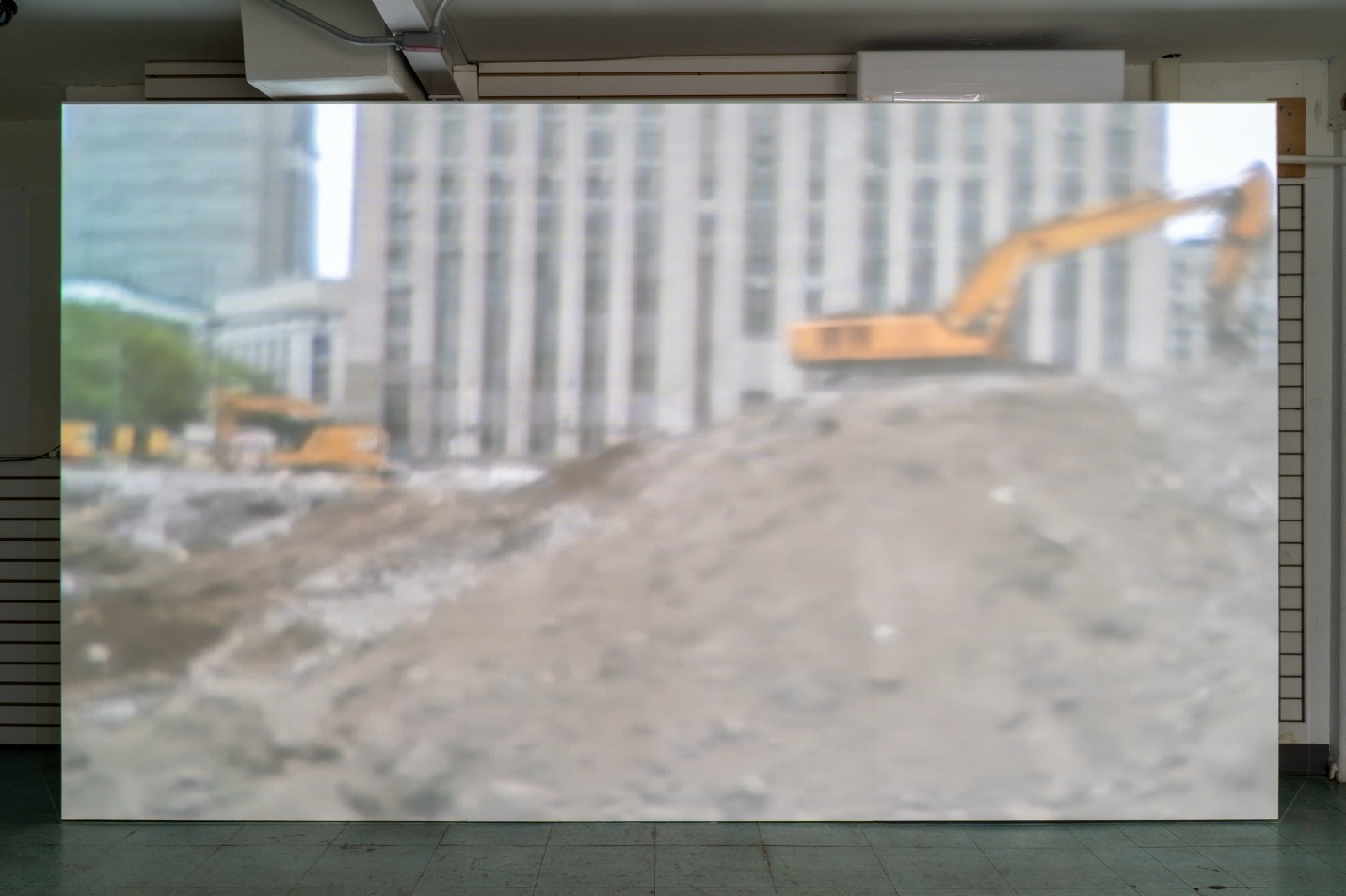
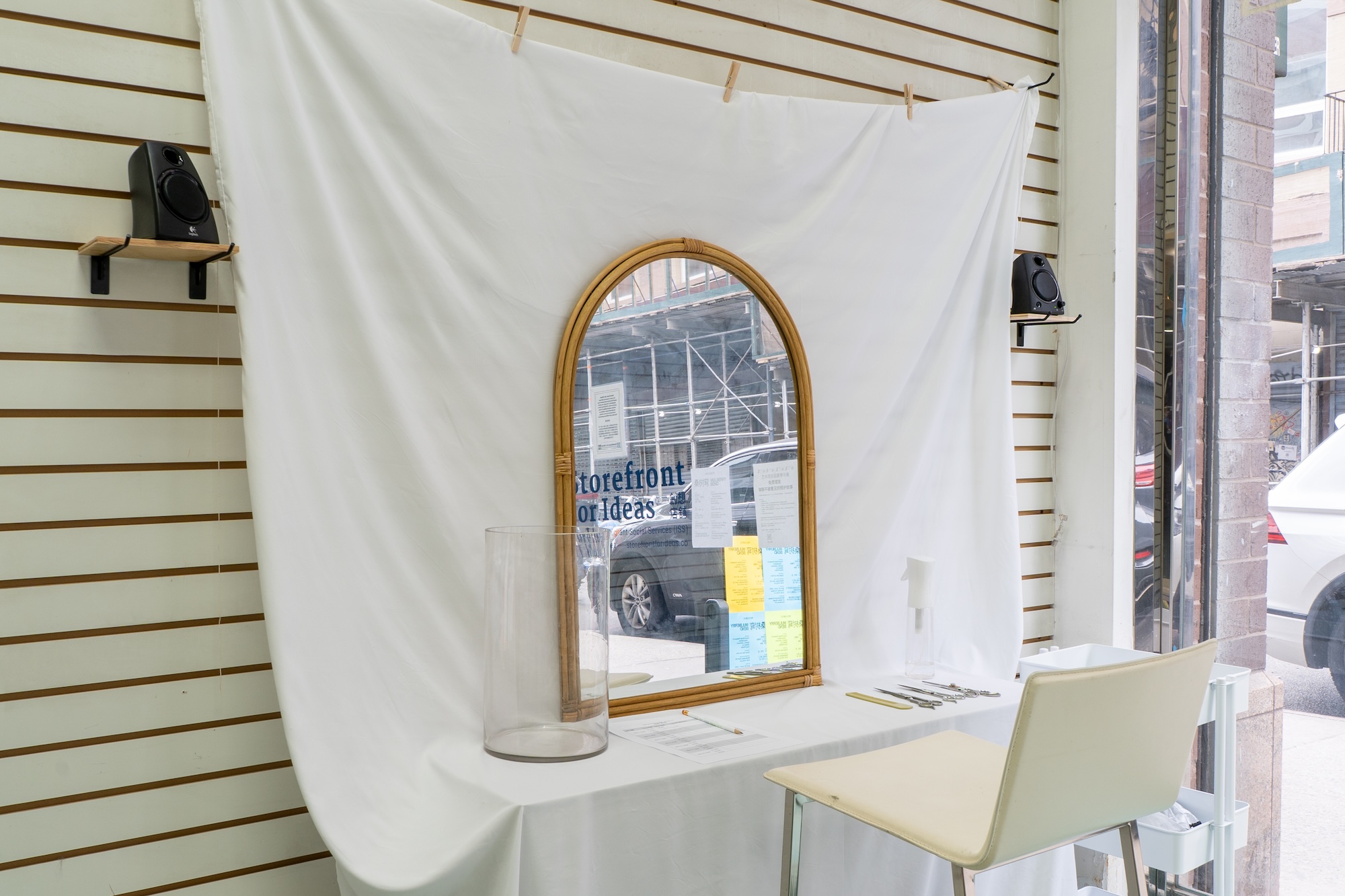
The show is bookended by Sidian Liu’s episodic performance on invisible caretaking labor, 照拂 reflect/brush, and Paul Pfeiffer’s Perspective Study, a life-size live feed of the megajail construction site on the other side of the Storefront’s back wall, accompanied by plastic chairs salvaged from the former detention center’s visitor waiting area. In 2021, with fellow members of Asian American artist network Godzilla, Pfeiffer withdrew from their retrospective exhibition at the nearby Museum of Chinese in America over the museum’s acceptance of arguably concessionary city funding after the jail project’s announcement. A materialization of long-term, ongoing engagement with the site, Perspective Study inverts the jail project’s artwashing by making its presence unescapable, something like “politicswashing” the art show. At the same time, for all of the committed, impactful community engagement enacted within the exhibition—not least of which includes Liu’s intimate oral histories and free haircuts for caretakers—Perspective Study does communicate the horrifying persistence of the jail project in spite of it all, an honest acknowledgment of art’s limits.
Through their processual temporality and evasive spatial operations, which modulate visibility against the cruel demand of demonstration, the practices represented in Mulberry Bend show us how a parasitic orientation to art’s provisions generates new aesthetic literacies and strategies beyond the representational. It likewise demands a more expansive temporal framework in its analysis: one that considers the ongoing project of thought, durational engagement, and action over time that these practices enact. This is the time it takes to conduct deep study, build relationships, or organize, which far exceeds the fast capitalist consumptive model of spectatorship proffered by revolving door exhibition cycles.
The alternative literacy demanded by social practice implicates the attendant apparatuses of circulation and discourse as well. As a form inherited from cultures of patronage and collecting, the exhibition apparatus demands particular kinds of legibility organized around passive, consumptive spectatorship. At the same time, an exhibition is not merely a gathering of objects, but represents funds, labor, tools and space, social connections, and time dedicated to certain practices. What are alternative ways of sharing or bringing people into practices like those in Mulberry Bend, or directing resources in their support? Likewise, can the capsule exhibition review, as a key unit of criticism, ever account for the complexity and ever-unfolding nature of this kind of work? Perhaps the show, like this review, is compromised from the start by the forms we inherit to carry them out. Mulberry Bend prompts us to think about these compromises and contradictions, and to look beyond the conventional remit of art in negotiating them.
Protocinema is a non-profit arts organization that collaborates with artists and institutions to create artworks exploring the shared human experiences. Mulberry Bend is on view at ISS Storefront for Ideas (127 Walker Street, New York) from April 30 to June 7, 2026.