

In Conversation with Noorain Inam
Interview
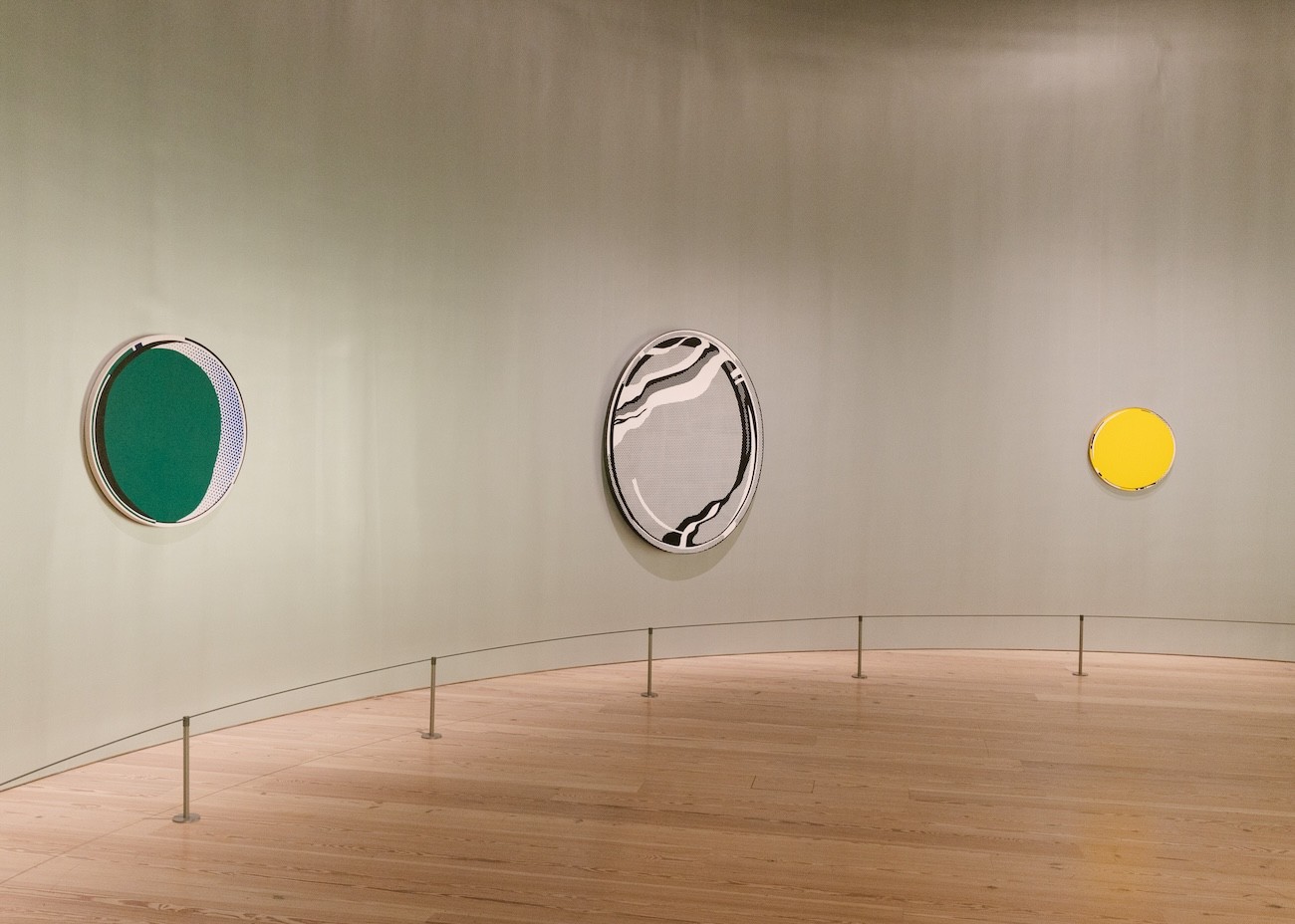
Roy Lichtenstein’s mirror paintings don’t reflect anything, and he said as much: they only look like mirrors if someone tells you they do. At the Whitney’s Roy Lichtenstein: Like New, co-curated by Meg Onli and the artist Alex Da Corte along with Nakai Falcón and David Crane, Lichtenstein’s mirror paintings hang in a curved oval room whose walls are coated in metallic paint—the only reflective material as far as we can see in the show.
Mirror #12 (1970) is a two-foot circle that looks machine-made until closer inspection reveals the hand-made idiosyncrasies in every painted dot. Down its left side, the dots swell and are sliced in half along a vertical edge. A bold black line tapers through the middle like a lightning rod. Is the line a crack in the mirror? Or is it a light reflection? On the rim, next to what could be a mirror’s beveled edge, sits one small blue rectangle that stands out like caution tape but could also represent the mirror’s thickness.
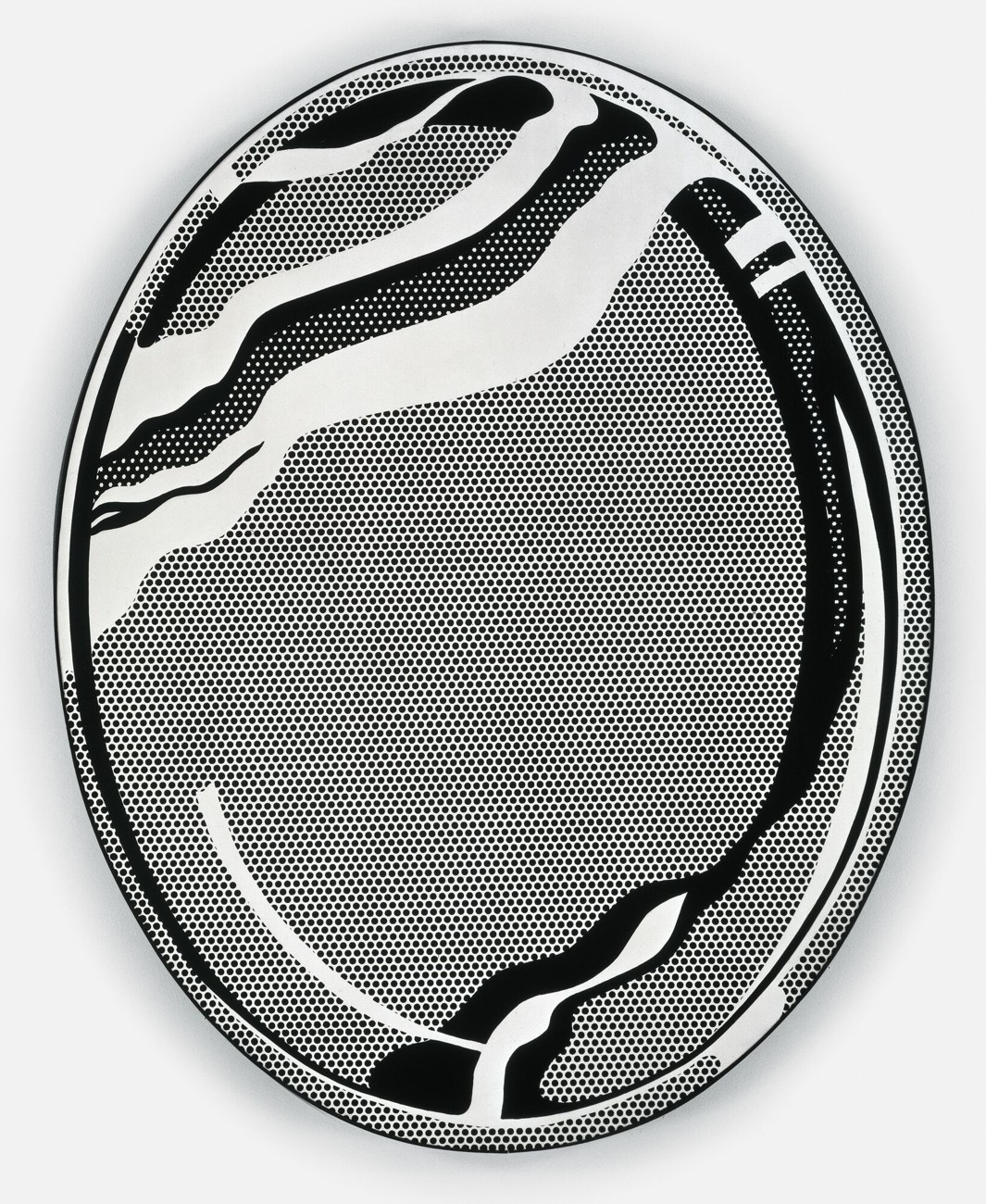
Lichtenstein has painted the sign for a mirror and made a language of signs.
Da Corte likens the paintings to Duchamp’s readymades, ordinary objects chosen and exhibited to show that an object’s meaning depends on context. Both begin with a fascination for found objects, but where Duchamp would have moved an actual mirror from a shop to a gallery, Lichtenstein hangs only its shorthand, the convention we use to picture a thing, like how a flipped z-shaped line came to stand in for lightning or how a string of zzzzzzs could signal sleep. The iconography could have been lifted straight from a pamphlet of mirror ads, but inevitably, they are deceitful, since a real mirror has no image of its own. A real mirror shows only whatever stands in front of it, and these painted ones, which cannot reflect the world, are Pop Art’s anti-trompe l’oeil, making no serious attempt to fool the eye yet remaining convincing representations of objects whose very purpose is to produce images.
These paintings are positioned in an odd relation to Szarkowski’s Mirrors and Windows, the 1978 MoMA show which argued that photographs sit somewhere along a spectrum between pictures that strive to express something about the photographer and pictures that look out to the world with the belief that the world is richer and more complex than a studio construction. The mirror paintings would have been the enfants terribles of that show, because they make clear that representation can achieve neither a precise account of the author nor of the world. Representation sits mid-stream, mute and ambiguous, and context decides what it temporarily says. Lichtenstein gives us occasion to notice the limits of knowing something through representation. The mirror paintings, with their neither-this-nor-that facetiousness, can help us to know something about not knowing by failing to deliver us back to ourselves.
At first the mirror paintings all look very similar, with their consistent use of circles and ovals of dots and streaks, but looking closer reveals how varied they are. The one nearest the East River entrance to the room, facing the window with the massive sunset mural, is almost totally awash in yellow, like the sun itself; another mixes faint traces of brushstroke-visible red with a solid yellow slot and dots; in a couple, pure fields of color curve gently at the edges against the dot schemes, while in others there are only dots and lines. What first looks like a unified body of work, flat and uniform, turns out to have as many ways of being seen as mirrors do, and as many moods as we have when looking at them.
We stop being surprised by things once they’re famous, because we think we know them. Da Corte says Lichtenstein is overlooked because he is everywhere, and the mirror paintings get passed over for a related reason: we look so much more at the legible work, the pictures of women, laundry detergent, hot dogs, fighter jets, all images many of us know and love him for, where a subject distracts from the sign. The mirrors leave no subject to look at except the sign itself, Lichtenstein’s abstraction of light, shade and depth into dots and lines, marks borrowed from commercial printing.
I ran into David Salle at the show, who hung out with Lichtenstein in the ’80s and says that for all Lichtenstein’s eloquence, he never liked talking about his work, calling it baubles for the rich. Mary Boone showed the mirror paintings in the ’80s, but people preferred the pictures with more obvious images. Lichtenstein was obsessed with art history, Salle says, and he looked at how mirrors were handled not just in comics and commercial pamphlets but also by the European old masters—Spanish, French and Flemish alike. Van Eyck’s convex mirror in the Arnolfini Portrait is one grand ancestor, made for the well-to-do of his day and full of them (the couple, a witness in the doorway, visible in the mirror). Lichtenstein’s mirrors are emptied of all that, yet still collected by the rich. A mirror that reflects no one and has no clear function is, apart from anything else, funny, and humor is often about surprise. If I were to ask one of the mirror paintings who is the greatest of them all, it would say nothing.
Roy Lichtenstein: Like New is on view at the Whitney Museum of American Art through May 10, 2027.