
.webp)

“Call me gravity” at WIELS
Review
Nimbus Dance’s Sum of Parts arrives at a moment when the United States is engaged in its most hostile redefinition of belonging in recent memory. Jersey City—across the water from the Statue of Liberty—is a city built by successive waves of immigration, each becoming, in time, the established community that greets ensuing arrivals, often with ambivalence if not outright disdain—one of the country’s oldest stories. This performance at the Nimbus Arts Center in Jersey City implicitly engages longstanding debate over the role of artists amid political turmoil. Some insist that art should transcend politics, while others hold that it is the duty of artists to use their craft to influence current events. Sum of Parts is firmly in the latter camp.
Yoshito Sakuraba opens the evening with Avenoir (2020), a dance named after a word from the Dictionary of Obscure Sorrows meaning the wish to see memories in advance—a sentiment at the intersection of nostalgia, grief, and love. Four dancers in sheer tops and pleated pants shift configurations, from solos to duets to group work. Set to a composition by Philip Glass and Jóhann Jóhannsson, the work is sentimental in that its affect is felt rather than stated. Just as its arc begins to cohere, however, it ends. Avenoir reads like a poetic excerpt rather than a complete statement. It is the evening’s quietest voice.
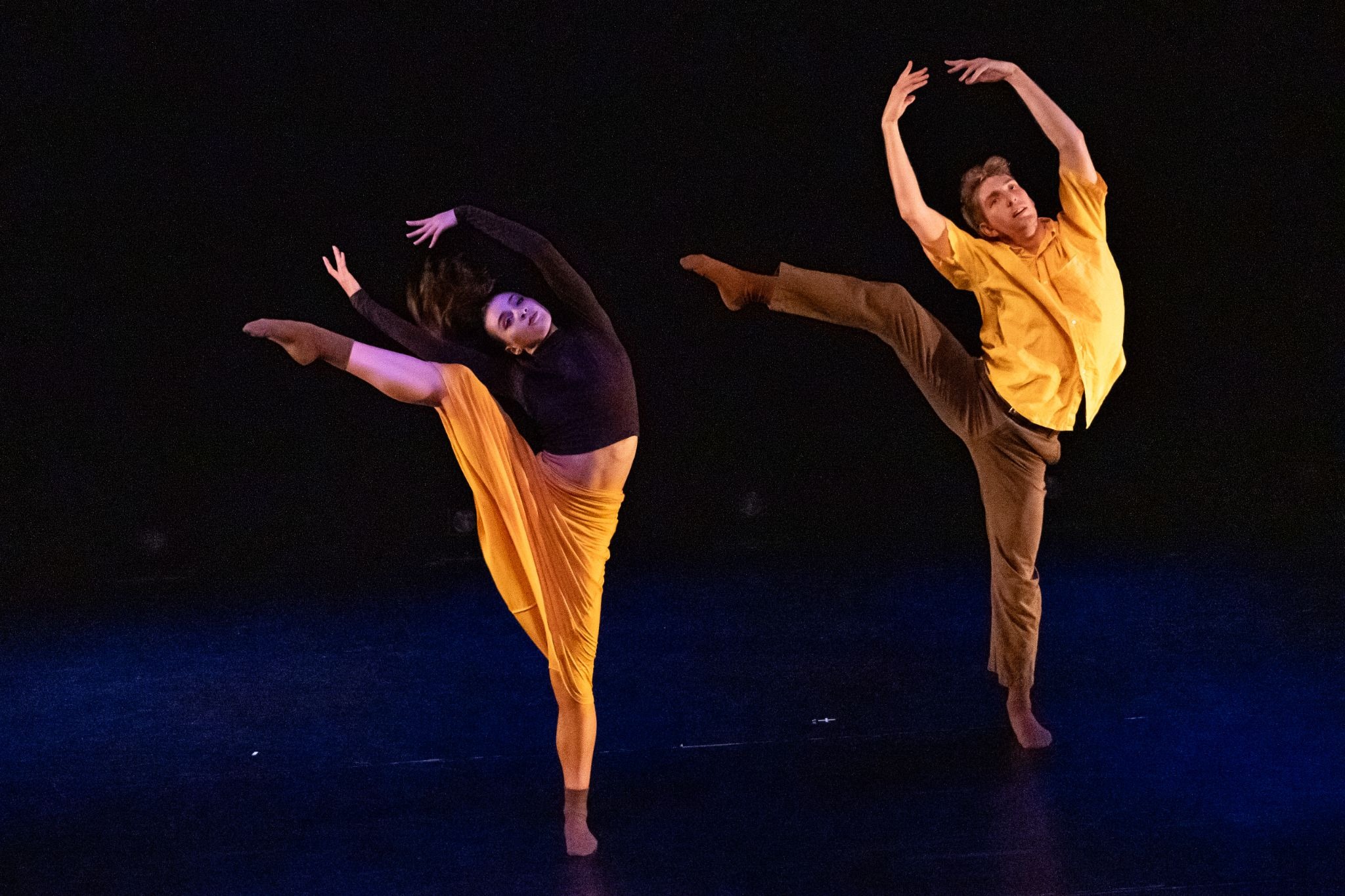
Through the Golden Door (2025) is the program’s most complex work. Built around recordings of interviews conducted by Helene Stapinski—a chronicler of Jersey City life—the piece layers voices into a cacophony of memories. A woman sings “I Wish You Love” a cappella as dancers oscillate between technical choreography and pedestrian movement, illustrating and interpreting the recorded testimonies.
The central point is clear: the city has changed, and that change is mourned. The complaints are familiar—new residents are rude, family once meant more, something essential has been lost. Yet the piece never confronts the irony at its center: this performance takes place inside an arts center implicated in the very transformations it critiques. The voices mourning displacement descend from earlier generations of settlers, and the land they now call home once belonged to the Lenape people.
Pedro Ruiz's Heart & Flesh (2024) offers relief, not from the evening’s themes, but from the tendency toward literalism. The duet, set to music by Caroline Shaw, is shaped by Ruiz’s fascination with birds and their migratory patterns. For Ruiz, a Cuban immigrant, the metaphor is personal as well as formal. Dancers Catherine Escueta and LeighAnn Curd are intense and technically adept in a piece that frames migration as a lived, embodied experience rather than abstract political discourse. Yet when the West Village Chorale joined the dancers, its thirty-four fully illuminated singers packed across the stage, the choreography was denied its room to breathe.
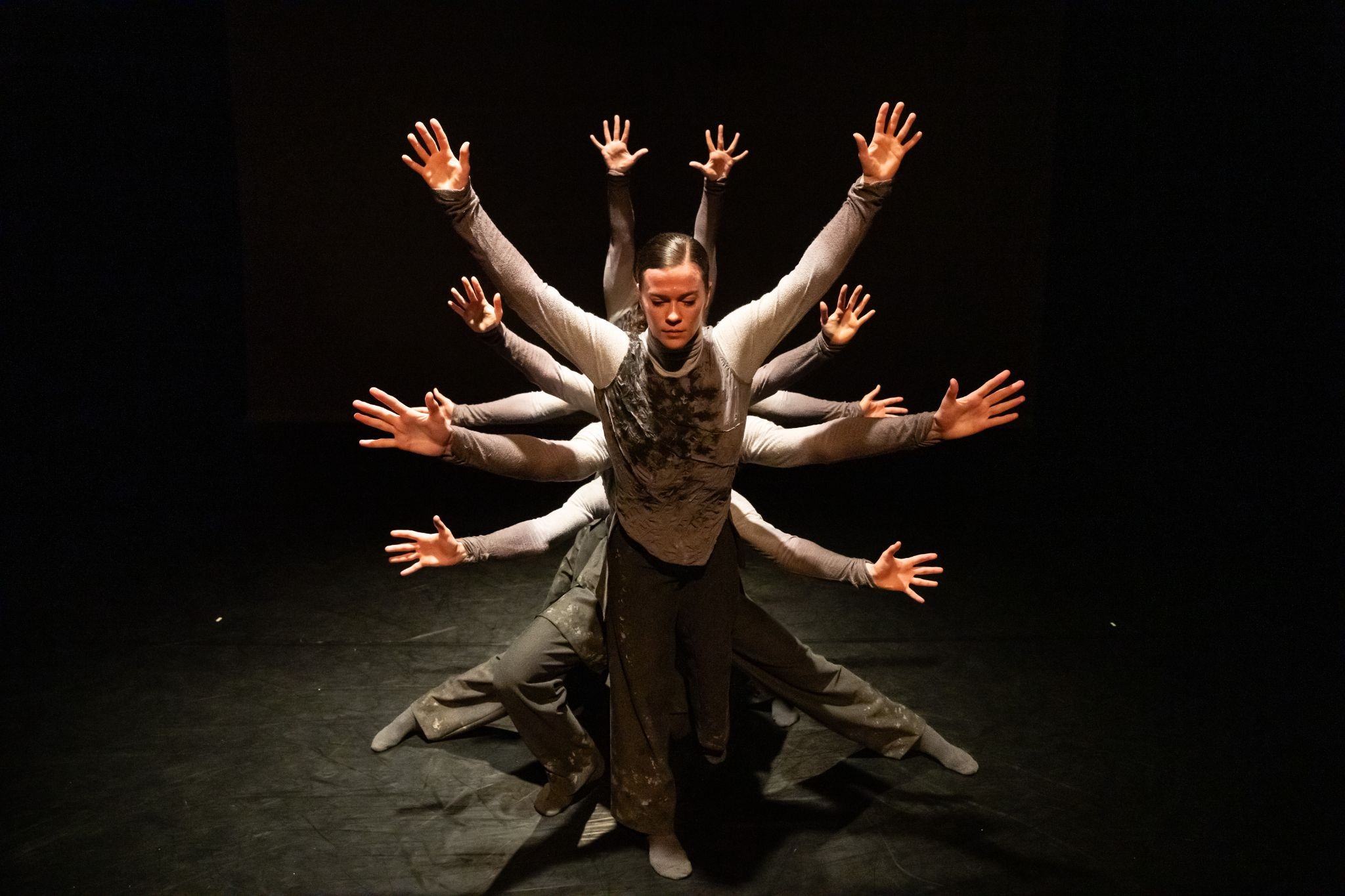
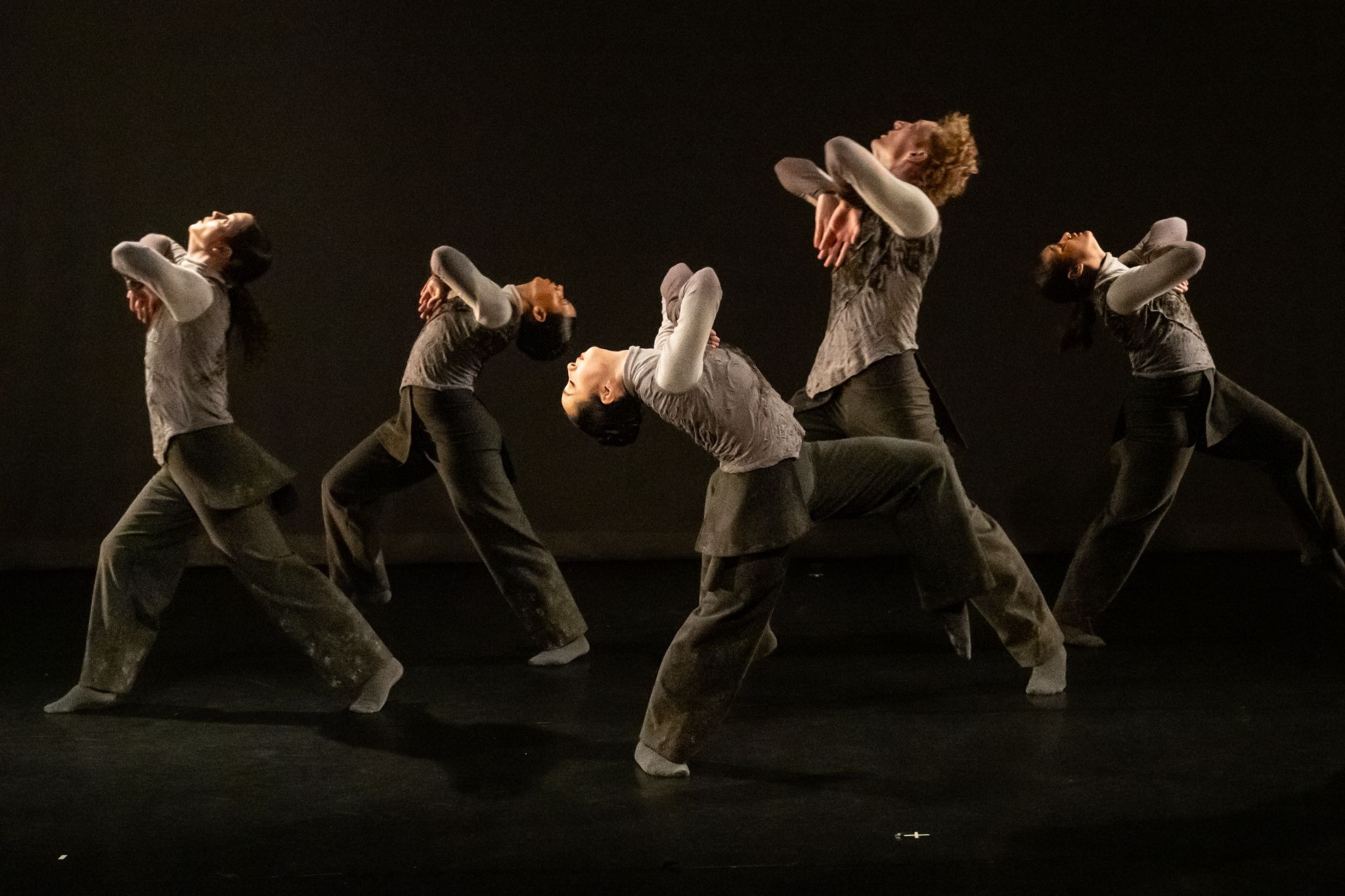
Choreographer Houston Thomas’s world premiere of A Land, A Promise is an apt culmination to the evening. Set to a commissioned score by Saunder Choi—a Los Angeles-based Filipino-Chinese composer and choral artist—the piece is inspired by two juxtaposed sources: Emma Lazarus’s 1883 sonnet The New Colossus, whose words are inscribed at the base of the Statue of Liberty as an official welcome and promise; and the poems etched by detained Chinese immigrants into the walls of California’s Angel Island. These references encapsulate the contrast between the country’s promises and the reality of its practices.
Nimbus’s dancers are excellent technicians and charismatic performers. Despite their varied stylistic backgrounds, they move with striking cohesion while preserving individual clarity. Thomas’s ballet background acts as a foundation for his contemporary movement, marked by dynamic geometric patterning. As in Ruiz’s piece, however, the choreography competes for attention against the rocking mass of singers. When a solo cello plays, the eye can finally settle on the dancers, and the work opens up entirely.
For Sakuraba, Ruiz, Thomas, and Choi, questions of belonging in the United States are not abstract. Nimbus’s assembly of this particular group, in this particular city, at this particular moment, is itself a poignant statement about memory and migration. The program is most persuasive when its dancers are entrusted with the weight of its themes. In those moments—in the quiet of a single cello, or in the precision of a dancer cutting through sound—the evening finds its clearest expression.
Sum of Parts ran at Nimbus Arts Center in Jersey City on May 15 and 16, 2026.