
.webp)

“Doll Dressing” at The Museum at FIT
Review
I heard a joke the other day. It was a riff on a true story: a humanoid robot recently ran a half-marathon at world-record speed. Previously, the record was fifty-seven minutes; now it’s fifty minutes. Next year, a robot will murder everyone at the starting line. The humor behind the joke depends, in part, on the widespread fear that robots are inherently violent. But even if they’re not, the era they have ushered in is definitely unnerving. Consider two mollusk-like robot balloons created by the artist Anicka Yi for her piece In Love with the World (2021). They’re currently flying around a gallery at the New Museum as part of New Humans: Memories of the Future, curated by the museum’s artistic director, Massimiliano Gioni, and senior members of the curatorial team, Gary Carrion-Murayari, Vivian Crockett, and Madeline Weisburg. Yi’s robot balloons are innocuous and slightly creepy; occasionally lingering overhead, they seem poised to lunge or drop a payload, but they don’t. They maintain a respectful distance, patrolling from the upper reaches of the room.

The New Museum reopened in late March after closing for two years to build its $82 million expansion. New Humans, sprawled across three floors, inaugurates the added galleries and repopulates the old ones, assembling an unwieldy, oversized collection heavy on retro-futuristic artworks meant to speak to this strange time. Instead of clarifying the moment, however, the exhibition wanders, suffering from the curatorial team’s over-historicizing and unwillingness to edit. In terms of the exhibition design, think early Louvre or the 1913 Armory Show: objects floor to ceiling and cheek by jowl. “Dream Machines,” one of the exhibition’s thirteen thematic sections, is stuffed into a back hallway. Artworks and inventions with overlong labels line both sides of the tight corridor that feels more like visible storage in a collecting museum or open stacks in a library than a focused curatorial presentation typical of a kunsthalle like the New Museum. There’s so much: mathematician Marvin Minsky’s Useless Machine (1952), which can turn itself off; Kristin Walsh’s Engine no. 11 (2024) with matchsticks dancing on its surface; a plan for Agnes Denes’s Liberated Sex Machine (2013); and more. In sections like these, the exhibition proffers technological exploration as perennial but misses the opportunity to underscore and elaborate on the uniqueness of the present or suggest where humanity is headed.
The central claim, if there is one, is that the era we live in is not unprecedented—or more specifically, that the first quarter of the twenty-first century mirrors the first few decades of the twentieth, and much of the thinking in the intervening period constitutes a discernible evolutionary trajectory. The conceit of century-spanning bookends, although unusual for a contemporary art museum, looks good on paper or in a Google Doc. It’s true that, as electrical grids and cars changed life in the 1920s, AI and social media are transforming the 2020s. 1918 saw an influenza pandemic; the 2020s began with COVID. Totalitarianism is on the rise today as it was back then. World War I (1914–1918) was characterized by brutal trench warfare and massive carnage, and global conflicts, including genocidal wars in Gaza, Ukraine, Myanmar, and Sudan, cast a dark shadow over 2026. Such violent imagery indeed manifests across New Humans: suspended from the ceiling in the Pepto-Bismol-carpeted “Hall of Robots,” Lee Bul’s Cyborg W7 (2000), a headless silicone warrior, is not necessarily a robot. Perhaps it could be a prototype for an autonomous weapon. If that is the case, which war it is intended for is unclear, but in today’s tense geopolitical landscape, contexts for it are easy to imagine. (New Humans opened a month after the United States and Israel went to war with Iran.) In “Human Animals,” another section of the exhibition, a painting by Jacqueline de Jong, Confinement (Border Line) (2020), involves Guernica-like figures pressed together under barbed wire and, according to the corresponding lengthy wall label, alludes to both de Jong’s experience as a Jewish person in World War II and the poor treatment not long ago of refugees and migrants in Greece.

These parallels are blunt. The temporal construction here mostly functions as a statement and restatement of the platitude that history repeats itself—an unsatisfying replacement for the thoughtful storytelling and surprising encounters the New Museum usually offers. Moreover, Western artists are too often positioned as the starting point in the thematic rooms, presented as originators, the first to take on a topic, while artists of color are frequently cast as respondents. The section “Prosthetic Gods” echoes this pattern. It includes Heinrich Hoerle’s Krüppel (Cripples) (1920), lithographs showing soldiers who lost limbs; Hans Bellmer’s La Demie-Poupée (The Half-Doll) (1972), which has missing limbs but wears an oversized bow at the back of its penis-like head; and Cao Fei’s video Oz (2022), depicting a human-ish figure floating through the sky, part octopus, part machine. More diverse examples of creativity from across the globe in the early twentieth century would have strengthened the section’s undertaking.
There are also no Gen Z artists included—an odd choice for a curatorial project ostensibly about the future. The youngest artist is Vitória Cribb, born in 1996 in Brazil, the only participant who could plausibly claim to be a digital native. Her video, BUGS (2023), runs as a sideline in a stairwell, easily missed. It involves a resigned character in a glitchy simulation of a model apartment who sprouts ears and eyeballs all over their body. “I could no longer fix the bugs,” a voiceover admits as the character becomes less and less human.
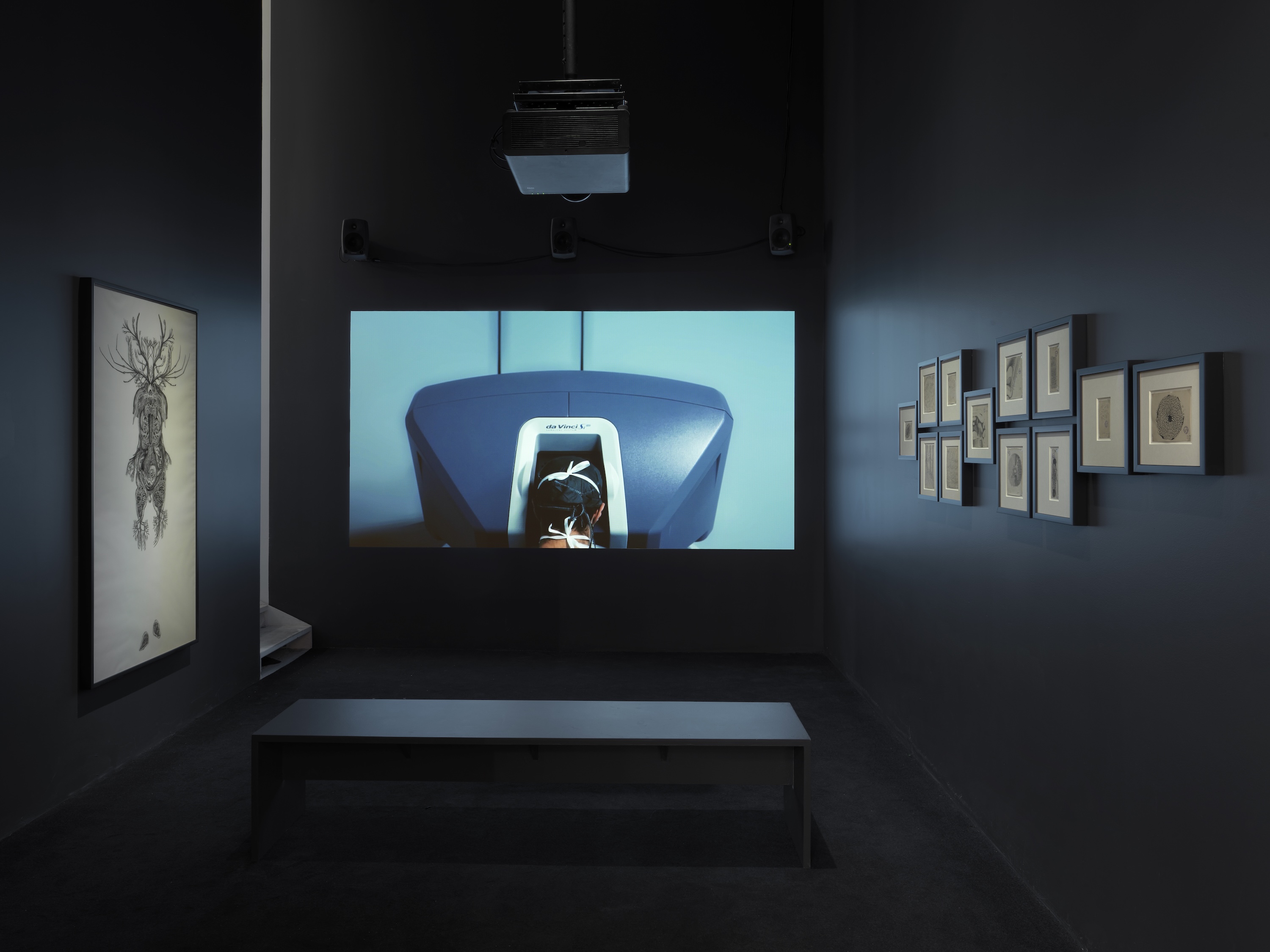
Recognizing that contemporary art and many of today’s challenges may have antecedents does not make them inconsequential. If repressive governments and human ignorance are nothing new, individual pieces included here do insist on the specificity of recent conditions and suggest that people are as much, if not more, of the problem than technology. In Christopher Kulendran Thomas’s video installation, The Finesse (2022), included in the section titled “Animacies,” young people reflect on authoritarian attempts to extinguish Tamil culture and unmet demands for autonomy. They discuss the importance of the internet for political organizing and assert that in a representative democracy, the state controls the media and presents a version of truth that serves its own interests, whether or not those interests serve the general public. In the exhibition segment “Automatic Women,” Camille Henrot’s video, In the Veins (2026), filmed at home and in wildlife rehabilitation centers, observes how cheerful, cuddly representations of animals are omnipresent in her children’s upbringing, while real animals nearby are at risk. Interspersed in the video are scenes showing New Year’s Eve celebrations. In this context, the end-of-year countdown clocks look like they’re tracking the dwindling number of animal species left on earth.
The traffic flow through the exhibition is abysmal. Two different visitors crashed into me as I stood looking at artworks. Crammed at one end of the “Dream Machines” hallway-cum-gallery, Mika Rottenberg’s video Dough (2006), an absurdist labor parody, plays on a small monitor above a curtained door, ensuring that anyone who stops to watch it will block the passageway. With over seven hundred objects, there’s something for everybody here, but it’s a mess, like Geppetto's workshop in Pinocchio, or a fever dream. The viewer, by necessity, becomes a browser. Although they’ve moved bodily into public space, they might as well be at home skimming and scrolling, since the New Museum seems largely uninterested, sadly, in creating ready avenues for careful contemplation.
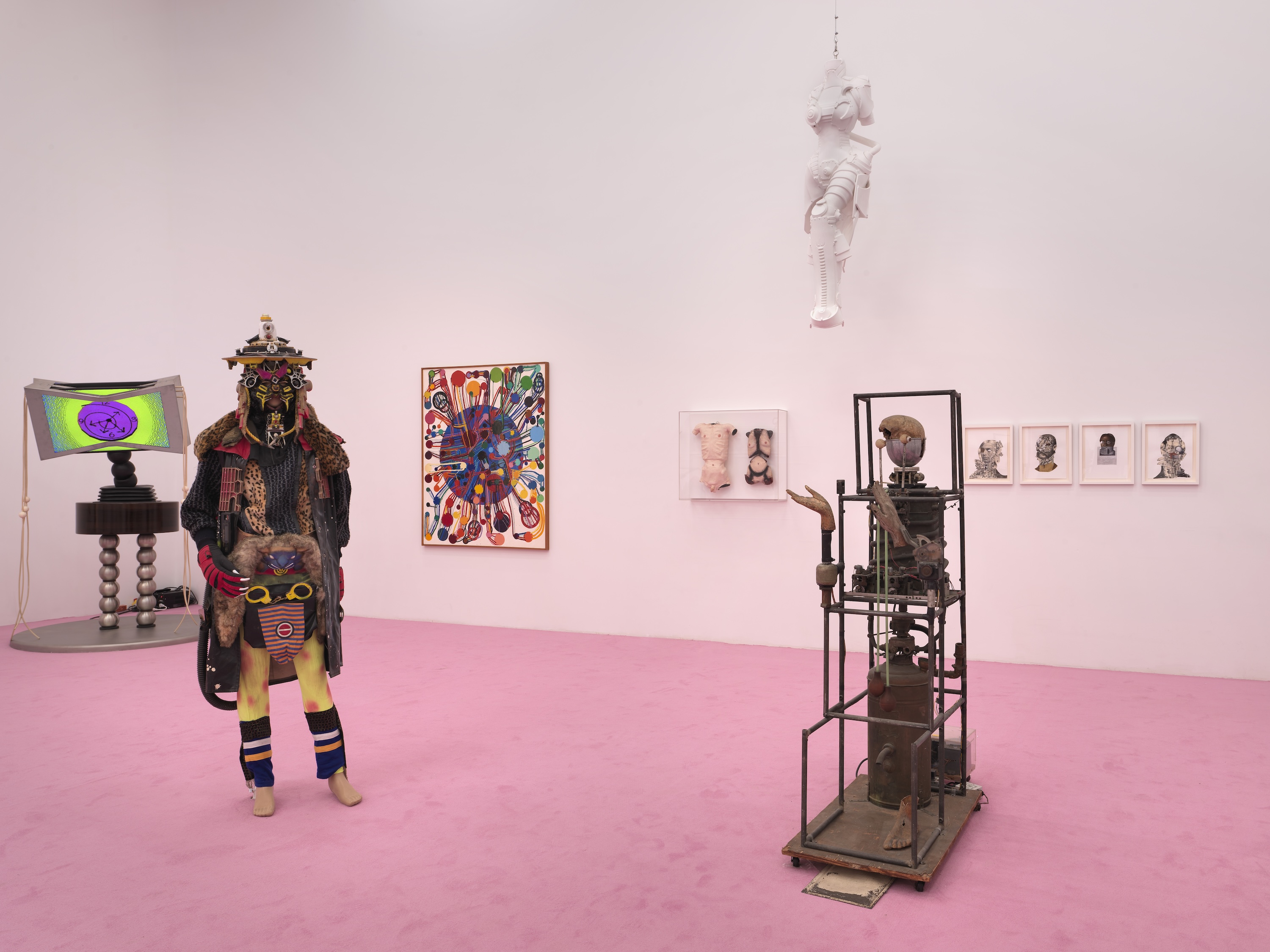
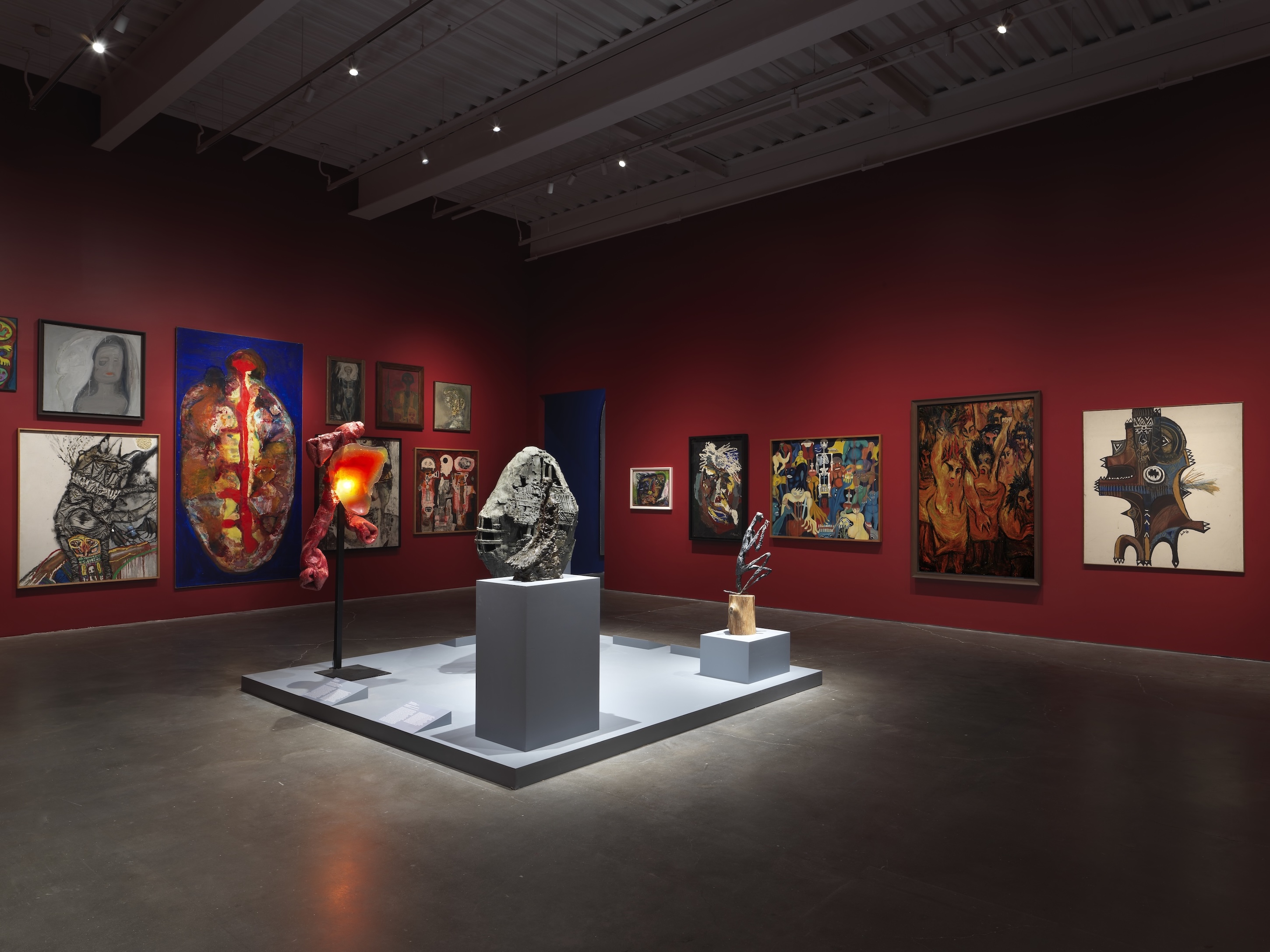
Atsuko Tanaka’s acrylic lacquer painting, 77Q-81 (1981), in the “Hall of Robots” resembles a central hub with a proliferation of smaller nodes plugged into it, demonstrating the kind of connection and cohesion this exhibition lacks. The curators’ somewhat haphazard and isolated emphasis on feminist engagements with technology suggests that a better, more focused presentation could have centered exclusively on that. Alternatively, the quasi-portrait gallery, “New Images of Man,” could have been the beating heart of a stronger exhibition, but it unfortunately remains an entirely separate experience. A revamp of a 1959 exhibition at MoMA with the same title, the selection positions paintings and sculptures by artists included in the original—Francis Bacon, Karel Appel, Asger Jorn, and many others—alongside an Eva Hesse, a Melvin Edwards, and exciting paintings from the 1960s by African artists not well known in New York. In Women Riot (1965), the Nigerian artist Uche Okeke depicts a group of women with fast, thick, fiery brushstrokes, their fists in the air. More contributions from people currently living through global conflicts or staging protests—perhaps bolstered by just a few historical items—would have made for a more pointed venture.
To move through New Humans is to experience information overload and the fragmented attention typical in contemporary life. For the most part, the works on view do not individually set out to present this condition, but the exhibition as a whole reproduces it. New Humans could have been three or ten separate shows. Frustrated viewers will wonder, “What isn’t a New Human?” In the universe Gioni has created, they can be magical, merge with machines and other organisms, modify their bodies, or be brought down by sharp-taloned or toothy monsters. Gioni is an artworld heavyweight with impeccable credentials. When he curated the Venice Biennale in 2013, he called his central endeavor “The Encyclopedic Palace.” Holland Cotter, writing in The New York Times, criticized that show for being too neat and tidy. This one, by contrast, hurtles back and forth in time and is packed, but ultimately never coalesces or shines, making the New Museum seem like an institutional Rip Van Winkle, an old guard waking up confused, reaching for the past to get its bearings. But the past is cold comfort. Singular works included sometimes seem like they could shake the show out of its mire, but alas, any one piece is overwhelmed—and so are we—by the curators’ loose and indecisive gestures. Maybe what the New Museum needs is new curators.
Why would good curators produce an exhibition so diffuse? What went wrong here is likely a symptom of ways of working and thinking today. What seems ambitiously exciting on an object list or looks fine in a digital model might not work in person. Maybe there just wasn’t time to make a necessary editorial overhaul while opening a new building. Or is the show sprawling and historically scattered because contemporary institutions, unlike the New Museum of old, are risk-averse and afraid to surprise or make focused claims? Were the New Museum curators unconsciously or consciously afraid to say anything coherent about the present moment because making a clear statement now risks controversy, unwelcome scrutiny, and censorship? After all, technological growth is driving the economy. While individual works might make a statement, the museum stays effectively safe by breezily presenting many statements and much gadgetry. Maybe New Humans says so much, includes so much—too much—because saying something, making a critique, especially in the United States, risks looking ideological, divisive, or out of step. Whatever the case, the result is an exhibition without conviction, and it’s a real loss. Everywhere humans proliferate dubious tech advances, but bold new thinking is in short supply.
New Humans: Memories of the Future is currently on view at the New Museum.