.jpg)

.webp)
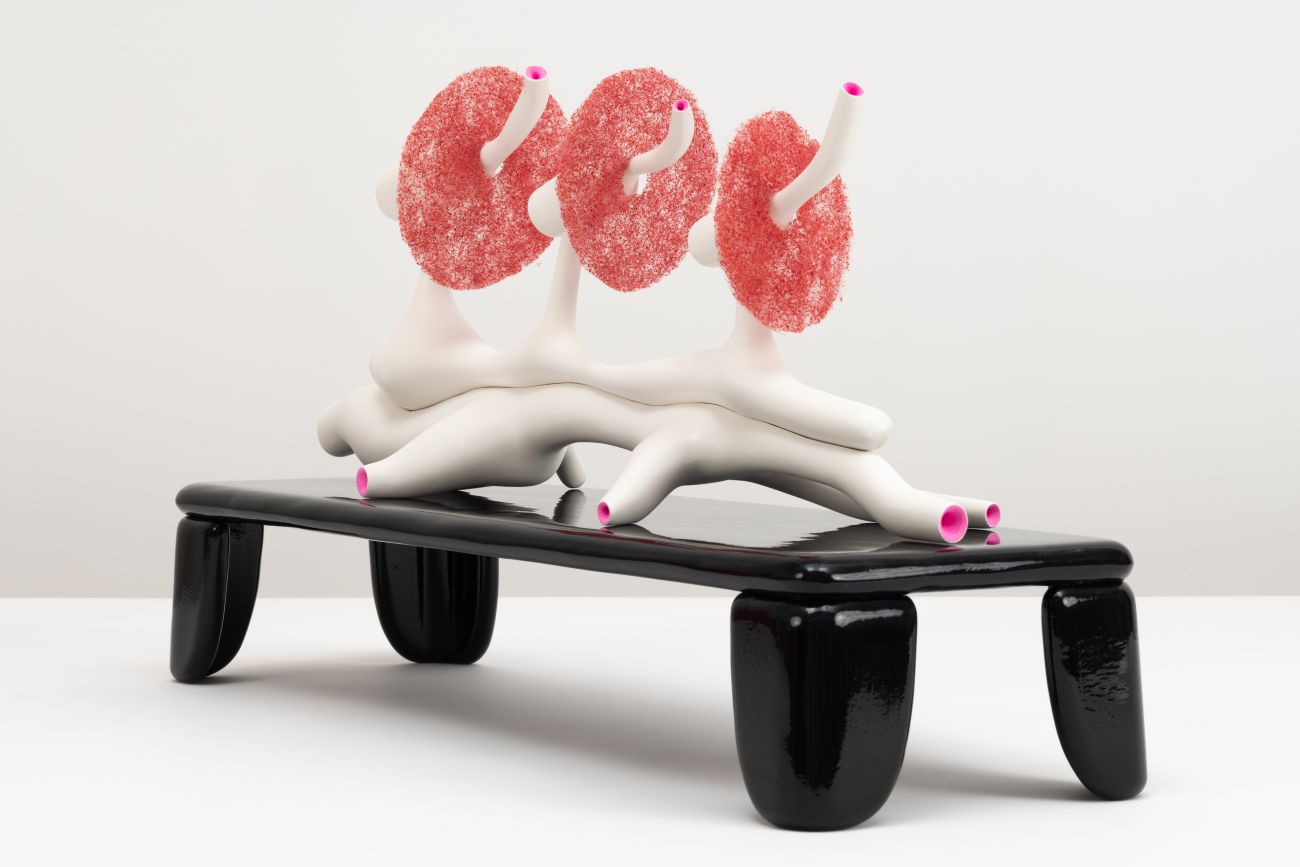
Matthew Ronay at Casey Kaplan Gallery
Review
It is always compelling to see what happens when structures of organization are pulled out of the realm of abstraction and made to wrestle with the physical world. Across this presentation of three recent works of steel, paper, chalk, pressure, and geometric patterns, Mira Dayal’s Nets offers ways of thinking through the relationship between systems and the materials that give them form. The works evoke maps, textiles, industrial meshes, and computational networks, and they also suggest a state of indeterminacy, where a structure can be simultaneously an object, an image, a diagram, and a set of interactions.
The work on view transforms Dayal’s plasma-cut steel “net” sculptures into printing plates, a shift that might initially seem to involve a straightforward translation of a three-dimensional object into a two-dimensional image. But Dayal complicates that relationship by challenging the usual points of contact in the printmaking process. In one work, colored chalk records the steel's structure. In another, the press simply forces the metal into paper, leaving an embossed impression. The result is not simply an image or imprint of the sculpture. It is evidence of an encounter between surfaces, a material consequence of pressure. This detail feels central to the exhibition, where Dayal is using the printing process to expose the conditions through which something becomes an image. The press, the plate, the paper, and the force that moves between them become part of the work's meaning. The image is therefore inseparable from the process that produces it.

Nets is especially compelling in relation to Dayal's longstanding interest in systems, which promise a degree of abstraction and establish relationships that can, in principle, be understood independently of the things that instantiate them. A grid remains a grid whether it is drawn on paper, woven into cloth, cut from steel, or rendered digitally. Yet Dayal's work continually tests this assumption. Her grids acquire weight, thickness, texture, and resistance. They bend and cast shadows. They press into paper. What appears to be an abstract structure is never simply abstract once it enters the physical world. The work consequently asks us to think about systems through the conditions that enact them. Through its connection to mathematics, Dayal's practice separates formal relations from specific material objects. They assume an identity that occupies an unusual position between precision and variability. They are clearly organized, yet they are not perfectly reducible to their organizing principles.

There are subtle resonances between Dayal’s prints and Dorothea Rockburne’s Locus, on view in the adjacent gallery, particularly in their shared attention to the physical relations activated by the printing press. Rockburne’s works emphasize the interaction of paper, plate, ink, pressure, and weight, transforming the print into a three-dimensional object through precise geometric folds. Her use of white ink over these creases produces the impression of an inkless print. Dayal is similarly interested in printing as a physical system rather than simply a means of producing an image, though she pushes this relationship further by eliminating ink altogether, allowing pressure to register directly onto the paper. In Dayal’s hands, the print becomes a network of material relations that draws upon the dialectic between abstraction and control. Her structures resemble systems of measurement or maps without actually measuring or representing anything. They are organized enough to trigger our expectation that they should communicate something, but open enough to frustrate that expectation. The conventions of representation are stripped back even further in the absence of ink, not just its color. In this way, the work recalls the broader history of the index, in which a mark can be understood as evidence of a physical event rather than a representation of it. Here, presence is communicated as a gesture, what remains following an encounter between pressure and resistance. The resulting print becomes both the trace of objects in contact and the trace of that process.

This may be the deeper significance of the exhibition's title. A net is a structure made through connection but is also a structure defined by intervals and gaps. Its organization depends equally upon what is there and what is not there. The embossed surface does not contain an image in the conventional sense. Its information is distributed across presence and absence, raised and recessed surfaces, visibility and touch. Likewise, a mesh reveals what lies beneath the net. What is “imaged” from these gaps are interactions and forces within those interactions. The work encourages us to think about how every system can be physically rendered, whether as surface or infrastructure, and each depends upon a process. Dayal makes those hidden relationships visible.
The works in Nets are minimal forms that contain questions about abstraction, representation, materiality, reproduction, language, computation, and perception, but they avoid separating these concerns into discrete categories. A steel sculpture becomes a printing plate; a printing plate becomes an embossment; an embossment becomes an image. An image recalls a diagram; a diagram recalls a map; a map recalls a system. Through each stage and loose category, the works remain objects of hidden encounters, and their ambiguity is both their philosophy and their aesthetic. They invite us to dwell somewhere in the space between the thing and its representation, between a system and the material conditions that allow it to exist.
Mira Dayal: Nets is on view at Print Center New York from September 17 to November 19, 2026.