Alix Vernet: “LANDMARKS” at Chapter NY
Review
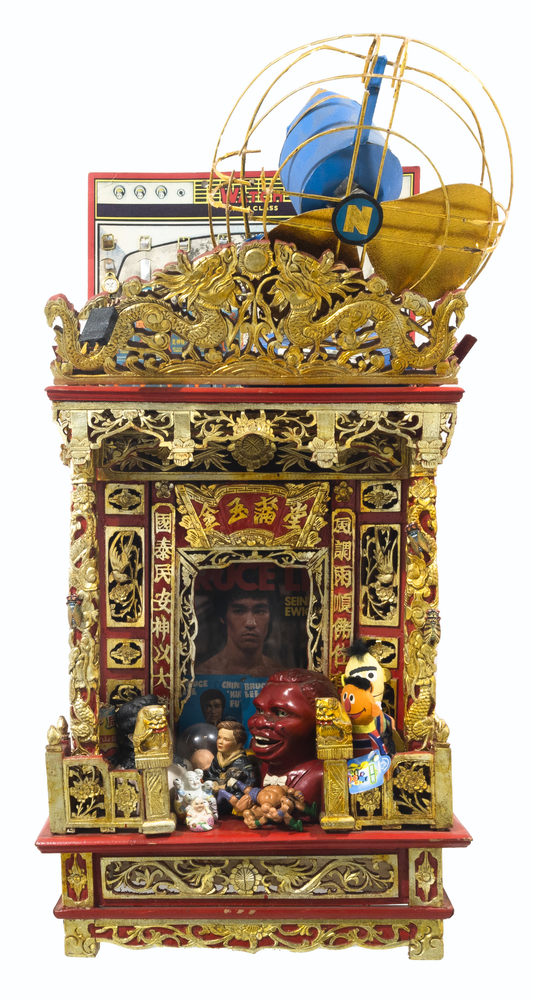
I walked out of Martin Wong: Chinatown USA at Wrightwood 659 feeling a bit lost. For someone like me who never got to see many of Wong’s artworks in person, this exhibition is a feast that leaves a complicated aftertaste. Many of Wong’s monumental paintings are on view: by the third-floor entrance, Canal Street (1992) juxtaposes the vicissitudes of the Golden Empire Jewelry Center in a trompe-l’oeil diptych. Further in, his elongated paintings, mimicking a Chinese scroll, collage together Chinatown attractions in incredibly vivid details and vibrant colors: the Jade Palace, the Chinese Pagoda—nightclubs that adorned Chinatown with exotic glamour to attract a white man’s gaze. And in the foreground, Wong’s nightmarish human figures, usually copied from photographs he had, from clippings, or of his family, such as his beloved mother Florence and his aunt Eleanor (Nora) Wong—a former nightclub performer—hover like ghosts. Their skin is in a grayish green tint, their irises hidden in the shadow, gazing right back at you lifelessly. Bruce Lee Shrine (1993), the only wall-based sculpture of this kind in this exhibition, is a miniature altar filled with old toys, memorabilia, and magazines, topped with a dilapidated fan. It’s a slice of some antique store in Chinatown I remember entering: tidy but filled with stuff from floor to ceiling, lit with piercing fluorescent lights. An unsettling sense of dislocation gives me fainting spells.
I measure my distance to Wong’s paintings against the distance he’d kept from his Chinatowns. At least according to the catalogue essays, Wong claimed to have always been an outsider and never been one at all.1 He grew up in proximity to the San Francisco Chinatown. In 1978, he moved to New York, residing in the Lower East Side, the heart of artistic possibilities. He painted his Puerto Rican friends, fell in love with a poet named Miguel Piñero, and was fondly called by the community a “Chino Malo.” The bulk of the Chinatown series was created while Wong was in New York, culminating in a solo show at the P.P.O.W. gallery in 1993. But many compositions reference sites that can be traced back to San Francisco—the city’s Chinatown, with its bustling crowds, vendors, neon signs, and diverse immigrant communities, was always part of Wong’s surroundings.

But Wong didn’t speak Chinese. His primary connection with his ethnic heritage was through his mother, who would translate texts and talk about her time in the Canton region.2 This is discernible in his paintings: Wong would occasionally miss a stroke when he copied shop signage to his painting, such as in Chinatown Telephone Exchange (1992). But it’s also evident that it was the image of the Chinese characters that interested him. His handwritten poems from the late 60s, such as Untitled (Dead Heat) (1968) and Untitled (How Very Much Alike) (1969), on display in the vitrines, prove his typographical creativity in addition to his work as a poet. There’s something about how he approached everything as visual matter when he painted—sometimes delightfully democratic, other times naively flattening. Wong treated many instances of text on canvas in the same way as how he’d treat an image—even his signature was stylized and painted out as a Chinese seal. The American Sign Language, which the artist claimed to have discovered from a “Hello, I’m Deaf” card after boarding the subway, had also been stylized in a fashion similar to Tibetan scripture and incorporated into his paintings as pretty images; their significations beyond translation came secondary, if at all.3
For Wong’s mid-career survey show at the New Museum in 1998, the catalogue claimed that Wong was “entirely self-taught.”4 However, Wong’s early years of artistic activities in Eureka and the Bay Area paint a very different picture: in the most psychedelic era at the acid-drenched locale for the counterculture movement, he went to school for ceramics, dabbled in architecture, returned to ceramics for graduate school, and dropped out again before he travelled extensively and collaborated with theater troupes as a designer for posters or sets. The distinction of being “self-taught” or not is mere institutional framing, but I do want to consider this in relation to Wong’s method of artmaking. His hyperfocusing on techniques and details was a result of his training, and his voracious appropriations of identities not his own, often undertaken with a naïveté that rustles the viewer, seem to come from a vantage point of belief that everything was connected. Wong worked like a self-taught artist who had promiscuous curiosity for everything, and he assumed incredible liberty to claim much of it his own, whether in his self-proclaimed Chino-Latino heritage or his declaration, in My Secret World (1978–81), of having painted the first picture for the hearing impaired simply because he integrated fingerspelling.
I write this as I wrestle with valid criticism that I find reads too literally into his painting, and with Wong’s own unstable iconography that defies clean interpretations—like the buildings he has painted, that everything always tilts a little to the right, as though they are slowly sliding away from the picture frame, from anyone’s grasp. But I want to believe Wong’s dreams were vivid, his visions well intended, despite some falling into ignorance or fetishism, or both. His invented signature “I.M.U. U.R.2,” which reads “I am you, you are too,” reflects his investment in a unity across the constellation of meanings, cultures, races, and languages.
Wong has arguably benefited from an era in which idiosyncratic cultural remixes like his didn’t cause immediate backlash. He also aligned himself with the street, supporting and collecting from graffiti artists (a part of his collections is on display in this exhibition), painting over his painting rather than starting anew, as though inadvertently flipping a finger to those who tried to collect and preserve his work.5 Wong’s attitude as a LES artist active in the 80s and early 90s—his liveliness and coolness—come forward in Ahearn’s documentary that can be viewed on a small monitor at the exhibition and online.

By the entrance to the exhibition on the third floor, on the bare brick wall of Wrightwood 659’s interior, hang a set of Wong’s brick paintings: Heaven (1988), Desire (1988), and in the front, Altar Screen (1989), a brick painting incorporated into an antique Chinese tea screen. The red brick is a recurring motif in Wong’s paintings as background, or as illusory pattern that builds up his subjects culled from subcultures. This can be seen in the set of kinetic sculptures of Popeye, currently on display at P·P·O·W’s concurrent show (titled Popeye) comically flexing his motorized brick-hard biceps. Here, the tessellating bricks are both a motif and a subject matter. In fact, Desire is rather Magrittean. Wong, who has a predilection for painting trompe-l’oeil frames, chooses this time to nest a three-dimensional gold frame within a larger one; the bricks, the representation of which flatly fills the board, extend, so to speak, beyond the picture frame and become the actual brick wall that holds up the painting.
After a whirlwind of an exhibition filled with psychedelic imagery, signs, and symbols that serve more to evoke free associations than to produce stable linguistic meanings, I return to this quiet and poetic space by the atrium. It is a corner where one’s mind doesn’t get carried away by Wong’s immeasurably busy compositions or outlandish colors and can concentrate on the gilded frames and the antique screen and wonder just where he found them. Wong left us with a lot of questions unanswered, and I think that’s the allure of his work. He is confusingly complex and fascinating, like how he was fascinated by the world he was in.
Martin Wong: Chinatown USA is on view at Wrightwood 659 from April 17 through July 18, 2026. Martin Wong: Popeye was on view at P·P·O·W from April 18 through June 6, 2026.
1 In his 1989 interview with Margo Machida, Wong said, “My view of Chinatown is more like an outsider’s view [...] whereas my view of the East Village, even though I’m not Puerto Rican, is more of my own view.” Through Lydia Yee's essay "Martin Wong: Constellations," in the Chinatown USA exhibition catalogue, 2026.
2 Margo Machida, "Martin Wong: Visual Dialogues with Chinese Modernity," in the Chinatown USA exhibition catalogue essay, 2026.
3 Elliot Gibbons, "It's Like Arguing with a Brick Wall: Elliot Gibbons on Martin Wong at Camden Art Centre, London," in Texte Zur Kunst, August 11, 2023.
4 Dan Cameron and Carlo McCormick, Sweet Oblivion: The Urban Landscape of Martin Wong (New Museum Books, 1998).
5 In a roundtable discussion held by Hyperallergic on March 10, 2025, which was later made into a podcast, "Street Stories: Graffiti and the Legacy of Martin Wong," published on April 10, 2025, one of the panelists and Wong's long-term friend, Lee Quiñones, mentioned that Wong would paint over his paintings.