
.webp)
Wenfei Quan: “Contemporary Hominin” at TaThaTa
Review
Descending into the basement project space at Nicelle Beauchene Gallery, one encounters an array of composite panels resting on narrow, wall-mounted shelves, pitched forward at slight angles off the white drywall. Up close, rusted metal, cast resin, and raw mineral blocks appear stitched together with tightly cropped photographs of abandoned domestic interiors: a water-damaged door, a corner of exposed brick, a wooden staircase peeling with faded paint. This is the entry point into Lucy Puls’s Constitum and Geometrica Concretus series, initiated in 2009 amidst the wake of the subprime mortgage crisis and on view as part of Puls's current show Righting. Focusing on bank-owned houses after the eviction of their occupants, Puls frames the damaged physical state of the domestic sphere as a direct record of displacement, trauma, and social rupture.
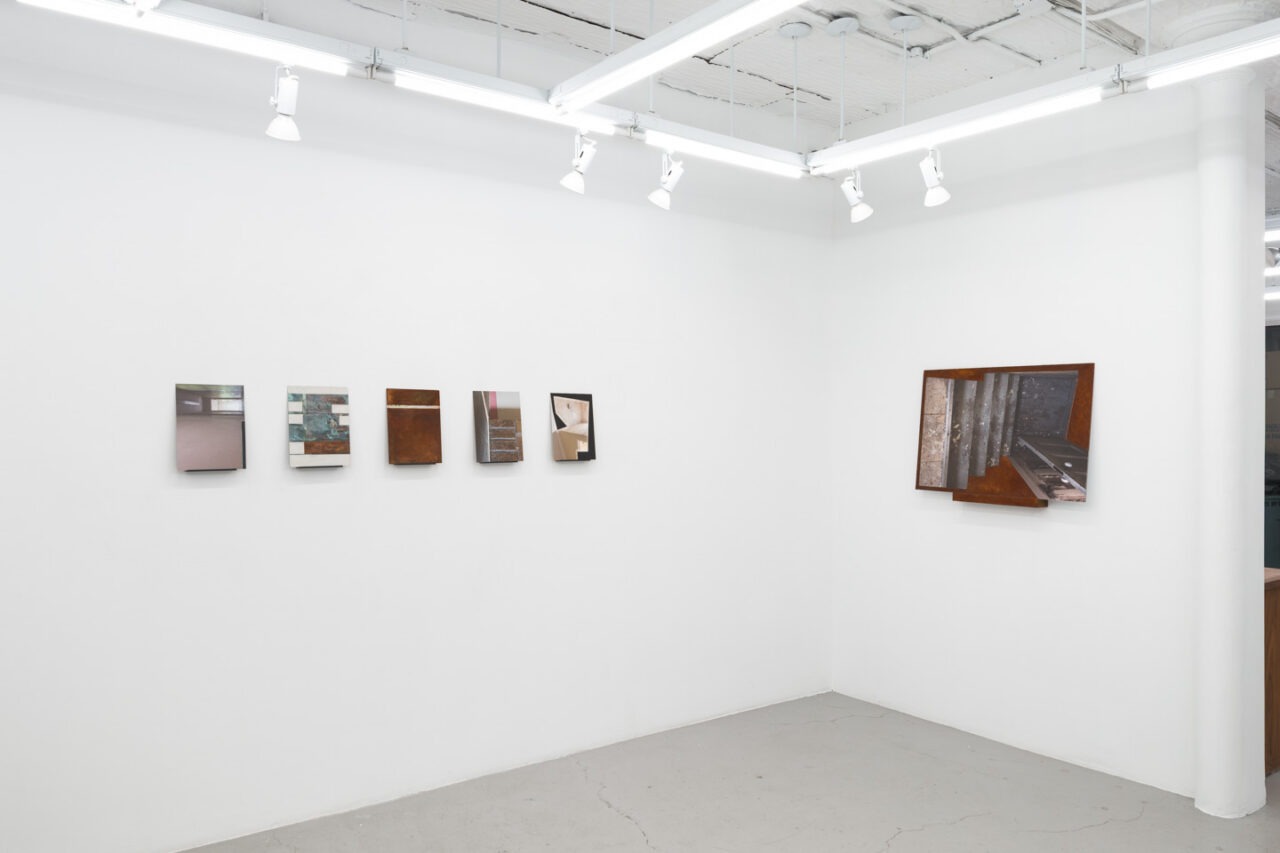
To gather these images, Puls entered foreclosed properties with the help of a real estate agent and began to meticulously document “worn carpets, moldy ceilings, scratched wood veneers, and faded wallpaper, looking for a cause of death.” Her microscopic focus strips the home of its capacity to act as a sanctuary of intimacy and memory, and instead documents a form of expulsion. In her 2014 book Expulsion: Brutality and Complexity in the Global Economy, sociologist Saskia Sassen terms “expulsion” as the brutal mechanism of 21st-century capitalism that expels vulnerable populations from livelihoods, social safety nets, land, and membership in society. When mortgage-backed securities unraveled, 9 million households in the United States were foreclosed, transforming living shelters into dead, liquidatable assets.
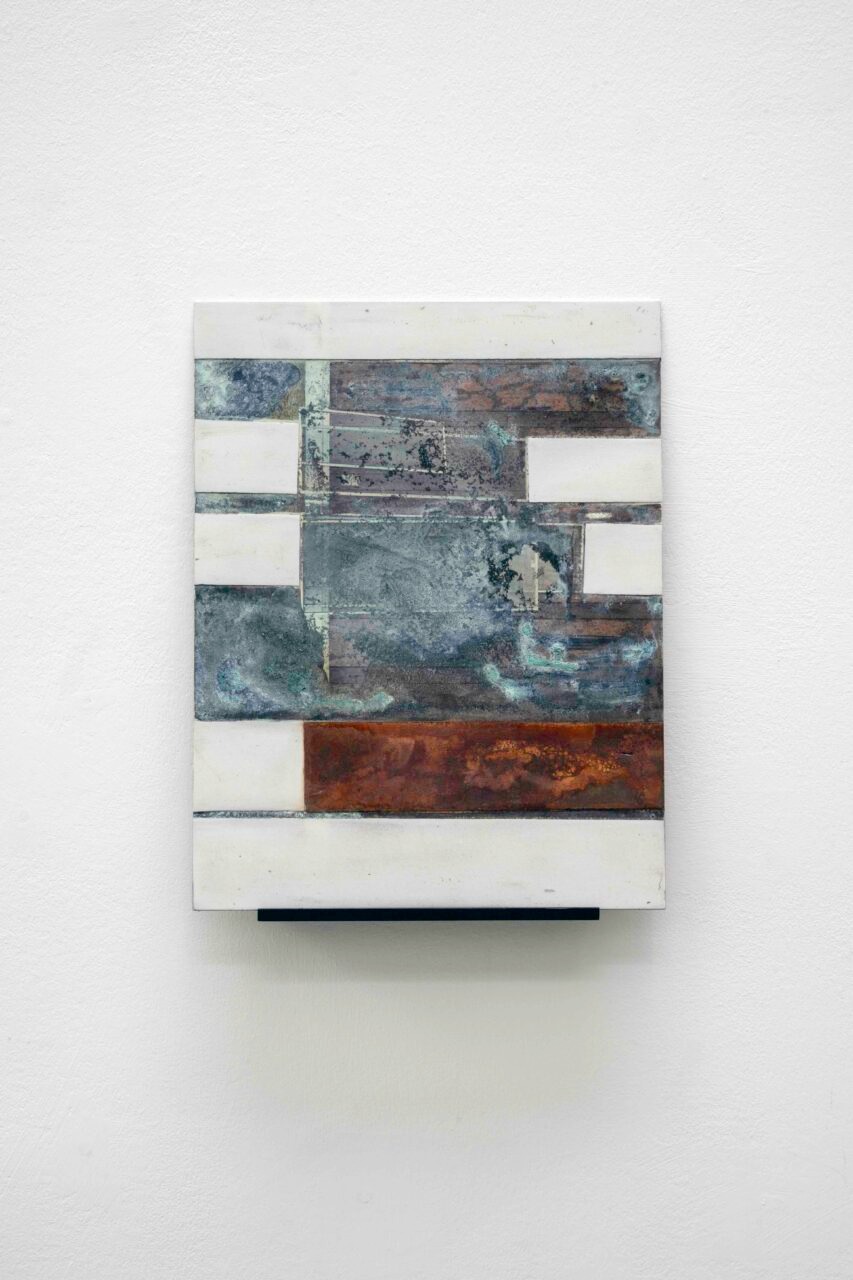
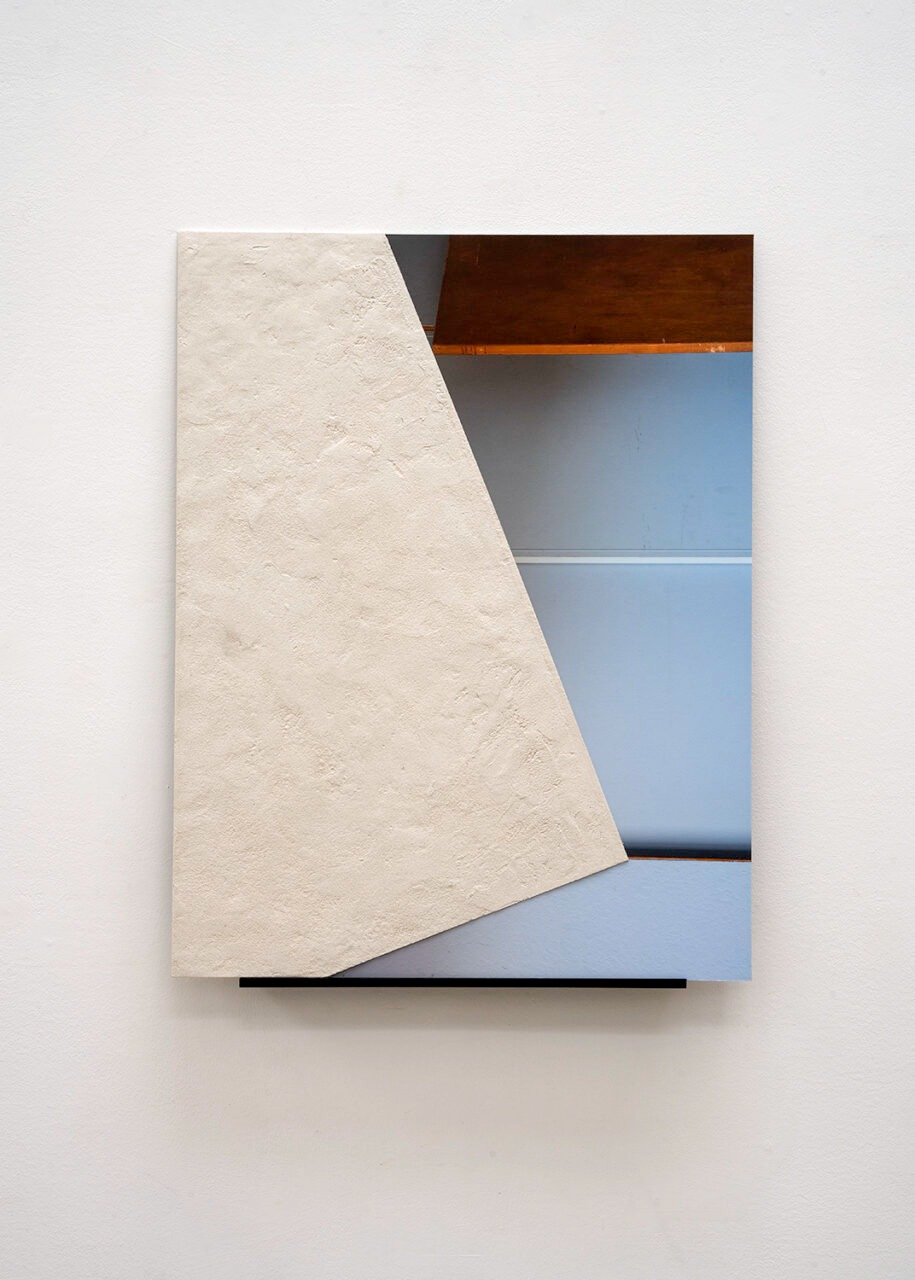
Puls matches this socio-economic violence with an equally intense material process. Mounting pigment prints onto aluminium and Dibond, she applies adhesives that physically tear ink off the surface, as well as resin and mineral compounds that build up new lines, planes, and geometric forms that cover the original composition of the photographs. In Geometrica Concretus (Stephens 2645) (2016), a beige pentagon of textured, wall-like material conceals over half of the underlying photograph. Blue and brown stripes extend from beneath this shroud, yielding a minimalist composition that quietly recalls the textures of painted drywall and dark wooden floorboards. Meanwhile, the intimate, 11-by-8.5 scale of Constitum (Posen 0544) (2016) echoes the exact dimensions of a legal property deed or eviction notice. Here, matte white and rust-colored blocks—cast from materials including silica, pumice, whiting, and bronze powder—overlay the photographic composition like floorboards. A wash of light-blue mineral slurry renders the original image illegible, evoking the lingering residue of water damage. Through these physical interventions, the photograph ceases to function as a window into a past event, but becomes a fossilized slab. The home is evicted twice, first by the bank from physical reality to financial asset, and second by Puls from its photographic surface.
It is precisely these material interventions that complicate the exhibition title, Righting, which refers both to the physical act of bringing an object upright and the moral gesture of repairing an injustice. The gallery’s shelf display reinforces this tension, keeping the panels in a state of suspended physical imbalance. While the term “righting” frames Puls’ geometric overlays as an attempt to correct or mend past rupture, these heavy, impermeable, industrial skins cannot fix the physical state of the house nor undo the devastation experienced by its inhabitants. They function instead as forensic containment, permanently sealing and suspending the socio-economic and emotional trauma of displacement.
In doing so, Puls re-politicizes the formal vocabulary of minimalism. Where minimalists deployed primary geometric forms and industrial materials to reject narrative and illusionism in favor of literal presence, Puls weaponizes those exact tools. Her clean rectangles and metal blocks are no longer transcendental forms, but cold, bureaucratic structures: the legal borders of a sealed property imposed over human suffering. Angled away from the flat wall, Puls’s panels stand as a sharp question: can systemic violence ever be truly “righted” through the tidy ordering of art?
1 Dena Beard, “Lucy Puls: [just you]” (Verge Center for the Arts, 2015).
2 Saskia Sassen, Expulsions: Brutality and Complexity in the Global Economy (Harvard University Press, 2014).
Lucy Puls: Righting is on view at Nicelle Beauchene Gallery from September 9 through October 24, 2026.