.webp)
To Touch the Sky: The Drone in Contemporary Performance
Voice
The characters on a dance stage are always first inhabitants of the creator’s subconscious, whether they have names and defined characteristics or not. As modern image-culture becomes increasingly saturated, Lu Yim’s Bottom Edge Air, performed at Mabou Mines on July 26, contends with the characters and symbols embedded in our collective subconscious, inviting the audience to play with their preexisting meanings.
In this evening-length performance, Kiera Bono, the narrator seated in the front row, introduces a small cast of these characters ranging in cultural clockability. The audio description, which runs for the duration of the show, both reframes the work and offers an elegant example of the accessibility measures increasingly common in performance spaces. Beyond mere report of the work—in and of itself a useful and necessary tool—Bono’s narration functions here as a performative motif, with the script oscillating between the utilitarian and abstractly poetic.
“Starman and the Red Tesla Roadster are tethered together in an infinite deterioration,” Bono begins softly, opening the show. Musk’s SpaceX mannequin is represented here by Yining Chi, who wears the Tesla Roadster on their body, a sort of backpack-harness of deconstructed car parts designed by Zo Roze. Chi, also wearing sunglasses and tight athletic wear, slowly circles their hips with hands on their head, eyes looking upward. Bono’s description, as with much of their narration, both accentuates Chi’s movement as well as distorts it.
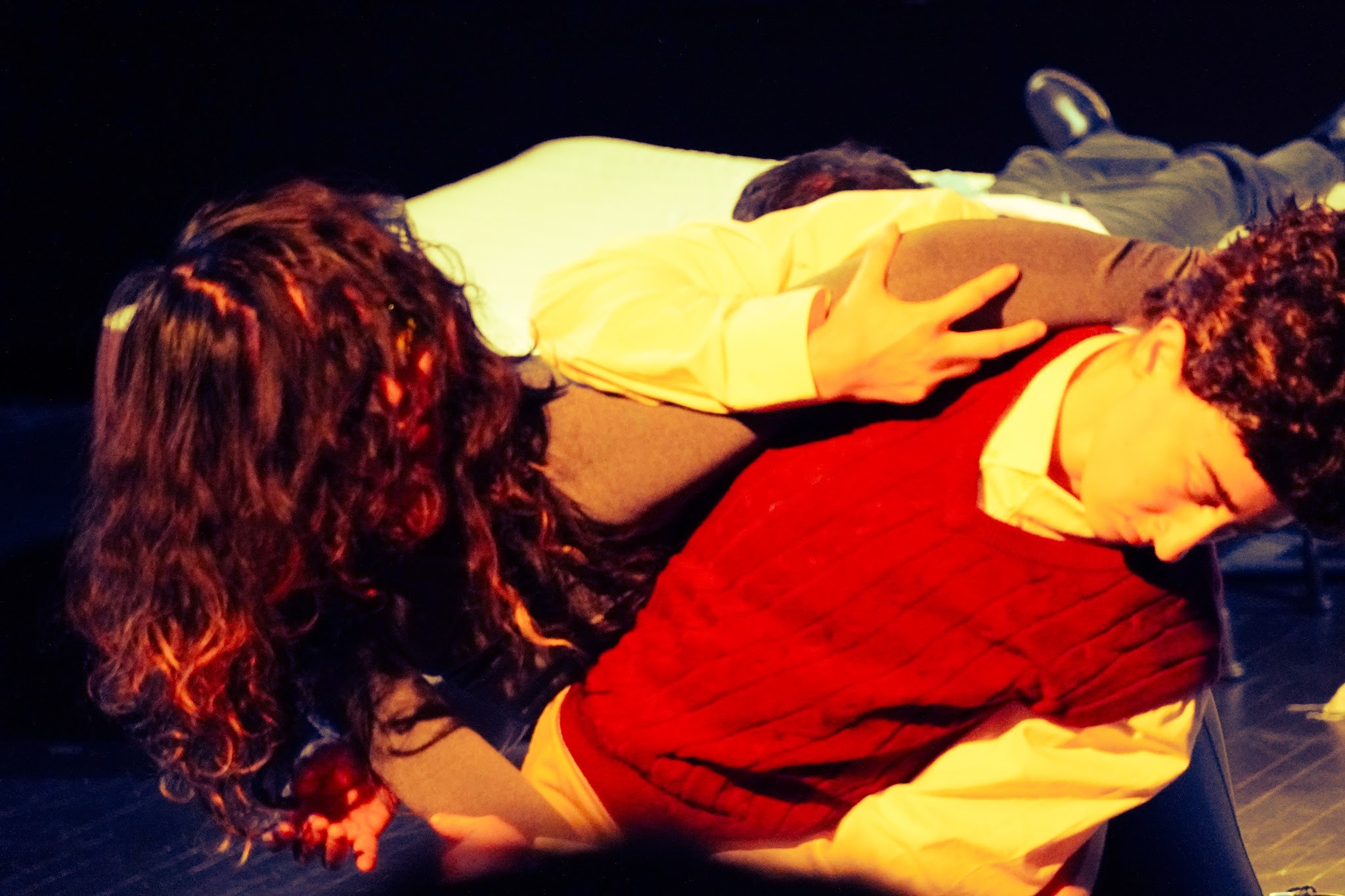
“Luigi enters from upstage right,” conducts Bono, directing the audience’s attention to the most recognizable character of the ensemble. Performer Ella Dawn W-S wears a dark curly wig and an outfit modeled after Luigi Mangioni’s now-iconic ensemble from his December 2024 court appearance. Much of W-S’s movement here extends outward from the spine—slumping forward or arching back—perhaps in reference to Mangioni’s chronic pain. Bono continues: “Vertebra by vertebra, slowly decentralizing the effort.”
The cast is rounded out by more archetypal characters: Baby, played by Cynthia Chang, and Military Man #1 and Military Man #2, played by Takahiro Yamamoto and Yim respectively. Chang’s Baby is a tenderly transgressive presence who seems to be in a constant state of unraveling. Yamamoto and Yim’s Military Men are anonymous off-duty soldiers donning white T-shirts and camouflage pants.
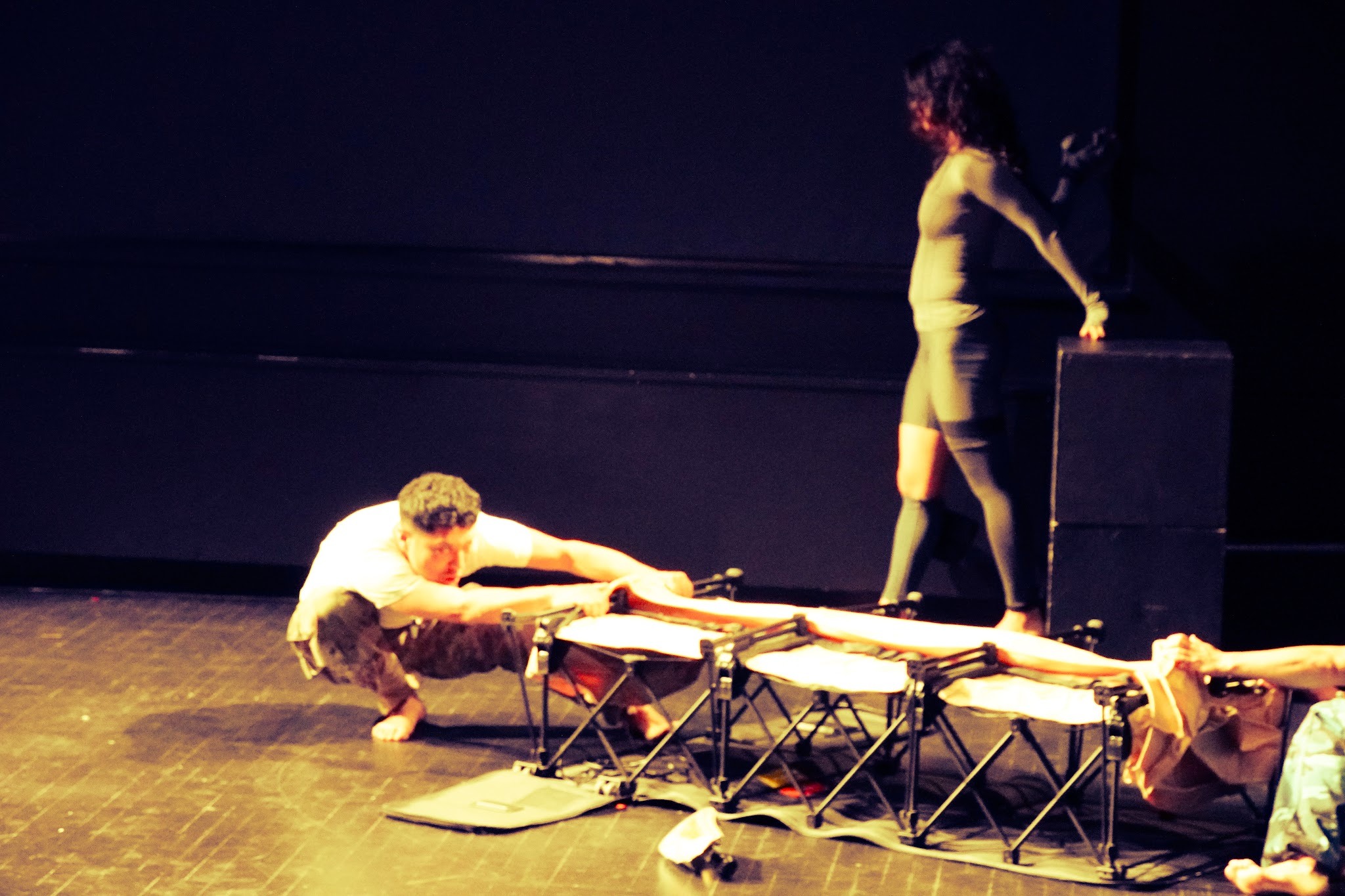
With the narrator as a disembodied docent, the ensemble twirls within the void of the stage like bodies in a black hole. Throughout the first section of the piece, the dancers enter and exit from both sides seemingly without cause, creating a kind of limbo effect. Yim’s characters carefully enact physical choices in isolated trajectories, often traveling in repeated phrases of slow, grasping motions, as if in a trance or stuck in a memory. At times, their bodies do mash together in crumpled flocks and align briefly for synchronized duets, like how the orbits of planets might coincide over the course of an era.
Each dancer’s track progresses as an unfurling of inner cognition, onto which the audience is left to project. Luigi performs one backbend after another in a daydream of physical mobility and freedom from incarceration. Starman gyrates sensually with sunglass-shaded eyes, entwined with the Roadster in a pas-de-deux evoking the subconscious of a billionaire dilettante. Baby is the id-driven character of this primordial soup, meandering the stage pelvis-first in slow laps, tugging on their voluminous cloth diaper with the attitude of an infant—or a stunted adult. And the Military Men’s full-bodied gestures of yearning, their bodies collapsing and folding into each other, undermine the sort of masculine stoicism associated with combat.
Around the halfway mark, the narration shifts from removed observation to more opaque confession. Bono rises from their seat in the audience and lies on an inflated mattress upstage left, resting from their descriptive duties. Baby takes a mic from offstage and begins a monologue from the perspective of a surgery patient, invoking the only “I” of this work. Yim’s Military Man #1 reemerges in a hospital gown, performing a looping solo, and Luigi and Starman don surgeon attire.
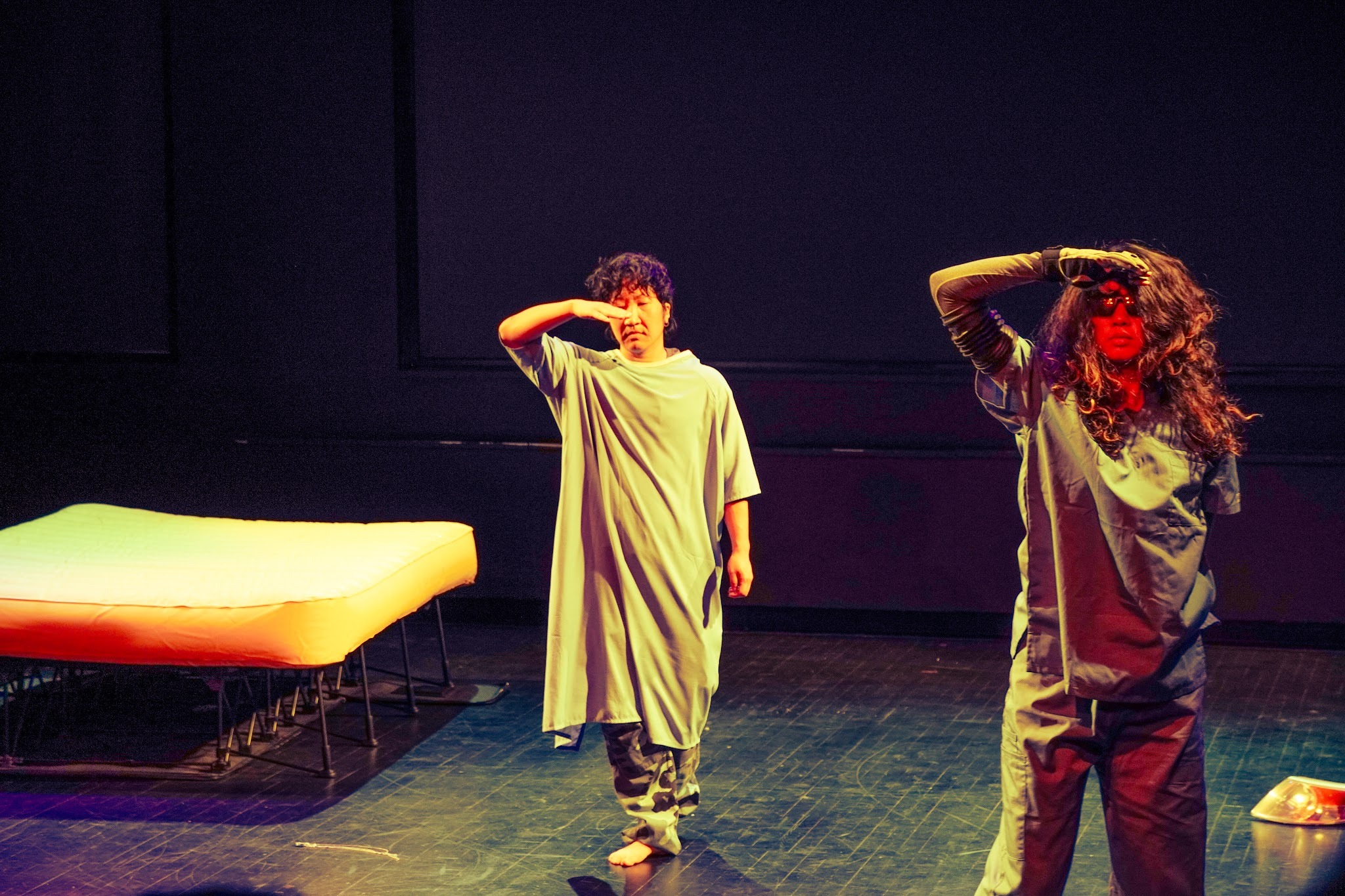
While Bottom Edge Air’s characters do the work of pre-loading this performance with cultural context, their relationship to one another on the stage is often mysterious. Yim lets the thesis of this work hang rather ambiguously, perhaps more interested in creating a contemplative environment for the audience to sit with these jumbled-up personas. Bono’s narration feels crucial to the mixture, providing a diffuse but rigorous textual framework that can channel the audience’s attention while also opening a figurative avenue of thought.
In a world defined by engineered inequity, the hoarding of wealth, and carceral violence, what remain are the washed-out artifacts of personality cult—proliferated personas and simulated archetypes expanded to the size of cosmos. Yim does not seem overly concerned with mining these artifacts for deeper meaning, instead using them as superficial signifiers. By placing these loaded personas upon their dancers, Yim engages in a choreographic question of how outside violence might brush up against these specific bodies trapped in the contrived boundary of a performance.
The overall effect is a soft-focus cross-section of medical urgency. Like the personas of the characters, the props are similarly charged yet somehow neutral: the chrome bedpan banging against the wood floor, the blowup mattress unfolding like a breathing creature, the Tesla’s discarded taillight winking at the audience. When Military Man #1 drags the mattress onstage and Baby inflates it, the empty stage is suddenly a room. But where is this? Perhaps a hospital, perhaps a soldier’s tent. The bodies continue to tumble in and out from offstage, which might as well be another universe. Sometimes entangled, they are easily detached. The movements and textural audio track may swell for a moment, portending doom, but nothing is revealed or released.
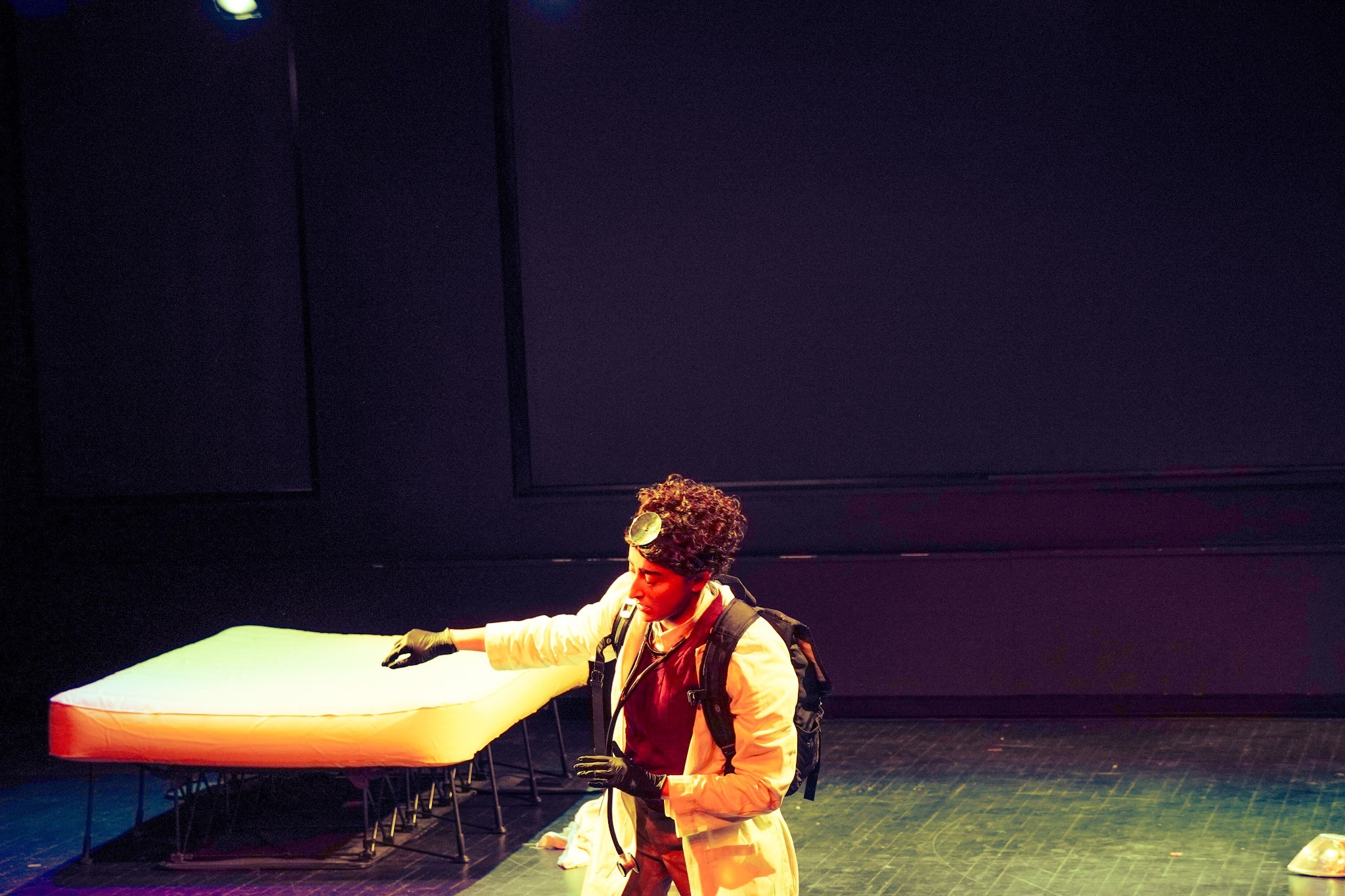
Eager as the audience might be for these heavenly bodies to coalesce, gravity has other plans for the assemblage. The air-filled cot crumples with a sucking sound, and the room is no longer a room. Bono resumes their station among the audience, as Baby and Luigi continue their visceral writhing, each in a vortex. Barefoot, Military Man #1 laboriously pushes the deflated skeleton of the mattress across the expanse of the stage as Starman draws endless circles with their hips. Yim’s Military Man #2 reemerges from darkness and crawls into the folds of the deflated mass, burrowing away from us into another enclosure.
Finally, it is Starman who concludes the ensemble’s trajectory through the troubled landscape. The stage lights dim, swallowing the cast in shadow, as Chi makes their way to the center of the stage. Facing away from the audience, their spine curves all the way back, reaching and looking out behind, before thrusting forward, grunting into darkness.
Lu Yim’s Bottom Edge Air was performed on July 26, 2026, at Mabou Mines in New York City. The performance featured Cynthia Chang, Yining Chi, Ella Dawn W-S, Takahiro Yamamoto, and Lu Yim, with audio description by Kiera Bono, wearable construction by Zo Roze, costumes by Laurel Atwell, sound by Lu Yim, and lights by Shana Crawford.