.webp)
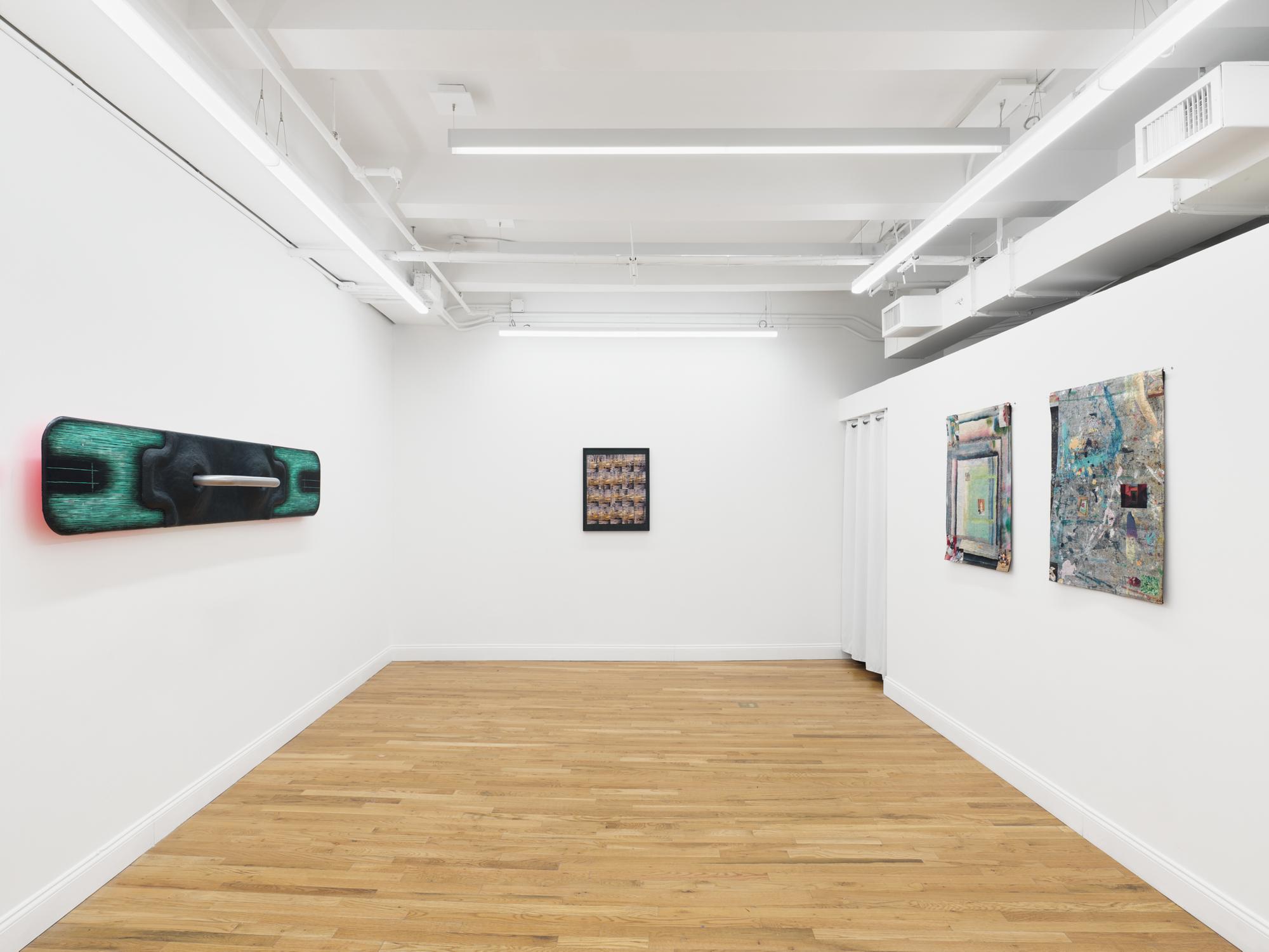
“Wetware” at RAINRAIN Gallery, Curated by Spine
Review
Taking its name from Eileen Chang’s eponymous novella, Love in a Fallen City recontextualizes expressions of love and desire as inextricable from the project of living. With over 60 artists contributing works staged complementary to the pre-existing ornamentation of an apartment space, the show literalizes the old adage “home is where the heart is” and memorializes the lingering afterlives of relationships spanning generations, time, and space.
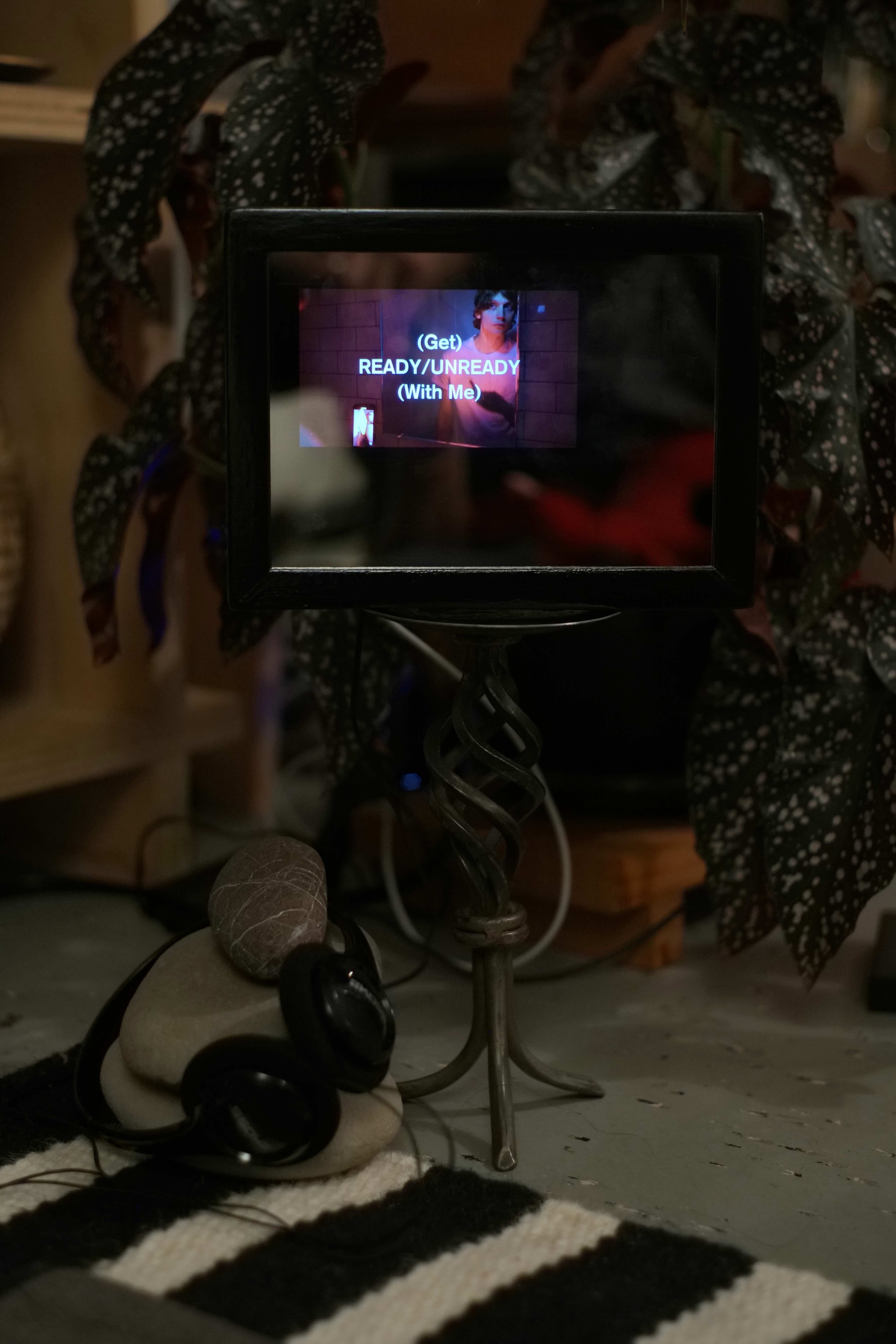
To desire is to express a want for what you do not already have; to love is to know something real and to continue that wanting, even if the object of your affection is not what you envision it to be. In an interplay between what is real and what is constructed, Matilda Lin Berke’s sculptural video Do u rly wan2 live 4evr? (2026) posits the question of whether or not the actual self can be spliced from one’s desire. The video is a film that the artist shot in 2024, and loops on an old iPhone 7 fixed behind mirrored glass set inside a frame. The sculpture itself is a lacquer box mounted on top of a wrought-iron candlestick polished to a similar finish: a construction that allows the apparatus to be held aloft much like a hand mirror. Facing the picture window, the glare of the setting sun obfuscates the video loop and reduces the screen to a mirror, forcing the viewer to confront their own reflection while wondering about the film concealed on the other side. As the sun goes down and the room dims, however, the mirror darkens, allowing the video underneath to glow through the glass. The viewer and the video cannot be seen clearly at the same time, because desire is by nature transmuted through the act of projection: what we seek is obscured, at least in part, by what we bring to it. Depending on the time of day and the moment in the film’s loop, the work continually shifts between image and reflection, revealing different facets of something that remains fundamentally unchanged.
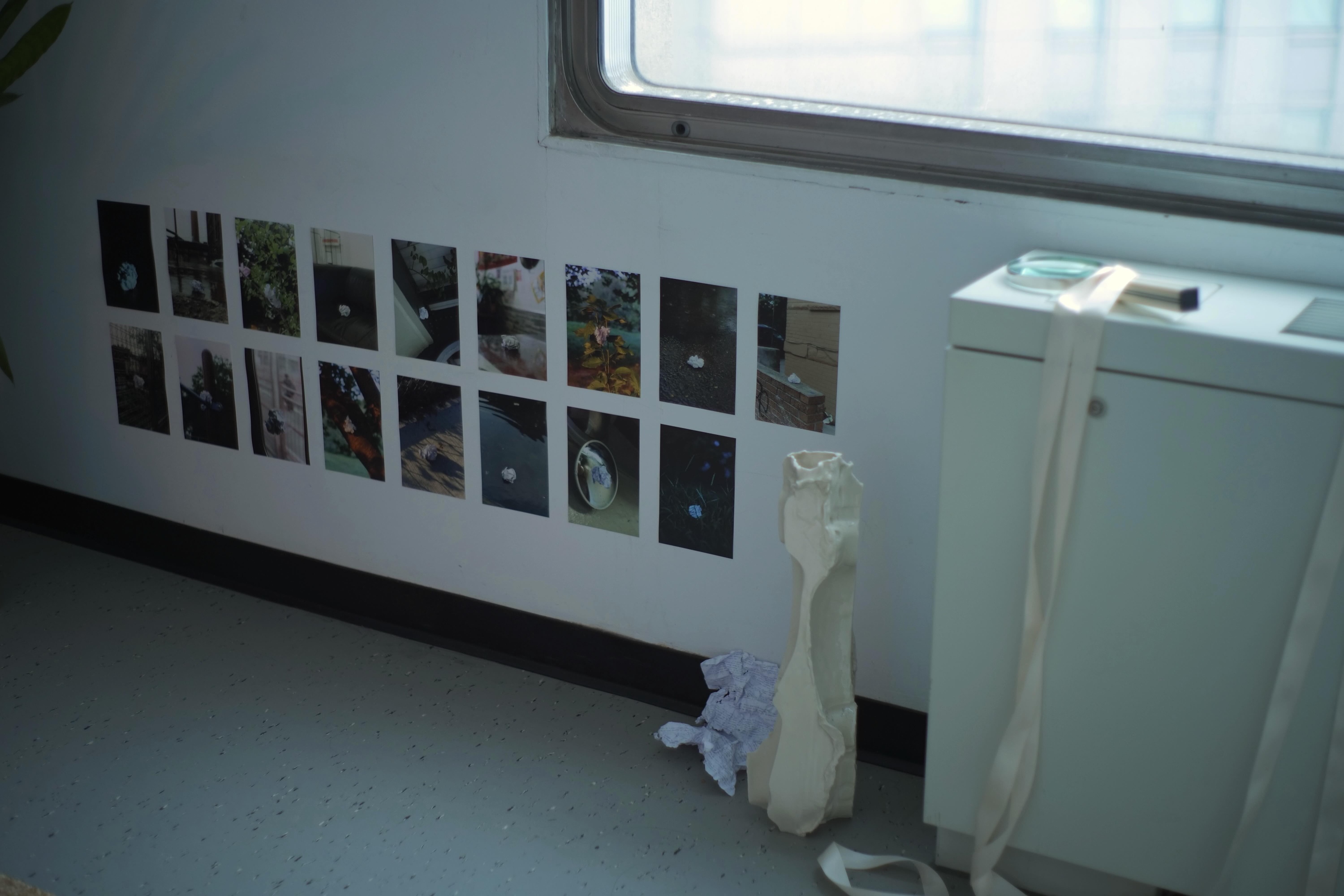
The same is true about found objects. Their being found and desired by another metamorphoses them so that they become a part of something bigger than they are. Take, for example, Megan Mi-Ai Lee’s Love Meter (2026), whose glass vial is nestled inside a yellow cardboard box. It’s meant to be a game played between two people, where each person takes a turn cupping the object’s glass body in hand and watches the red liquid bubble to the top; whoever makes the liquid rise and bubble quicker wins, and is implied to love the other person more. The inherently tactile nature of the game emphasizes physical presence as a prerequisite to determine compatibility, the gulf between artists and their loved ones made apparent when contrasting Love Meter against surrounding video works. Meanwhile, Alice Gong Xiao Wen’s Untitled (2026), a magnifying glass tethered to the window handle, is oriented to a tight space and thus encourages viewers to engage closely with other works nearby (such as a balled-up breakup letter featured in Nico Poblete’s a romanticized version of us (2026), small type made more readable through the lens).
Some of the found objects strewn in the show also serve as divining tools, reaching toward one’s personal history and a desire to understand a past that was not their own. Simon Shim-Sutcliffe’s Horizon (2026) is quite literal in this way, the handmade sailor’s compass a physical reminder of what it means to orient oneself and lineage across geography and generations. Alan Ruiz’s Serfín 1977-2004 (2026)—an inherently organizational artifact bearing the name of a Mexican financial institution which underwent several iterations of ownership before bankruptcy—is similarly made compelling through its provenance, having belonged to the artist’s father when he worked at Serfín until the bank’s restructuring, a souvenir of the tension between public and private relations.
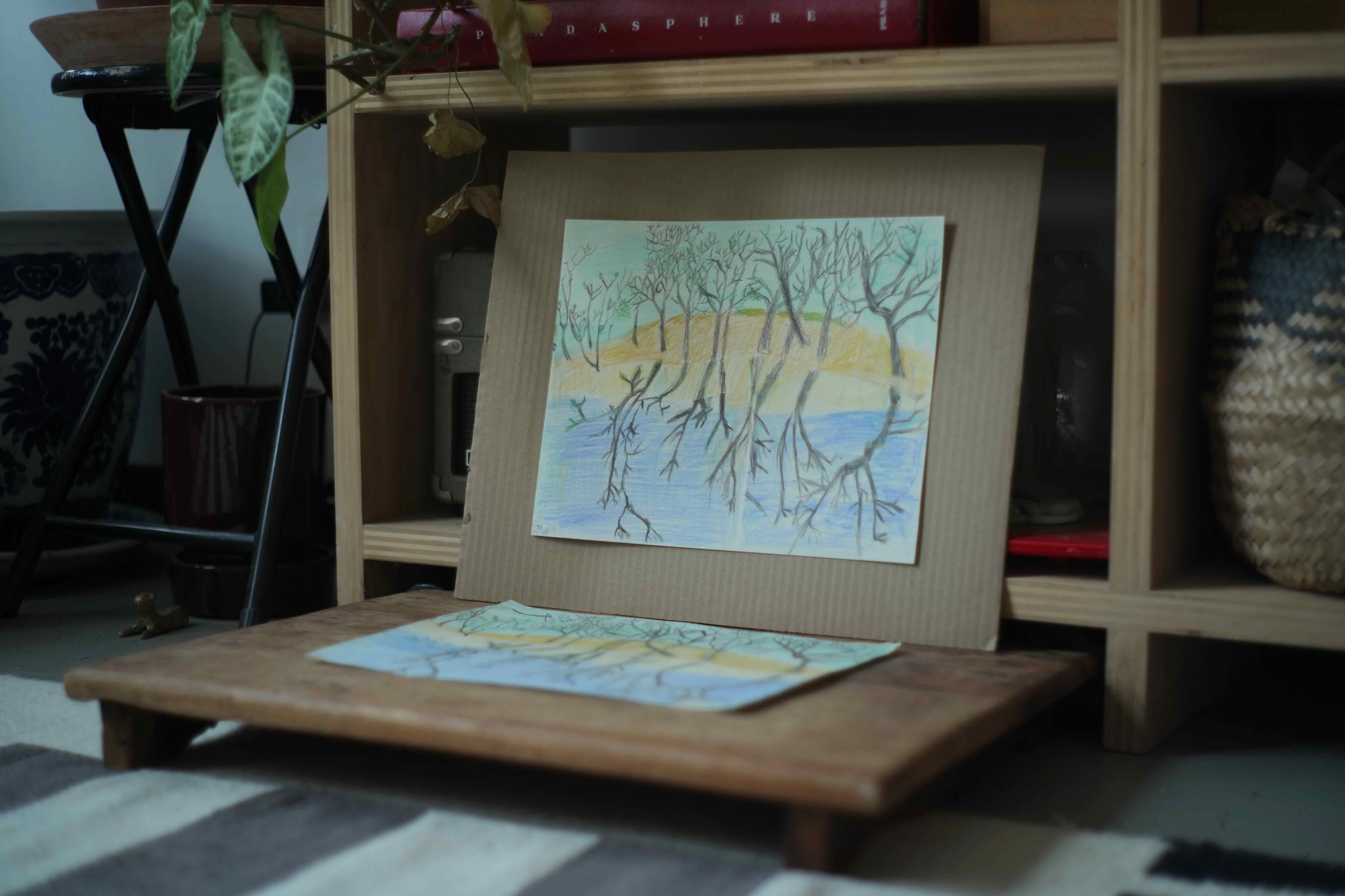
Though found objects are given new lives through the generous desire of their scavengers, they can’t speak truthfully for themselves. Desire is a signal transmission, an assumption; real love is symbiotic, a reciprocity. It takes two to tell a full truth; in that way, Love in a Fallen City is ripe with love stories as collaboration. Ami Lien and Piece Whang’s Light Journal (2025–26) was stitched together and submitted by Lien out of the desire to memorialize Whang’s journey of capturing moments of hope and joy amidst the backdrop of a broken world rife with personal and political grief. Bradley’s Drawing (2010/2026) by Ara Hao stages two drawings against one another in reflection of each other. The original was made by the artist’s younger brother as an imagined representation of the Bay where her family’s from; the copy was pieced together years later by Hao, Hao’s brother, and their mother across the Bay and New York City, its tear lines nearly indistinguishable from a distance.
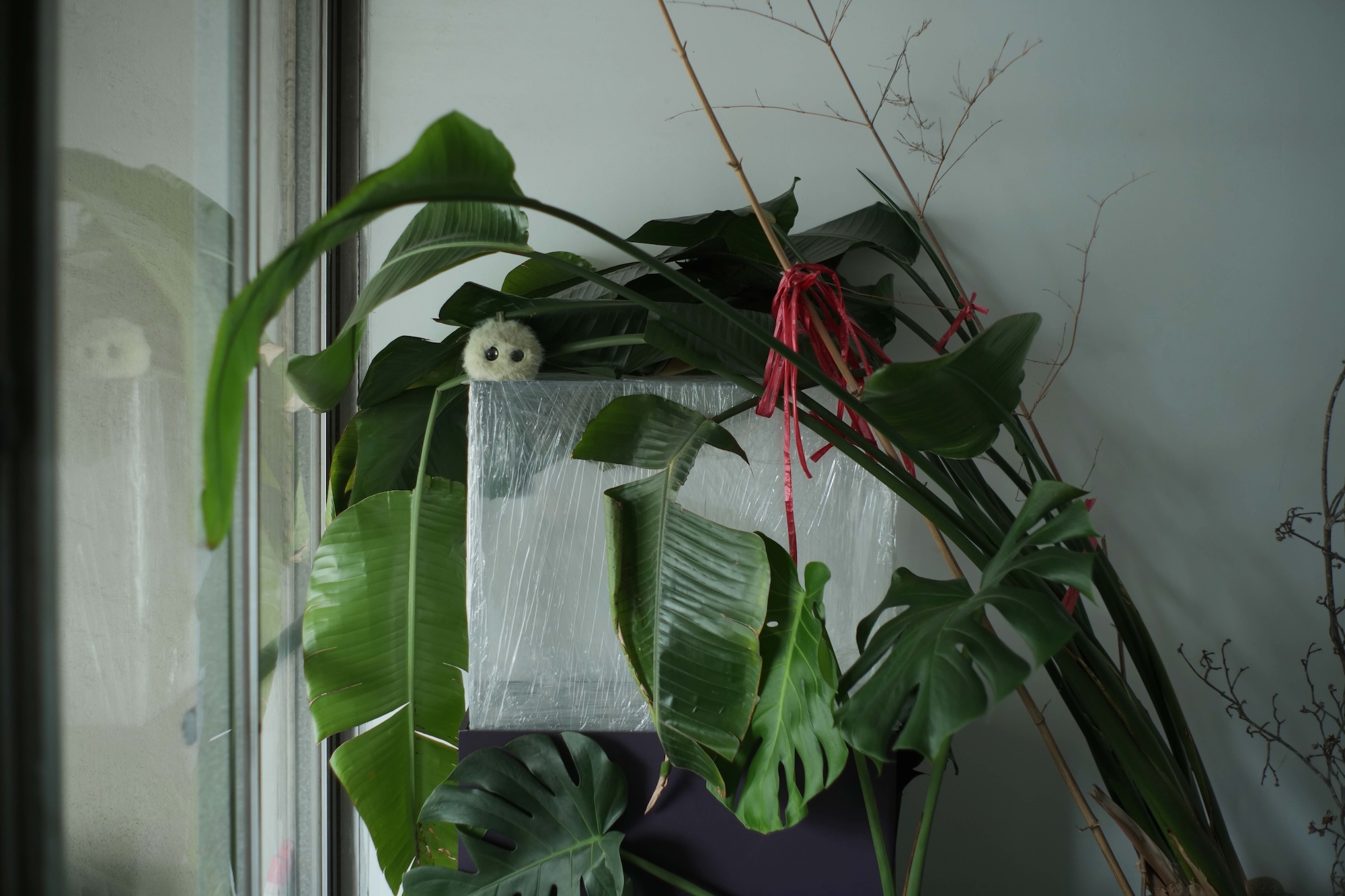
Jade Kuriki-Olivo’s Fuzozo (2026)—an anthropomorphic “AI emotional companion” with imploring green eyes—perches atop Craig Jun Li’s The Next Frame of My Picture Is a Moment with (2026/ongoing), a pedestal with a plexiglass vitrine that was recently used to show a Paul Thek meat piece, itself part of a larger body of work expressing fear that technology would suppress the human spirit. Juxtaposing a foreign AI object intending to do exactly as Thek feared, against an apparatus evoking Thek’s artistic vision and spirit, highlights the dismal question that our show’s fallen city asks of us: in a world so cruel and unforgiving, how do we stay strong enough to keep living?
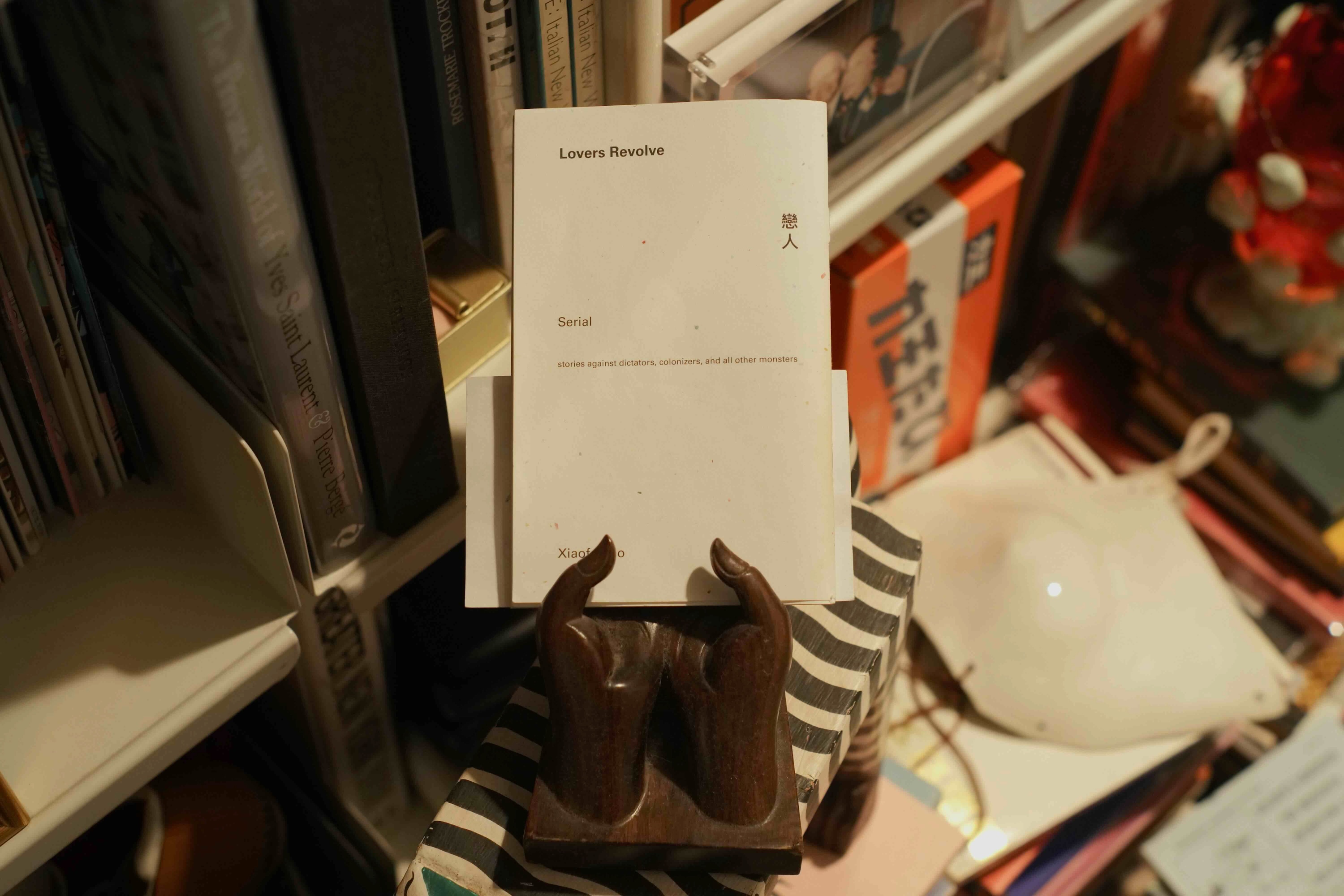
Cici Wu and Xiaofei Mo’s Lovers Revolve Lovers Revolt: Stories against dictators, colonizers and all other monsters (2020) proposes a solution and offers up another question that is held in cupped wooden hands: What is love if not a revolution, be it your own or others’? To be loved is to be changed, to transform yourself as reciprocation. If loving is the call, then action is the response; and within the exhibition, the call for communal engagement with artworks and artists brought the space to life. Autumn Ahn’s Doing and Undoing (Lampshade) (2026) was made specifically for the show, a blush-colored lampshade tailored to the space like the artist’s previous wedding presents for friends. Cherisse Gray and Cole Lu’s Somewhere in the Middle of Crime and Love Me Tender (2026) mapped the apartment space to fit a site-responsive installation, featuring erasure texts shimmering as a call to attention towards the architecture. Other works became socio-contextual readymades, performing as part of the installation site owner’s hosting, turning the apartment into a Fluxus capsule. Bonny Poon’s Fragile Woman (2026), a whole durian fruit collectively eaten with bare hands, and Zaid Arshad’s No title (2024-ongoing), a supply of dates offered as refreshment during exhibition open hours, were disappeared by the close of the show. Ivan Cheng’s cookie jars were emptied of their almond pastries and defaced. As attendees left the installation site, the host requested that they take a photo with a plushie on their way out; many grabbed the Addison Rae plushie from Maya Man’s Platform (2023). Regardless of the time of day or day of the week, as the works aforementioned were transfigured by viewers, visitors were transformed in kind through found kinship and relationality upon entering lovers’ embrace.
As attendees filtered out of the apartment each night, the guest list grew longer—a record no longer of strangers, but of newly kindled relationships dispersing across a city that suddenly seemed a little less cold.
Love in a Fallen City was curated by Lily Kwak and Qingyuan Deng. The group exhibition was on view at lovers, an apartment space hosted by Cynthia Leung, from August 18th to September 3rd, 2026.