
.webp)

Wenfei Quan: “Contemporary Hominin” at TaThaTa
Review
In the spring of 2026, Athens-based curator and writer Stamatia Dimitrakopoulos presented exhibitions in Los Angeles and New York dedicated to Grigoris Semitecolo (1935–2014), marking the US debut of a key figure in the Greek avant-garde. Moving between painting and performance, Semitecolo developed a language shaped by intensity, humor, and a restless energy that ran through both his art and his life. Dimitrakopoulos has worked closely with his estate, bringing careful attention to an artist whose work still feels strikingly relevant. In this conversation, she speaks about Semitecolo’s distinctive vision and the ways in which his legacy continues to unfold.

Nicolas Vamvouklis: To begin, how would you introduce Grigoris Semitecolo?
Stamatia Dimitrakopoulos: Grigoris Semitecolo occupies a singular place in the Greek context, a radical artist with an equally radical temperament. Born in Athens in 1935, he briefly studied at the School of Fine Arts under Yannis Moralis, and around that time, met his wife, the remarkable pianist Nelly Semitecolo. In his case, it is often difficult to separate performance from life, as the two seem to constantly fold into one another. There are countless accounts of his presence as unpredictable, subversive, and disarmingly humorous, whether he was staging an impromptu epitaph procession in the middle of a restaurant or stopping traffic in Exarchia to orchestrate a fictitious wedding on a white horse.
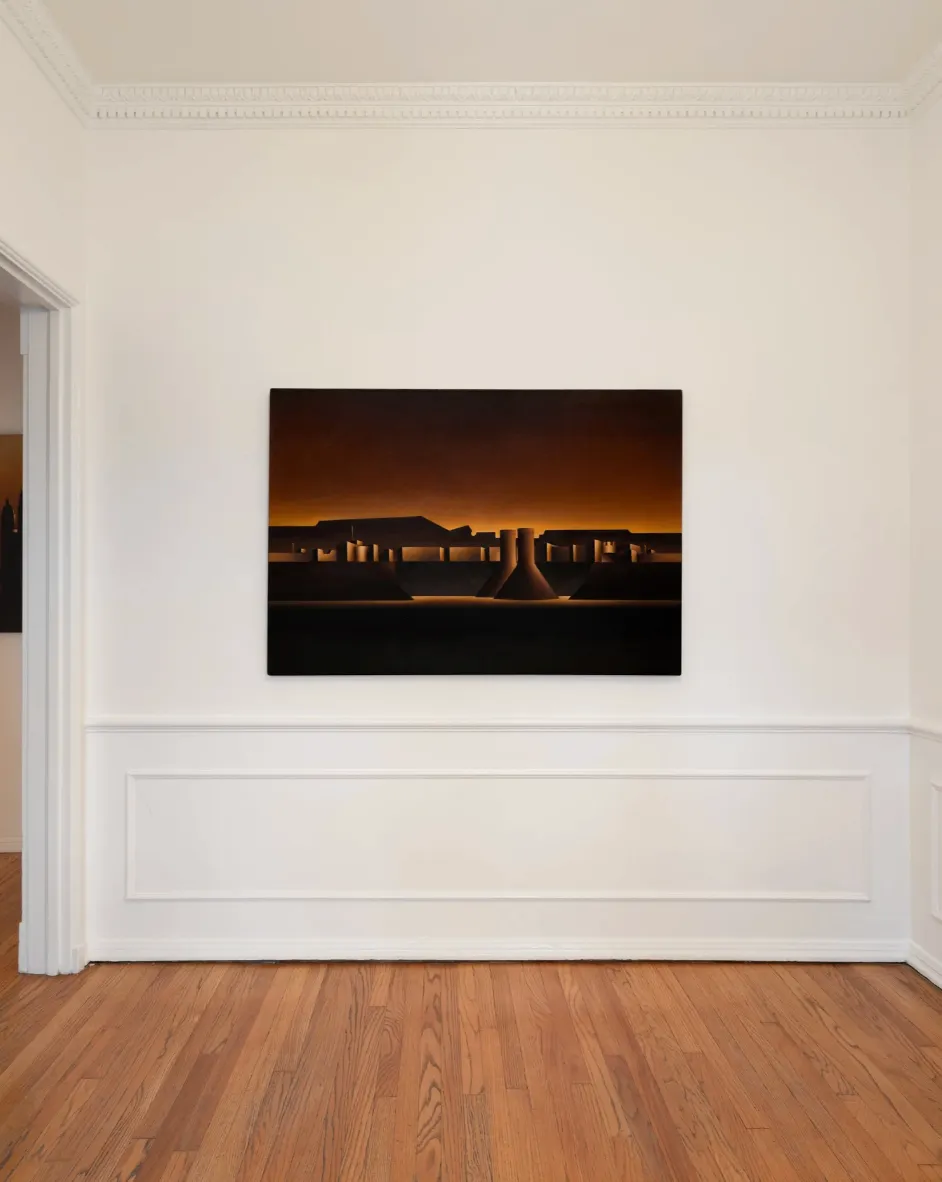
His close collaboration with Yani Christou gave him an important companion and interlocutor. Together they realized some of Christou’s most significant performances and toured internationally. In Semitecolo’s paintings, though, the atmosphere shifts. His psychological landscapes seem to emerge from the depths of Surrealism and Futurism. As he once said, “they resemble the view from the peak of an otherworldly feeling,” where objects and structures take on the role of quiet narrators.
NV: How did you first come to his work, and what made you feel it deserved renewed attention now?
SD: Semitecolo was always within my field of references, mainly because I’ve long been interested in that very thin point where the rational meets the irrational, where the first traces of the unconscious begin to appear within the conscious world. I think he sits exactly there.
In 2022, Christoforos Marinos organized a retrospective of his work at the Municipal Gallery of Athens, which gave me the chance to see a large body of it up close. Then, in the summer of 2025, he was one of the five artists in the group exhibition Janus, which I curated. While preparing that exhibition, I visited his studio, where I encountered not only the works but also the full extent of his archive. I asked Nelly if she would be open to revisiting his story, and that is really how it began.
I would not describe this as “renewed attention.” His work should never have been set aside in the first place. Artists like Semitecolo function as custodians of our contemporary cultural memory, and they require continuity. At the same time, in a context like Greece, with limited means, it is not unusual that when an artist passes and their network fades, the work ends up stored away. What feels important now is that, among curators and historians of my generation, there is a more instinctive return to these legacies. We are already seeing this with several major, often overlooked figures from previous generations.

NV: This spring, you curated two solo presentations of his work in the US. Why did it feel important to introduce him there?
SD: The collaboration came about quite organically, through a conversation between people who share a similar sensitivity. Sara Lee Hantman from Sea View in Los Angeles and Mike Egan from Ramiken in New York first encountered his work in Janus and almost immediately felt the need to engage with it more closely and to tell his story. There was something in the idiosyncrasy of the work, and in its many registers, that resonated with them right away.
At the same time, Semitecolo belongs, in his own way, to the broader field of postwar abstraction, and I think there is a common ground between his work and the movements that emerged in the US. in the 1960s. Not in a literal sense, but in the way certain questions are approached. I think they recognized that immediately, and intuitively understood how to situate a practice like his within that context.
NV: The exhibitions focus on paintings that move between the architectural and the abstract. How did you approach the selection across the two galleries?
SD: That is actually a very interesting observation, because it shows how much the exhibition context shapes the way a body of work is perceived. In reality, we did not divide the works between the two exhibitions according to city or theme, as we wanted both presentations to function as full introductions to Semitecolo’s work. The body of work remained consistent, but the conditions of display were entirely different.

NV: What did those different settings bring out?
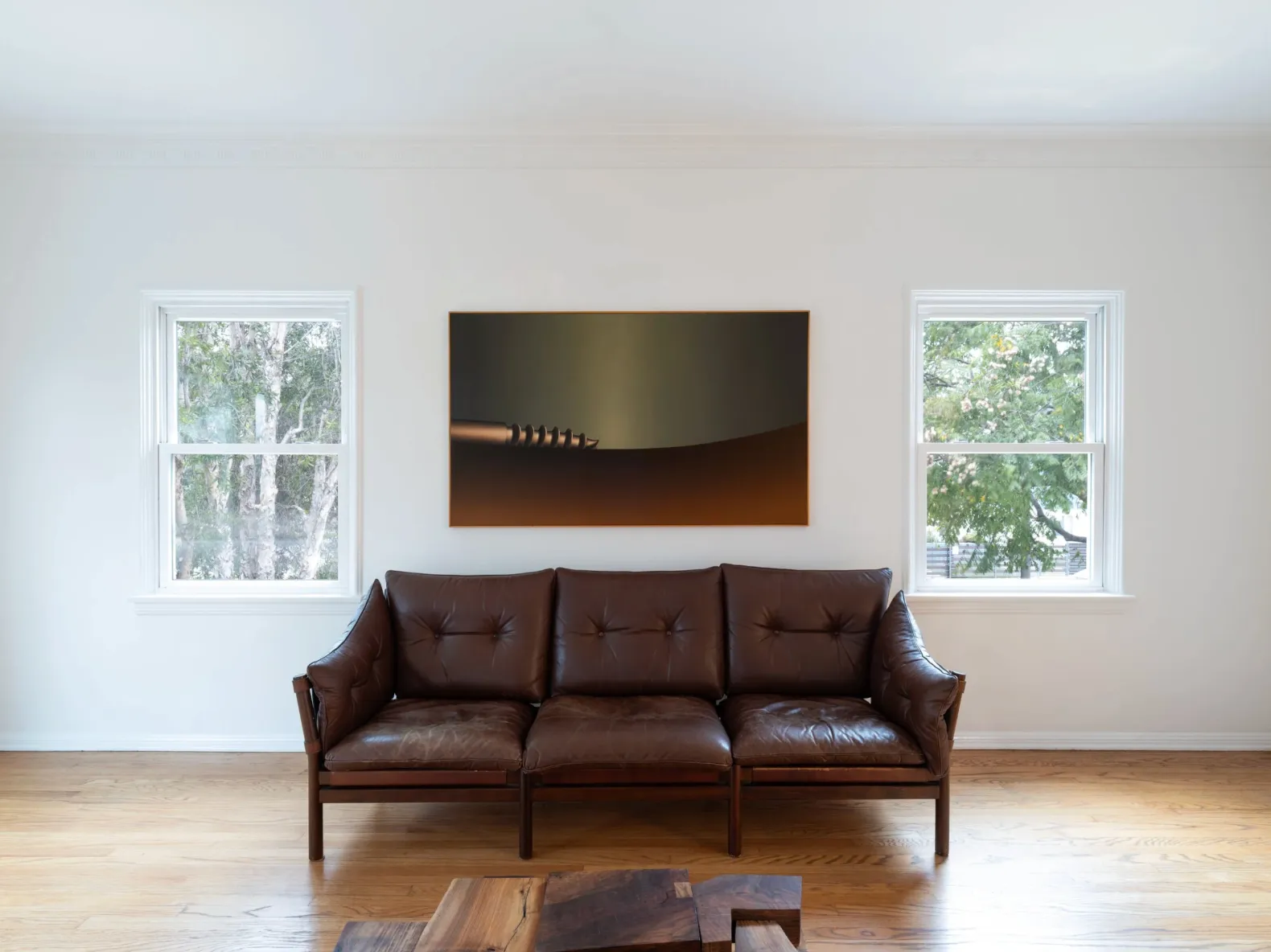
SD: Sea View in Los Angeles is housed in a beautifully restored 1930s Hollywood building, where art, design, and architecture intersect. The works were shown within a domestic setting, in dialogue with striking furniture pieces by artists represented by the gallery. It was the first time I saw his paintings in that kind of environment, and what was remarkable was how fresh and contemporary they felt, seamlessly inhabiting the space.
By contrast, Ramiken is the epitome of a New York gallery, a more condensed white cube on Grand Street, with a large two-way mirrored glass façade that shifts between reflection and transparency depending on the light, casting a slightly sepia tone over the exhibition. The same works appeared more urban, sharper, almost more exposed.
NV: The Los Angeles show carries a poetic title: At Dawn the Mad Hare Gleamed. What kind of reading did you want it to open up?
SD: The title comes from Miltos Sachtouris’s The Mad Hare, a poem of particular importance to Semitecolo. In it, the hare moves through a kind of suspended time, searching for love in a world that already feels depleted. Sachtouris builds a world that feels closed, slightly nightmarish, marked by repetition and a quiet but persistent tension.
Semitecolo often identified with the figure of the mad hare himself, moving constantly, never fully settling, existing somewhere in between. There is a sense of being slightly out of place in every field, while still being able to move between them.
The poem also resonates strongly with the present moment in the United States. A society struggling to move beyond a deeply ambiguous and often destructive condition, where political irrationality has entered everyday experience, mirrors the hare’s agitation and lack of direction. The mad hare becomes a figure through which a broader collective unease can be recognized, a subject navigating contradiction, instability, and exhaustion while still trying to find a path forward.
NV: In his text on Semitecolo, C. Georgiades begins with the line, “The artist is nuts.” Why did he choose to frame him that way?
SD: And that was only the beginning. It’s a very funny text written by C. Georgiades, who introduces himself as an “internationally unknown Greek writer” before going on to completely roast Grigoris. Mike Egan is particularly fond of it, as it captures the spirit of a period, when humor went hand in hand with absurdity and exaggeration, and people did not take themselves too seriously.
I was also quite surprised to see it printed in the Ramiken show next to the actual press release. It feels close to Fluxus, and it reminds me of a book I love, An Anecdoted Topography of Chance by Daniel Spoerri, with its attention to chance encounters, everyday life, and friendships between artists.
NV: Beyond reintroducing a radical body of work through exhibitions, you are also navigating the stewardship of an artistic legacy. How did you work with the estate to shape this research?
SD: In this case, it was a very hands-on process, as his studio had remained closed for many years. In close collaboration with Nelly Semitecolo, the initial focus was on reorganizing the studio space. In relation to the works, this involved documentation and the necessary conservation. In relation to the material, archiving, and digitization.
At the same time, because Grigoris’ work is held in major museums and private collections, and because of his performances and important collaborations, there was already a significant amount of material out there. He also exhibited for years with the historic gallery Nees Morfes, which later became the Contemporary Greek Art Institute (ISET), where a large part of this material has been digitized and is accessible online. Alongside that, there are also a few publications he produced himself, so there was already a solid base to work from.
NV: What were the main challenges in bringing this material together?
SD: Any minor difficulties fade in comparison to the privilege and joy of working with the legacy of Grigoris Semitecolo at such a primary level. Direct contact with the works, the archive, the process of structuring the material, and the orchestration of the next steps were all part of it. The trust of those close to him, along with the energy of a wider circle around his work, especially other artists, created a very supportive context. That became the driving force behind the project.
NV: What does it mean to keep an artist’s work alive without fixing it in place?
SD: I think the most essential aspect of Grigoris’ temperament, and therefore of his work, is that he never allowed himself to become fixed in place, even at moments when that might have served a more conventional career trajectory. In that sense, the way to approach his work today is already there, by following its own internal logic.
This is already happening. His work was recently presented in Janus, where it entered into dialogue with artists such as SAGG Napoli, Rallou Manou, Mungo Thomson, and Nausika Pastra. It was then included in a large group exhibition in Istanbul curated by Brandy Carstens, presented during Art Basel Miami, and shown in a solo presentation at the historic Chelsea Hotel in New York, preceding the solo exhibitions in Los Angeles and New York. In the coming days, a small part of his work will also be included in the major Jani Christou retrospective at EMST, curated by Costis Zouliatis, focusing on their collaboration. So the key, for me, is to follow the natural inclination of the material and allow it to find its course, while making sure that a strong framework of opportunities is in place.
NV: Do you see these exhibitions as the beginning of a larger reappraisal of Semitecolo?
SD: Definitely. The work seems to be re-emerging at a moment that speaks directly to it. Younger audiences often assume they are looking at a contemporary international artist. The timing is striking, as many of the questions and conditions his work engages with feel entirely present. What is currently underway is a major monograph on his work, alongside a series of institutional presentations, both in Greece and internationally.

The exhibition of Grigoris Semitecolo is on view at Ramiken from March 4 to April 11, 2026. The exhibition At Dawn the Mad Hare Gleamed at Sea View is on view from February 21 to March 28, 2026.