

.webp)
%20Headshot_Matthew%20McPhillips.jpg)
Unsympathetic Clock: In Conversation with TJ Shin
Interview
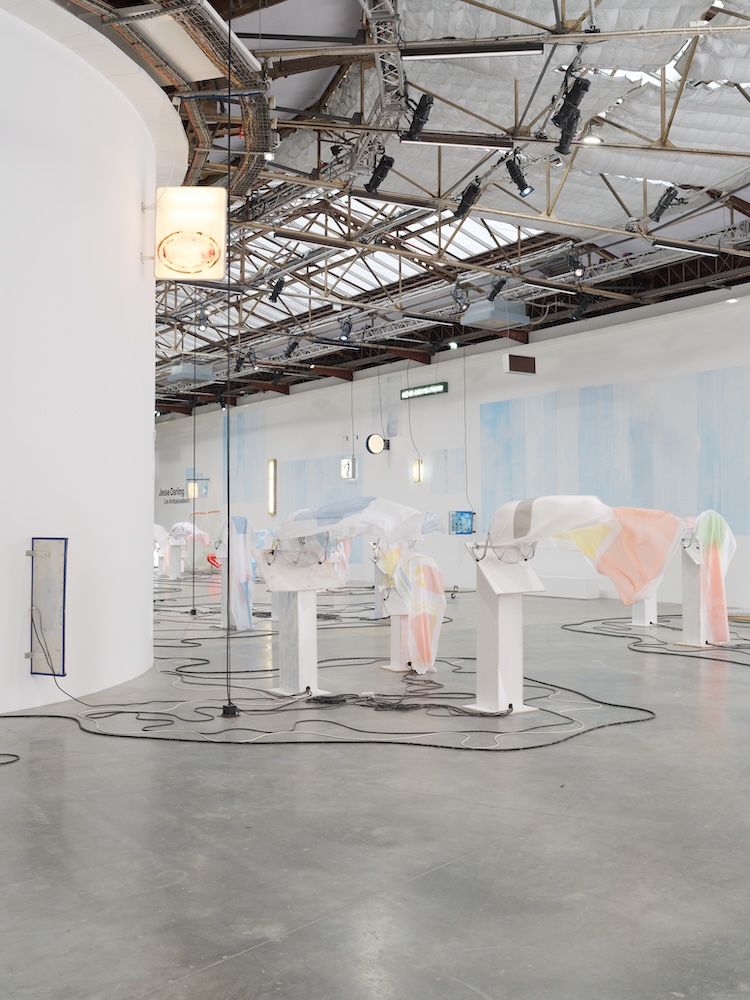
An orchestra of low industrial hums welcomes visitors into Jesse Darling’s new commission Les Ambassadeurs (2026) in the grande verrière of the Palais de Tokyo. Atop lecterns, large fans periodically whir to life in sequence, fluttering flags that seem to have lost the defining colors of their origins. The power of these objects has been drained, as with the posters that appear ripped from the surrounding walls alongside illuminated advertising signs that have been reduced to abstracted paintings. When the lighted signs flicker, the fans stop, and the flags slowly float down, visitors are left with poetic stillness and a pervasive sense of unease.
The exhibition borrows its title from Hans Holbein the Younger’s renowned The Ambassadors (1533), a Renaissance painting depicting two French diplomats among allegorical objects that project knowledge and authority yet betray a world fracturing beneath them. Completed in the same year that Henry VIII remarried after breaking from the Catholic Church, the painting reveals the long-term political and religious dissonance fueled by the English king as he ushered in the Reformation. Details on the lower shelf of the table between the men—such as the missing flute, the broken string on the lute, and the mathematics book open to a page on division—indicate the lack of harmony. No symbol is more striking than the anamorphic skull stretched across the canvas, visible in correct proportions only from a diagonal vantage point below its lower left edge—a hallmark of the vanitas tradition.
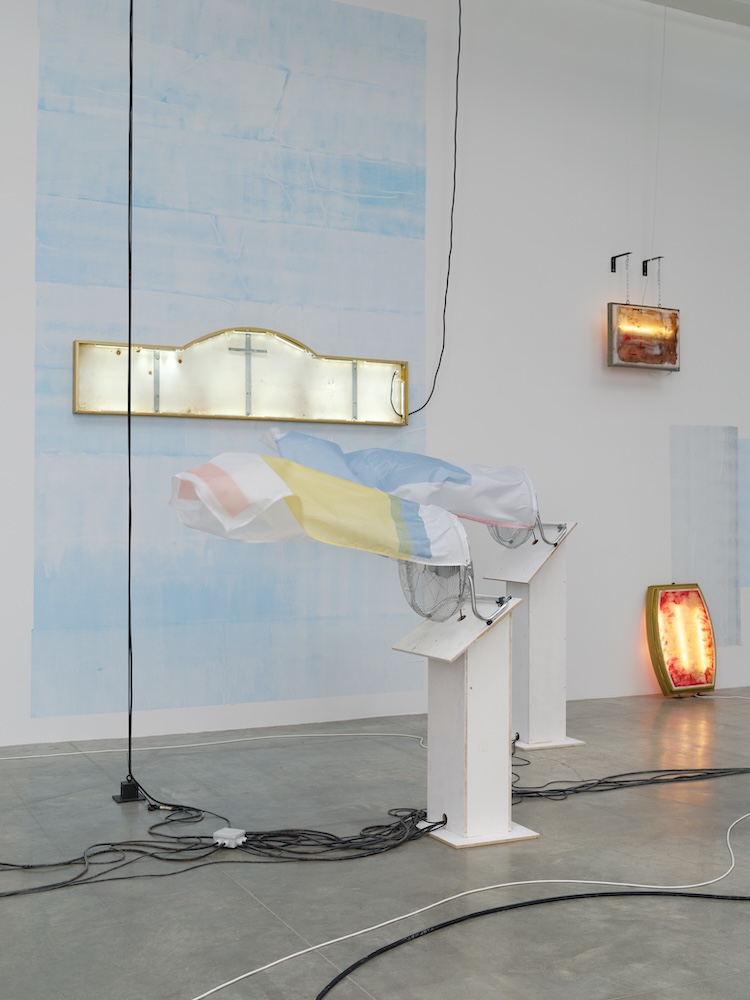
Instead of invoking traditional vanitas subjects, Darling incorporates abstracted posters and signs, which appear faded as if left under the harsh sun. The thirty-two lecterns are grouped together in small continents delineated by thick black wire. In lieu of a speech, each lectern holds an industrial metal fan fitted with a screenprinted flag representing a NATO nation, though almost entirely degraded. The flags take on a semblance of a nationalistic cape, each acting as a politician adding to an installation that operates like an eerie UN meeting.
With Les Ambassadeurs, one feels like an escapee from Plato’s Cave, observing the shadows of systems of power, production, and consumption. As the tempo of the installation unravels and the power flicks off, the flags slowly flutter limply, and we’re left in stillness. With some fans starting back up in a different pattern while others lie silent, there’s an elegance to the system shutting down. The cyclical rhythm of deflation recalls historical episodes, lessons from the Reformation that might just apply to the current geopolitical climate. Darling’s installation acts like a rogue puppeteer from Plato’s Cave, putting down their shadow performance and electing not to tell lies.

The commission also recalls the myth of Pirithous, who enlisted Theseus to accompany him to the Underworld in a bid to marry Persephone, effectively abducting the goddess from her husband Hades. Appalled by their hubris, Hades traps them in stone chairs that slowly fuse to their flesh and cause their memories of their past to vanish. Pirithous remains bound for eternity, punished for seeking what was never his to claim. The same logic of hubris emerges in Darling’s installation: the lecterns recall the intoxicating effects of control exemplified by Henry VIII’s defiance of the Catholic Church. It’s this sort of unchecked power we are seeing resurface as present nations wash away not only their own history but also that of other nations.
The installation leaves an impression beyond the Palais de Tokyo, haunting me at the Jardin du Luxembourg, where I watched children enthusiastically pushing miniature sailboats on the Grand Bassin. Each was adorned with a nation’s flag and initials—aside from one boat with a pirate flag hovering in the center of the fountain. As I approached the edge, a young pair of brothers from the UK were playfully arguing over whose turn it was to use the short bamboo stick to cast their “GB” boat across the water. Nearby, a girl no older than four was crying on the gravel, upset that the strong winds slammed her Norwegian (“NO”) boat into a corner, where it hugged the wall without moving. As I scanned the fountain, there was no sign of the flag of my home country. There were boats representing Korea (“KO”), Japan (“JP”), Ireland (“IR”), France (“FR”), Italy (“IT”), and Argentina (“AR”), among other countries, but no United States. As I passed the boat master’s stall just past the Grand Bassin, though, there was a “US” boat, front and center, available for rent for €8, awaiting its opportunity to join the world on this fountain’s stage.
There is a particular poignancy and innocence in the scene at the Grand Bassin after the experience of Les Ambassadeurs. Cast away to sail across the expanse, the boats are the opposite of Darling’s static lecterns, maintaining certain freedom. But remarkably, both scenes contribute to the sense of our present systems quickly fracturing. The symbols on flags, signs, and advertisements—even if abstracted suggestions of what it once was—point back to histories we need not forget. Left in the stillness, hovering somewhere between political regression and imagined futures, Darling has offered us an elegant picture of the fragility of our world.
Jesse Darling: Les Ambassadeurs is on view at the Palais de Tokyo through September 13, 2026.