

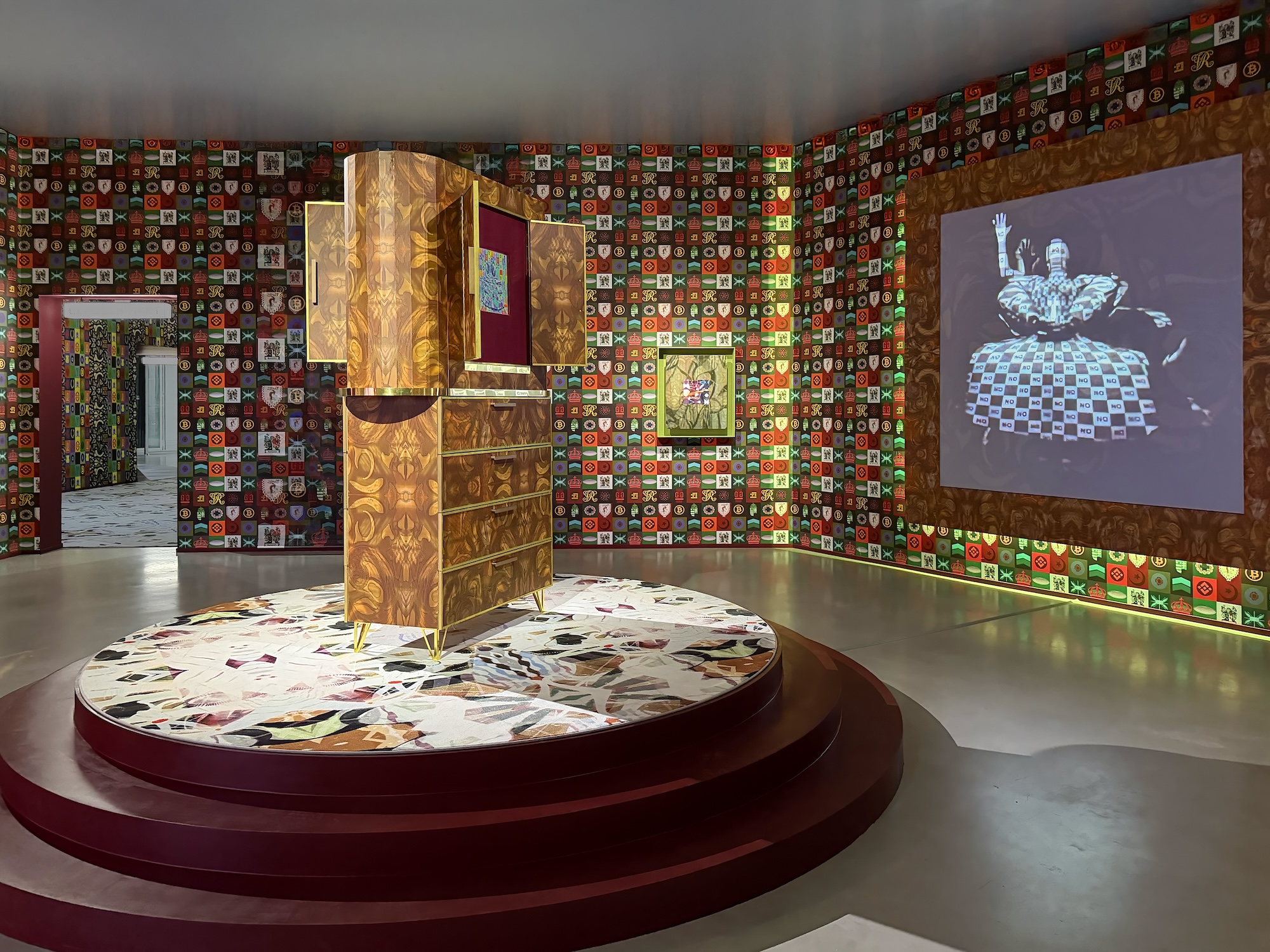
In Conversation with Amira Gad, Claudia Hart, Larry Achiampong, and Corinna Kirsch
Interview
For Maurice Merleau-Ponty, the body is the absolute anchor from which spatial, environmental, and regulatory forces are negotiated. It is via the lived body, the philosopher maintains, that one becomes rooted in their milieu. Through this account of embodied perception, the mixed-media practice of Melbourne-born, New York-based artist Nick Modrzewski lays bare the abstraction and violence perpetually unfolding at this center of orientation. In materializing the multitude of invisible pressures—contradictions, sensations, structures—concurrently acting on and through the body, Modrzewski explores the carnivalesque nature of our social narratives: cultural absurdities and collective hypocrisies permeate the artist’s work. Across painting and mask-making, Modrzewski cultivates spaces wherein legibility no longer holds meaning and rationality becomes subordinate. In the negotiation between explicit intentionality and the improvisational, haphazard behavior of the chosen material, visual architecture is continually constructed and disrupted, flesh is disfigured, and perception is unsettled. Interlacing various textures, forms, and movements, Modrzewski’s practice confronts the contradictory forces that, while invisible, encroach upon our embodied subjectivities.
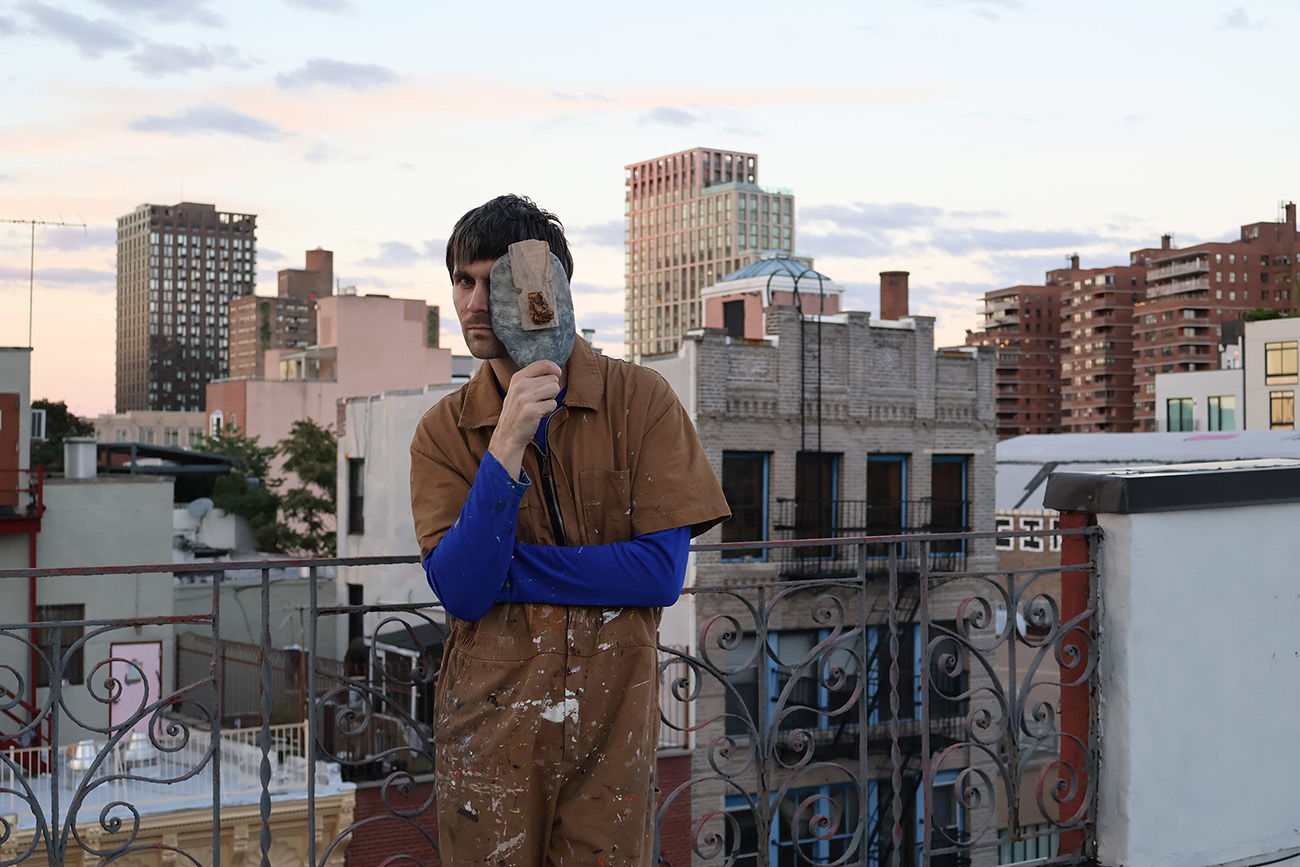
Having recently relocated to New York following an extended period in Los Angeles, Modrzewski discusses the intricacies and textures of his practice with Oscar Bloomfield. Together, the pair explore the allusivity inherent within any semantic or aesthetic lexicon, the power of abstraction, and the necessity of abandoning control.
Oscar Bloomfield: I’d love to begin by discussing your background in law, and how your work within this space became foundational to your artistic practice.
Nick Modrzewski: I’ve worked in law for around nine years, first as a judge’s clerk and then as a barrister. Law is a visceral discipline, despite all the paperwork. You’re often dealing with the most intimate and violent parts of people’s lives. You also need to navigate the rules and regulations that govern those lives, which sometimes means trawling through case law or legislation that might be hundreds of years old. You encounter all these stories of social and interpersonal conflicts, like the fallout from a wagon-maker going bankrupt in 1860s London. I find a lot of ideas for artworks in the law. My first solo show was called The Knees and Ankles of a Landlord (2020), where I made a series of paintings and sculptures and published a pretend legal textbook about property law. I wanted to play with the moment at which a familiar rational framework, like the transfer of land or building a dividing fence between two properties, is pushed so far that it turns on its head and becomes carnivalesque. So, the works in the exhibition depicted these partly real and partly imagined legal rituals, drawing on historic sources like the Sachsenspiegel, which is an illustrated manuscript from the Middle Ages full of pictures of legal formalities and customs.
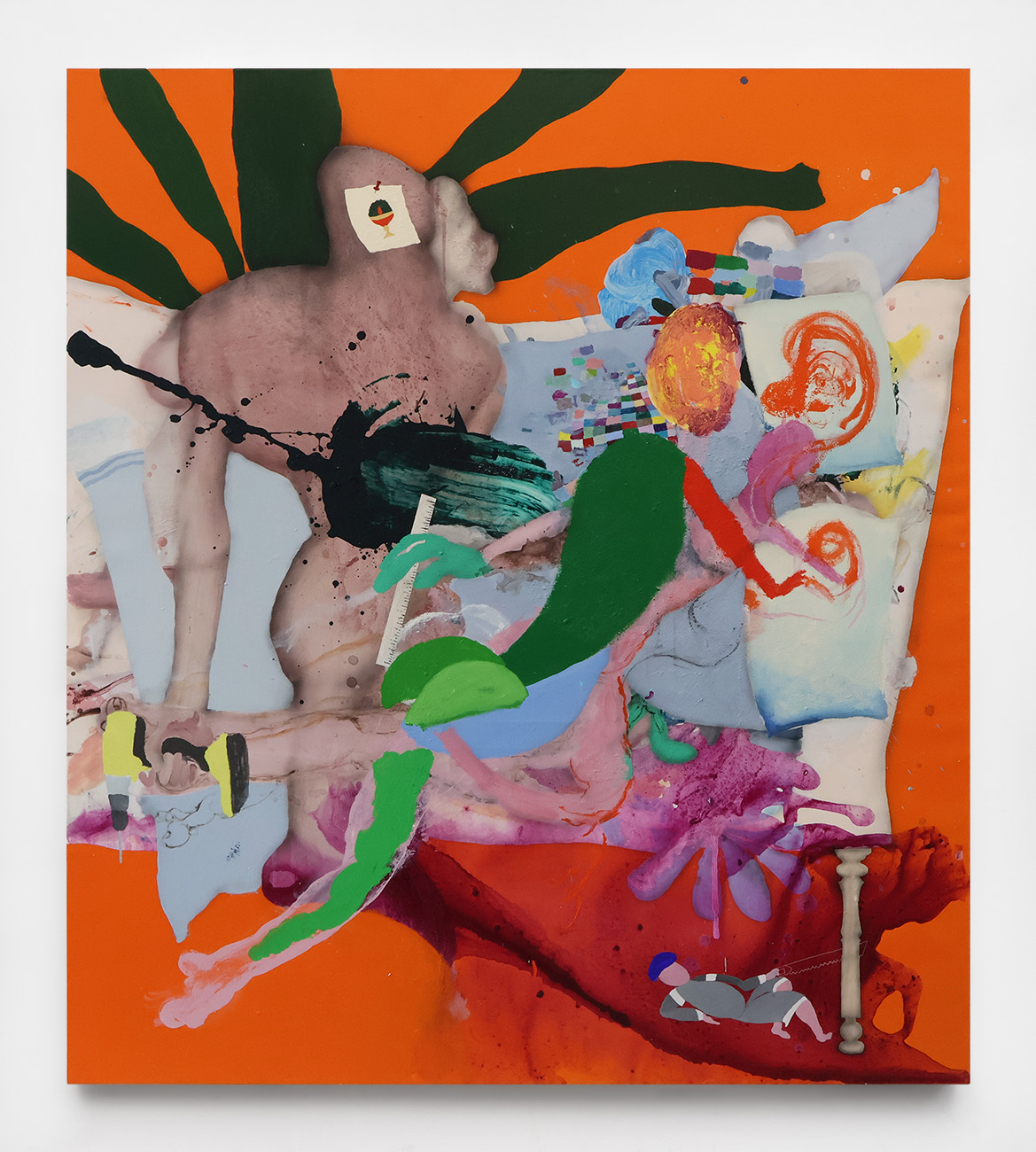
Over the next years, I kept returning to law as a context for my studio practice. As a painter, I’ve often tried to depict the effects of the law, how it looks and feels to be a legal subject regulated by this largely invisible but omnipotent force, the way it might stretch, distort, pull, and push our bodies in different directions. I think I’ve been striving for a visual language that speaks of the body’s entanglement with language, law, society, etc., but without always announcing the body through direct representation—it’s often buried under layers of paint and texture, or partially visible.
OB: Language is an inherently fragile and allusive phenomenon—equally capable of facilitating connection and alienation. How has your relationship with language developed as you’ve shifted from the semantics of law to the unsettled representations your practice evokes?
NM: With law, you're always wrestling with the ambiguity of language. You’re trying to control the possible meanings of words to serve your argument. Through this process, though, the slipperiness of language always reveals itself. The obvious one is the legal definition of a “person,” which can mean anything from a flesh-and-blood human to a corporation or a river. But there are also lots of other poetic ambiguities in legal taxonomy, like the meaning of “bread” or a “fence.” When you start to look closely at something, you start to see new worlds of possibility emerging from something you thought was settled. It’s in these grey areas that disputes tend to blow up. So practicing law makes you very aware of the different ways that meaning can expand and contract.
Painting is also concerned with similar questions but from a different angle. I’m always thinking about how to represent something in a painting. A chair might become an arm or part of a sandwich. It’s not just free association. A painting will have an internal logic, but you often can’t quite see it while you’re in the middle of making it. It’s only when something reveals itself through the painting process that certain associations become possible—so this particular chair has something sandwich-y about it. It can’t really be explained in words; there’s something about the texture, the shape, the color, the treatment. A lot of the time I’m following the clues offered by the painting itself, emphasizing certain aspects of this chair-sandwich relationship.
OB: A kinship emerges in how both “texts”—legal and artistic—transfigure into sites of density and texture.
NM: Yeah, I think that both disciplines can transform seemingly stable things into things that are open-ended, dense, and abstract. To be a lawyer or to make a painting, you have to be comfortable submerging yourself in messy and unfamiliar territories and find ways to hold onto something tangible. I think about this when I’m reading a long judgment, or any long and detailed text, really. I’m trying to hold on to one idea, like the legal definition of a particular word, then I’m trying to carry that definition through 200 pages of text. I like to pay attention to the different mental shapes that start to form in my brain. Sometimes I feel like I’m constructing a type of visual map or mental architecture, like a case about a contractual dispute might start to feel like a garden of flowers, with different clauses growing out of the ground. Sometimes when I look at my paintings, they can resemble these kinds of intricate mental worlds.
OB: I’m particularly interested in how your distinctive forms of abstraction work to “wrestle with language.”
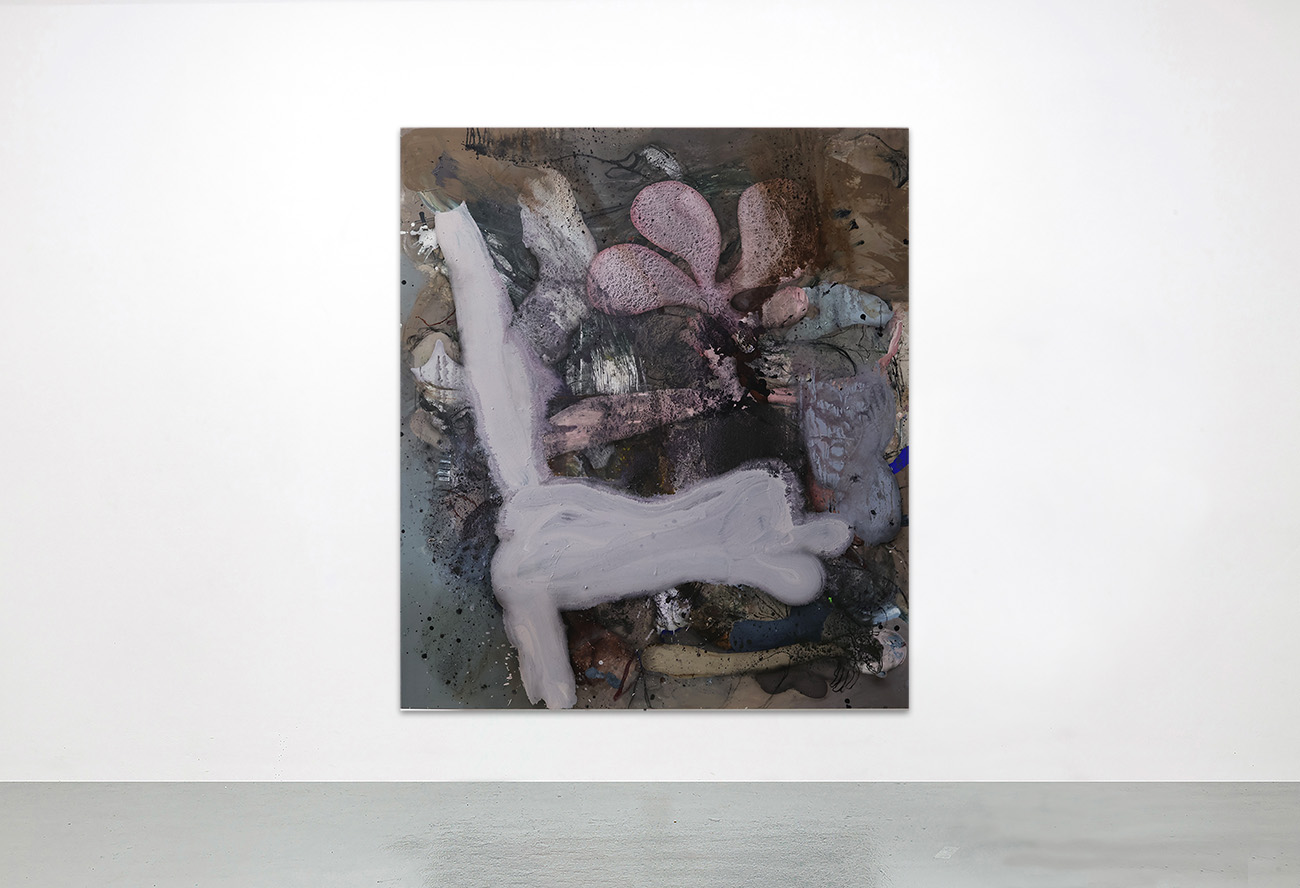
NM: For the type of paintings I make, I want them to hover between categories. So they never fully descend into pure swaths of color and texture; they can’t become entirely non-representational. I’m still trying to tell a narrative and represent things of the world, but I’m allowing it to be loose and unfixed in its legibility. I love that moment when you see a painting for the first time, and there’s this suspension of time as you figure out what you’re actually looking at, what it’s made of, how it works. It feels a bit like floating, where the rational part of you is calculating what you’re looking at, but another part of you is just experiencing it. It’s quite an ecstatic feeling, but it usually only lasts for a moment. The disorientation of that moment is what I’m trying to achieve and prolong when people look at my work. It’s a bit like wrestling. You’re wrestling with the image, with the language of representation, with your own tools of perception, and with the different parts of yourself.
OB: A term I work a lot with throughout my writing on cinema is “hermeneutic instability.” Hermeneutic instability is used to describe spaces where language becomes frustrated: opposing narratives, techniques, and tensions become indiscernible from one another and produce something categorically resistant. I think this framework invites interesting reflection towards how your work confronts and explores contradictions.
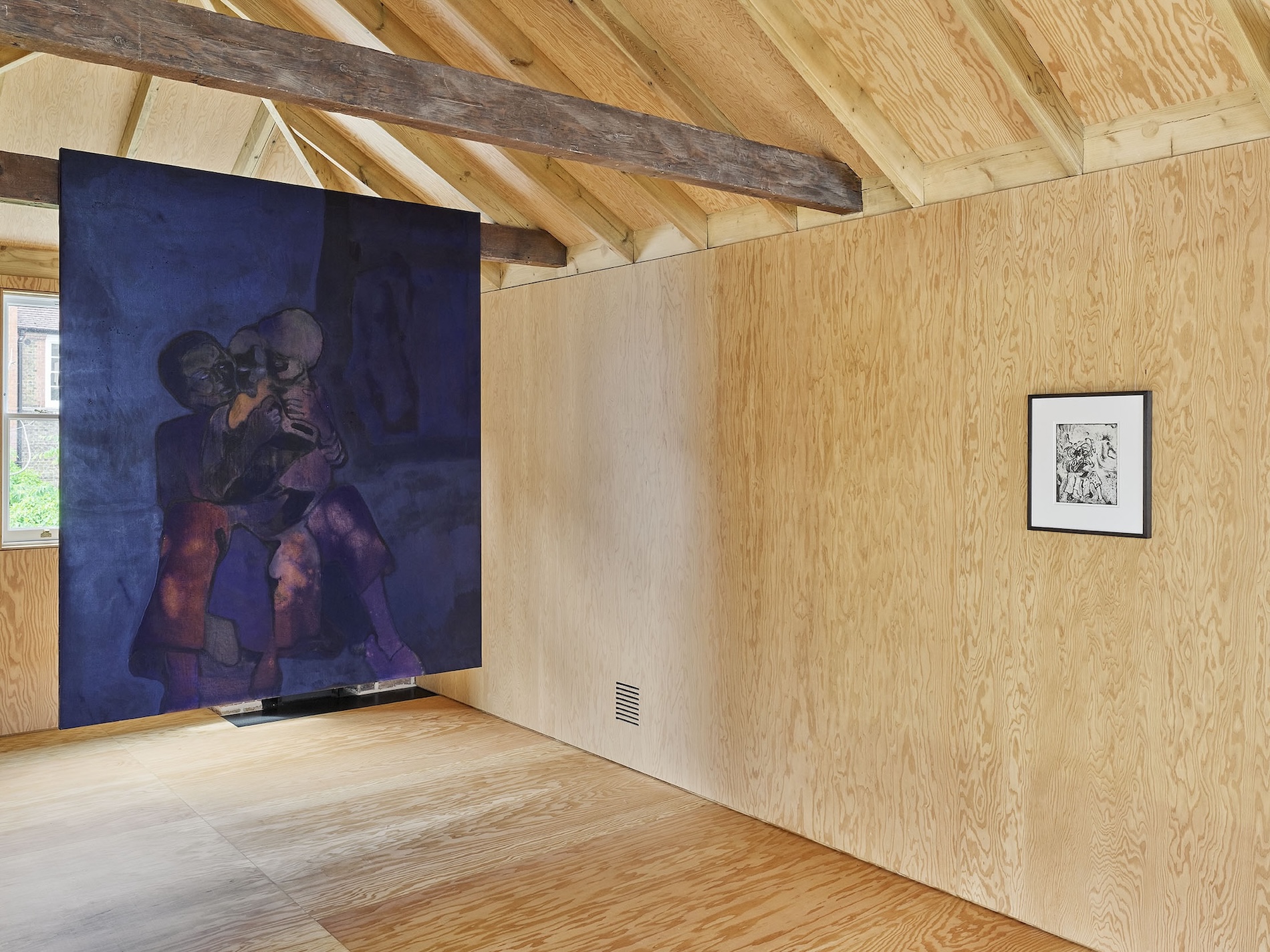
NM: Yes, the way you describe it, I think it applies to my paintings. A painting might take a month to complete, or a week, or a year, and each time I get back into it I’m bringing a slightly different perspective. One day, the painting might call for a geometric shape to emerge from a shoulder; the next day it might ask for a transparent wash of blue over the entire left-hand side. So the finished work faithfully records the process of making, which is full of contradiction and tension. For instance, I often spend days painting a specific image or area of the painting, carefully rendering it, only to then partially destroy it the next day. Sometimes it’s the only way to push the work forward and reach an unknowable state I’m aiming for. I arrive there through this process of consistent reworking and risky interventions, like spilling large buckets of paint over the image, allowing it to partially dry, carving back into it, and removing some of the paint. It can be brutal. But it can lead the painting into this interesting realm where you can see evidence of the risk, the struggle, and the choices made along the way, and they all add up to this sometimes illogical and often contradictory finished statement.
OB: Shifting from your painterly work for a moment and discussing your mask-making, what inspired your curiosity to begin experimenting with mediums outside of painting?
NM: I think it came from the simple impetus of “what is a head?” and “what is a face?” It's a simple curiosity: looking at the different faces I see around me at any given moment and asking, “What is that?” “Why is that nose there?” I had this desire to understand what it means to construct a face. I would cast masks on my own face using thermoplastic. It’s an imperfect material. It doesn’t perfectly “cast” a face. Instead, it renders a kind of warped version. The process is also quite physical: I place this hot, semi-melted plastic on my face and press my fingers into it to mold it around my nose, my mouth, my cheeks. I can’t really see what I’m doing, so I submit myself on a very physical level. As the material dries, these skin-like textures and blemishes emerge. When it hardens, I have a facial structure, which I feel a strong obligation to distort. My initial curiosity of “what is a face?” develops into “what can a face be?” Then, just like my paintings, I layer and build the surface.
OB: Your masks, such as those shown in your 2021 exhibition The Plaintiff’s Third Face, articulate a breadth of historical and legal concerns. What did this work reveal about the masks, whether visible or invisible, we come to wear?
NM: For The Plaintiff’s Third Face, I made fifty-six masks. Each one was based on a different character created by the law. So, for instance, you might be sued by a Plaintiff in a civil court, in which case you “become” a Defendant. If you lose the case, and you owe the Plaintiff a sum of money, then you are transformed into a “Judgment Debtor,” and the Sheriff can suddenly force you to pay up. So, legal proceedings have this way of thrusting us into different roles, and each one has its own history and a set of rules around what it can and can’t and must do. The exhibition was a way to play with these roles and to think about appearances, legal theater, role-playing, deception, facial transformations, that sort of thing.
OB: What continually draws you back, not just to the face, but to the human body and its relationship with exterior structures—whether that be in the legal setting, architecturally, or socially?
NM: I think it comes down to the fact that these forces are always acting upon us. Whether it's an architectural setting, a set of legal rules, or social etiquette, our bodies are always subject to these rules. I take so much for granted about the way I move, about every gesture I make. When we stop and pay attention to our bodies, they feel really weird—they're doing things all the time, things that we're not completely in control of. When we feel the different sensations that are bubbling up within us, when we have moments to pause and experience our bodies, it can feel really alien. There’s something I’m trying to show in my paintings, which is the experience of having a body and not really knowing it, because it’s perpetually alienated by the various contexts in which it finds itself and by which it’s coded and by which it’s acted upon. This is why I think the bodies in my paintings become these conduits for violence and disruption. For instance, I might create a large, elongated figure—rendering it smoothly, building up the layers of the surface so it’s almost marble-like. Then I get these buckets of soup—acrylic paint that's been mixed with different mediums and water to become quite runny—and pour them on top of this marble-like form. As it starts to dry, the form will dilapidate, thereby beginning to look as though it’s aged, been rained upon, and subject to processes of decay. I'm really drawn to that feeling of history acting on the body, as well as how nature and time act on it.
OB: The notion of “abandoning control” remains such a pervasive sentiment throughout your practice—there is always a greater force acting upon the work.
NM: Exactly. This ties into the sense that we're not in control of our bodies. The abandonment of control through dilapidation is so necessary, I think, to the underlying ideas of the work. What I can do with distorting the body when I’m consciously in control is a lot less interesting than what happens when materials act upon the work in their own way and by their own course.
This interview was edited for clarity and length.