
.webp)

Wenfei Quan: “Contemporary Hominin” at TaThaTa
Review
The conventional history of digital art in the twentieth century goes something like this: at the height of the Cold War, computers were becoming a key part of military projects like SAGE, while communication networks were spreading over the globe. These new forms of technology were out of reach to most anyone other than experts and bureaucrats, their uses seemingly predetermined by corporations. Yet artists began to imagine other possibilities, partnering with engineers and mathematicians to explore uses for these technologies beyond their commercial and military applications. The sheer amount of experimentation with “art and technology” came to constitute a movement in its own right. This narrative—a dominant account that continues to shape our understanding of the present technological landscape—remains insufficient. What about the cultural effects of technology? How do social class and geographic background fit into these stories? Who is left out?
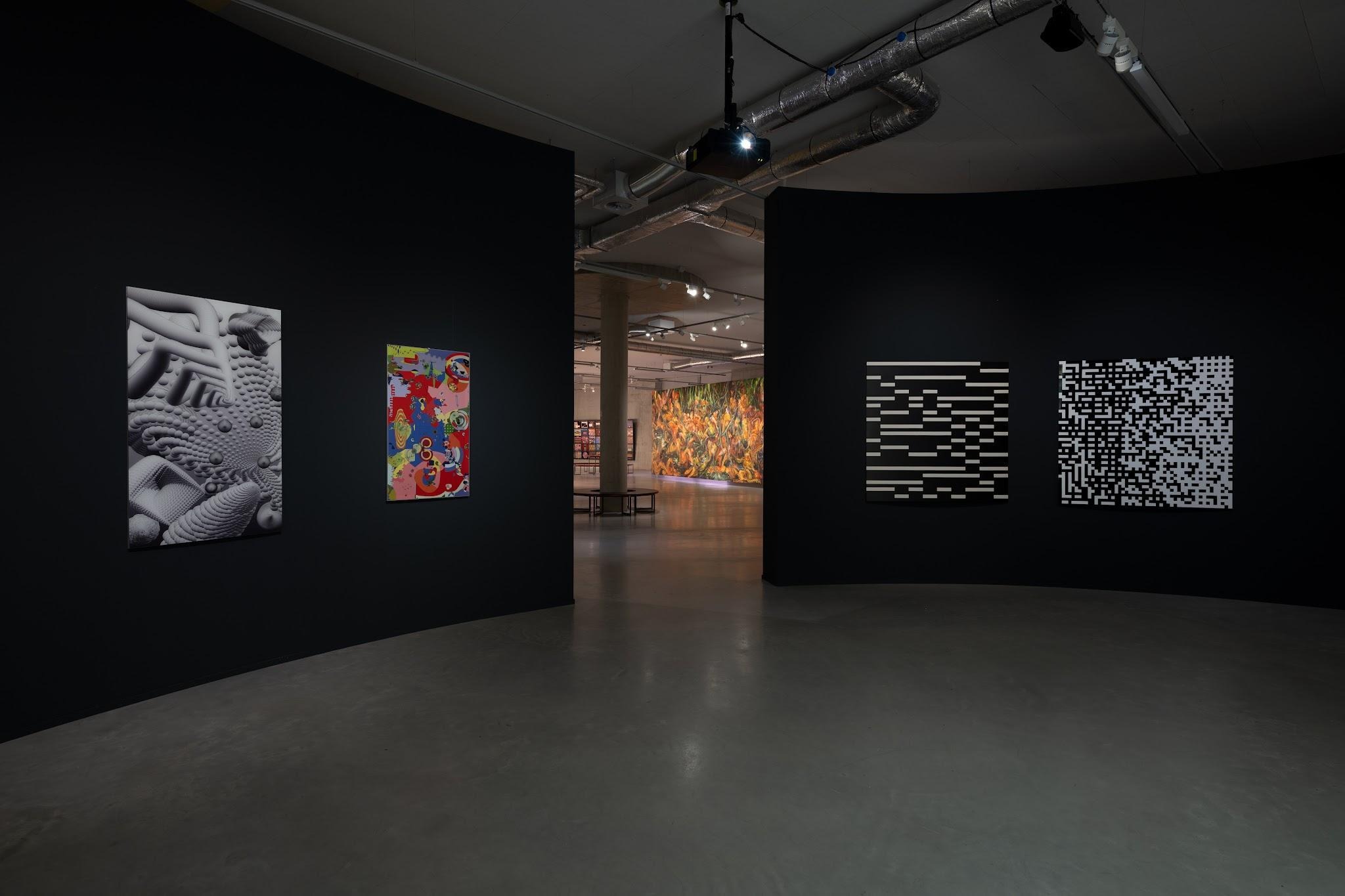
Pixel Pioneers at the Museum Boijmans Van Beuningen in Rotterdam proposes an alternative account of the history of digital art by reconsidering who and what is recognized as a pioneer. The group exhibition considers not only this history but also how that history is constructed. The premise of Pixel Pioneers is that technology brings us together “in common,” creating both cultural promises and pitfalls.
The following discussion between Pixel Pioneers curator Amira Gad and artists Larry Achiampong and Claudia Hart—both included in the exhibition—takes up questions of how art and technology might be reimagined beyond Western and corporate imaginaries. Taking place over Zoom, the roundtable conversation moderated by art historian and critic Corinna Kirsch considers these broad questions alongside the participants’ individual approaches to making art and exhibitions in this age of cryptocurrency and extraction. Hart both confirms and challenges the magic in secular worldviews, while Achiampong offers diasporic alternatives to the colonial logics underpinning processes of technological development. Together, their approaches shape a broader understanding of digital art that foregrounds the social, cultural, and colonial forces that shape the experience of technology.
Corinna Kirsch: Let’s start with a provocation. How does Pixel Pioneers—and your contribution to it—stake a claim for an alternative vision of this thing called “art and technology”?
Amira Gad: What was clear to me was that, as a curator working within a Western museum, I didn’t want to replicate or present technologies that only emphasize Western imperial thinking. The way to hack that thinking is to bring in different perspectives; for instance, Claudia’s feminist perspective and Larry’s diasporic one. I wanted to make sure we’re not presenting the same handful of artists and that we’re stepping outside our comfort zone to understand how incredibly rich the world is. The selection of the artists was also based on techno-diversity, an idea that I'm always quite keen on.
I visited and researched a number of shows, especially more recent ones such as Tate’s Electric Dreams (2024–25) and Radical Software: Women, Art & Computing: 1960–1991 (2025) in Vienna. They were both solid, good, and key exhibitions in Europe with a focused historical approach. But it was clear to me that Pixel Pioneers needed to have a different approach, one that looked at key questions and debates within contemporary art and arts technologies today. And so the approach I opted for was to open up the thinking and questioning with each invited artist, providing multiple outlooks, insights, and understanding into the “genre.”
Claudia Hart: At this point, 50 years later, the original avant-garde position seems conservative. The avant-garde became corporatized, influenced by innovation capitalism into making new products.
Larry Achiampong: I’m absolutely in agreement with Claudia. The show looks at history, but with the retro-based nature of these technologies as still being useful, not just as nostalgia.
If you look at gaming culture, people are talking about a glass ceiling in terms of fidelity. That’s forcing people to rethink innovation and how it uses the planet’s resources, like what’s happening in Congo due to the materials gaming platforms use. In recent years, exhibitions have included work focused on high polygon rates, but that’s a consumerist angle.
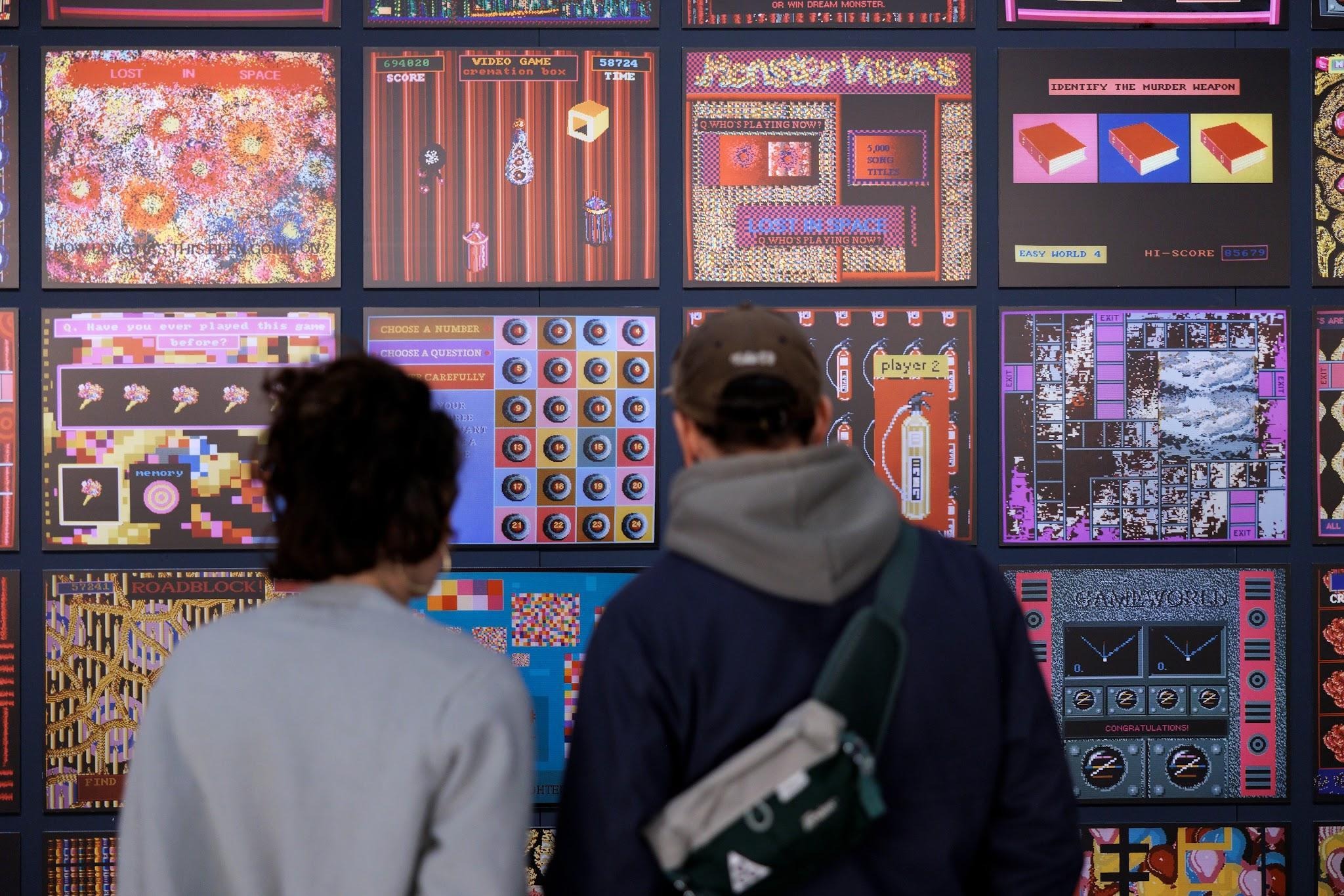
AG: The feedback I’ve been getting about the exhibition is about regaining a sense of culture. The show is cross-generational: fathers, mothers, and teenage kids hang out in Larry’s work (Gaming Room, 2021–ongoing) for hours or come back to play with Feng Mengbo Long March: Restart (2008). Visitors come back to try it again to understand the different mechanics and forms of digital culture.
LA: Some people see outdated technologies in the Gaming Room. But for me, it’s the opposite. It’s an intent to participate in the cyclical and intergenerational nature of tech. It doesn’t have to cost a gazillion dollars or quid. It’s about how we pass on stories.
CK: Everyone here has arrived at digital art practice indirectly, yes?
AG: From a curatorial perspective, I became an accidental specialist in art and tech. I worked on a few projects with artists involving technology, particularly during my time as a curator at the Serpentine, and, when I was heading up the LAS Art Foundation in Berlin, our mission was to develop an ambitious program around art and tech.
Presenting an exhibition around technology at the Museum Boijmans Van Beuningen required a different approach, one that counteracted the spectacle of 360-degree projections and immersive rooms, which have now become the symbol of art and technology exhibitions today. I wanted to reconnect audiences with the roots and varied histories of digital art practices and highlight this important discourse at its core. We haven’t outgrown it yet and that remains relevant today.
CH: I ended up going into technology because it seemed magical to me. It seemed like alchemy. When I lived in Berlin, someone gave me a free ticket to see Toy Story (1995) at the Berlinale in 1996. I couldn’t believe my eyes—it was uncanny: spectral highlights and the drop shadows! It was a surreal hybrid of architecture-meets-photography. I felt like I had to do it myself. You couldn’t learn it in Europe, so I went back to New York.
I’ve told this story many times, but when I grew up in New York City in the ‘60s, my mother wanted to rise out of the working class and be cultured, so she took me to the Met and MoMA. My heroes, even as a kid, were Van Gogh, but later, Manet, who famously said that it was the job of an artist to express their own time. It became my credo: I want to be in art history but also fully of my own time. I don’t believe in the ideology that art must rupture or break with history.
AG: You talk about magic, Claudia. That’s true about trying to understand the physical dimensions of digital culture and the magic being created from small, pixelated screens and bulky equipment. The physicality of it is also important because it’s about demystifying the eternal, slick aspect of digital artistic practices.
With Pixel Pioneers, Suzanne Treister, for instance, had to work several jobs in the 80s before she could buy her first Amiga computer. While we don't have an Amiga, we do have a Commodore 64 in the exhibition! Another person in the show is the Dutch artist Hoos Blotkamp. She was never fully recognized during her lifetime, but she made colorful graphics and prints using computer programs. For me, these 2-D works are early examples of what we today call “world-building.”
LA: Video games are one of my first loves artistically. Art was introduced to me through those pixels, on a CRT television.
With Pixel Pioneers, it’s almost as if it’s a video game itself! The layout has you travel, as if across a map, then enter each artist’s distinct “biome.” For instance, Claudia’s Empire Failure (2026) “biome” is filled with the volatile nature of crypto and NFTs. You then move into spaces that focus on revisionist and revolutionary history. Christopher Kulendran Thomas uses AI as a tool to make copies by hand, in relation to the Tamil massacre.
AG: I like how you talk about the show as a biome, Larry—what world does each artist open up? The show plays with different dialogues related to our collection, showing that digital practices aren’t a recent trend but a historically rooted practice that emerged out of photography, video, and new media. As Claudia put it, there’s no rupture, and yet there’s a very real interest in these different archives and cultures that aren't typically discussed in terms of art and technology.
CK: Everyone here works with archives to some degree. How do archives figure into your work and practice?
LA: My studio in Essex is divided into two distinct spaces. One’s a wet studio for building physical objects, and the “Ark,” short for archive. I have tens of thousands of items: software, hardware, games, comics, Blu-rays, DVDs, vinyl, and CDs. For me, there’s an additional story knitted into the item itself as a keepsake. Growing up as a kid, if you don’t have much, what you do have becomes symbolic.
I often think of play as a form of resistance against adulting and the loss of childhood. Why do we lose that sense of play, innocence, and wonder?

CK: Play, as well as relationships, seems to be a strong part of your approach to archives. The Gaming Room isn’t just systems, monitors, and furniture. The environment you’ve made includes flags and painted posters of heroes with names like “Captain Sankofa.”
LA: “Sankofa” is a turn of phrase from my Akan heritage in Ghana that means to go back and retrieve what may have been lost in time, but which may have been in front of you all along. From “Sankofa,” I developed “Sanko-time,” a term important to my work. It initially manifested through the Relic Traveller (2017–ongoing) project and films. Traces of the Relic Travellers Alliance can be found in the Gaming Room. There’s the Pan-African “Healing” flag and Ph03nix Rising: The 3rd Son, which plays on one of the CRT televisions. We inserted it as if it were part of the actual games there.
At the time, I was thinking about what would happen if the UK voted to leave the EU. At the same time, the African Union had a passport program in gestation that would allow Africans, both from the diaspora and on the continent, to travel among the 54 states without visa issues. Within the speculative future of the films, I imagined a “Pan-African Union.” It included the Relic Travellers who were sent outside of the Union to pick up clues—vocal testimonies, physical objects, and stories—connecting people not simply to African heritage, but the interconnected aspects of oppression in colonialism, globalization, and capitalism. These clues were used to govern a future built from the bottom up, not from the top down. That’s always been the problem, right?
Installation view of Claudia Hart’s room in Pixel Pioneers. Claudia Hart, Empire Failure, 2026. Algorithmic projection and carpet developed with Licia He, Claude-AI and Firefly-AI computer-assisted wall-coverings; Claudia Hart, The Rise & Fall of Art and Other Histories, 2026. Silkscreen printed-tapestries, live-recorded and AI computer-assisted media projection, algorithmic carpet, media objects combining wood, pure pigment submerged in resin applied with computer-assisted brush, and Claude-AI + Firefly-AI computer-assisted 3D animation. All works commissioned by the Museum Boijmans Van Beuningen. Photo by Copper Giloth. Courtesy of the artist and the Museum Boijmans Van Beuningen.
CK: And Claudia, you worked directly with the museum’s collection for your work in Pixel Pioneers.
CH: Amira asked me to make new work. When I came to the museum, I was privileged to meet not just Amira but also a furniture and glass specialist. They said, “Oh, we’ve got a few things for you to see,” although I had very different ideas of what I wanted to work with in their collection. I’m a history buff, and it was like a giant candy store to me. But the curators had another idea, taking me to see Jacoba van Heemskerck’s stained glass. She’d been largely forgotten about, but the museum has helped revive her reputation. I was not familiar with her work, but I immediately felt that Jacoba needed to be part of my mission.
A big part of my practice is working with women artists who’ve been written out of art history. It’s a driving obsession. I did a project for the 2023 Armory Show called The Armory Women, about women from the original Armory Show who had been erased from art history. There were Fauvists and others who were players in important early 20th-century movements, but who’d been erased after prices for their work didn’t reach the level of a Matisse or Picasso.
From looking at Jacoba in the collection, I created an algorithmic work based on her stained glass in collaboration with Licia He, a computer scientist and artist. It’s one of the animations in my room, Empire Failure and The Rise & Fall of Art and Other Histories.
CK: How does the animation compare to Jacoba’s original work? Is it an update?
CH: We deconstructed her visual language. It’s totally new, but the forms we used—like the teardrops—are recognizably hers as they morph from one shape to the next.
In addition, for Pixel Pioneers I worked with an archive I made with students for a media ballet that I did in 2014 called The Dolls. It was originally focused on the heraldry of collapsed empires as its iconography, but I also included the logos of corporate tech companies, which I abstracted so I couldn’t get sued. For Pixel Pioneers, I updated it with the icons of failed cryptocurrencies. Interestingly, cryptocurrency logos often draw on Roman legionary symbols, already featured in my archive!
AG: The way I see it is that these voices—and those like Jacoba’s—come out of the ruins of tech empires. Art and culture prevail while the rest fail.
This interview was edited for clarity and length.