
"Savdie / Soutine" at NORR COHAN
Review
A SEAT Ibiza happens to be parked outside Taon—an independent space in Paris’s 12th arrondissement—during the opening of Ibiza. The two-person exhibition, like the supermini car, borrows its title from the iconic island to present Bruno Pélassy (1966–2002) and Perla Zúñiga (1996–2024) together for the first time. Given that neither artist ever visited the Balearic island, the title operates ironically, evoking a perpetually deferred horizon through corny clichés of leisure. As Zúñiga wrote in the installation Ibiza is waiting (2023), the island will endure as a perennial fantasy. The Mediterranean likewise lingers in Pélassy’s work through an ornamental visual language shaped in the maritime city of Nice during the 1990s, decades before Zúñiga’s practice developed between Madrid, Barcelona, and Berlin.
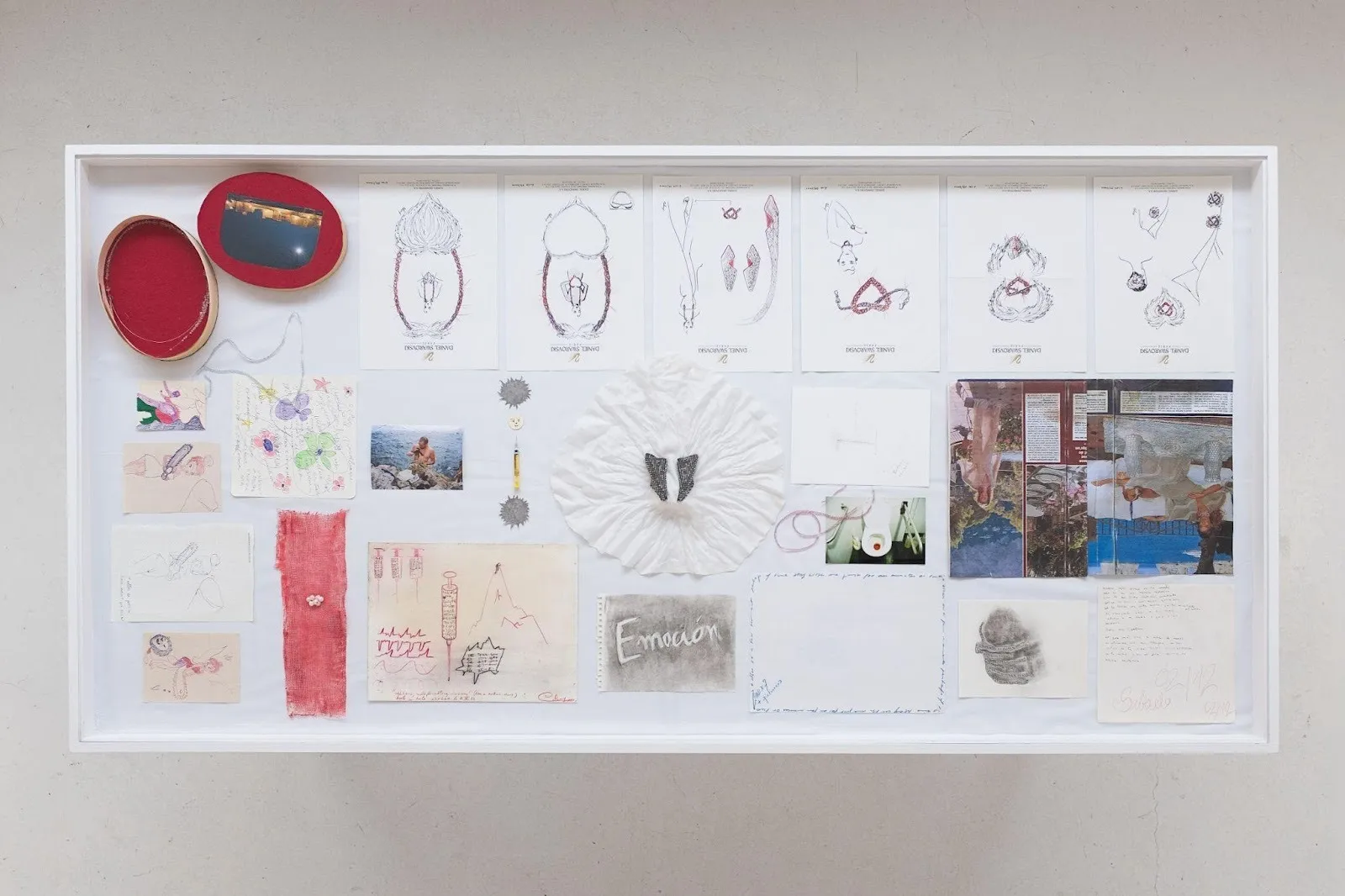
In both artists’ work, there is a clear attraction to preciousness, especially to objects that adorn or extend the body. Pélassy transformed the round box of Camembert cheese into a small reliquary, which he made for his sister. Lined with red suede, it resembles an improvised jewellery case, with a photograph affixed inside. In the same display case, a photograph shows Pélassy in the sea, in a bathing suit, with a starfish attached to his chest. His apparent affinity toward aquatic creatures is echoed by his small sculpture of an octopus on a plinth nearby. He assembled the form using semi-opaque red, white, and transparent beads, tiny diamond-shaped jewels, and crustacean-like eyes. The gleaming sculpture sits beside a needle used by Zúñiga during chemotherapy. Although this particular medical instrument is unadorned, she often decorated her used needles, folding them into her aesthetic language and intimate concerns. Zúñiga, like Pélassy, routinely approached bodily vulnerability through ornamentation, such that the two phenomena are inextricable in her practice.

The technical refinement of Pélassy’s assemblages recalls his training in textile and jewelry design. He worked for Swarovski before leaving to focus on art in the nineties, as illness meanwhile increasingly shaped his daily rhythms. Yet the haute couture precision of these assemblages is undercut by the precarious quality of certain scavenged materials culled from what Laura Cottingham referred to as Pélassy’s “junkyard of jewels.” His beaded, bejeweled penises made during the HIV/AIDS epidemic, for example, push back against the panic surrounding contagion and disease.
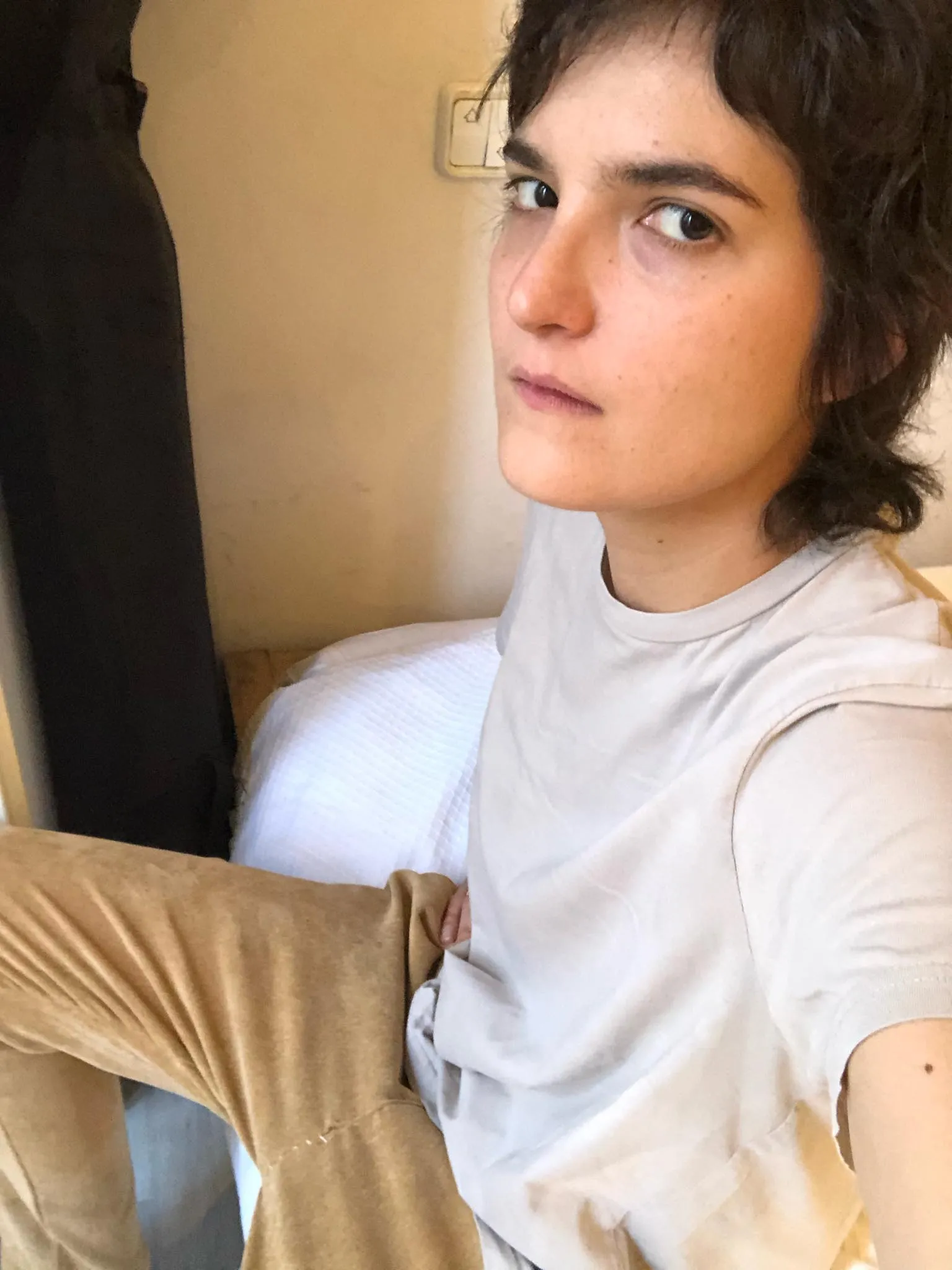
Zúñiga similarly explores the embellishment of the vulnerable body. The artist named Perla—pearl in Spanish—places plastic pearls over medical bandages painted deep garnet. In the sculpture Perlita 2 (2023), the same faux pearls fill a mousetrap, pressing the limits of the metal structure. Zúñiga carries this tension into her poetry, where she writes: “Imagine me waiting for death / with a Vaquera purse.” The line draws attention to material desires that one might expect to fade in close proximity to death. There is irony in Zúñiga’s line, which draws on references that shaped her life, reclaiming a personal field beyond diagnosis.
Many of the works in the show by both artists were made during periods marked by long hours in bed, interspersed with more energetic social moments. These experiences register in the small scale of drawings and assemblages produced in immediate proximity to the artists’ bodies. Both practices were simultaneously shaped by uncertainty while waiting, whether for medical results or for side effects to pass. In one of Zúñiga’s drawings on view, Untitled (2023), text running along the margins maintains a mantra-like quality, as if to manifest endurance. In another, she draws her ribs inscribed with phrases such as “it is okay not to be okay.” Zuñiga would later recite these same words during her DJ sets in clubs across Europe between treatments.
For both artists, the imposed temporalities of medical treatments fueled sustained immersions in literature and film within the domestic context, deepening a constellation of queer cultural references. In Zuñiga’s oeuvre, flyers, disposable medical materials, and Pokémon porn memes coexist with allusions to figures such as Juliana Huxtable and Anohni, in addition to texts by Katherine Mansfield and Fernando Molano Vargas. Pélassy’s voracious engagement with the cinema of Rainer Werner Fassbinder, Jacques Demy, Andrzej Żuławski, and Kenneth Anger, among others, is reflected in his sole moving-image work. He assembled Sans titre, Sang titre, Cent titres (1995) from fragments of these films. Always presented on VHS, this audiovisual array gradually erodes through repeated projections, each screening effectively withdrawing something from future viewers.
Where several of Pélassy’s works take the form of gifts, Zúñiga likewise mobilizes an expanded social language through the figure of Tinker Bell. Biro drawings of the fairy function as preparatory posters for parties thrown by Culpa, the music collective for trans and queer people that she co-founded in Madrid. Several drawings depict the fairy posing obscenely while floating, holding a chainsaw in place of a penis, pinched between two fingers. In keeping with the social networks and communities embedded in the works themselves, this exhibition was organized collaboratively by Elsa Estrella and Vega Almena, among others, Zúñiga’s longtime friends, with the support of Florence Bonnefous, one of Pélassy’s closest friends whose gallery Air de Paris represents the artist’s estate.
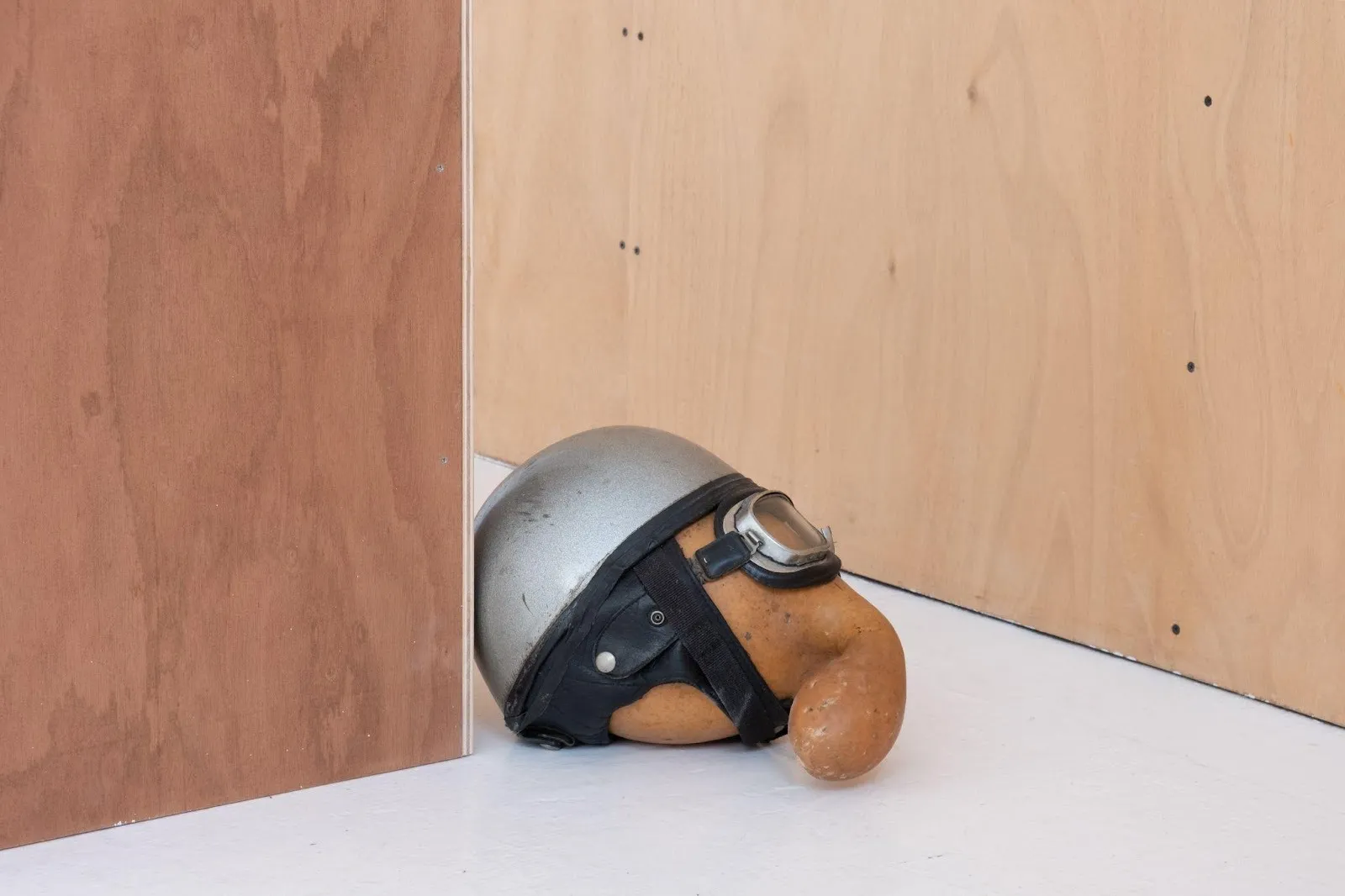
In the work of both artists, the frustration of desires hindered by illness is negotiated through humor. Zúñiga leverages Tinker Bell to reckon with the interruption of her gender affirmation process following the resurgence of illness, using humor to highlight the limitations imposed by her physical health. On the floor next to a plinth, one of Pélassy’s sculptures resembles a head made from a gourd wearing a vintage motorcyclist helmet and goggles; its exaggerated “nose” compromises its aerodynamics, perhaps complicating tropes of escape.
Another one of Zúñiga’s needles is mounted to the wall, with a smiling cardboard cutout wearing sunglasses dangling from the tip. The precariousness of the used needle and the ephemerality of the sun evoke Ibiza as a fantasy indifferent to material and bodily limitations. Both Pélassy and Zúñiga turn to irony without the detachment of those who can afford distance; theirs is a form of humor embedded in life-sustaining artistic practices.
Featuring the work of Bruno Pélassy and Perla Zúñiga, Ibiza is on view at Taon, Paris, from March 7 to April 14, 2026.