
.webp)
Tim Kent: “Sojourn” at Hollis Taggart
Review
Tate Britain invites visitors into a lifetime of work through Hurvin Anderson’s first major solo exhibition, curated by Dominique Heyse-Moore and expertly hung by Mikei Hall. Across six rooms, the show unites more than 80 of his vivid paintings, ranging from dreamlike tropical landscapes to more rigid architectural interiors. Staged thematically rather than chronologically, Anderson’s oeuvre traverses the Atlantic world, encompassing scenes from the UK and the Caribbean. The Birmingham-based artist’s paintings engage with the landscape tradition, blending the seen with the imagined to forge novel vistas that seem nonetheless navigable. Shaped by individual memory and collective history, these emotionally charged scenes have the half-remembered quality of dreamscapes—or perhaps better put, soulscapes that register a sense of belonging and transformation.
The youngest of eight children, Anderson was the only member of his family born in England, following their move from Jamaica to Birmingham in the 1960s. A sense of dislocation became a catalyst for the artist’s creativity, as he negotiated questions of belonging. Evoking Edward Said’s idea of “out-of-place-ness,” Anderson understands that exile situates the individual in a liminal position, always partly inside and partly outside any given culture. Belonging does not have to be singular; rather, individuals can maintain multiple, overlapping affiliations at once—a condition that Said termed “contrapuntal.” For Anderson, the analogous word might be “rafting,” which is the title of both the last room of this show and his most recent series, drawn from nineteenth-century Jamaican photographs by Adolphe Duperly. In the wall text, the artist describes rafting as a “quiet act of resistance,” one that acknowledges Jamaica’s legacies of slavery while signaling the reclamation of freedom as something constant and evolving.
The works in this exhibition are presented in a looping rather than linear layout, perhaps channeling Anderson’s interest in self-determination. Visitors are encouraged to meander between obliquely titled rooms: “Arrival,” “Scrumping,” “Welcome,” “Is it okay to be black?”, “No one remembers,” and “Rafting.” The sixth room, “Rafting,” presents four previously unseen paintings, conceived in two pairs, situated opposite each other in a quadrant. From the center of the room, the four cardinal directions of Anderson’s compass become apparent: history, memory, color, and art-historical reference. One diptych shows a couple rafting down a river banked by dense tropical foliage, their reflections melding with the water’s surface. In the first painting, Rafting (2025), a barely perceptible sliver of whitewashed wood serves to illuminate the pink-clothed woman, who stands tall in an illuminated section of the composition. The most captivating aspect of these two works is their tonal richness, with a dizzying panoply of emerald greens. Redolent of master colorists such as Paolo Veronese, Anderson’s work reflects not only the influence of his dual heritage but also his exploration of the painted history of the world.
These recent paintings—like all of Anderson’s work—began with archival photographs from nineteenth-century Jamaica that the painter transforms into temporally layered amalgamations. The resultant landscapes emerge from the artist’s complex relationship with the Atlantic world, reflecting his diasporic positionality. As Anderson puts it, “What I do is about questing my history, my place.” These are not literal representations of Jamaica, but they afford insight into the artist’s relationship with the place his family once called home. Through painting, he reconciles their memories with his experience, filling in the blanks.
These paintings—fragmented distillations of cultural heritage—simultaneously work through the slippages of photography as a repository of collective cultural memory. Recalling the profound impact of photography on the genre of landscape painting in pushing artists toward abstraction, Anderson often layers scenes and revisits subjects from multiple perspectives, resulting in a kind of visual drifting.

Much like Anderson’s layered process, the non-linear layout of the exhibition evokes the accumulation of memory. The room entitled “Arrival,” which shows a cluster of small paintings together with more monumental canvases, explores how a sense of belonging is tethered to the natural world, while also questioning how identity, connection, and safety are forged under conditions of displacement. Visitors first encounter Limestone Wall (2020), a large-scale painting bursting with sunlit tropical foliage, likely painted after Anderson visited the Caribbean. To the left, in stark contrast, hangs Beaver Lake (1998). Two black figures wrapped in winter layers stand on a white tundra; the empty space surrounding them lends a chilling quality. Anderson, who sourced imagery from his sister during a visit to Canada, explains in the wall text, “The painting is like an extreme of immigrant experience. The simpler it got, with the horizon pushed back, the more it looked like she was out in the cold, far from home.” While Anderson explores the Atlantic world, his work speaks to a more universal diasporic experience of finding one’s own way in a new land.
Anderson seemingly uses his paintbrush as an exploratory tool, working his way through vague impressions towards a deeper, embodied understanding of believable places. “There’s a perception of the Caribbean, and there’s the reality, and I wanted to dig into the reality in some way,” says Anderson, using the word “digging” in the same way that the poet Seamus Heaney uses it to forge his own trajectory.
Throughout the exhibition, Anderson renders inhabitable spaces, colored by nostalgia yet hollowed out by a kind of absence or disconnection. Anderson channels a multiplicitous sense of belonging most powerfully with his interior scenes, which often recall childhood experiences, featuring his family members in settings of individual and broader cultural significance. Rather than stable subjects, these remembered places are malleable touchstones that he returns to repeatedly, as in his prolific Barbershop series (2006–23). These iterative paintings reference a period in the 1950s and ‘60s when Caribbean immigrants in the UK created makeshift barbershops in their homes. This series, together with Peter’s (2007–09), is his best-known work in the UK. In contrast to the landscapes in this exhibition, the works from this series shown in “Scrumping” create moments of intimacy and opportunities for reflection.
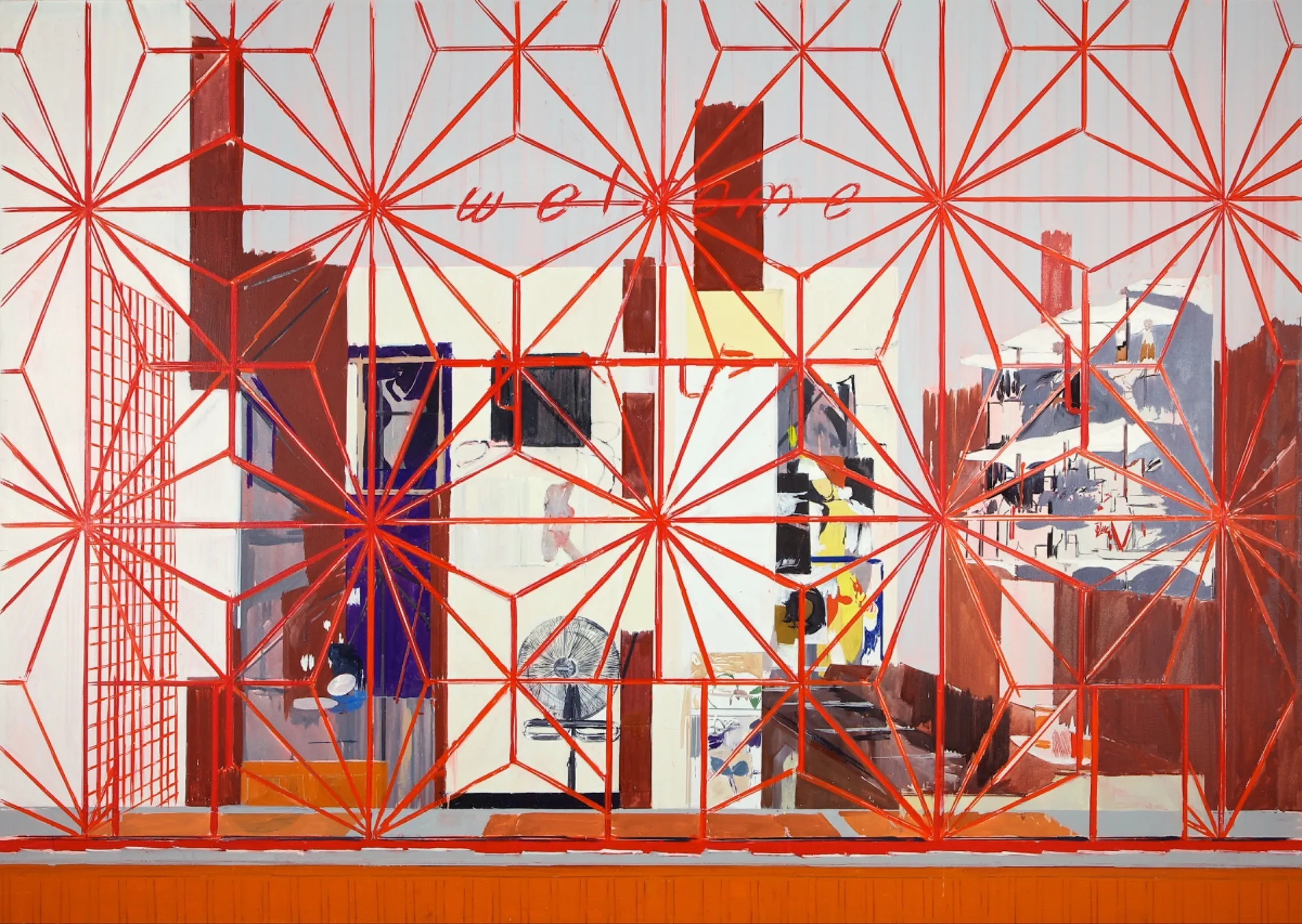
Fences and grills appear as motifs throughout his work. Following a visit to Trinidad in 2002, Anderson developed this strategy to distance the viewer, creating physical and emotional separation. In Country Club: Chicken Wire (2008), a hexagonal wire fence shuts out the visitor, while evoking the residues of racial segregation in Trinidad. “No one remembers” features seven works from Anderson’s hauntingly evocative Jamaican hotel series, including Grace Jones (2020) and Ashanti Blood (2021). Inspired by a visit in 2017, these filmic paintings depict the greyscale of derelict hotels built for tourists, now consumed by vegetation, haunted by the occasional figure.
By layering locations and blending disparate moments, Anderson questions the reliability of memory while also giving form to the invisible complexities of cultural heritage. Bucolic landscapes like Wait a Minute (2017), with its gentle lavender hues underscored by a brilliant line of cobalt blue, capture the strangeness of existing in reality while dreaming of paradise. Rather than charting only isolation and dislocation, though, Anderson’s show becomes a celebration of belonging to many things at once. The paintings channel the unknowable, often impenetrable places we seek—a “questing” for some far-off locale.
Hurvin Anderson will be on view at Tate Britain, Millbank through August 23, 2026.