.webp)

Tim Kent: “Sojourn” at Hollis Taggart
Review
When the body dies, a spring-loaded list of processes will snap into action. Like a series of intelligence protocols ignited by an activation code, agents of mortality walk, calmly but with purpose, to their assigned tasks; unknitting the brow, producing strange liquids, dimming the lights in the brain stem. It is a grim laundry list for the custodians of our post-mortem body, though neatly, nearly lovingly organized.
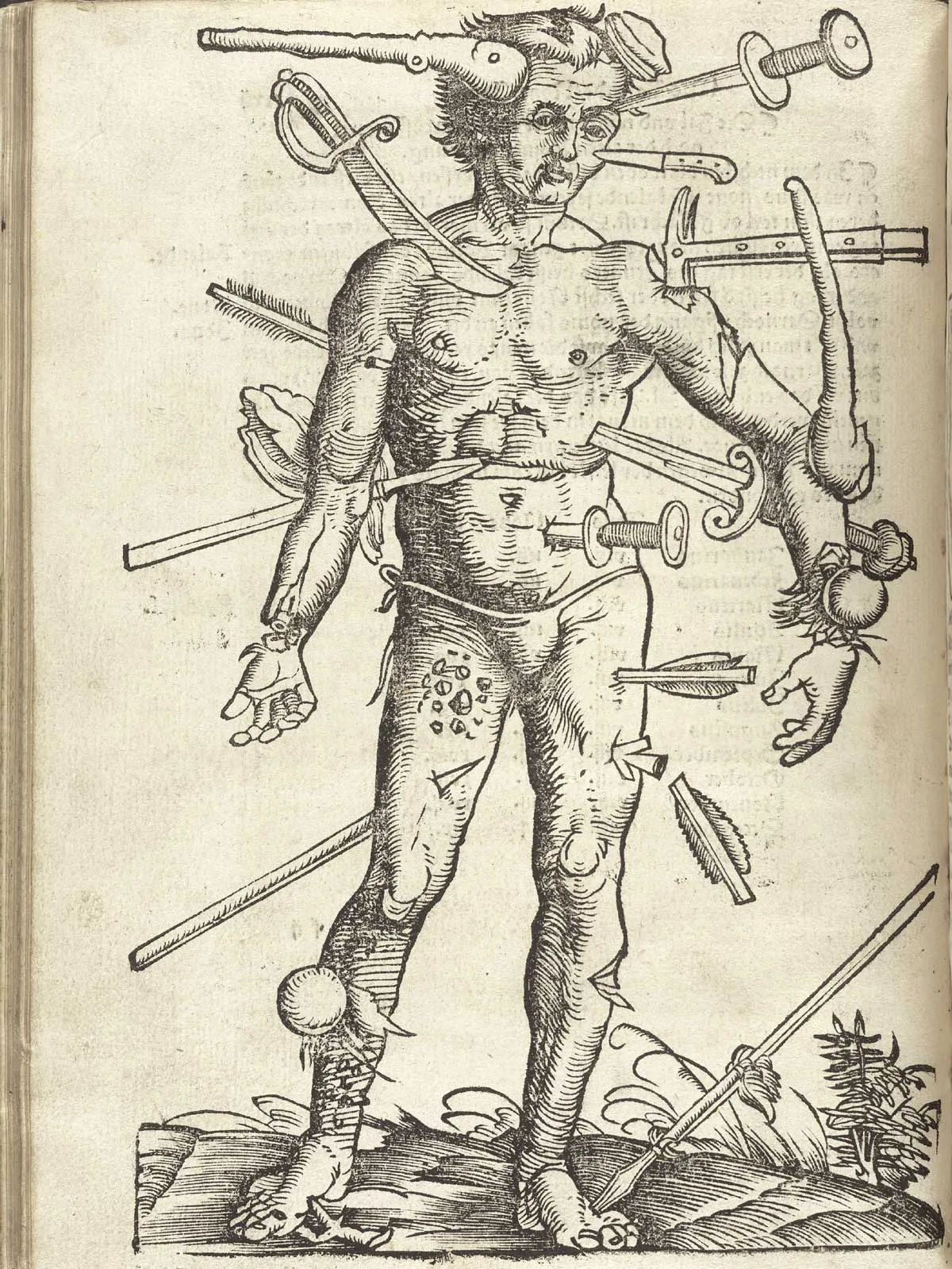
When I arrived at Miguel Abreu Gallery on Eldridge Street (an echoing white cavern of a space) to see Alex Carver’s solo exhibition The Knot, I knew of the artist’s ongoing infatuation with the body, medieval depictions of death, agony, and medical diagrams. His 2025 White Cube solo, Effigy, literally depicted images of Hell. I had read the press release and prepared myself for images of The Wound Man, a Medieval European surgical diagram depicting various sharp and blunt instruments stuck to the body of a figure, his gaze oddly impatient. I was prepared for the artist's latest fascination with a CT scan of a fallen climber, whose only identifying feature seems to be the climbing boots still laced to their feet. I was, however, not prepared for how it made me feel: dizzy with color, and psychically soluble.

Miguel Abreu Gallery offers a lot of physical space to view Carver’s work, which is visually satisfying at any distance, and some pieces you will want distance from. I’m surprised that the four humors (the Hippocratic version of the four agreements) are not mentioned in the gallery press release, though I suppose no one wants to write “bile” or “urine” in an email to a collector. However, the transmutation of corpse alchemy is present in the work. Each piece is the prismatic yellow-pink-green grave of a decaying homunculus sinking into an indigo abyss. They are disturbing yet hypnotically revealing in my desire to see my own body within his compositions. My hiking boots, my pain body, my limbs heavy like a fallen tree (an echoed motif from Carver’s previous affair with landscape). Without his usual medieval figure aesthetic, I couldn’t form a mental separation between my body and this body, a visual lever that flung me deep into the paintings.
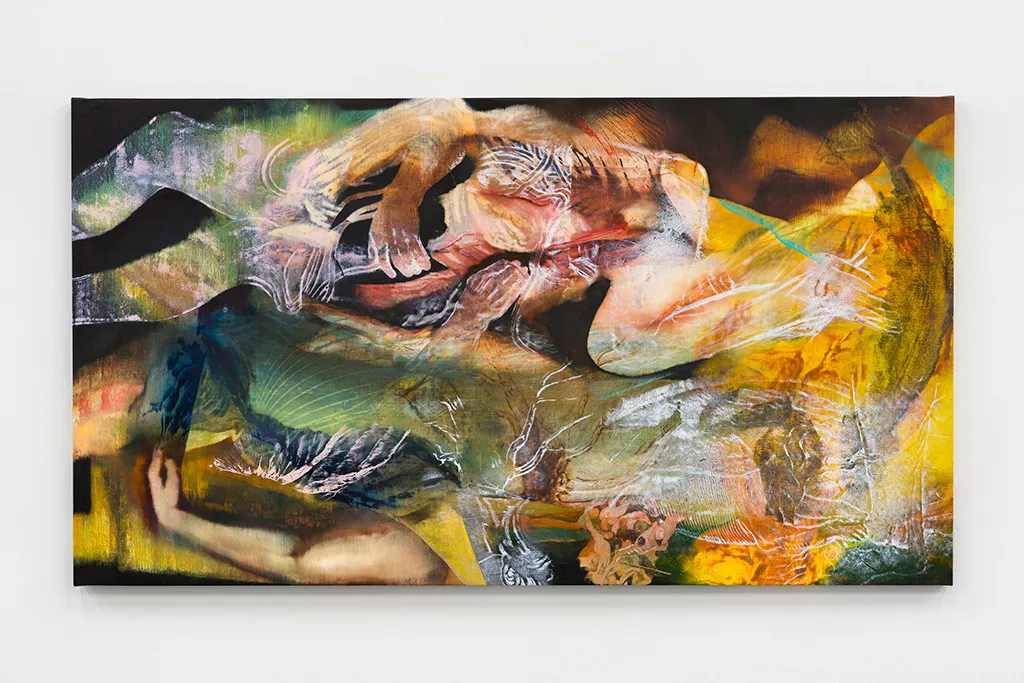
Carver wants us to be simultaneously “inside and outside the body,” but we are also beyond it and before it. His layered super-compositions play among afterimages of The Wound Man burned into our retina, a surgical shroud of Turin knotted to the painting with tangled images of a fleshy rope. Where is the end of it, the rope and this painting? Where do I clip in? Where do I stand? “Is the artist a climber?” I asked someone at the front desk. “I don’t think so,” she replied. Taking in the work, I imagine it’s not so much the ascent but the fall, the earth violently catching you, your humors seeping into the dirt, our planet, your blunt instrument. One that is decidedly not featured in the diagrams sent to prepare me. A lot of things aren’t on that list.
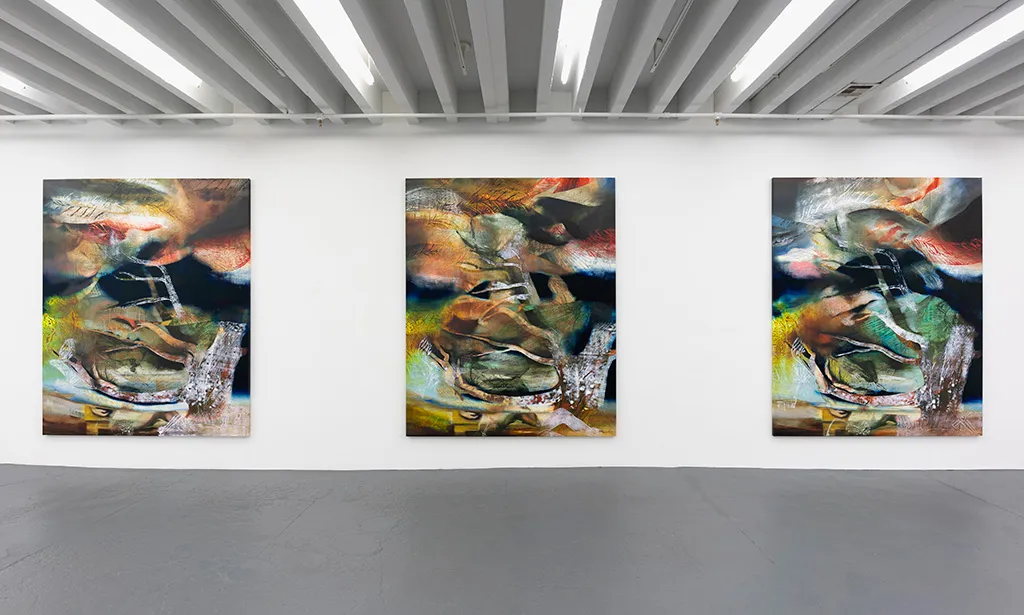
In specific sects of Buddhism, there was the lightly mythologized practice of “cemetery contemplation” where monks were said to sit with the decomposing corpses of the deceased as part of their spiritual training, watching the theater of “dust to dust,” but much wetter. It is not enough to see the body bloat or take in the smell of decay. It’s an act of witnessing until the very last note, the final microbial breath of self after which the “body” arrives at infinity, drawn in by the soil and its many actors. In front of Carver’s paintings, one is made audience to that place of infinite renewal. The seeping parts of us that soak, collect, and pool. Me. You. The Climber. Dissolving into wet mixings on his linen canvas.
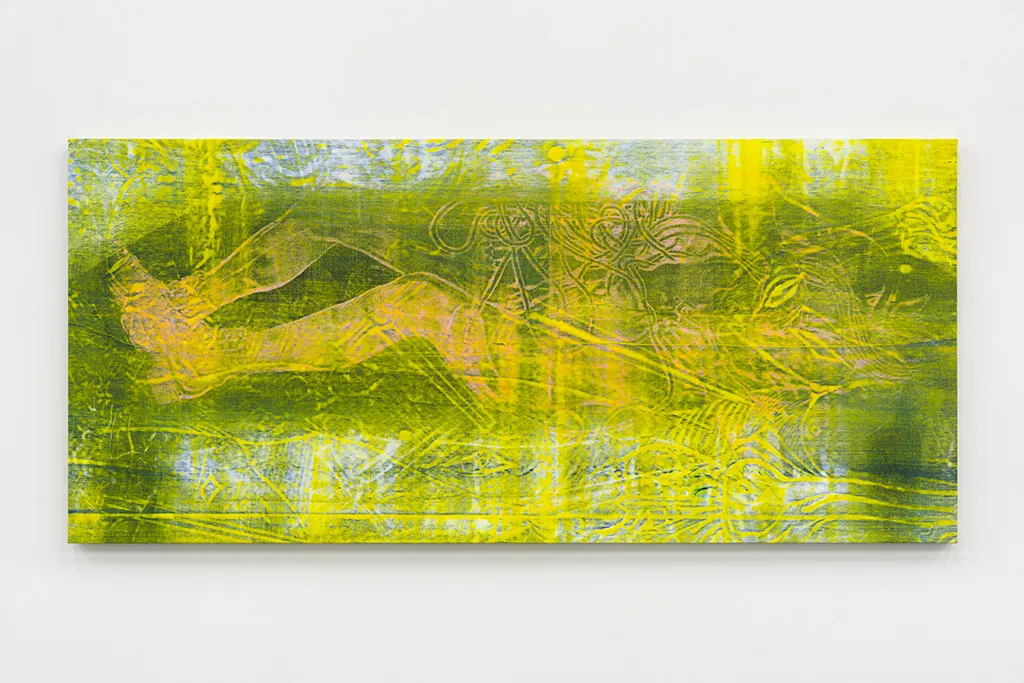
It was kind of a lot. I feel weak for admitting it. In a spring gallery season featuring many elegant flower shows, Alex Carver dug up bulbs from the garden to show us what the compost is made of. It is an eternal loop of wet mummified remains that curl and knot. They are beautiful, nourishing, almost biblically so, yet they petrify me. Perhaps because the edges of those boots are a sturdy foothold reminding me that this color cacophony is based in our reality. Yet, despite the presence of wounds and spilling sinewy knots, I don’t sense this body of work surrounding death has much to do with suffering. The figures you will find at Miguel Abreu feel electrically quiet, at rest, accepting. Even The Wound Man stares at us with eyes relaxed, mouth closed, his ancient severed arms offered limply for our witnessing.
Alex Carver: The Knot is on view at Miguel Abreu Gallery, New York, from March 12 to May 9, 2026.