

.webp)

Sonia Boyce: “Demonstrate” at the Queens Museum
Review
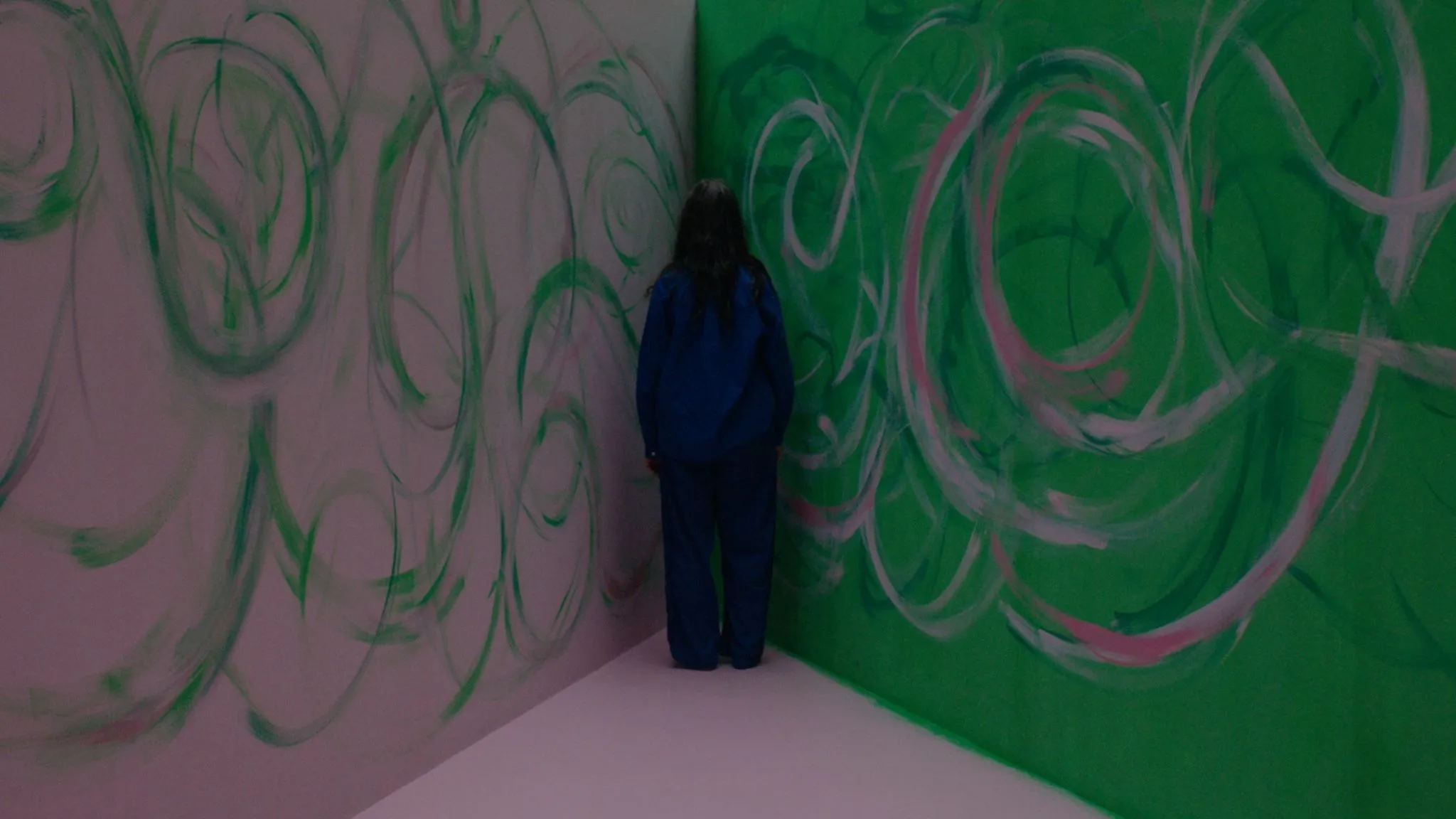
Dominique Gonzalez-Foerster’s ruminative short film Meteorium III (2026), featured in her latest solo exhibit Zone at 303 Gallery, includes a shot of the conceptual artist standing at the corner between two of her converging paintings, one pink with green swirls and the other green with pink swirls. They are inverted mirrors, two of sixteen paintings featured in a structure of canvases arranged into an interactive asterisk. Each painting presents desertscapes and forests, clouds of moisture and ash, dawn and dusk, day and night, rain and snow. In short, these canvases embody abstracted, distinct natural states.
The aforementioned shot features the artist attempting to walk between these environments, as if eschewing a fork in the road for an invisible center pathway. It directly challenges the necessity of segmenting and distinguishing objects, environments, and states of being. In The Order of Things (1966), Michel Foucault similarly disrupts our collective desire to categorize, framing the practice as subjective. Absolute distinctions between material and metaphysical, sanity and insanity, and even colors, Foucault argues, disregard the inherent fluidity between categories, as well as the malleability of standards and methods of classification across both cultures and time.1 Through the same Foucauldian lens invoked by Zone’s curation, Gonzalez-Foerster’s work obliterates perceived boundaries, not only between elements of nature, but between the gallery and the outside world.
Gonzalez-Foerster’s portfolio encompasses many other forms of abstract worldbuilding in pre-existing spaces, including her haunting outdoor installation Desert Park (2010), a juxtaposition and recontextualization of whitewashed abandoned bus shelters against the verdant tropical backdrop of the Instituto Inhotim in Brumadinho, Brazil, and chronotopes & dioramas (2009), a series of liminal, dreamlike dioramas and literature interventions within Hispanic Society’s Beaux Arts-style library. She also experiments with emerging technology to realize these dreamscapes, including augmented reality in endochrome (2023) and analogue-generative digital media in IUM (JM) (2026).
In her 2026 installation, also entitled Zone, Gonzalez-Foerster uses the bare walls of 303 Gallery’s first showroom as the foundation of her metaphysical installation. Here, a faintly ominous montage of ambient sounds suffocates the otherwise empty, white-walled gallery: whirring helicopter blades, shrill steam engine whistles, faint clattering of amalgamated machinery. Cicadas chirping into the night and dogs baying for food. Groaning of distant cargo ships. The piercing ring of a rotary telephone. The sounds fluctuate in clarity and volume, occasionally fading into murmurs. Once in a while, the abrasive, percussive sounds of city life release their tension, transitioning to more romanticized soundtracks of the countryside, like the echoey thrums of bullfrogs and languid plashes of water. The twenty-minute sound installation cycles indefinitely, with no sense of beginning or ending, escalation or de-escalation. Its effect is at once calming and disturbing, an invitation to reflect without accompanying visuals while forcing the viewer into an uncomfortable soundscape.
.webp)
The archetypal blue-chip contemporary gallery’s standardized appearance forms a quiet respite from its surrounding bustling metropolis, tempting the visitor with a controlled environment free of pedestrian traffic. Contemporary galleries (like 303) are what Foucault would characterize as heterotopias, or as structured places within larger communities and cultures.2 Heterotopias are upheld by rules ostensibly to improve participants’ conditions while existing alongside, and sometimes enmeshed within, other heterotopias with different standards of conduct. Such constructs are a result of the deteriorating distinction between sacred and profane places, an attempt to concretize unattainable utopias in small societal pockets. Foucault’s 1967 lecture Of Other Spaces addresses two forms of heterotopia applicable to arts spaces: heterotopias of indefinitely accumulating time (collections that seek to permanently preserve histories and cultures) and heterotopias of the festival (transitory spaces designated for showcasing cultures and activities for brief moments in time). Museums apply to the former, galleries with rotating exhibitions to the latter.
The Zone installation, by unusually featuring the Contemporary Gallery as the art itself, highlights its inherent heterotopic qualities, including its consistent, unified aesthetic; brief exhibition timeframes; and internal rules that refine the visitors’ conduct, like forbidding physical contact with the art, walking at a slow pace, and regulating entry. It also cleverly amplifies them. Bathed in tense audio, the gallery’s inviting four white walls and smoothed stone floors merge into a prison cell, while its gentle overhead lighting intensifies into harsh fluorescence. Here, Gonzalez-Foerster removes the Contemporary Gallery from its idealized heterotopia, merging it with the outside world—even its walls fail to hermetically seal art from the elements, as a long, narrow buddle of water slices an open wound across the floor.
.webp)
Though amorphous and unattributable to a singular location or state of being, Zone invokes a sense of place, or a hybrid of many places. The installation mutates the Contemporary Gallery into a perverse mirror of humanity’s perpetual cycles of pain, serenity, isolation, joy, violence, faith, and instability, the midpoint between meditation and confinement, transforming 303 Gallery’s walls into a porous membrane. By extension, Gonzalez-Foerster’s exhibit transposes and distills the environments that inspire individual works of art into the space that houses them. Zone, the installation and exhibition, disrupts the visitor’s expectations of the gallery space, offering the visitor rare moments of controlled focus while eliminating the implied barrier between the art as object and art as space.
Dominique Gonzalez-Foerster: Zone was on view at 303 Gallery from March 20 through April 16, 2026.
1 Michel Foucault, The Order of Things: An Archaeology of the Human Sciences (Vintage Books, 1994).
2 Michel Foucault, "Of Other Spaces," in Architecture/Mouvement/Continuité no. 5 (1984): 46–49.