
.webp)

Marie Lorenz and Jeff Williams: "Roll, Pitch, and Yaw" at International Waters
Review
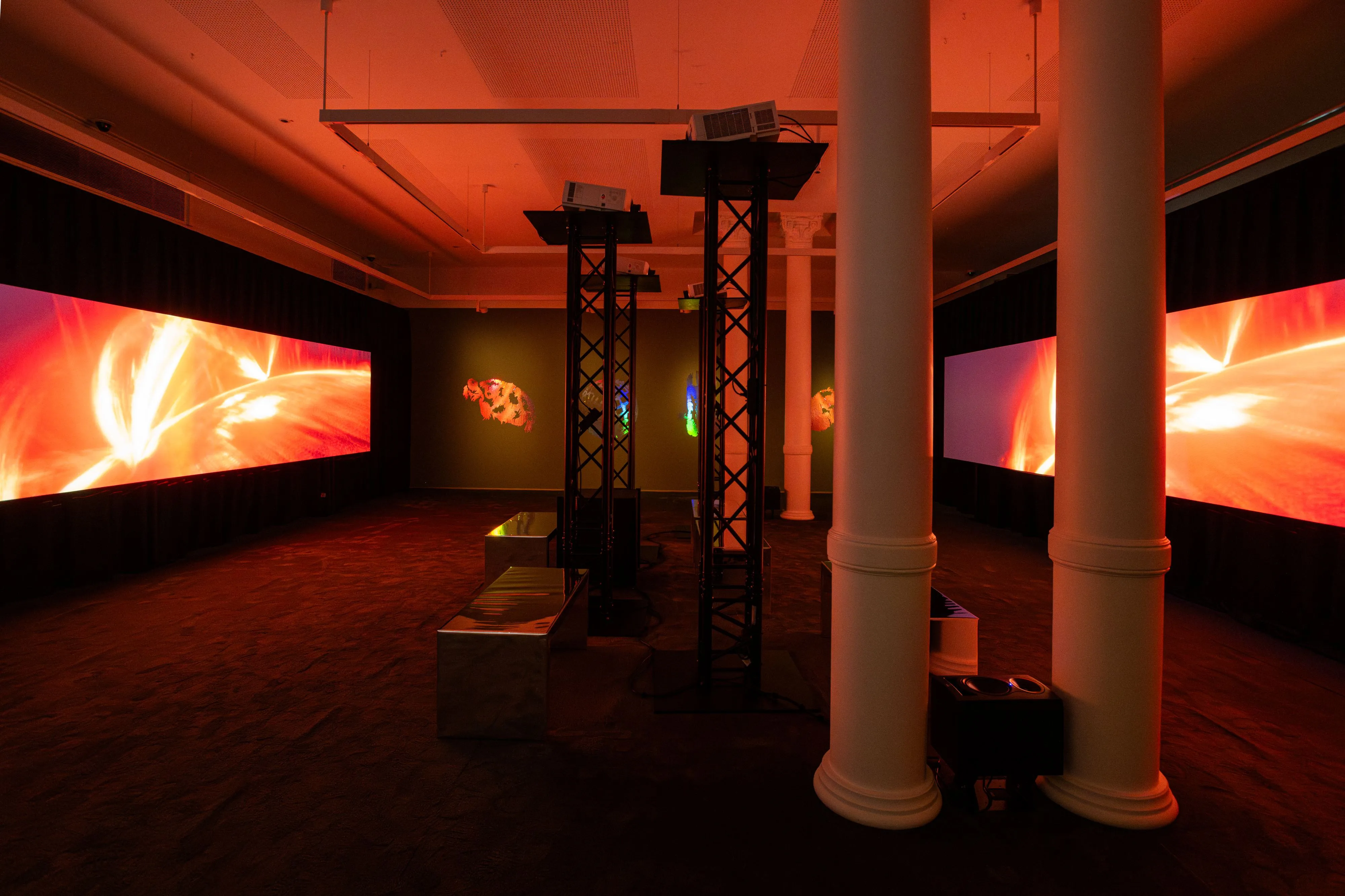
In their film Staring at the Sun, presented at Cercle Cité until April 5 on the occasion of Luxembourg City Film Festival, Alice Bucknell teases out the anxieties, grand promises, wishful thinking, and cultural paranoia surrounding the contemporary state of climate engineering. The piece is presented as part of Here Comes the Sun, an exhibition curated by Elektron that, amid a techno-dominated contemporary moment, argues for a return to the energy source that started it all: the sun. Alongside works by James Bridle and Solar Protocol, Bucknell’s film offers a “speculative drizzle” on a not-so-distant future currently being built as we speak.
Across the film’s forty-minute runtime, Bucknell probes the fields in and around the climate model simulator Derecho. Derecho itself isn’t fiction: it’s a very real, hulking piece of government-funded, bleeding-edge machiney that the artist—and at times writer—traveled to Wyoming to see for themselves. From this research trip emerges Staring at the Sun’s avuncular supercomputer engineer, donning a shocking red Hawaiian shirt, who explains how Derecho, and models like it, work.
He’s accompanied by a cast of other future-focused characters that work in and around the field of climate engineering. They appear in the forty-minute, two-channel work projected onto parallel walls. In order to watch it in full, one must either view it twice or crane their neck repeatedly in hopes they’ve caught the better scene. While watching, there’s a sense that you’re always missing a beat. Something—maybe a turtle—just wandered out of frame? A snaking tube is attached to… a cow udder? In the twisting and turning, in the missed sentiments and the looming score, there is a risk of being cut out of the dialogue, missing something, being left dangling on the offcut of the bleeding edge.

Annalise June Kamegawa: For a time, you were doing journalistic arts writing —how long were you writing for?
Alice Bucknell: I started writing around 2017, freelancing for all these different outlets. It was 2023, maybe, when I really started pulling back on the text-based practice because the practice-practice side of things was getting busier.
But the writing is still in the room with us; it just sneaks into the back end of the scripts. Staring at the Sun is a good example of this—I call it a ‘sci-fi documentary’, in the sense that probably 80% of the film’s script is based on real-world interviews I did with the global protagonists and antagonists of climate engineering protocols. Zooming out, all the work I make now is super informed by my time as a writer, both in the construction of these multiscalar narratives and what underscores all of them: talking to experts in their field, taking some specialized knowledge system and cracking it open, then trying to draw connections between its many moving parts.
AJK: In Staring at the Sun, your film showing at Cercle Cité, there are definitely some Easter eggs in your work that heavily point to the discourse in the US around politics, technology, and the climate.
AB: I feel like people seem to latch onto the dystopian elements a lot more and a lot quicker. I do a bit of grudge work in bringing in these real-world antagonists, or maybe they are protagonists in some way as well. I changed names—corporations, individuals—and like 20% of the script, but basically everything that you see in that film is something that someone told me in an interview. The CTO (chief technical officer) of Selling Sunsets, the Climekin character Ellie, the very southwestern-coded supercomputer engineer in the Hawaiian shirt with the lizard ankle tattoo: these are all real people that I interviewed and talked to.
For me, if phase one is creating this horror show based on the real—the banality of evil of these people existing in the world and the amount of power they have—then phase two is the driver of speculation. The narratives I create have some elements of dystopia, but then I think a lot of the exciting and fun work for me is thinking about alternative systems that can respond to those conditions of the present.
I try to do the documentarian thing in a way, the balancing act, the simultaneous leaning into and reframing of well-trodden assumptions. I like to onboard these technological systems that are actually undergoing legislation/implementation IRL, the kind of glossy infrastructure renders from the corporate PR reel, but also adds some friction and pushback through the speculative elements. Sometimes this creates a bit of a leapfrog dynamic where one work starts seeding itself in the work that I’m currently developing, and that’s just how these “cinematic universes” expand. For instance, the “Earth Engine” system that emerges in the final scene of Staring at the Sun—a kind of alternative climate simulation system based on big feeling vs big data—became the scaffolding for the video game that I'm now working on, called Earth Engine.
AJK: I noticed that the alligators seem to carry over from your previous works.
AB: Yeah, I love a good swamp. Can't get away from the swamp.
AJK: Were you raised near a swamp? Not to make assumptions about Florida, but . . .
AB: No, it's fine. I grew up on the Gulf Coast, around halfway down the state, in a planned community called Lakewood Ranch. The closest cities of note would be Sarasota and Tampa. I grew up in a census-designated place, which, hilariously, after the influx of tech bros in the pandemic, is now this smart city. When I was there, it was all cow pastures, golf courses, and retirement homes. Now it’s the silicon swamp, an eco-smart city, they want to put the whole thing on a solar panel power grid, and build out a digital twin, which is supposed to run all its traffic lights and infrastructure. Eventually, they’re planning an Estonia-style digital governance situation where voting will all happen digitally—but the average age of this place is like 86.
AJK: My skeptical response as an American is, "anything but a train."
AB: Literally. Men would rather create a digital twin of a swamp than go to therapy. Headline.
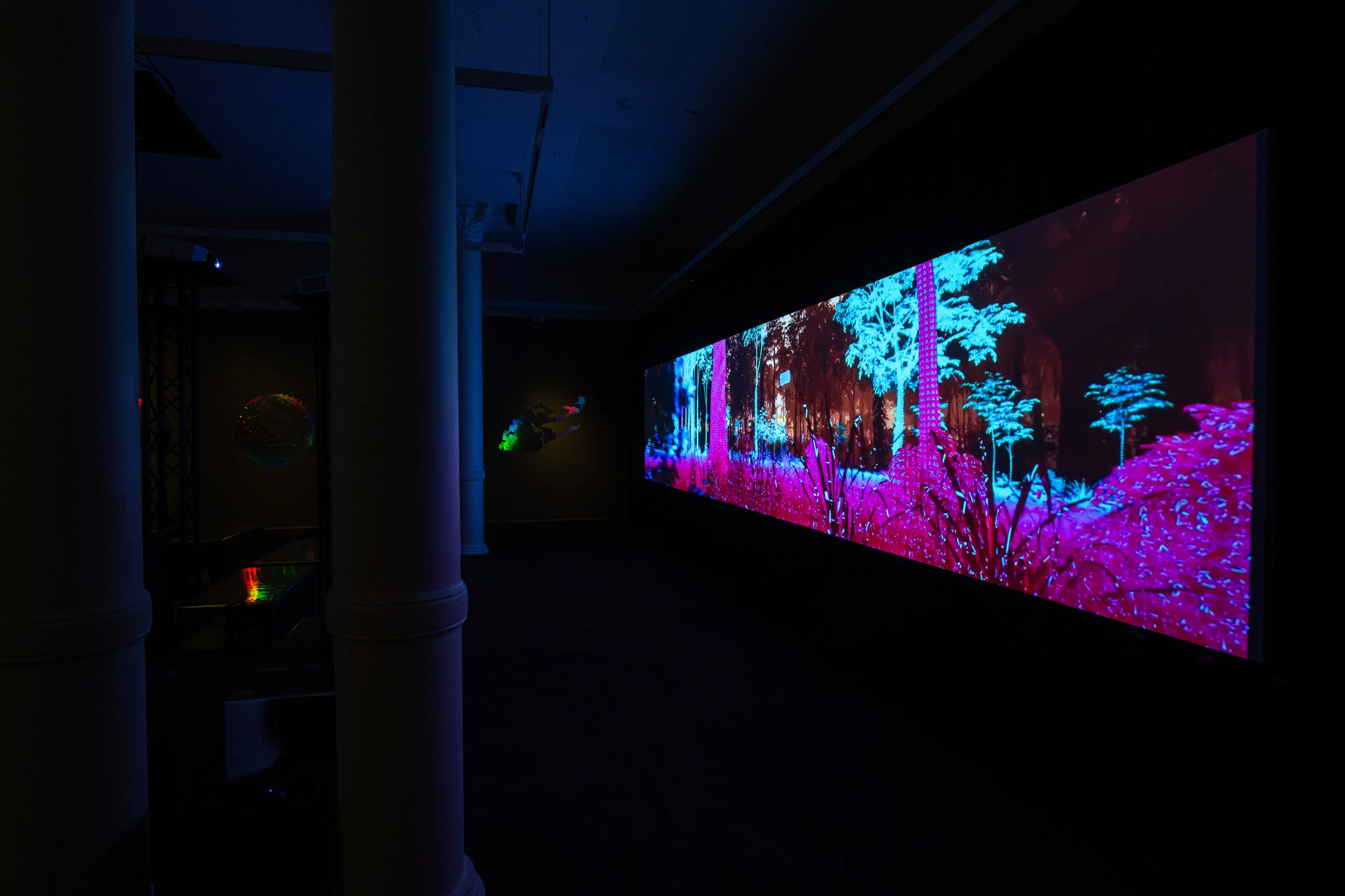
AJK: In Staring at the Sun, I felt that despite these “antagonist” characters, you came at each element of the story with this holistic and empathetic approach. Even with the Derecho Earth Simulator System, you balanced its promises with its limitations. For example, I was struck by how the scientist who was explaining the technical nature of the system had this line stating that he wasn’t political.
AB: That was an actual quote from a climate scientist I interviewed. I interviewed a couple of them, actually, for that character, and then they just merged into one. At the National Center for Atmospheric Research in Wyoming, there is a supercomputer called Derecho that was built specifically to run solar geoengineering simulations: spraying particles in the sky to dim the sun, and seeing the potential global effects.
In order to get access to Derecho, I had to apply to the National Science Foundation, who manage their press relations. I applied first as an artist, and was pretty swiftly rejected. Then, I resubmitted as a journalist, using whatever posturing I could recall from my last life. Bingo. They let me in but were a little suspicious, or maybe just confused. The employee running the visitor program was like, wait, I thought that you were an artist? I just said, yep, I'm both.
I also wanted to get the more technical POV, so I spoke with both the lead technologist training Derecho as well as one of NCAR’s leading experts on climate models. I asked them: how do we deal with this language around digital earth twins—real-time, real-scale digital copies of the planet—that are trained on patchy data, but still presented as objective arbiters of future Earth climates? How do you feel about this technology? Because obviously it's so rooted in inequality and the dredges of imperialism.
I was considering that these models are being trained on historical data, which has massive data voids for countries in the global majority. This includes the global south, which is most susceptible to anthropogenic climate change caused by the global north.
Their answers were interesting, from a social-science perspective, as they tended to default to a kind of black-and-white binary. I'm not a political person. What we are proposing here is no different than the natural processes of volcanic eruption. Solar geoengineering has a PR problem. If we called it an experiment to evaluate the effects of sulfur dioxide in the Earth’s atmosphere, no one would care. She went on to say that it’s really unfair to say that it has this bias. But it does have a bias! And there is a very real fear from the public around these technologies that can’t really be tested first without deployment. Because at the end of the day, whatever political straw man argument you build around solar geoengineering doesn’t reconcile with the scale of what’s at stake: atmospheric alterations deployed in the US ultimately affects everyone, everywhere, all at once.
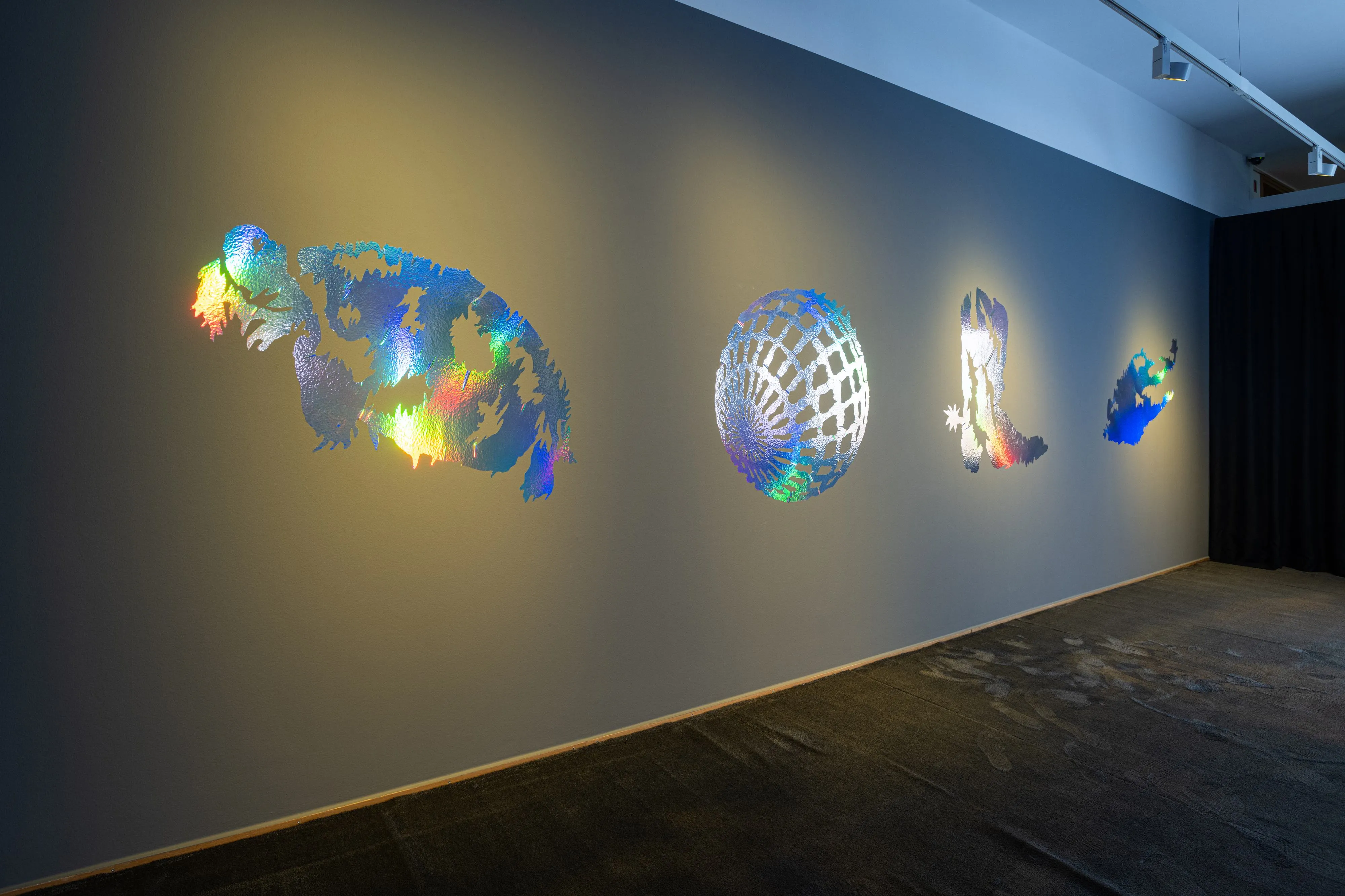
AJK: Do you ever feel that when you're working with these big research goals, you turn a bit conspiratorial, that there's a bigger system at play? Something nefarious with the powers that be?
AB: Unfortunately, in the R&D phase, I get very "red string" about everything. Honestly, it's a little disgusting. Staring at the Sun was developed in about two months during a research residency at EPFL, a polytechnical school in Switzerland, where I was working with climate scientists, including people who have studied clouds for decades, and through these experts I was also able to speak with a specialist at NASA working on GEDI: a 3D scanner stationed on the ISS that is building a 4D model of the Earth’s forest systems, kind of trying to prove how the Earth’s own carbon mitigation infrastructure—dark forests, deep oceans—are way more effective than any engineered solution humans come up with.
Sounds civil enough, right? But the workflow was basically long nights of me in a basement in Switzerland, whiteboards and sticky notes everywhere, trying to tether together all of these agents and angles while giving the story its own breathing room.
Staring at the Sun is big. It's trying to look trans-nationally, trans-technologically. It's not just looking at one method of geoengineering, but a bunch of different methods. It's looking at it from a corporate angle, from a business angle, from a government angle, a climate policy angle, an activist angle, an ecological angle, and, mostly in the last couple of chapters, an angle of mystery and wonder for a world that also escapes the model, the map, the simulation. Working in that intersection, it does get messy, conspiratorial, and weird. But I think that’s the point in a way, to stretch beyond the threshold of what we think we know: to grasp at the many ways in which a complex system can be imagined differently, and open up other futures in the process.
This interview was edited for clarity and length.
Here Comes the Sun: Art, Energy, and Natural Intelligence was on view at Cercle Cité from February 2 through April 5, 2026.