
.webp)
“Love in a Fallen City” at lovers
Review
If one were to throw a stone in Tribeca or Chelsea, it would likely hit a show grappling with the legacies of Surrealism, one of the most influential art movements of the twentieth century. Surrealism, both as a movement and an art historical term, occupies convoluted and liminal ground, maintaining different—at times contradictory—meanings across various contexts. The Whitney Museum’s recent Sixties Surreal exhibition demonstrated that there are many types of surrealism. Mriya Gallery in Tribeca recently echoed this proposition with Apple Face, a group exhibition titled after Belgian Surrealist René Magritte’s famed Son of Man (1964). Though nominally rooted in a Magrittean strain of Surrealism, the exhibition mobilizes this reference as a thematic springboard, a point of departure from which each artist generates distinct associations.
The exhibition, curated by Aidana Bergali, opens onto a surreal scene: a full-scale motorcycle installed in the middle of the gallery alongside two remote-control airplanes. These works by Kevin Russell Draper—the only sculptures in a show of paintings—could well be the military toys from a Malcolm Morley painting translated into three-dimensional form, occupying the personal space of visitors in unsettling proximity. Given Surrealism’s origins at a time of socio-political turmoil in the 1920s, there is a foreboding quality to these sculptures that subtly speaks to the state of the world in 2026.
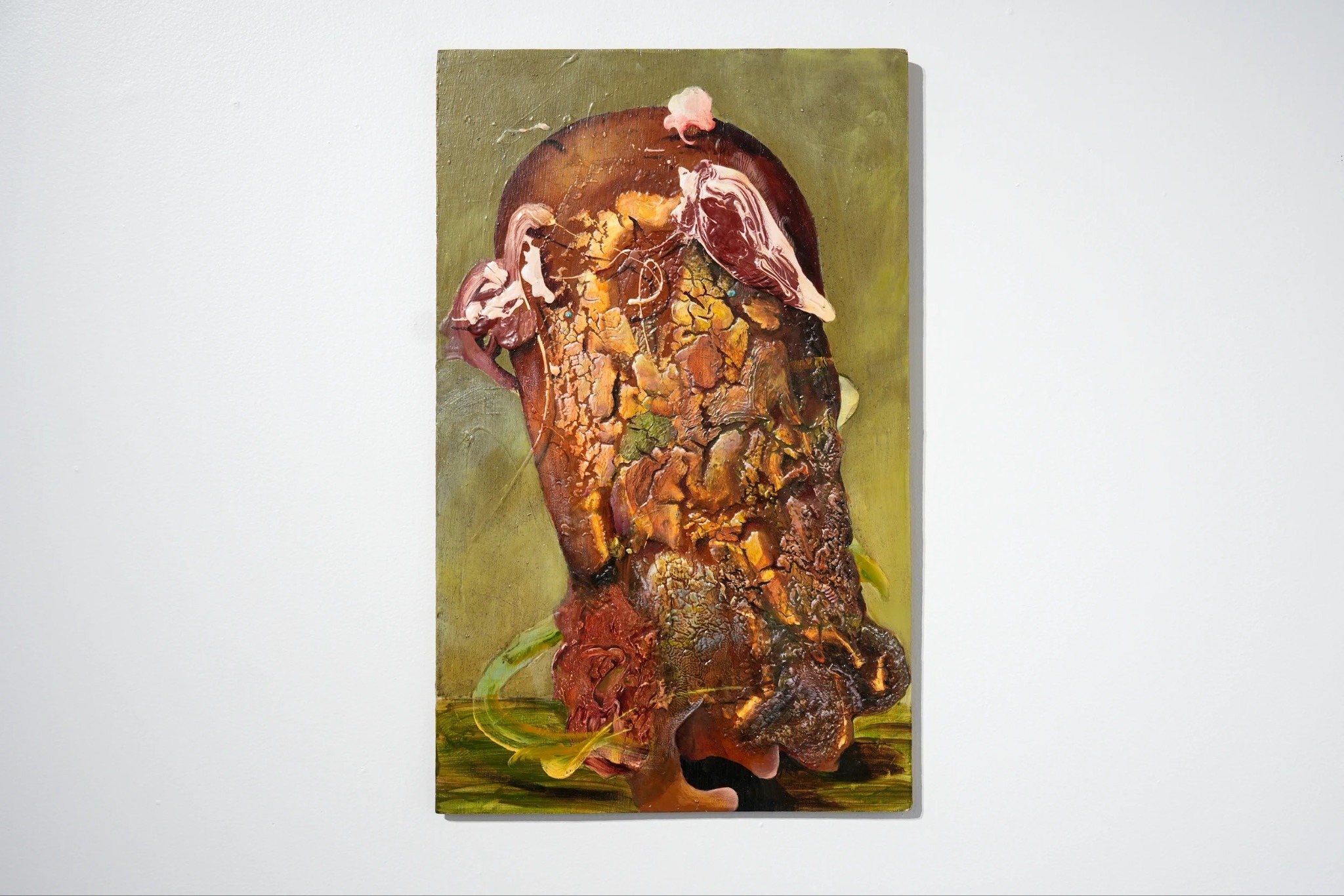
Iain Andrews’s paintings disguise figures behind a veil of abstraction. The violent splatter and build-up of oil and acrylic paint in a work like Hell at Last (2018) or Strange Fruit (2024) recall the melted-down subjects of Francisco Goya’s occultism imagery, while evoking the ecstatic religiosity of El Greco. Similarly, Francesco Cipollone’s paintings achieve a jarring effect with the distortion of hyper-stretched forms that verge on unrecognizability. With a sense of dematerialized figuration, paintings like At the Intersection (2026) loosely recall a sixteenth-century Italian Renaissance painting or a ceiling fresco that has been reduced to a blurred mixture of forms teetering on the precipice of legibility and illegibility.
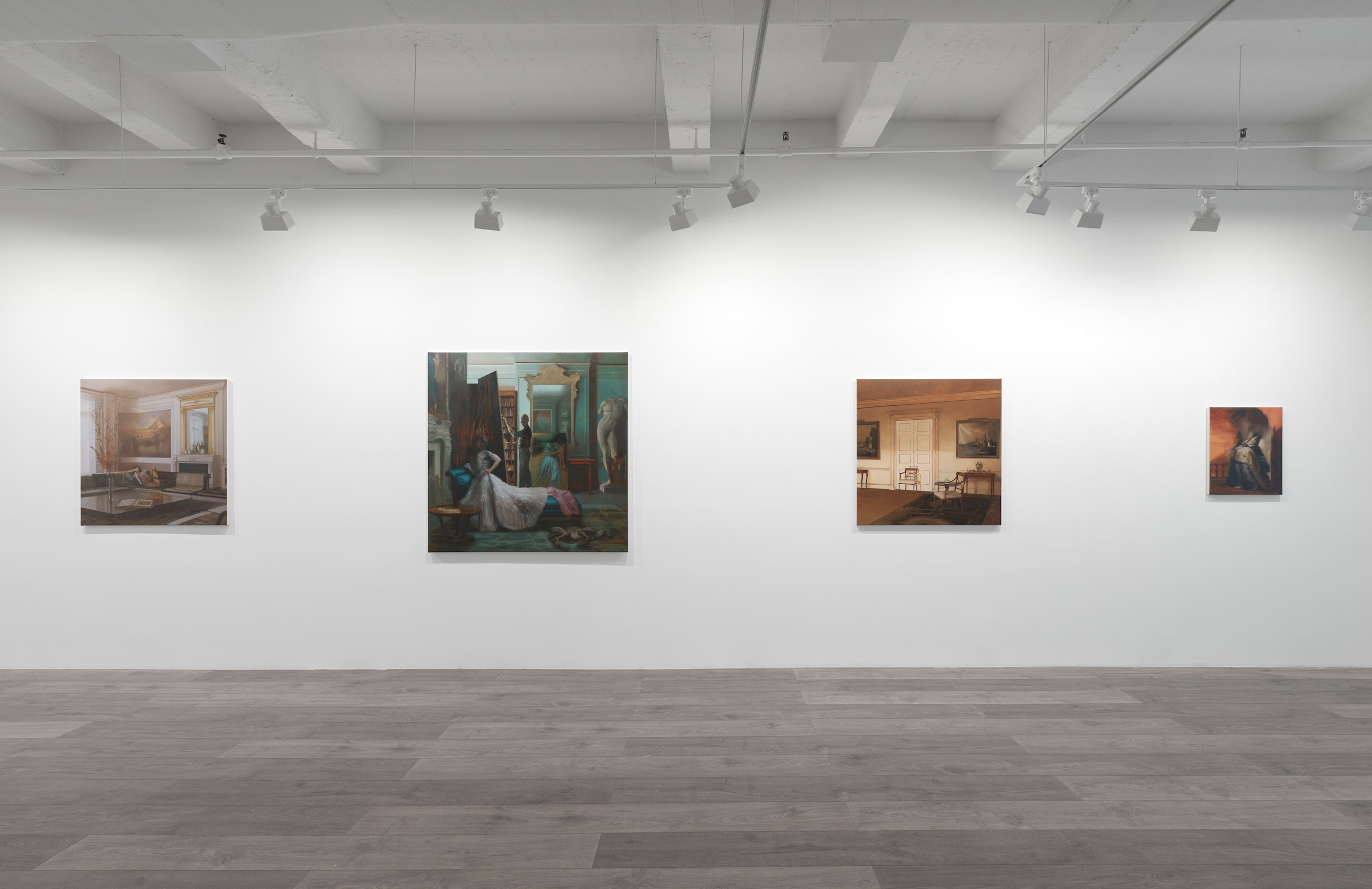
Jacques de Beaufort’s paintings are perhaps most overtly indebted to Surrealism, recalling two specific predecessors: Salvador Dalí and Max Ernst. These visuals evoke Dalí’s psychosexual figuration against backdrops reminiscent of Ernst’s unsettlingly grandiose worlds. However, de Beaufort diverges in the cybernetic quality of his paintings, which depict humanoid subjects in fictive spaces with a foreboding sense of surveillance.
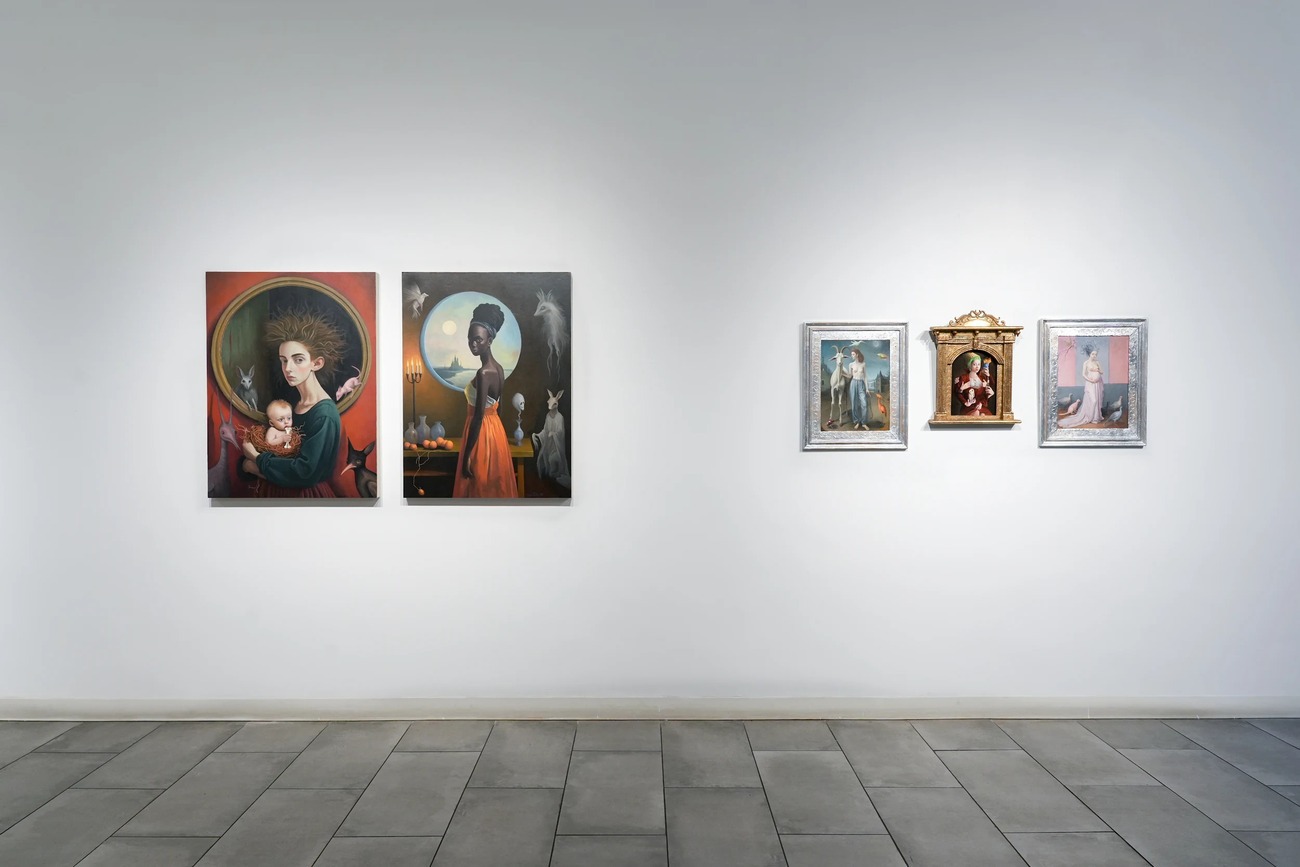
Kevin Kuenster’s fantasy worlds depict familiar animals alongside imaginary hybrids. In scenes reminiscent of Bosch’s dark and twisted Northern Renaissance paintings, the subject matter is unsettling, from the implicit erotica of a topless woman with rabbit ears seated poolside with a rabbit-man to the Lynchian noir of a domestic drama. The haunting ambiguity of works like Nostalgia (2023) is echoed by Miguel Bonilla’s graphite-on-paper drawings that deftly channel Victorian-era weirdness with an Aubrey Beardsley-esque morbidity.
One aspect of the show that remains murky is the pairing of the actual artworks with digital counterparts, which were projected on a screen in the back of the gallery. With the purchase of a physical artwork, the collector also acquired its digital version. Though this approach is creative in marketing the saleability of a single artwork in two forms, it seems extraneous, while perhaps diminishing the appeal of the actual artwork as a unique entity. The digital copy is not an NFT, but the format is familiar as a technological interface. With this model, how do online photographic reproductions of any of these artworks differ from the championed “digital” versions? By this logic, could one claim ownership of an artwork by simply screenshotting the image of that piece on any blue chip gallery’s site, claiming the screenshot as a “digital original”?
.jpg)
René Magritte is less an overt presence in the exhibition than a conceptual throughline linking the divergent directions taken by its artists. Apple Face complicates, and in turn enriches, conceptions of Surrealism. This exhibition is revelatory in underscoring the individualized approaches of these artists rather than defining the “surreal.” Sometimes this is done rather explicitly, as in Jacques de Beaufort’s neo-Dalí scenes, or much more subtly, as in Kevin Russell Draper’s introduction of a motorcycle and two toy military aircraft in the serious atmosphere of a white-cube gallery.
Apple Face was on view at Mriya Gallery from April 2 to April 23, 2026.