

.webp)
“Thucydides Fever Dream” at Hill Art Foundation
Review
How Asian Is It? (Notes on Asian Americanness and Abstract Painting), curated by Lilly Wei at the Milton Resnick and Pat Passlof Foundation, poses a very good—if provocative—question. It takes its nomenclatural structure from Walter Abish’s 1980 novel How German Is It, an investigation of postmodern German identity in the wake of World War II. Against the broader cultural context of retrograde right-wing backlash against the siloed identity politics of the 2010s, Wei locates the fundamental basis of these categories in the 1960s, when the term “Asian American” first entered public discourse.
Institutional barriers to access exist across overlapping axes of age, class, race, gender, and innumerable other identity-based factors. Every artist’s work, no matter how conceptual, cerebral, or abstract, is psychoanalytically informed and modified—but not strictly defined—by the textural substrate of personality, background, and individual experience. Is it possible to unpack the dimensions of these conditions without trapping marginalized artists within the limited bounds of the margins?
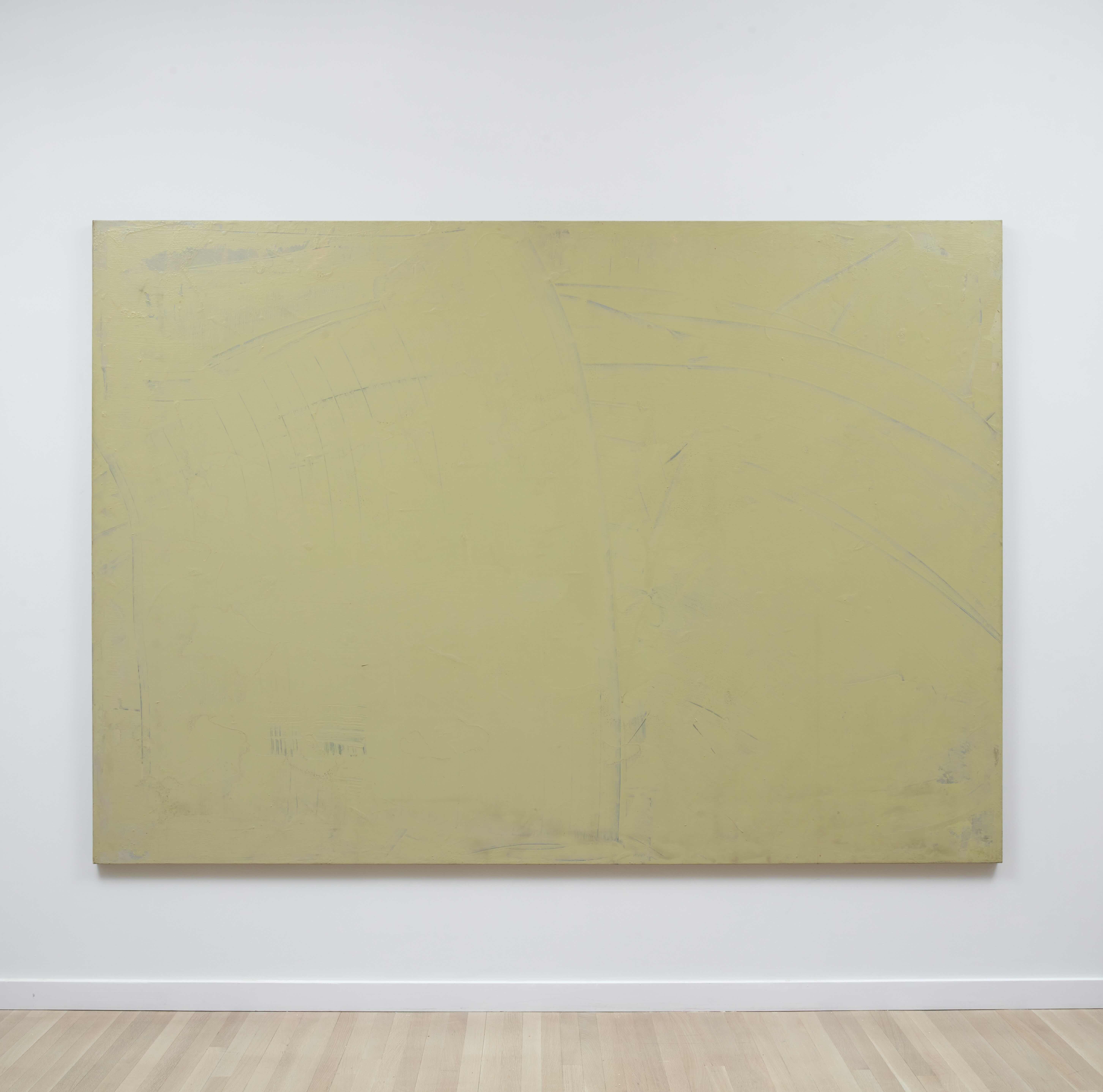
Additions to the historical record depend not just on inclusion but on sensitive, successful integration. The process of revising established canons often hinges upon discovering and platforming time-dependent facts of technical analysis. David Diao’s large painting Grandsweep (1970), which anchors the first floor of the show, predates both Jack Whitten’s and Gerhard Richter’s use of the squeegee technique from which this painting derives its title. The artist’s philosophical interest in Wittgensteinian language games characterizes much of his work; here, these theories physically manifest. In texture and tone, the composition of Diao’s specific squeegee object (a found cardboard tube modified and extended into an effective apparatus) seems to have imparted its particular qualities to the paint applied.
“Abstract” is a relative term—as with most paintings of the genre or images that appear in dreams, many of these works find original footing in the material, natural world. Like Diao’s Grandsweep, the title of Robert Yasuda’s Pacific (2011)—a curved, glossy surface reminiscent of the wood surfboards the artist (b. Hawaiʻi) shaped and sanded in his youth—mirrors its modes of creation and inspiration. In piercingly blue gradations of acrylic polymer paint laid down with the translucency of oils, Yasuda generates an illusion of oceanic depth.
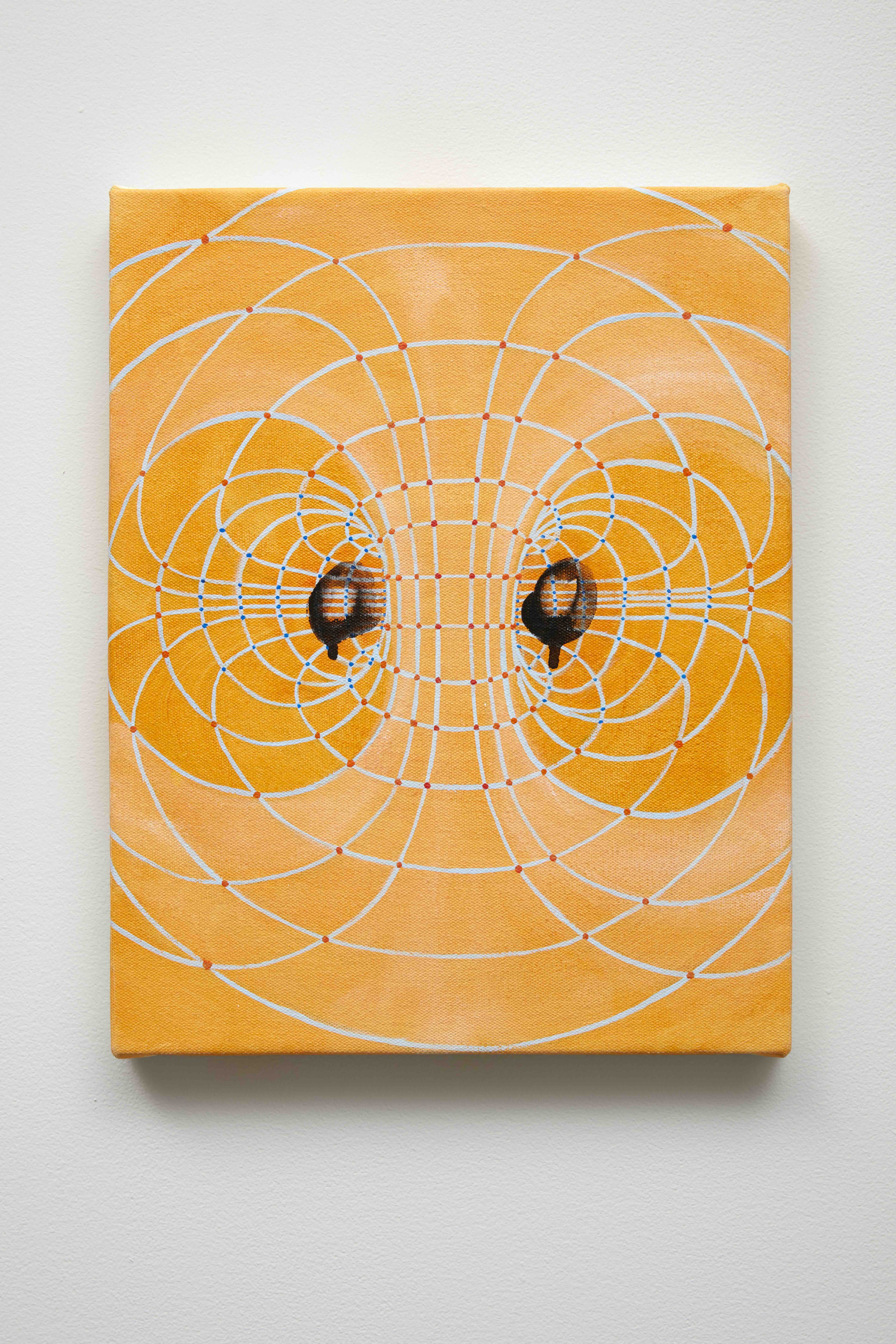
Juxtaposed against the looser forms of Kikuo Saito’s Island and Piano (1980) and Walasse Ting’s Untitled (1959), Shen Chen’s Untitled No.32238-13 (2013)—the newest work on the first floor, which boasts a screen-like transparency in its gradual dissolution of gridded order—feels like something of a prescient anomaly. The second floor, populated by the work of relatively younger artists, skews graphic, speculative, and technical (in the scientific/mathematical sense of the word). Emily Cheng’s flashe-on-canvas compositions from her A Force Like Gravity seriessuggest magnetic flux diagrams; Barbara Takenaga’s Hovenweep (2016) evokes centrifugally launched alien spores, rapidly expanding matter, or dandelion seeds; Il Lee’s BL-2403 (2024) traces abstract flows of movement reminiscent of string theory, while Richard Tsao’s Sci-Fi (2004) and Sizzling Hot Moon (1998) resemble heatmap topographies of the pockmarked surfaces of foreign planets. These water-and-marble-dust-based compositions of Tsao’s “flood room” paintings, presented in twin shadowbox-style frames, arguably approach a hybrid position between painting and sculpture.
The placement of Shirley Kaneda’s The Presence of Absence (2024) next to Kim Uchiyama’s oil-on-linen Apadana (2024) highlights the gentle, muted qualities of the latter. Though both works employ hard-edged blocking suggestive of minimalist paintings and geometric abstraction, Kaneda renders smooth gradients downstream of digital textures, while the fundamental color of Uchiyama’s linen—left exposed in places—functions as a kind of organic underpainting, imparting a materiality reinforced by the thin line of graphite that embellishes and divides the central form.
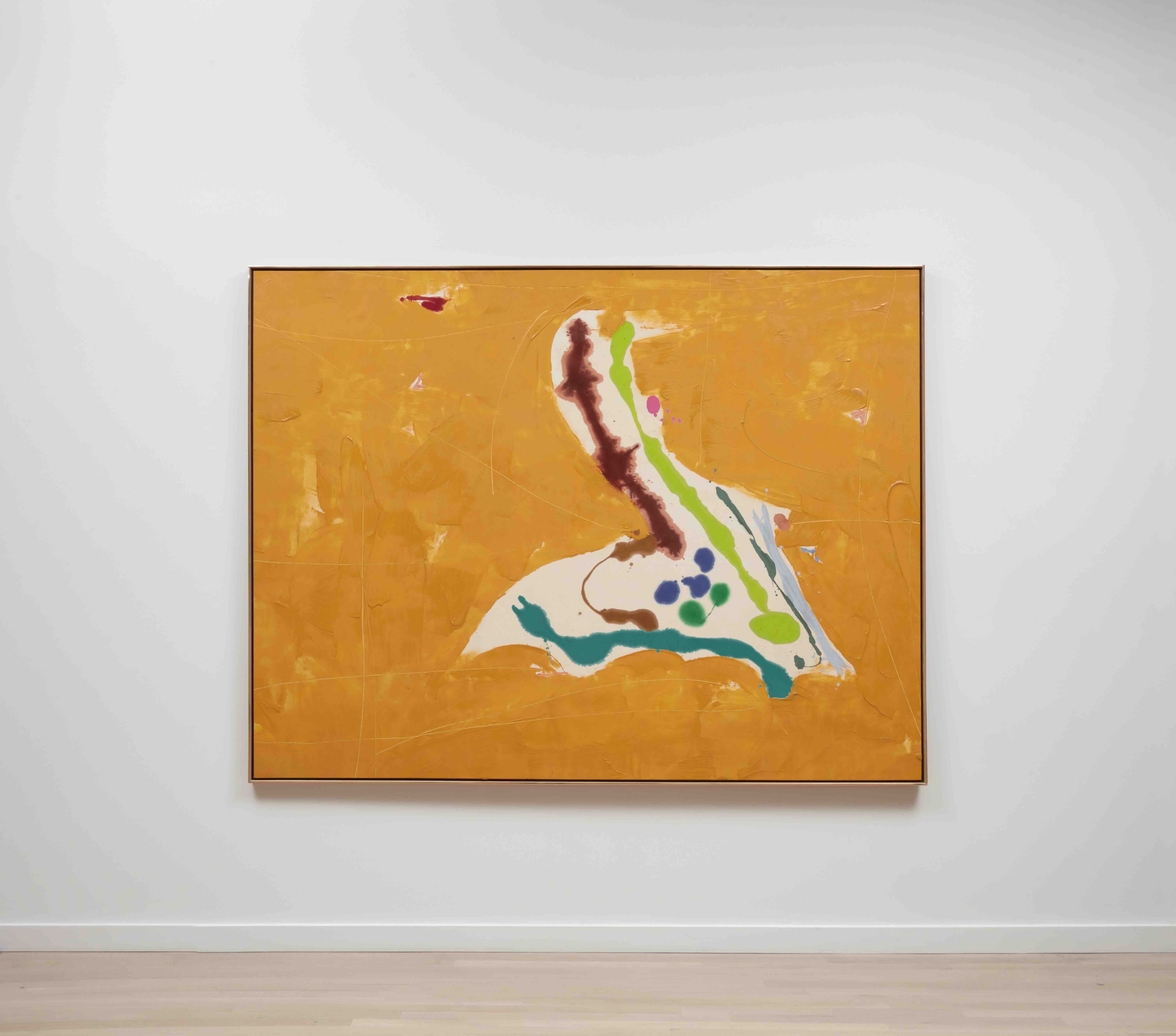
Many of the artists on the second floor crossed paths with the 1990s art collective Godzilla. While open membership was predicated on Asian American/Pacific Islander identity, Godzilla deliberately and explicitly refused definition. In taking its name from the “anarchistic lizard”1 (per art historian Alice Yang) of kaiju filmic fame, the collective—rather than limiting its artists on the basis of style or movement—established itself in opposition to a historically exclusionary art world to include Asian artists in broader institutional conversations.
Wei locates satisfying coherences through her curatorial decisions, but the varied material qualities of the works on display ultimately reflect a broad, disparate range of experiences and approaches. The band of umber that frames Apadana like a post and lintel, for example, appears very different in tone and finish than a similar color laid down in acrylic on Saito’s canvas downstairs. And though Lee and Yasuda both simulate three-dimensional depth through blues of varying opacity, Lee creates contrasting shallows by varying the spacing between strokes of his ballpoint pen as opposed to traditional painterly blending. (Lee’s technique bears more in common with the webbed, interlocked concentric circles that foreground Charles Yuen’s Touring Xanadu (2025), though these works diverge in media as well.)
When the very concept of abstraction has engendered an array of forms and styles since its “inception” (or, more accurately, its formal definition in the art historical canon), why should Asian art be any less abstract or multivalent? How Asian is it, really? As Wei herself suggests, this is primarily a show about the rich diversity in abstraction itself—where it’s been; where it’s going; and what any individual work of art can come to mean through the shifting lenses of intention, reception, and time.
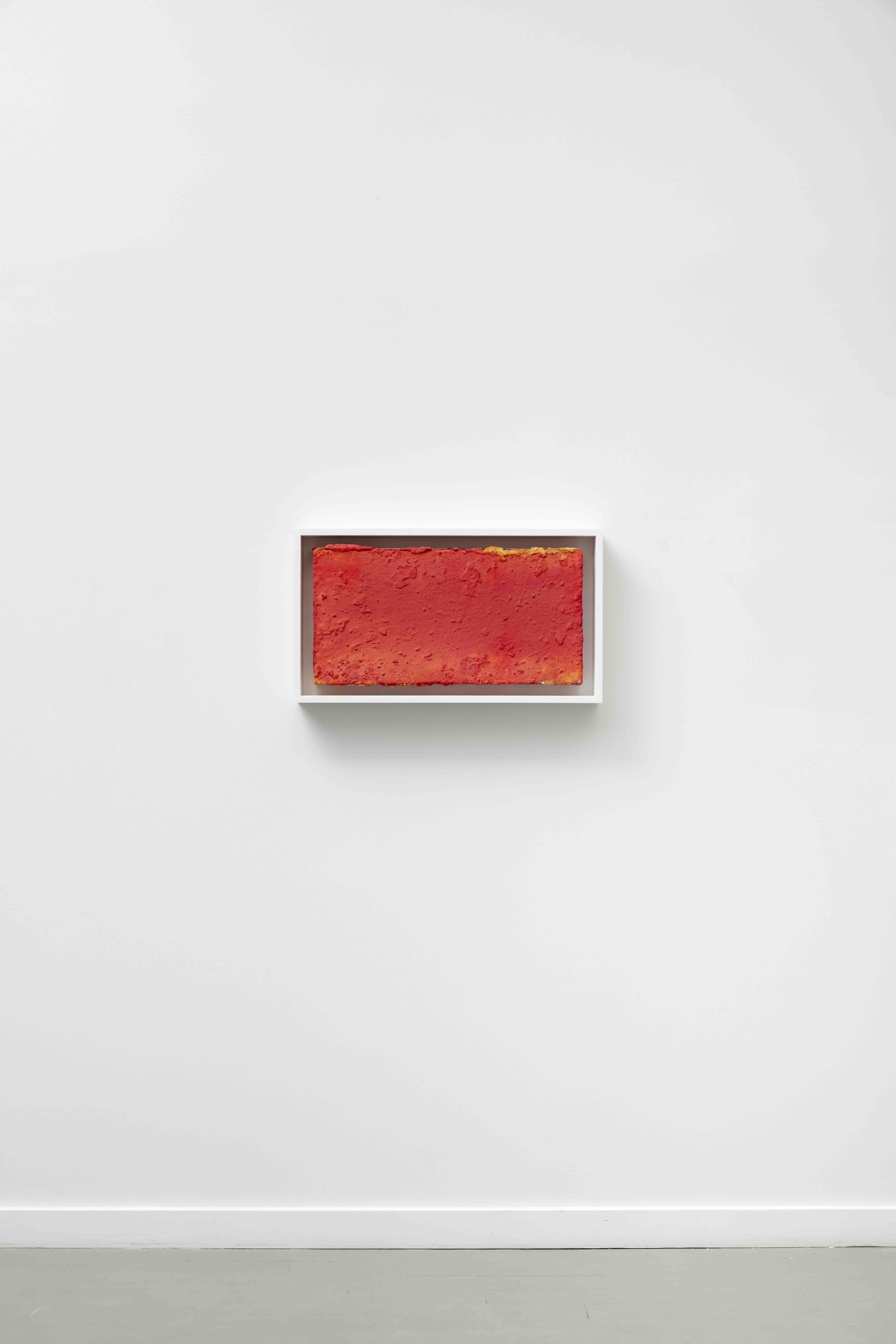
How Asian Is It? is on view at the Milton Resnick and Pat Passlof Foundation from February 13 through July 11, 2026.
1 Alice Yang, "Godzilla: The Anarchistic Lizard," in Why Asia? Contemporary Asian and Asian American Art (New York University Press, 1998).