
.webp)

Tim Kent: “Sojourn” at Hollis Taggart
Review
The excitement surrounding The Studio Museum in Harlem’s reopening last November remains palpable, extending beyond the institution itself into the surrounding streets. The energy gathers on the sidewalk, circulates through bodies, and settles as anticipation. Inside, Fade—the sixth iteration of the museum’s “F” series—does not simply open but unfolds, marking the continuation of the museum’s curatorial lineage and reasserting its presence within the cultural life of Harlem and contemporary art more broadly.
The exhibition unsettles the museum’s usual sense of containment. Sculptures are lifted above eye level and suspended from the ceiling, while others extend outward into walkways, interrupting a clear path through the space. Sightlines open across rooms, allowing works to bleed visually into one another rather than remain neatly contained within discrete galleries. In several instances, the installation presses up against thresholds and transitional areas, softening the boundaries between galleries, corridors, and entries. Here, the neutrality of the white cube gives way to something more porous. The space feels lived in, responsive, attuned to the weight and insistence of Black contemporary expression.
Working within a moment marked by social and political upheaval, the seventeen contemporary artists in Fade turn toward spirituality, surrealism, and nonlinear time, seeking to reconfigure reality rather than withdrawing from it. Many engage place as both origin and echo, drawing from ancestral lineages and collective memory to trace the persistence of the past within the present. The built environment emerges as an archive, where architecture and land register accumulation rather than erasure. The body likewise operates as a site of inscription, where gestures register presence as both fragile and enduring.
As viewers enter the first gallery, Antonio Darden’s Untitled (Reclining Figure) (2025) hovers overhead, seeming almost weightless and carrying a distinct devotional charge. Darden’s practice, grounded in intimacy, draws here from personal loss: the photograph depicts his late brother, David (“Rico”), who was killed by police in a case that remains unresolved. Reclining in a suit, arms outstretched, he appears simultaneously still and strained, at once composed and unsettled, as if charged with an unspoken tension. The soft blur of the image refuses fixity. Darden does not resolve grief so much as recast its visual language, weaving fragments of memory into a fuller, more unstable truth. As an opening gesture, Darden establishes the exhibition’s stakes, foregrounding the weight of memory and the refusal of closure.
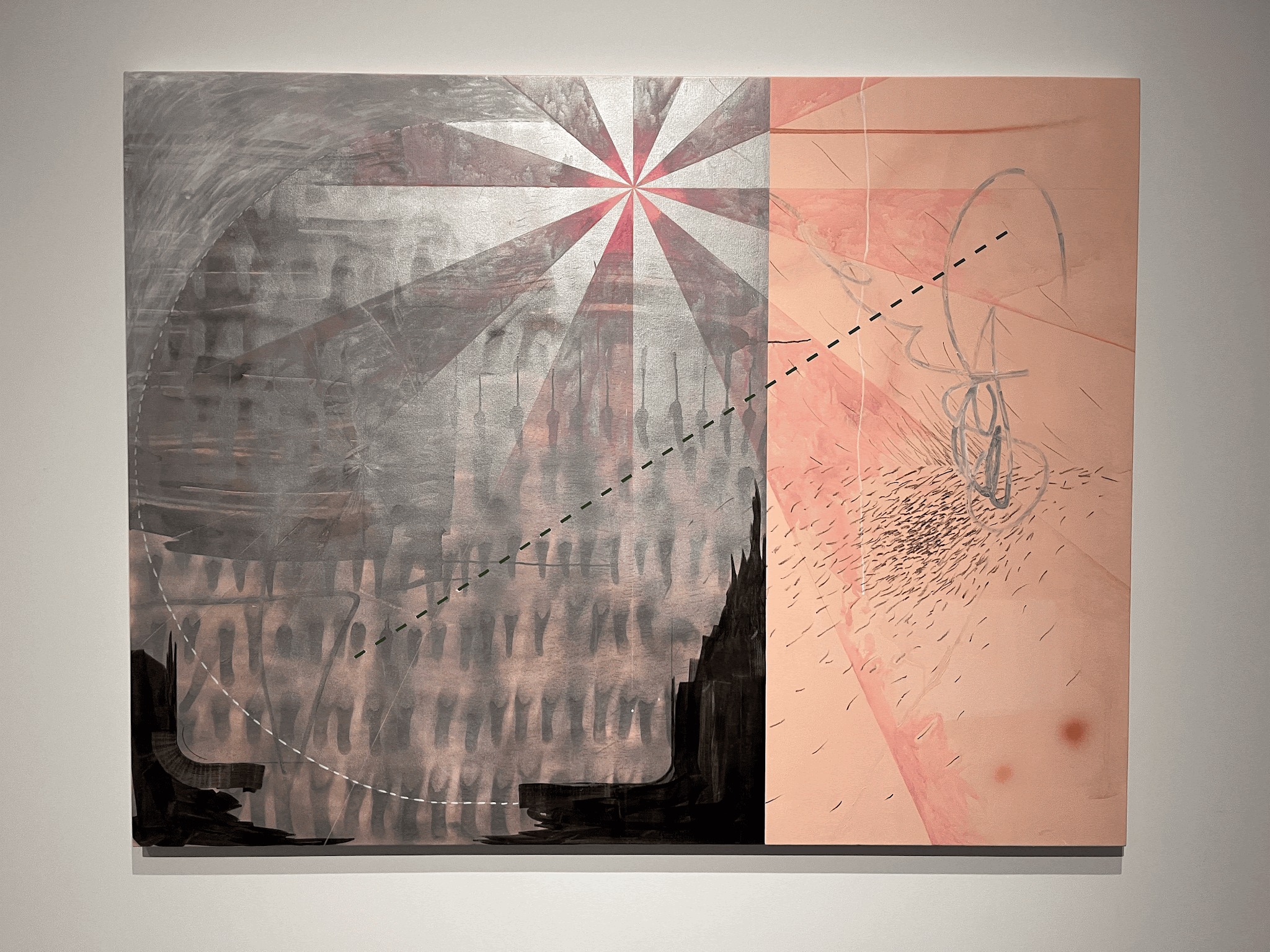
Nearby, Turiya Adkins offers another form of suspension in Admittance of Guilt (2025) and Pretense (2025), paintings shaped by movement, flight, and free fall. Through loose, gestural marks, Adkins renders motion as force and sensation. Her references to Sun Ra and the Afronauts of the 1960s Zambian Space Program do not operate as illustrations but as translations. Each mark registers as event, decision, and trace, forming a constellation of unfolding thoughts. Her work demands slow looking, with attention to accumulation within an expanding field of Blackness as both subject and method. This intricate visual language signals Adkins’s rise as an artist poised to shape the next chapter of contemporary art.
London Pierre Williams’s scale shifts the register of experience. His painterly compositions are expansive and speculative, grounded in Black queer futurity. In The Stage: He that leaves me blue, a dream (2026), figures drawn from his Pittsburgh community inhabit archetypes that refuse singular definition. The butch queen is not a contradiction. Styled in dresses and pumps, boots and sagging pants, the figures maintain multiplicity with subtle differentiations, resisting collapse into a discrete category. In Travel tight and close: keep your brother in your hand (2024), Williams renders his scene in graphite and burnt umber, evoking the patina of early photographic processes. The painting carries a deliberate sense of age through double figurations, which suggest the spectral residues of images intertwined with life. What remains is the persistence of memory, continually made through looking.
Amina Ross’s Man’s Country (2021) shapes the exhibition’s affective resonance, with digital reconstruction as a vessel for intimacy and loss. By rendering a now-closed Chicago bathhouse through 3D modeling and layered sound, Ross reframes video art not as a detached document but as a mutable structure that holds and reshapes the personal and communal dimensions of remembering.
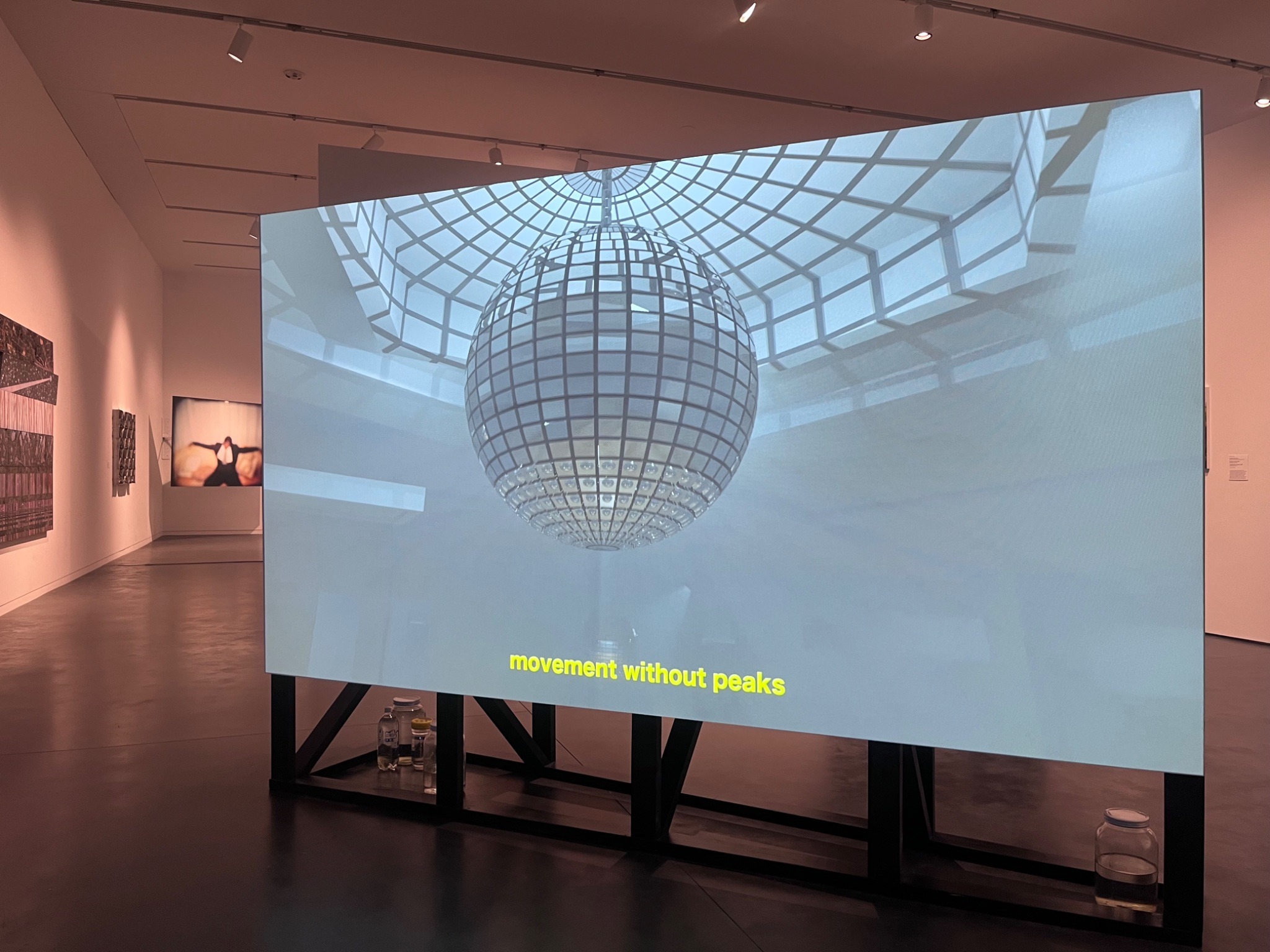
The significant space between works is particularly striking. These intervals enable the works to breathe. While the title suggests disappearance, distance here becomes generative: “fade” names transition, movement, and slippage from view. It gestures toward the cinematic while serving as a conceptual framework for how artists resist fixed meaning through abstraction and material transformation charged with emotional resonance.
Fade is loud in its insistence, refusing the quieting tendency of institutional display. It does not simply position emerging artists as the next wave but situates them within a lineage shaped by the “F” series of exhibitions, from Freestyle (2001) through Frequency (2005–06), Flow (2008), Fore (2012–13), and Fictions (2017–18). The exhibition makes clear that this lineage shifts, expands, and refuses closure. In doing so, Fade offers a view of the future, coupled with a reorientation of how we see, feel, and exist in relation to one another.
Fade is on view at The Studio Museum in Harlem through September 6, 2026.





%20.jpeg)