
“Are you lonely tonight?” at the Australian Centre for Contemporary Art
Review
I remember encountering Andrius Alvarez-Backus’s work at his 2025 MFA thesis exhibition at Columbia, where two pairs of feet, almost furtively, supported a towering column of Manila palm. One pair stood hip-width apart; the other, held together, nested into the gaps between them. That image lingered as I visited his current solo exhibition, I Want to Know, I Need to Know, at Eli Klein Gallery.
In his new work, You Took Your Time With Me (2026), the feet reappear. This time, they are suspended, with the soles facing the viewers, as bamboo stalks erupt upward from the pair of bound ankles. “The feet upturned is a gesture of humility,” Alvarez-Backus told me. “In Filipino culture, to bow and touch someone’s feet with your forehead is a sign of deference. By exposing the back of the feet, I’m moving away from the surface, moving towards vulnerability.” The shift in the feet’s placement speaks to the artist’s turn towards the previously unseen, the interior, or “the subcutaneous,” which underpins the ethos of the exhibition.
I Want to Know, I Need to Know showcases Alvarez-Backus’s most recent body of work, which emerged from a period of medical uncertainties within his family. The title carries an almost compulsive urgency for knowledge and clarity. “The body is an unknowable entity,” Alvarez-Backus explained. “I am fueled by the desire to know, while constantly confronting the confusion as I know more.”

Alvarez-Backus’s practice, rooted in assemblage, moves fluidly between beauty and abjection, often collapsing the two. His compositions draw from Surrealism, foremost as a method of dislocation; the subconscious is a guiding principle in his making. Humor and whimsy surface, as feet—along with other parts cast from the artist’s body—are disembodied and reassembled. These body parts and their resonances are destabilized into a system of exchange, translated by the fusion of the poetics of everyday objects, often with personal allegories of intimacy and embodiment.
This oscillation between knowing and uncertainty is materially embedded in works like I Was Softer Then (2025–26). Here, a disco ball is split open, revealing a cross-section resembling raw flesh: the interior of a thigh rendered in resin, stylized in a way that is both seductive and disquieting. “The disco ball is a symbol for queer collective joy and liberation; it’s usually above us, spinning. However, in this work, it is caught in a moment of vulnerability, cut open, as though in mid-surgery.” Alvarez-Backus mystifies a once reliable object, complicating its symbolism by supplanting its interior with a moment of bodily distress. “Growing up, I inherited a lot of medical textbooks from my late grandfather. The anatomical images in those books proved to be more representational than mimetic. I’m okay with the illusion being a little flimsy. I’m not trying to trick the viewers into thinking that these are real anatomical images.” This slippage is key, as we see the cross-section resembles not so much a medical specimen as a diagram from a textbook. “This is a purposeful mistranslation,” said Alvarez-Backus, suggesting that when something resists full comprehension, we begin to devise ways of navigating through ambiguity.
Repetition and precision become a form of healing. When I asked about the labor involved in laying tiles and arranging mirrored fragments, Alvarez-Backus described it as meditative. The act of making, with an insistence on order, offers a healing reprieve from the anxiety induced by the inability to know more.
Healing is further explored through the intimacy evoked by materials, especially textiles. In several wall-based assemblages, Alvarez-Backus uses reclaimed fabrics—old clothing, bedsheets, muscle wraps—stitched together into quilt-like surfaces. These fragments function as bodily indexes, standing in for skin. Painted to approximate his own flesh tone, they hover between representation and substitution. “It’s like skin grafting,” he said. “I’m reframing a violent but reparative medical procedure as an agent of protection and comfort.”

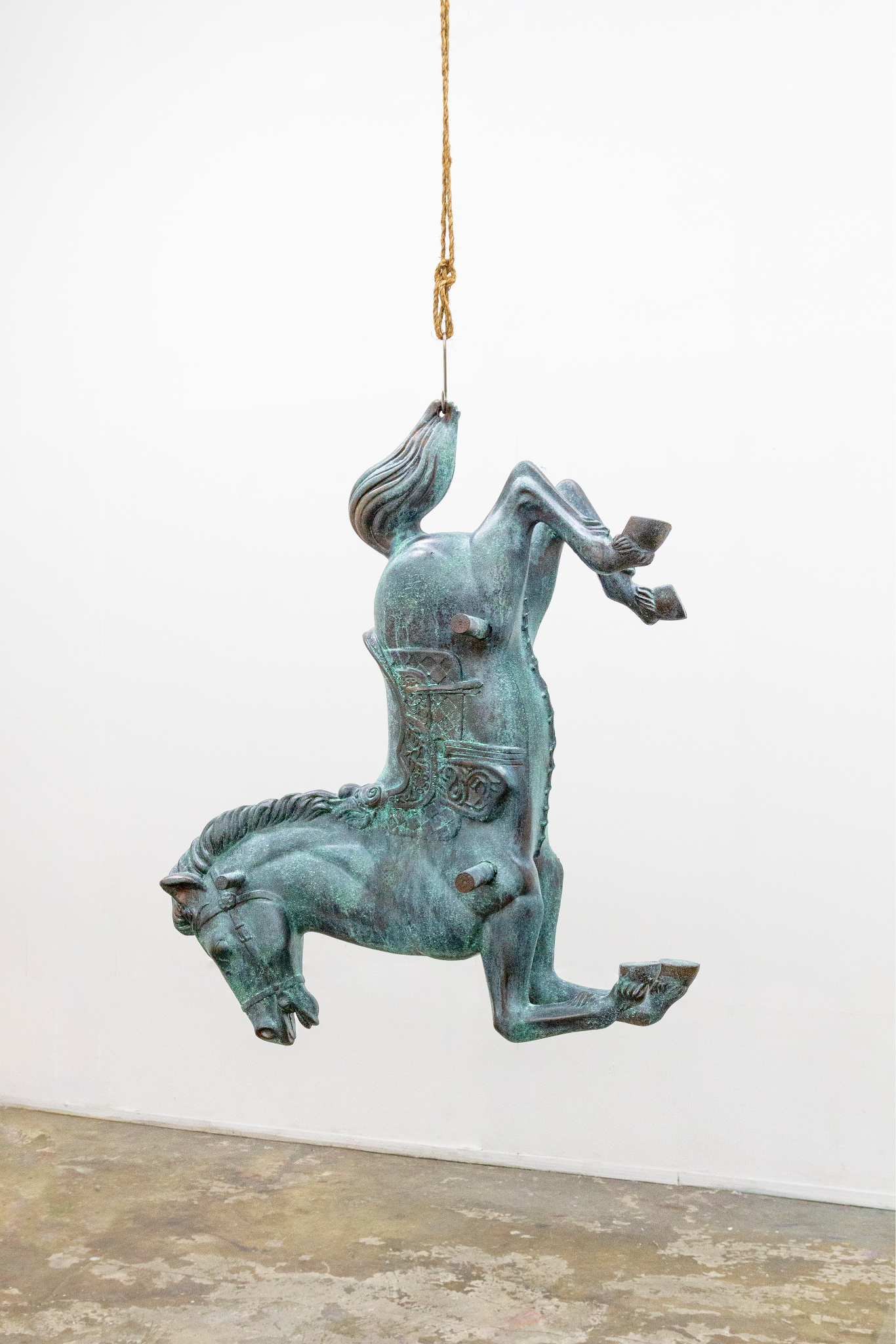
Bondage is a recurring motif in this body of work. Grappling with ambiguity through materiality, Alvarez-Backus considers the “divide between desire and disgust, between fear and fetish,” exploring the shifting meaning of bondage across healing and pleasure. In You Took Your Time With Me, its usage was practical, like a bandage, to camouflage the seam where the feet meet the bamboo. However, in Are You Still Strong Enough? (2025), a handcuff knot suspends a patinaed reclaimed Wonder Horse toy “of mysterious origins.” The horse’s belly was tempered with clay to evoke evidence of suturing. The equestrian symbol of conquest and virility is now immobilized, dissected, and sutured back up, strung, as though in a butcher shop.
This ambivalence extends to questions of identity and desire. When talking about his sense of misbelonging in queerness and Asianness, Alvarez-Backus introduced me to Richard Fung’s 1991 article “Looking for My Penis: The Eroticized Asian in Gay Video Porn,” one of the sources cited in the creation of this body of work. Fung describes the tropes of the eroticized Asian male since the 1920s in film: either the desexualized “egghead/wimp,” or the “kung fu master/ninja/samurai,” rendered functional with his almost mystical ability to threaten. This second trope, perhaps subconsciously influenced To Whom I Belong (2025): a halved, patinaed wooden chair leans on the gallery wall. On the chair perches a dissected penis. “Have you heard of forniphilia? It’s the sexual desire to become a piece of furniture, to become a utilitarian object in submission.” In this work, however, the once utilitarian chair is now ailing and fallible; the urge to be functional in order to be desired has collapsed. The phallus, meanwhile, is both symbol and fragment. “It is an insistence on sexuality,” he said, “but anonymized.” Desire is double-edged: “On one end, there’s the desire to be desired as a gay Filipino-American; on the other, there’s the danger of being fetishized based on identity categories—just like how pain and pleasure are both sides of a coin.”

Across the exhibition, bodies are disassembled, reconfigured, and preserved. Direct casts of the artist’s own body parts are treated with bronze patina, granting them a kind of permanence. “The body parts may have less agency when dismembered,” Alvarez-Backus reflected, “but I’ve transformed them into objects that will never decompose.”
Alvarez-Backus never intended to offer a coherent answer through I Want to Know, I Need to Know. This state of exposure is not without risk, but for him, healing begins precisely in this sustained engagement with what cannot be fully known. “Resilience is key,” he emphasizes, “my grandfather always told me to be like bamboo—bend, don’t snap.”
Andrius Alvarez-Backus’s solo exhibition, I Want to Know, I Need to Know, is on view at Eli Klein Gallery from February 21 to May 9, 2026.