.webp)

Kern Samuel: “IM” at Derosia
Review
Whitney Oldenburg: hardening the braces
CHART | 74 Franklin St, New York
April 17 – June 6, 2026

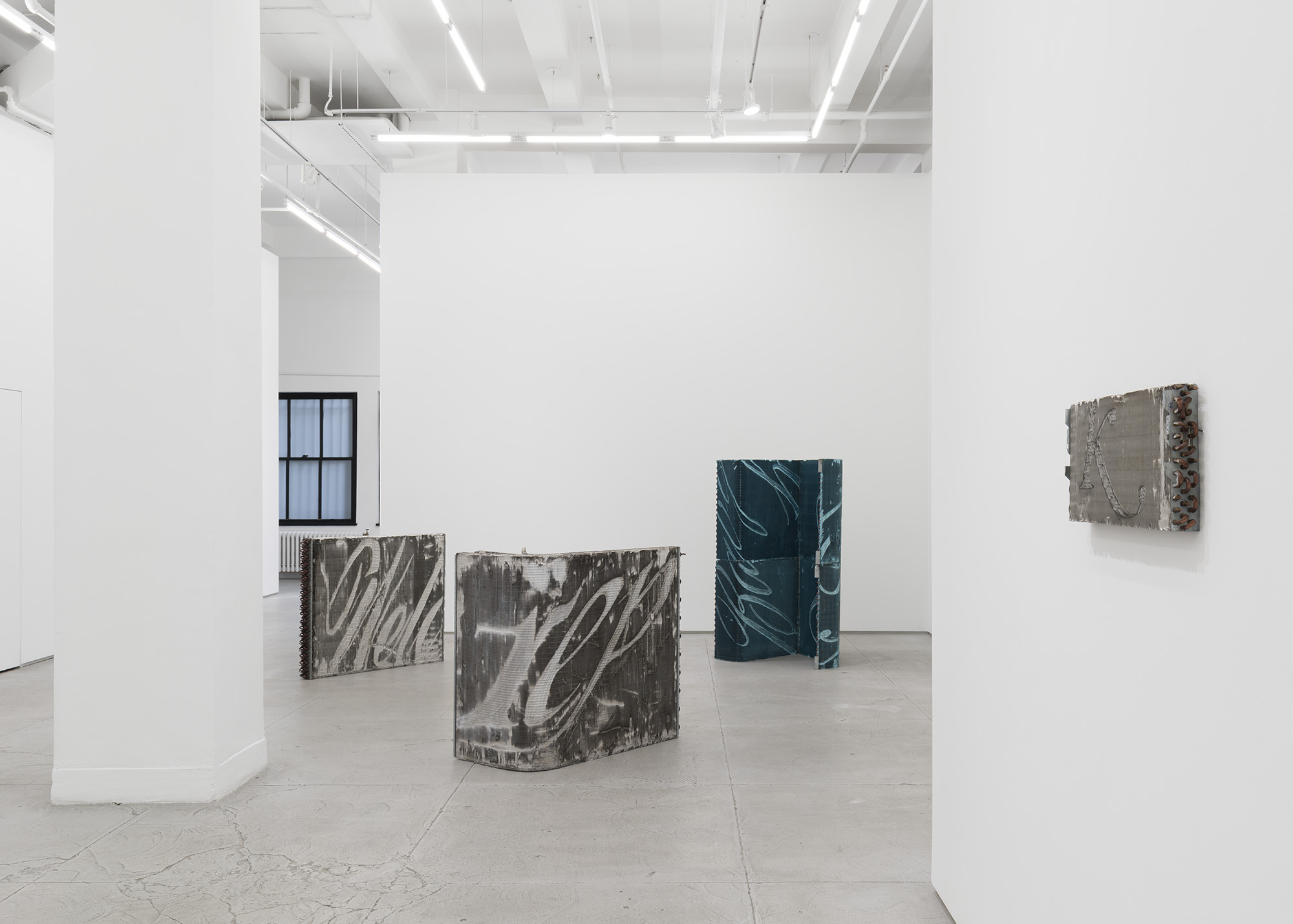
What water jugs, seed bags, medical bandages, and potassium iodide tablets have in common is their perceived utility during all varieties of apocalypse; the tablets can be bought in bulk on Amazon as a provision against nuclear fallout. The three human-sized sculptures that populate Whitney Oldenburg’s solo show at CHART, hardening the braces, incorporate shopping recommendations from doomsday prepping communities, alongside deconstructed boat hulls, leather horse collars, and excess packaging formed into stacked chambers of negative space. The disparate parts are then melded together with dried clay—visibly marked by the artist’s touch—and the upright sculptures take on an ancient demeanor, as if they could be unearthed, in the future, as totems from the bygone Anthropocene. Several accompanying charcoal drawings echo their fossil-like, multilocular forms, similarly abstract yet still bearing an uncanny resemblance to something alive.
In a continuation of her work’s inquiry into the emotional roles of inanimate objects, Oldenburg presents the compounded supplies in her sculptures as a primal source of comfort. Like the repurposed soccer ball called “Wilson” by the solitary survivor in Castaway (2000), even the barest trace of anthropomorphism makes them ready companions for the bunker-bound. There are futuristic comparisons to be drawn, too, with the demand for simulated forms of connection in Artificial Intelligence, given evermore stratified and isolated conditions for the everyday person. Accretion is a salve for both anxiety and exile. Yet the situational irony here, and the tragic logic behind the artist’s choice of materials, is that the excessive consumption involved with prepping itself contributes to climate catastrophe: the survival mechanism begets the event requiring survival. With their mournful and sulking forms and titles like “aftermath of apathy,” “the pursuit of more,” and “sentinel of hubris,” these three horsemen perhaps make for, at best, compassionate fatalists.
Given recent rumors of tech billionaires investing their fortunes in personal doomsday shelters, hardening the braces points out paradoxes that are topical as they are evocative of timeless quandaries. In 2026, where does prepping stand between paranoia and realism? Is the impulse to hoard resources indicative of a community-dooming “after me, the flood” attitude? Is it needlessly pessimistic to bet so much money on The End, or foolishly optimistic to believe one could weather it with precisely 1,000 plastic jugs of water? Perhaps the sculptures’ water storage containers, prone to leaking and evaporation, are really half-empty, and their mutilated boat hulls signal no rescuing ark. Yet those who have seen Oldenburg’s show at CHART gallery know where to head just in case.
Dena Paige Fischer: Implements for Deviation
Parent Company | 154 E Broadway, New York
May 7 – June 27, 2026
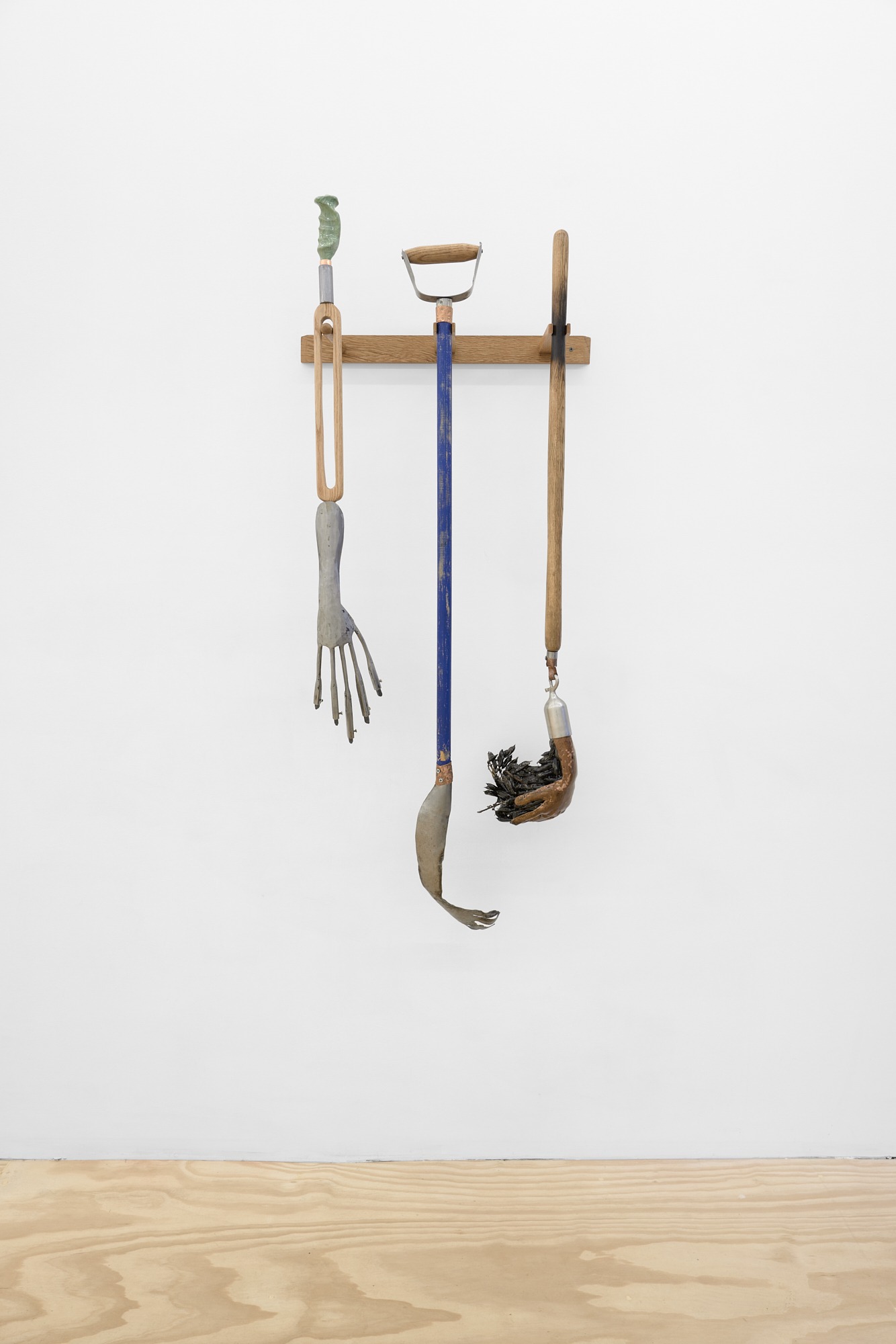
Parent Company’s latest exhibition, Implements for Deviation, showcases what Brooklyn-based artist Dena Paige Fischer calls her “mark maker” sculptures: encumbered and transformed everyday objects, such as brooms and hand rakes, that can still paint or scratch, though with significant effort. By collecting, combining, and altering natural and industrial materials, Fischer assembles sculptures that signal the irony latent in the notion of the tool as an artistic instrument and everyday object.
BRU_05 (2026) transforms a doorstop by attaching a wooden deer handle and, on the other side, a paintbrush twisted toward the wall—a warped echo of its doorstop origins. Similarly, SWP_02 (2026), an assemblage of oak dowel and straw brush, recalls a medieval flail, undercutting any utilitarian seriousness when used as a paintbrush. BRU_04 (2026), a series of brushes welded together and attached to a handle resembling a hand, further illuminates the paradox underlying the word tool by playing on the extension of forms: one uses their hand, extended through a handle, to a hand-like assortment of brushes to produce an indiscernible mark. As such, Fischer highlights the contradiction inherent in an object defined by its utility transformed to resist it.
In a way, Fischer’s mark makers function akin to a surreal object, a sculpture that deliberately pairs readymade objects such that they counteract each other’s intended purposes. Nevertheless, in Fischer’s case, there remains a telos of artistic utility, as if one were to dip Man Ray’s Gift (1921), an iron rendered useless through a series of thumbtacks, in ink and use it to make prints. Unlike traditional tools designed to abbreviate time and effort, Fischer’s create distance, hindering precision and defying efficiency. This “forced imprecision” differentiates her work from the surreal object’s pursuit of total dysfunctionality, aligning its layered humor instead with Jasper Johns’s Book (1957).
The curation leans into an inverted hardware-store logic, presenting artworks pinned to the wall as they might appear in a shed or on a tool rack. DRW_02 (2026), DRA_01 (2026), and SHA_01 (2026)—three hand-like pieces hung on a rack—literalize the tool as an appendage. Even the corporate-esque titles reinforce this. At the back of the gallery lies a secret display of prints created by the mark makers. If the tools resist use, these prints are an index of that struggle—evidence of the deviation.
Aura Rosenberg and Egon Schiele
Meredith Rosen Gallery | 327 West 36th Street, New York
April 24 – May 23, 2026

Meredith Rosen Gallery presents a new body of paintings by Aura Rosenberg in dialogue with a double-sided drawing by Egon Schiele. The paintings, from a series titled Champs Délicieux (2026), mark a departure—or perhaps a return—in a decades-long practice that has primarily engaged photography and installation. In a callback to the method of her early paintings of the 1970s, which engaged a masculine art canon, feminist sense of appropriation, and dialectical relationship between an artist’s marks and found objects, here she takes printed oilcloth as her base, dripping, splashing, and pouring acrylic paint over fruity tableaux, forks, and flowers. Rosenberg restrains her palette to that of each oilcloth—green broccoli, red tomatoes, yellow sunflowers—and at times her interventions engage directly with the kitschy scenes printed on the oilcloth; in Couleur Cafe, for instance, warm shades of brown spill like lattes from dozens of coffee mugs.
Ketchup in the Night stands out from the group, its vibrant composition accented by the bright red plumbing pipes that run across the ceiling of the gallery, drawing the eye to it from all angles. Unlike works such as Couleur Cafe, there is a rupture between the layers of paint and oilcloth in Ketchup in the Night that creates a compelling emotional tension and sense of curiosity. Rather than painting around or with the fruit pattern of the scarlet oilcloth, here Rosenberg applies color in a spewing, splattering, bodily, and even bloody diagonal from the upper right to lower left. It’s kind of gross, and its boldness cuts through the busy quality of the clusters of fruit. The textural contrast between the emotive, thick impasto and the mass-produced fruit motif calls attention to the distance between the two visual registers at play. One can imagine that the fruit pattern repeats under Rosenberg’s color, but perhaps another secret lies beneath.
Similarly, Schiele’s drawing Reclining Couple (1913) contains hidden depths, and not only because it’s double-sided. Behind the bold graphite lines of an embracing androgynous (perhaps lesbian) couple lies a spare self-portrait, and in an unusual turn for Schiele, there’s no indication of his angular nude torso. Instead, he stands in a boxy tunic, his hands folded demurely across his chest in a reserved, observational pose. Again, one can picture what lies beneath, but here it’s an erotically loaded thought exercise, like imagining one’s way through the layers of limbs in Reclining Couple, or even imagining the Schiele of the verso watching the couple through the sheet of paper. Despite its seeming simplicity, the drawing is layered in its transgressions, and it’s well-complimented by Rosenberg’s colorful and expressive works.
Danielle McKinney: Forest for the Trees
Marianne Boesky Gallery | 509 W 24th St, New York
May 7 – June 13, 2026
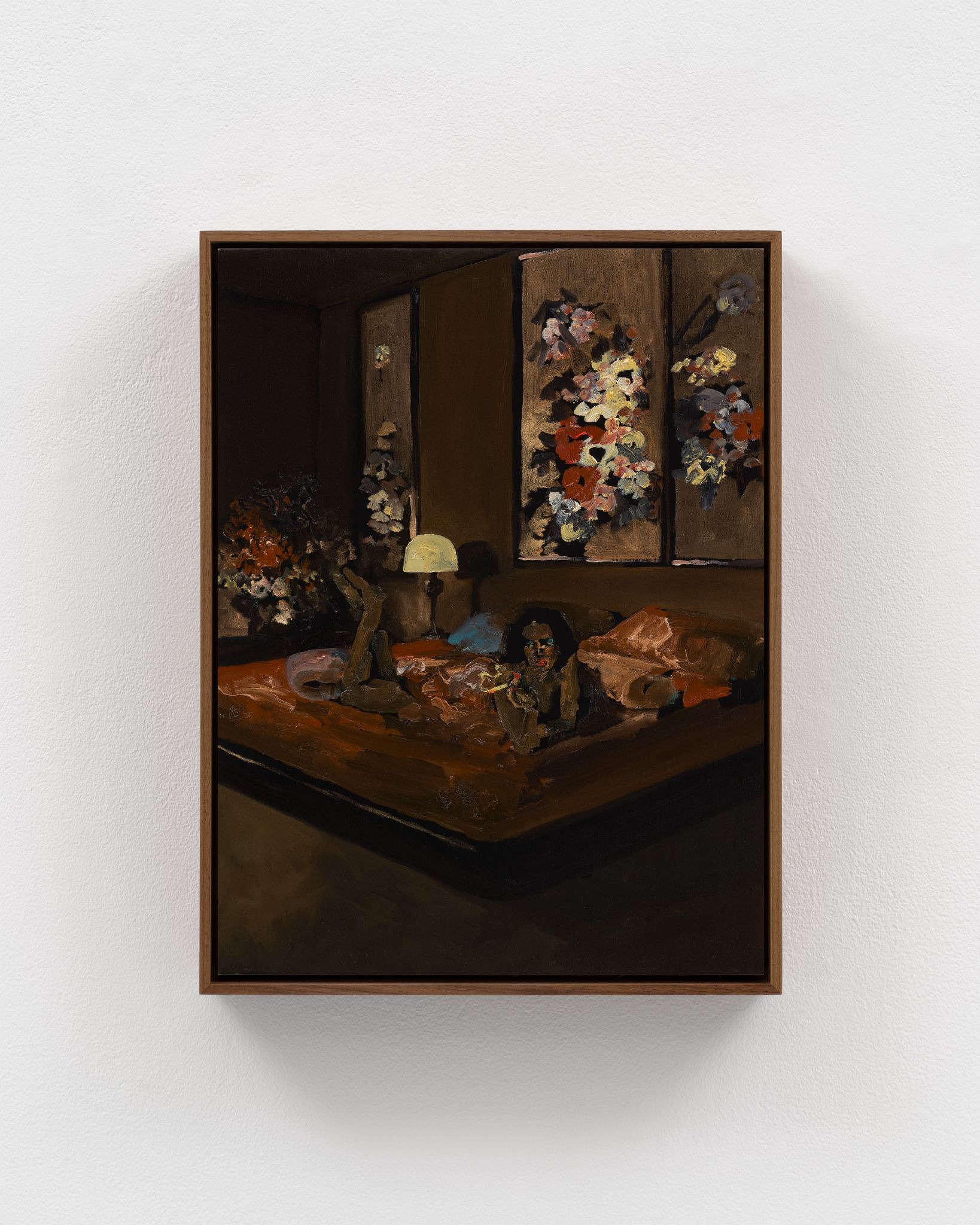
There is almost a sense of intrusion the moment you enter Danielle McKinney’s Forest for the Trees at Boesky Gallery. Through a series of paintings and watercolors, McKinney depicts female figures during private moments of leisure, alone in domestic interiors, lying down, smoking, and enjoying their seclusion. The works were created during a time of personal and collective turmoil, a very different reality from the scenes they portray. Taking inspiration from the 19th-century French painter Edouard Vuillard, Forest for the Trees creates a pocket in time where McKinney’s figures reject the urgency of the world around them.
In Milk and Honey (2026), a figure lies down on a bed in a dimly lit room, smoking and looking away from the viewer. There are flowers everywhere in the background: in the paintings on the walls and on top of what looks like a dresser behind her. Something covers her naked body—it's hard to tell if it’s her own clothes or part of the bed—and the smoke blends seamlessly into her figure. It feels as if the outside world is muted, and everything around her blooms in response. Her relaxation defies the urgency and the chaos of reality, as she melts into a moment of stillness.
That defiance becomes more deliberate in Cloud Nine (2026), where a female figure reclines on a sofa, also smoking a cigarette, with her head back and her clothing undone. Like most protagonists in the exhibition, her nails and lips are painted a bright red. Her beauty seems carefully constructed: the bright nails instantly catch the eye, and she’s wearing a beautiful blue eyeshadow, but she’s completely alone, with no one to admire her beauty but us. In the watercolor Speak Easy (2026), a figure is half lying on the floor, with one of her arms supporting her laid-back, relaxed body with bright red nails. The colors bloom across the paper, exposing the material underneath it. There is no background, no flowers, and no furniture, just her. McKinney’s figures remain inward, where their beauty and leisure are shaped exclusively by the self.
Poet, writer, feminist, and equal rights activist Audre Lorde wrote in A Burst of Light and Other Essays (1988) that caring for oneself is not self-indulgence but self-preservation and an “act of political warfare.” In an extremely overstimulating world that demands constant productivity, McKinney’s protagonists choose to lie down, relax, and smoke a cigarette. Their leisure is a political act, and their vulnerability is a form of resistance. In Forest for the Trees, the protagonists have decided that, despite the pressure and expectations, the world can wait.
josh brainin: Rituals for Field Transmissions
Tala | 1644 W Chicago Ave #1, Chicago
April 10 – June 6, 2026
%20%F0%9D%98%B1%F0%9D%98%A6%F0%9D%98%B3%F0%9D%98%B4%F0%9D%98%B0%F0%9D%98%AF%F0%9D%98%A9%F0%9D%98%B0%F0%9D%98%B0%F0%9D%98%A5%C2%B2.jpeg)
Coinciding with its second anniversary, Tala presents Rituals for Field Transmissions, a solo exhibition by multimedia artist and filmmaker josh brainin. Curated by Youssef Boucetta, the exhibition spotlights a larger-than-life video installation personhood2 (2026). Within encircling vinyl curtains, two CRT monitors, stacked and facing opposite directions, sit on a custom plinth that elevates the monitors to a six-foot-tall monolith—approximately the same height as that of the artist.
A deeply personal work, brainin does not flinch when he addresses the multitude of his racial identities. In a close-up shot, the artist, whose face looks stretched because he has forced vertical selfie videos into a four-by-three screen, speaks directly to the viewer: “I’m a Black man!” Or—depending on which side of the monitor you see first—“I’m a white man!” And he repeats. But this declaration, the emotion of which mutates in every iteration, grows from doubt, confusion, to confirmation, to hysteria. “Am I doing it right?” He then turns left and right, seeking affirmation from beyond the frame.
This vulnerability is underscored by the vinyl curtains that veil the video installation, a nod to W.E.B. DuBois’s concept of the Veil. The viewer is barred from entering the zone. The plastic further distorts the videos while emitting a clinical smell; the industrial suspension cords that hold up the curtain rail introduce more violence. brainin’s selves are trapped inside this cell-like confinement; his identities are cyclically collapsing and being rebuilt, reconfigured, re-performed.
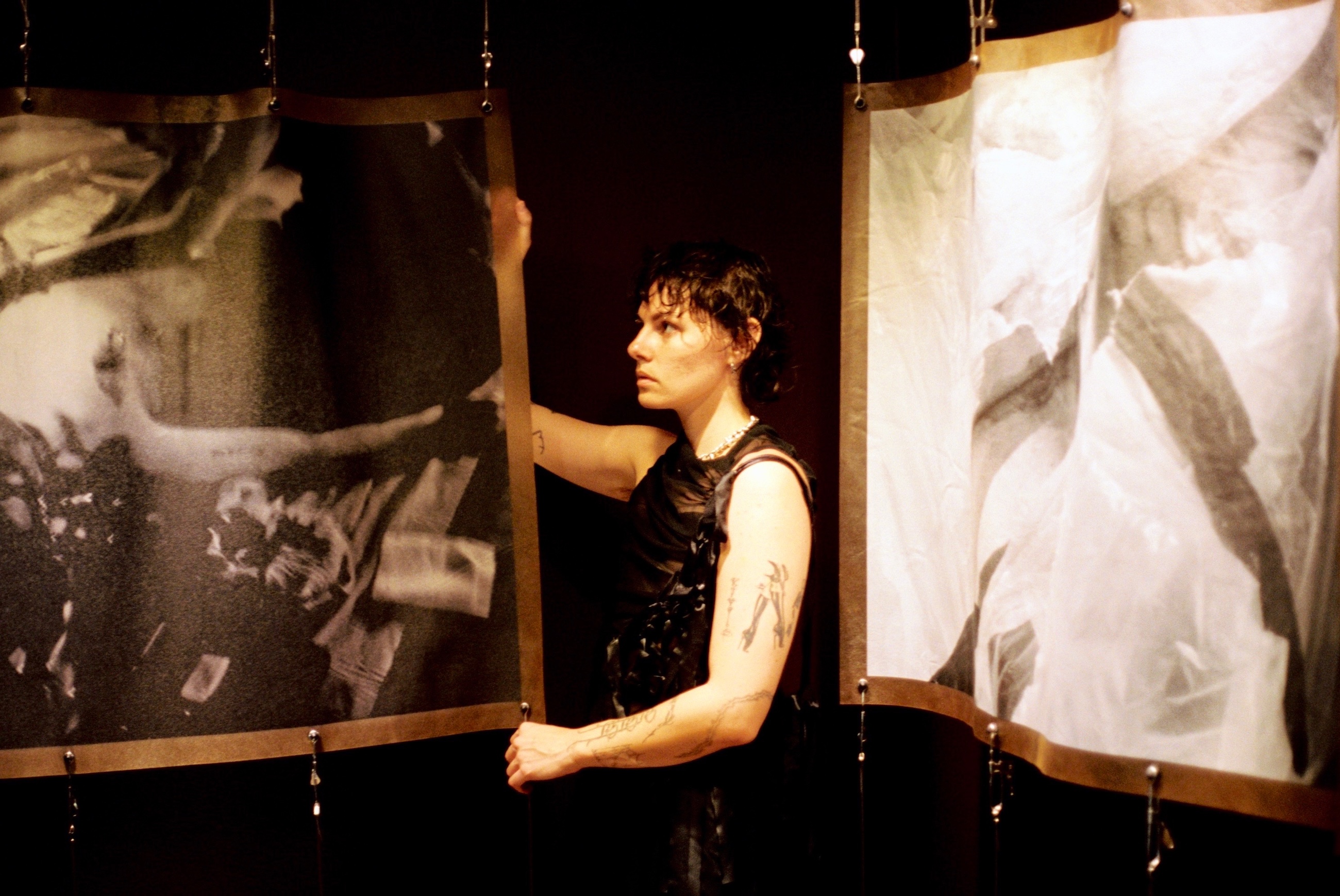
Similar turmoil, albeit latent, is discernible in a series of prints shown on walls. Printed on aluminum sheets and floating on walnut backboards, these prints invite the viewer into brainin’s mind-archives—his electronic tablets. Under the muted sheen, electronic images, some screenshots, some generated from the DALL-E 1.0 era, are collaged together. The compositions carry fingerprints of a smart device, such as the battery status or the slide-over tab, but the pictures are then decorated with frames and shading reminiscent of a Y2K computer aesthetic. The uncanny incongruity mirrors how our memory works: disorderly, malleable, idiosyncratically anachronistic.
Belonging to a generation born and raised on the Internet, brainin knows how digital image-making extends beyond the gallery walls. The documentation of another set of prints, made in a similar fashion and available at the gallery’s counter, can be seen as an Instagram carousel, like a fashion campaign. These Instagram-exclusive photographs, directed by Matthew Metcalf and photographed by Iman Malik, contextualize the prints within a house party. Fleeting youth is intercepted by nostalgia; the future is imagined with a memory filter.
Akwasi Brenya-Mensa: Tatale Provisions
Hannah Traore Gallery | 150 Orchard St, New York
April 30 – May 30, 2026

For those living in diaspora, food provides an irreplaceable link to the past. A meal can be a personal ritual or a shared one, unlocking the smells, tastes, and emotions of home, often buried beneath a disorienting immigration experience. In Tatale Provisions, a new exhibit at Hannah Traore Gallery, British-Ghanian chef Akwasi Brenya-Mensa explores the overlap between art, ancestry, and cuisine, using the latter as a vehicle for intercultural and creative dialogue.
Half exhibition, half retail space, the show is reminiscent of West African provision stores, communal hubs where people gather daily to connect and buy essentials. The title references Brenya-Mensa’s Pan-African restaurant in London, Tatale, which is named after the plantain pancakes he grew up eating. Conceptually, he favored plantains for their ubiquity across Black communities, not only in Africa but also in the Caribbean, Brazil, and Latin America. As the oldest child of Ghanaian parents who came to the UK in the 70s, the artist learned the unifying power of cooking early on while helping his mom in the kitchen.
Upon entering the gallery’s back room, the exhibition’s inspiration greets the viewer: a grainy photo of Brenya-Mensa and his family from 1995. It depicts the artist alongside his mother at Ebenezer Supermarket, a local provision store in Kumasi. On the surrounding shelves, there are Ghanaian spices like prekese alongside cookbooks by Black authors: Alexander Smalls, Ozoz Sokoh, and Marie Mitchell, whose debut, Kin (2024), celebrates the vibrant Jamaican flavors her parents passed down. Some items transcend borders and languages, from Coca-Cola bottles to Royal Dansk butter cookie tins, usually repurposed by families to hold sewing kits.
Music also plays a role in preserving culture, as evidenced by the record player on display and the various vinyls throughout the room, including The Sugarhill Gang’s “Rapper’s Delight,” Ol' Dirty Bastard’s “Got Your Money,” and Dizzee Rascal’s “Jus’ a Rascal.” Other analog media, like a VHS of Making of Michael Jackson’s Thriller (1983), evoke nostalgia for the 80s and 90s, when Black musicians increasingly topped the Billboard charts, a boom that continued into the early 2000s.
Rather than encouraging an impersonal, rushed encounter, Tatale Provisions invites viewers to ponder how consumption shapes our day-to-day lives and the enduring traditions that bring us together. It’s a departure from the instant gratification expected in a fast-paced city like New York, and yet — tucked away among endless immigrant-owned restaurants, bodegas, and corner shops — the exhibit blends right in, as if it’s been there all along.
Paula Turmina: Space is Punk
Instituto de Visión | 88 Eldridge Street, 5th floor, New York
April 23 – June 20, 2026

Brazilian, London-based artist Paula Turmina’s practice grows out of a sustained and detailed observation of landscape, the material conditions of the earth, and the social dynamics that pierce through it. Her work is deeply rooted in the materiality and colours of soil: through earth, pigment, and surface, she connects historical pasts with the projection of different futures, while also linking planet Earth to other stars, constellations, and speculative geographies. Turmina’s paintings often move through different shades of red, a colour that evokes the colonial exploitation of Brazilwood, and with it the extraction and violence of Brazil itself. It also opens onto the red surface of Mars, a planet once associated with technological progress and the future, and now increasingly imagined as a new territory to be occupied, owned, and conquered.
In Space is Punk at Instituto de Visión, Turmina’s first solo exhibition in New York, the artist presents a new series of paintings created specifically for the occasion. The works on view incorporate pigments derived from black tourmaline, a stone also sourced from Brazil, once again weaving together territorial materiality with fictional lands and futures. Unlike other materials, black tourmaline does not fully dissolve into pigment—its crystals remain visible on the surface, producing textures, densities, and small flickers of light. Although the works turn toward outer space, their materiality anchors them back to the earth, reminding us that speculation is never immaterial and that even the most distant imaginaries are shaped by physical matter. Another layer emerges when we consider that black tourmaline is also used in spiritual protection rituals. The paintings then become not only landscapes or cosmic scenes, but protective surfaces, thresholds between the earthly, the celestial, and the unseen.
Landscape painting has long been one of the ways through which we construct our relationship with the earth. To represent territory is also to organise it, imagine it, and possess it, drawing the physical and social borders that divide us. Once, maps were the tools used to trace the limits of the explored and the visible. Slowly, that imagination turned toward the sky. Outer space became the new place onto which we project our desires, fears, and fantasies. The images are full of contradictions: a realm once imagined to be synonymous with freedom has also become a space of surveillance and control. Between Earth and outer space, a dense layer of satellites organises our daily lives. They sustain our cellphones, computers, and the internet; satellite cameras watch over us, mapping, guiding, and governing our environment in mostly imperceptible ways. In Turmina’s work, the cosmos is not only the place of dreams and speculation—it is also a political territory, already structured by systems of power.
The exhibition is also grounded in research around the legal and political frameworks that regulate outer space. Turmina draws from the investigations of Lucian Walkowicz and Cris Van Eijk, which examine the outer space treaties developed during the 1960s and 70s, in parallel to the space race. With some additions and modifications, these agreements continue to regulate space today. During the Brazilian military dictatorship, the government proposed a peaceful exploration of outer space, creating a strange contrast between the violent reality taking place on Earth and the pacifist fiction being projected onto the cosmos.
From this tension, Turmina asks how outer space is regulated, and how we might imagine more communal, responsible, and creative ways of engaging with it. Against the logic of conquest, extraction, and surveillance, the exhibition proposes another possibility: a way of looking at space that remains playful and speculative. The paintings are fun, strange, and full of movement, holding together Voyager references, satellites, cigarettes, cosmic landscapes, and dancing bodies. In Space is Punk, outer space becomes a dreamlike field through which to rethink our relationship with the planet we already inhabit.