
.webp)

Samuel Alexander Forest: “A Bag of Tricks” at Ortega y Gasset Projects
Review
The tenets of reincarnation hold that each life is but a single chapter within a soul’s wider evolution. One moving through continuous samsara, the wheel of birth, death, and rebirth, with each incarnation carries the imprint of past experiences, yet forgets all specifics. A forgetfulness that makes it impossible to directly reference what is already known, while an etheric memory informs its path forward. Artistic creations mirror these cycles: sometimes works are chronological developments of what came before; other times they are their own reincarnations, subtly informed by the past yet made wholly new.
Gibney Dance’s recent run at the Joyce Theater featured four works by four different choreographers, encompassing a multitude of styles, voices, and time periods. Opening with French choreographer Medhi Walerski’s duet Silent Tides (2020), the show begins in total darkness except for a tubular horizontal light spanning the width of the stage. Centerstage stands a woman in shadow, barely visible, upright, legs together, hands crossed, resting on her shoulders, covering her chest. She unfurls her arms and slowly lifts a bent leg to the side like an icon in a temple. As she moves, the glowing white light rises slowly to the ceiling. Moments later, another shadowy figure appears upstage. He steps in front of the light as she disappears; he’s somehow still interacting with her absence. Danced by Madison Goodman and Zach Sommer, Goodman reads as both naive and intense, as if she’s still noticing her own power, while Sommer holds the space with her, for her, as if he were a guest in her temple.
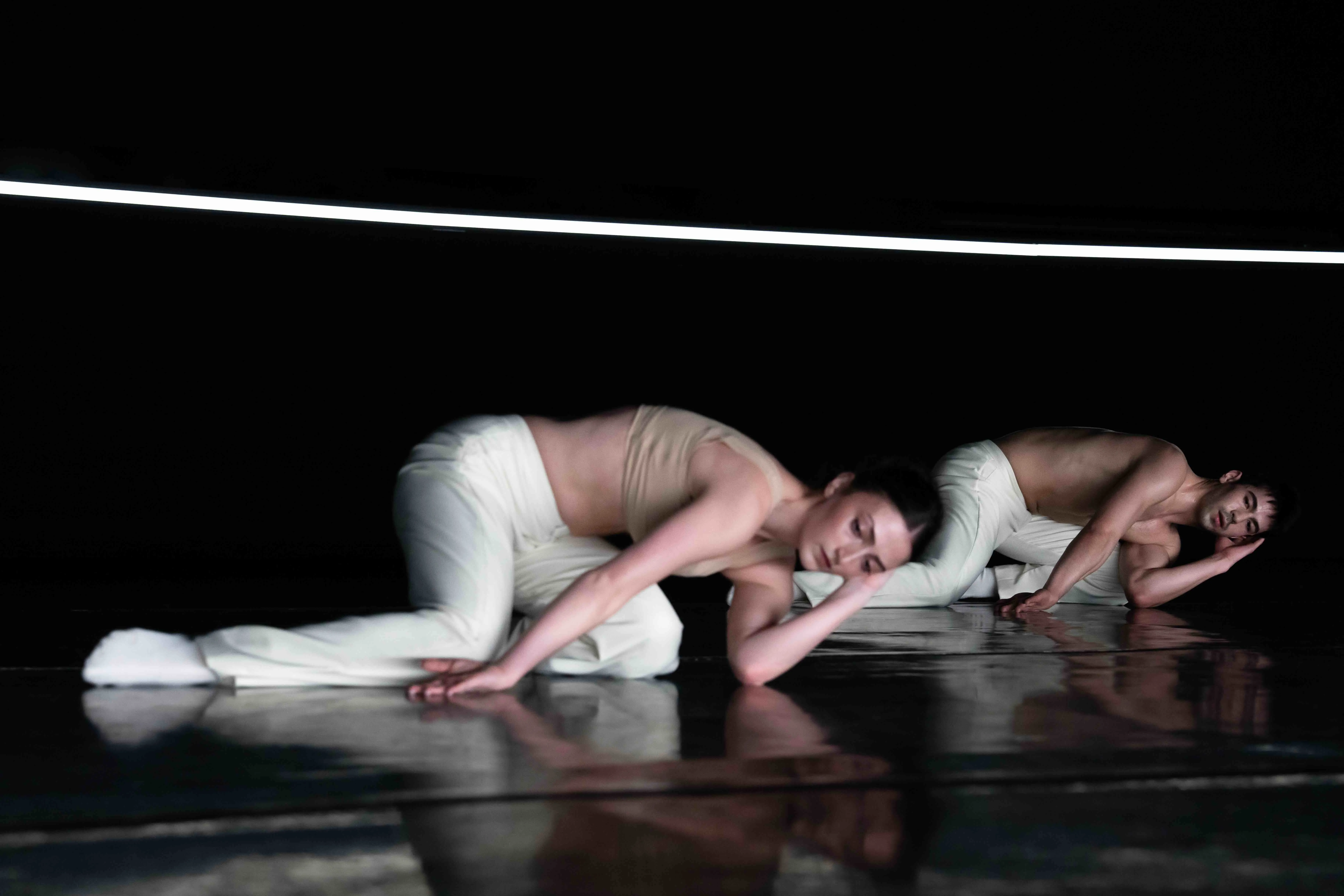
Walerski’s choreography is a direct descendant of the work of contemporary master Jiří Kylián. Like Kylián, Walerski trained in classical ballet, but ultimately found his home on contemporary stages, joining the Nederlands Dans Theater in 2001 when Kylián was the house choreographer. Silent Tides is a beautiful, easy-to-digest work, but it’s intended to be performed by topless dancers. Women performers were given a choice of whether to be clothed, and in this case, Goodman wore a nude bra. Nudity on American stages often reads as a shock or distraction, regardless of audience openness. The dancer’s body is meant to be a co-creator and vehicle for choreographic language; when it becomes a focal point instead, it creates a barrier to entering the piece on its own terms.
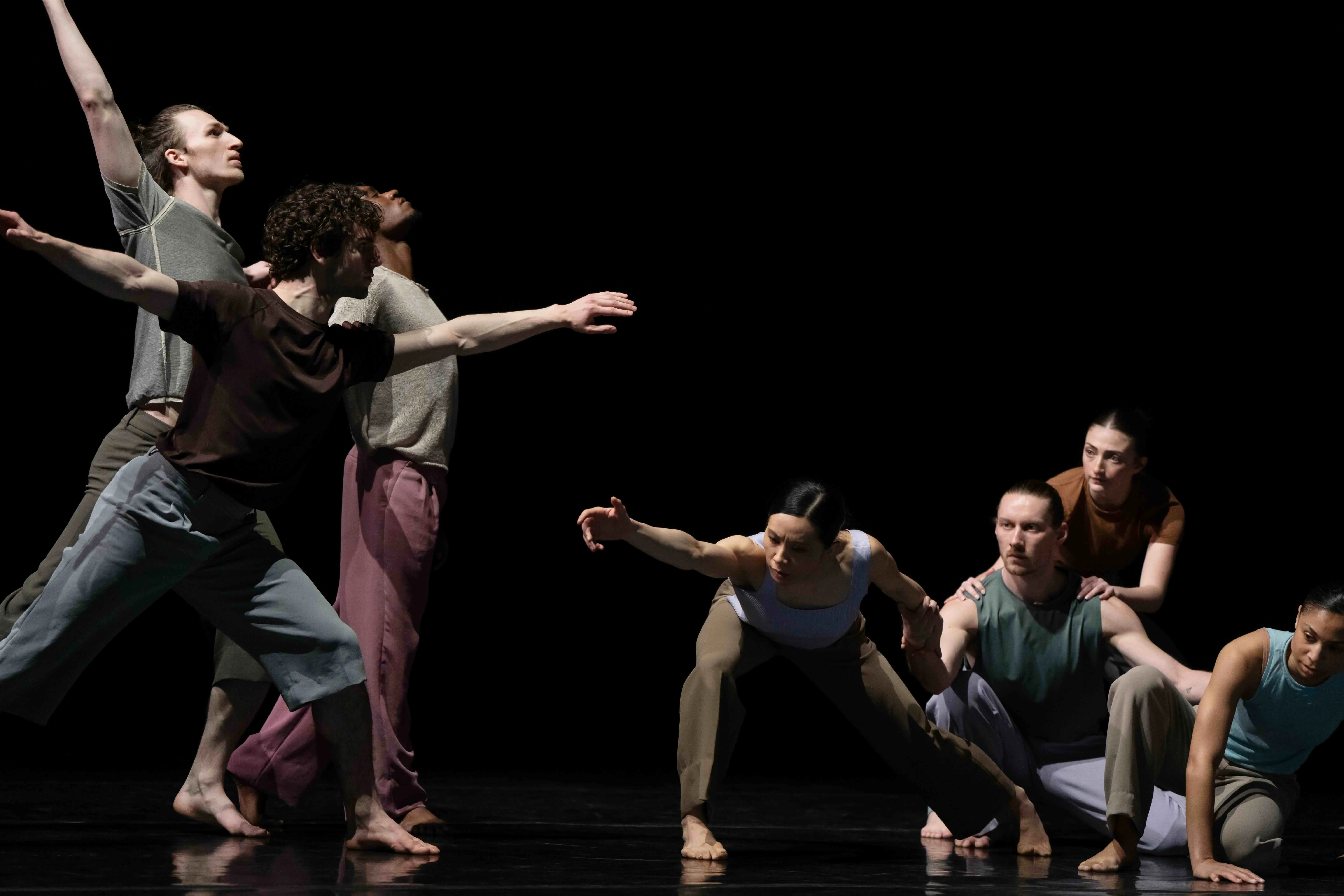
Choreographer Jawole Willa Jo Zollar’s voice is important in both dance and Black feminism: the founder of the dance company Urban Bush Women, her work merges folklore and religious traditions of the African diaspora with contemporary movement. On Contemplation of Wailing begins with eight dancers isolated under their own spotlights, wearing earth-toned and softly colored pants, tanks, and t-shirts. They move individually until the lights collapse into a single wide beam, and they too collapse, becoming a moving horde. With costumes that read as contemporary streetwear, the dancers are implied to be us, reflecting our own present-day condition of uncertainty and societal disorientation. The movement is grounded; the dancers look fresh-faced in their modern, youthful outfits, but their grief is palpable. There are moments of exuberance—a particular standout was Amari Frazier’s solo. Filled with joy and barrel turns, his enthusiasm reminds us that even our own despair can pivot towards hope at any moment. The work finishes with the dancers connected in a circle, lunging side to side under a spotlight that feels extraterrestrial; the imagery is like an apocalyptic GAP ad, or more unnervingly, a mirror to our current moment.

A child of the Judson Church era, postmodern icon Lucinda Childs’s Canto Ostinato (2015) speaks to her identity as a craftswoman and choreographer, encapsulating her signature geometric patterning and musical eloquence. The dancers, clothed in simple monochromatic blue-grey costumes, weave between each other, creating almost visible lines on the stage, as if tracing a mandala only they can see. Childs may be labelled a postmodern choreographer, but her work makes no secret of modern dance’s connections to ballet. Filled with classical vocabulary, Canto Ostinato is a modern dance remembering its past life.
If the previous choreographers are (or represent) monuments in the dance world, defining distinct eras and styles, the voice of South African choreographer Mthuthuzeli November reaches toward something both ancient and modern. He’s a multifaceted artist, having also composed the score for this work, and has had particular success in the ballet world. Vukani (2024) opens with a vibrant blue ombré backdrop. Five silhouetted dancers enter ceremonially while faint shadow figures loom large behind them. The dancers wear brown tunics and pants, except for one woman, a sixth figure in a nude top. She dances alone, observed by the group, before being surrounded, lifted, and passed among them. It recalls Stravinsky’s Rite of Spring (1913), which supposes a prehistoric Slavic pagan ritual in which a virgin girl is sacrificed to usher in the spring. Vukani is not violent, but the codes of initiation and ancient ritual are the core of the work.

The lexicon of Vukani begins in contemporary dance, but as the vocabulary draws from traditional Xhosa forms, it dissolves into the presence of something much older. The Xhosa, primarily from South Africa’s Eastern Cape, sustain a culture shaped by rites of passage marking life’s many transitions. Through grounded footwork, percussive clapping, and vibrating upper bodies, these forms honor life’s cycles—its renewals and losses. November’s work speaks to our own subconscious ancestral memories. His choreography straddles a range of languages: ballet, street, South African folk, and contemporary dance. Vukani, in cyclical return, absorbs the modernity in the bodies of its dancers into a collective ritual.
Contemporary dance is a name with many faces. Gibney’s dancers are adept and close-knit, able to blend and adorn styles. They guide us through cycles of life—not only within individual pieces, but in the dissolution of one dance language into another. After seeing these four works, like the central figure in Vukani, we, too, leave the theater having crossed a threshold.
The Gibney Company performance program at The Joyce Theater ran from April 7 through 12, 2026.