
.webp)

Tim Kent: “Sojourn” at Hollis Taggart
Review
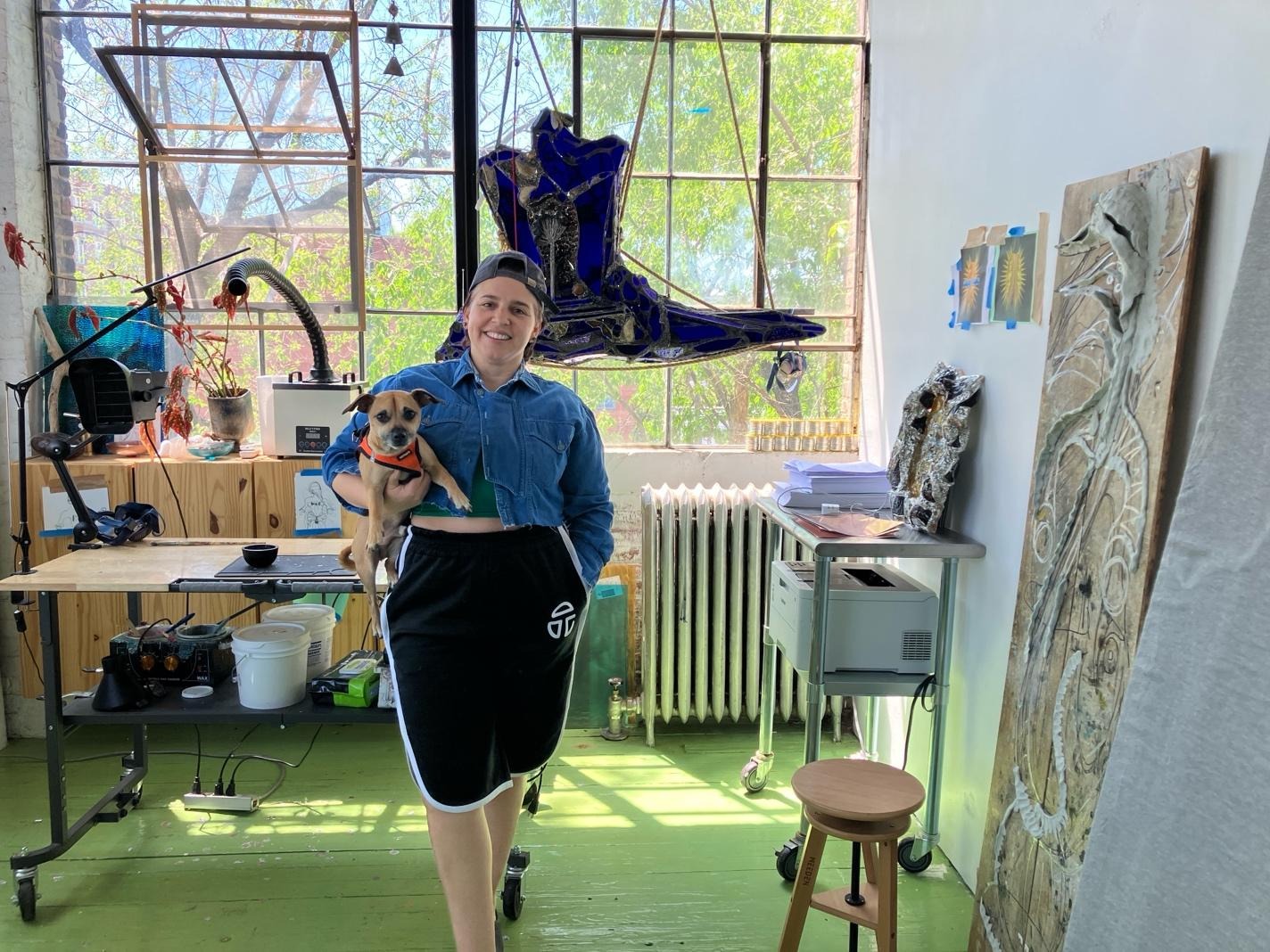
The pistachio green floors, oversized windows, exposed wood beams, and soaring ceilings of Earth Ængel’s Bushwick studio reflect their artwork—industrial, feral, delightfully bizarre. The trans, non-binary artist has worked here since 2010, producing mixed media works that subvert traditional systems of classification.
Ængel’s practice touches on a “sense of cyclical self-awareness or self-discovery and becoming,” they say. The ongoing Dolphin Gurlz series is a menagerie of dolphin-human hybrids composed of glass, steel, pine rosin, and an array of glittering objects that represents the artist’s journey to their true self. Ængel crafts the figures “to feel more alive”—armature wires act as marrow, clay as bone, copper patina the nervous system, and solder the skin. Mythical imagery inspires the artist. “Angels riding dolphins are psychopomps,” guides that lead individuals to “the underworld for transformation,” Ængel explains. The Dolphin Gurlz “mirror my own personal narrative, my own personal struggles and triumphs.” The characters will be part of The Dolphin Gurlz Finale, Ængel’s solo exhibition, curated by Lucas Ondak, at Parent Company in September.
Originally from Massachusetts, Ængel studied fashion design at Parsons. In 2018, they moved to London to attend Goldsmiths for a master’s in visual art. “It was really an eye-opening time, as far as identity, as far as becoming, and really understanding my work. I felt like I disappeared and reappeared.” The new environment was life-changing. “It wasn't until I got to Goldsmiths that I started to understand my transition.”
While at Goldsmiths, the artist selected their chosen name. “I always knew I wanted to change my name.” While working on an essay about artists who have changed their names, they found over 300 who had adopted new monikers. “It’s a huge list. Even Andy Warhol wasn’t born Andy Warhol.” For the artist, they were born on Earth Day, hence their first name. They spell their last name with the ligature “Æ” because “it's like merging the binaries.”
Later this year, Ængel will debut new works at The Church of the Village, an LGBTQ+-affirming church in Greenwich Village. Along with restoring 16 of the church’s windows, the artist is adding new stained-glass panels to six doors and creating a water fountain sculpture. To recognize the trans members of the church’s congregation, the glass panels will depict gynandromorphic and monoecious ocean life. The water fountain, Ængel Mountain (2025), evolved from an earlier work that the artist rebuilt. Composed of multi-colored glass, marble tiles, solder, and found objects, the life-size, kaleidoscopic piece reflects on loss and how rebuilding can restore agency. Reimagined as a public artwork, the sculpture is now a symbol of renewal. “I think the church needs a trans angel fountain,” the artist says. “It’s going to become something that's available to everybody.”
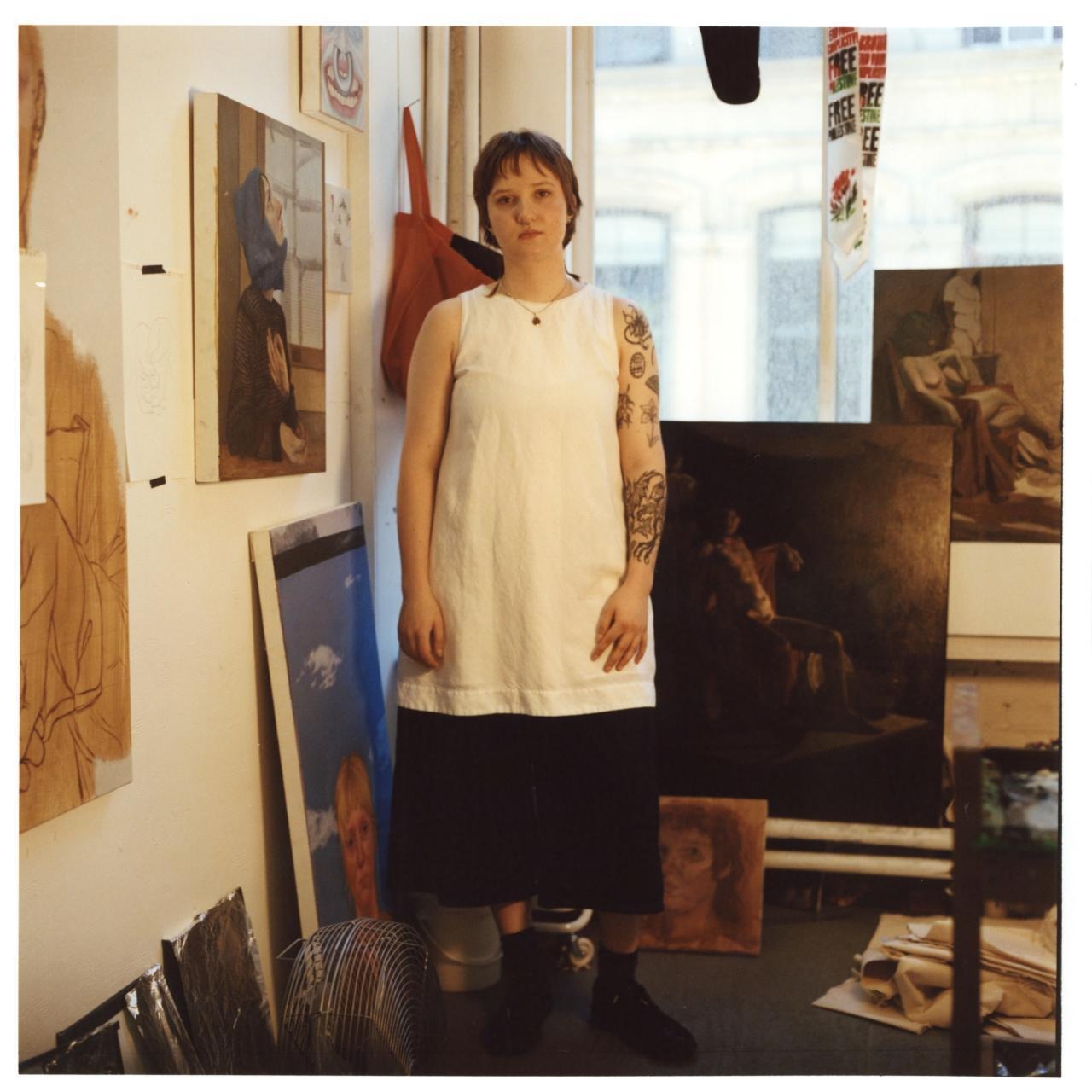
In Valerie Skinner’s studio, humor is both the apparatus and the residue—scattered like a child’s wandering steps across a dazzling room. There is a heightened guilelessness in Skinner’s paintings that accumulates immediacy organically. While the canvases often read as audaciously naive, even vernacular, they are also the site of a singular distillation: Skinner renders in oil the stick figures that children scrawl as doodles; a primary grammar of mark-making, the very first attempt at visual expression, which most viewers will recognize as shadows of their own childhood hands.
By yoking a relatively sophisticated material to an unapologetic directness and disarming innocence, Skinner approaches her art by “not taking herself too seriously,” as she readily admits. Yet this intentional loosening of grip never dilutes the conceptual richness underneath. Across these paintings, from an appreciation journal titled 3 Good Things Today to a still-in-progress rendering of a Ziploc box, Skinner plays with the appeal of “ordinariness” with both consistency and restless variation, illuminating the wonder and the wondering that permeate everyday life.
The guilelessness in Skinner’s work is not just an aesthetic register but a deliberate textural portal. Skinner describes her artistic process as “finding the quickest way to articulate ideas in an image.” That aspiration toward speed does not sacrifice depth but catalyze it. Enticed by the electric compression of her painted texts: “I wish I was a cat.” “I love my bed,” “I love’d my friend,” viewers are drawn into philosophical inquiry through candor. These naive, radically concise statements radiate meditations on selfhood, particularly in its most formative and opaque passages. The realistic elements that appear alongside the stick figures—a pair of vans, the plush silhouettes of a cat—act like anchoring sensations within an otherwise abstract drift: fragmented memory that repels full coherence yet insists on felt truth.
“I’ve been inspired by how parents look back at their kids’ drawings and think about what they meant in their childhood,” Skinner reflects. That psychoanalytic undertow quietly animates her humor, opening generous room for individual association without dictating an interpretive destination.
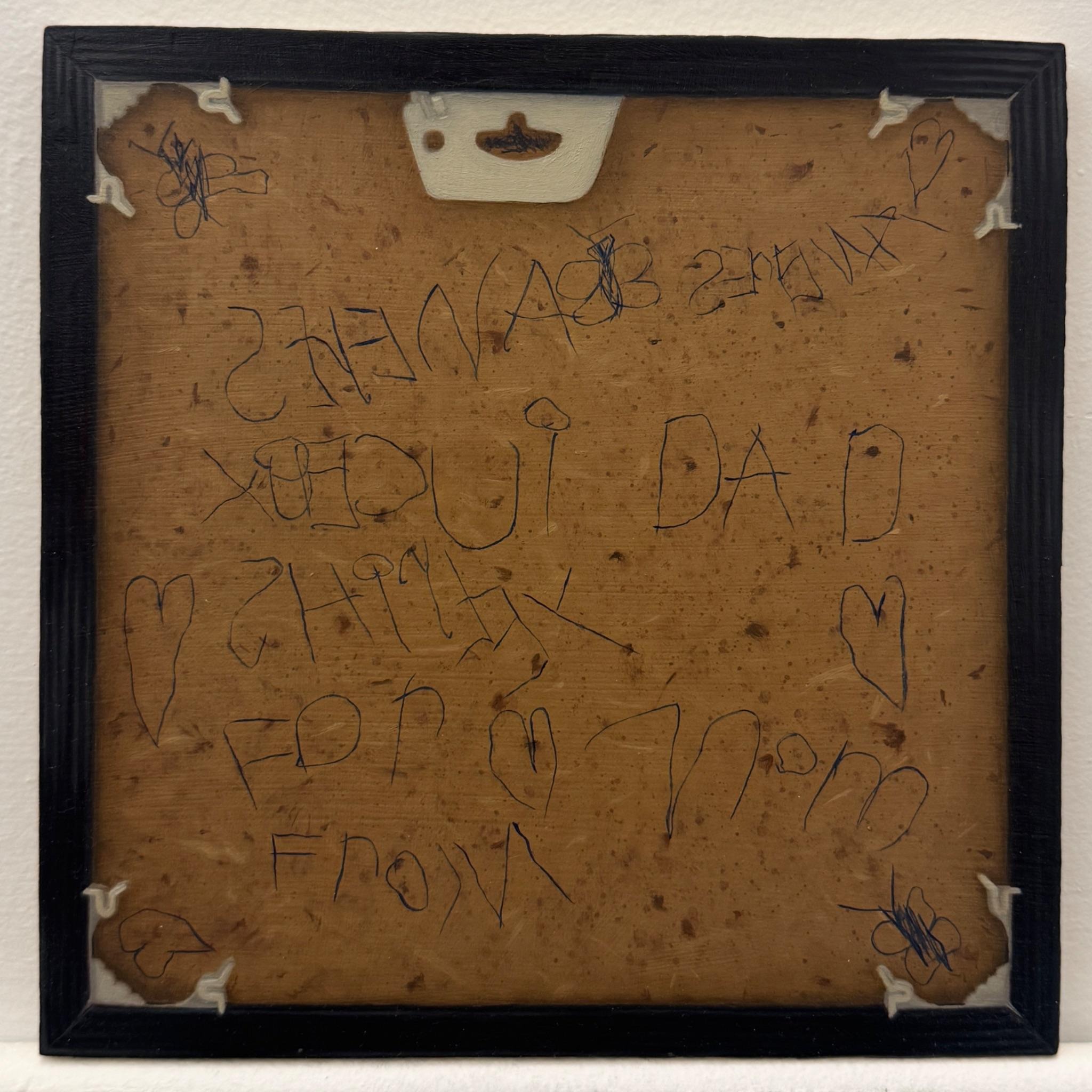
This archival impulse extends beyond the personal into a rigorous formal method. In one painting hung in the corner of the studio, the back of a picture frame is rendered in oil—its surface carrying twisted, mirrored fragments of handwriting: “Dad, heart, To From Mom”. Skinner shared that the inscription was borrowed directly from her girlfriend’s childhood picture frame, which she found to be a compelling object to reconstruct on canvas. Whether what haunts these fragments is reminiscence, tenderness, or the particular weight of the unrequited, the texts share a translucent gravity that conjures the uncanniness of remembrance, how the past emerges in shards, legible and estranged at once.
In Valerie Skinner's work, what is immediately rendered and understood is almost always the ripple of something denser beneath, like a childhood dream that recurs, each time trailing more traces of the inexplicable.
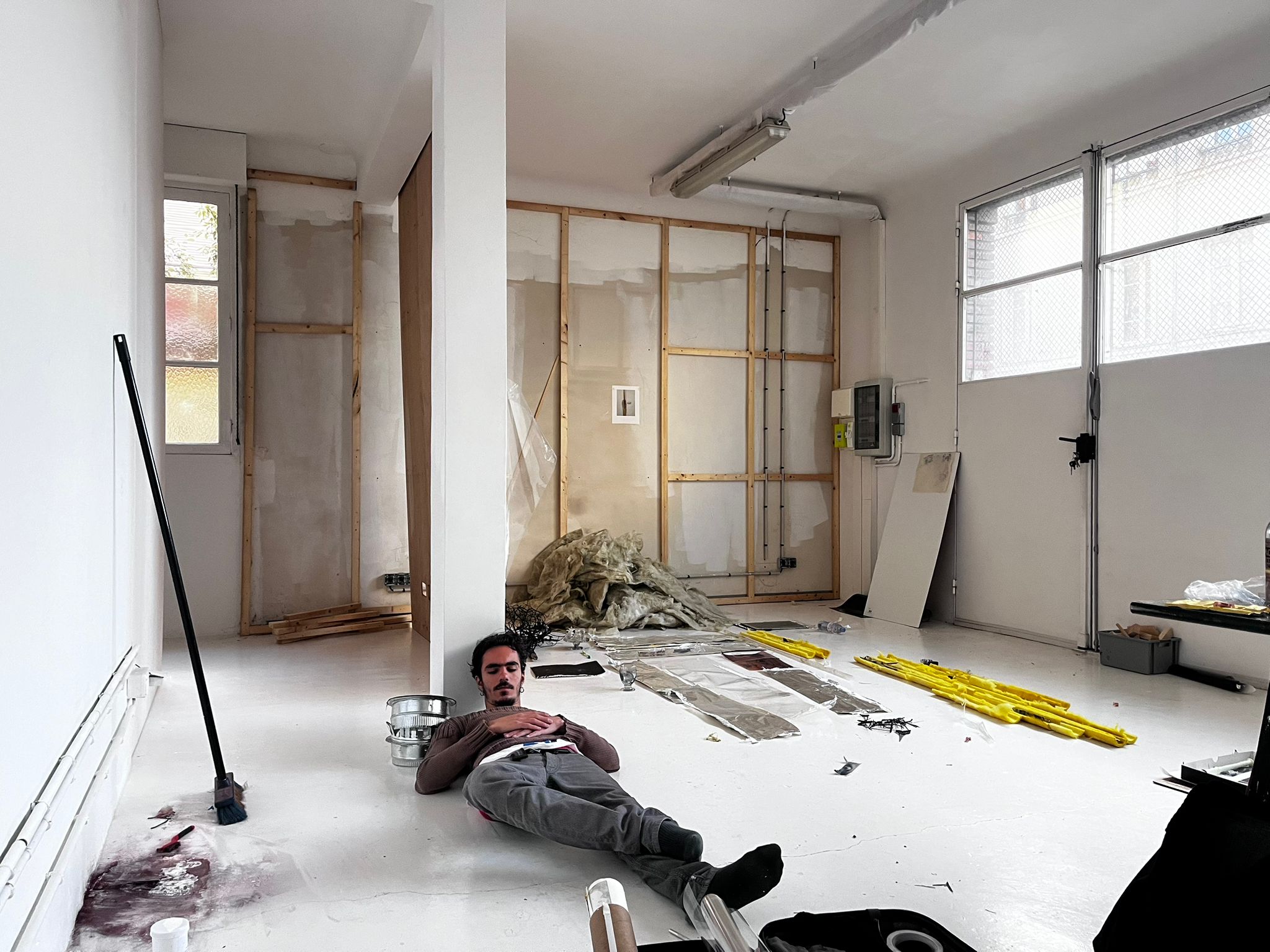
I am in the studio of Regev Haim Pardo, and I am seeing things I am not supposed to see. Or rather, things I am not usually asked to see. But he wants me to see them. He keeps asking me to look closer: insulation foam, crevices, the skeletons of our infrastructure. Suddenly, I feel a little queasy. A reminder that our cities are really just skin and bones.
A recent graduate of Cooper Union, Pardo is another prime example of how artists make it work. His studio is less a room than a corner in the line of fire of the door, in a space shared by two other artists. That corner is packed with materials, gestures, models, and drawings. One of the most admirable aspects of the studio is his use of airspace. In New York City, airspace, commonly referred to as air rights, is officially defined as the empty, three-dimensional space above a specific parcel of land. Under zoning laws, these rights are treated as transferable real estate assets. In Pardo’s studio, airspace becomes something else entirely: a place to store, suspend, test, and think.
Things hang and dangle from above, including a bright red sprinkler system, a metal air vent, and an exhaust ventilation system constructed out of cardboard by the artist. A nod, perhaps, to both Nancy Holt and the city itself. Summer is fast approaching, and I can’t help but feel desperate looking up through it, hoping it works but knowing it doesn’t. It’s not unlike the feeling of walking into many buildings in New York during a heat wave: faith and hope in the system, followed almost routinely by betrayal.
The vent makes me think of temperature, and I ask Pardo about his relationship to it. He seems less interested in temperature itself than in the infrastructural organs and materials that separate, control, dissipate, and dictate our bodies’ proximity to atmospheric conditions. These systems are both safeguard and gatekeeper. So the building’s innards, just like the ones surrounding us, become his materials.
.jpg)
It is nearly necromantic, a “forensic approach” as he describes it. There seems to be an attempt at digging, at finding a core or the central locus of these places. How finely can you split a building? In half, like Matta-Clark? In slices, like a CT scan? How far down can the divide go, into a single thread of fiberglass? It’s a compelling question, and one that feels deliberately unresolved. Perhaps this is a nod to the never-ending construction of the city itself, or maybe to the reality of quantum physics: there are always smaller units to discover, always another layer beneath the atom, the quark, the lepton. Pardo’s work seems to live in that space of splitting and searching, where the closer you look, the less stable the thing becomes.
Regev is in the midst of planning his exhibition, then remembered again, at Taon in Paris, on view May 23 through July 10, 2026. Pardo works in both gesture and thought. Some pieces begin as ideas, tested through models, drawings, and provisional structures; others seem to happen through movement itself. Accidental, residual, and unplanned. These works cannot be fully imagined in advance. They have to be realized in space, through pressure, proximity, and encounter.
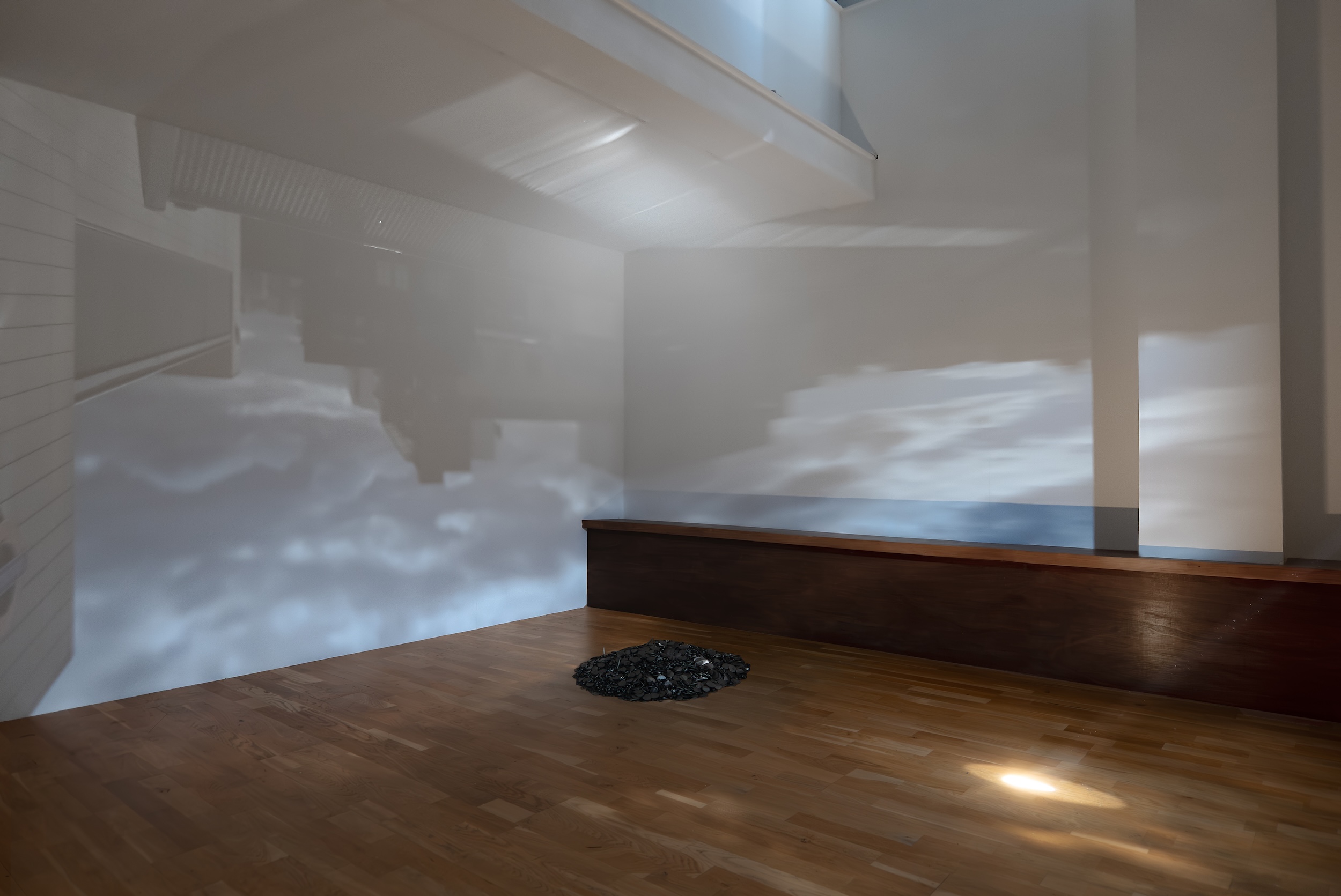
He describes wanting to flip the gravity of the space itself: to remove one wall and construct another nearby. This new wall would be hollow, something you can look through like a periscope, so that gazing into it sends you, visually, outside the gallery. A gaze outward becomes a gaze inward. This invented space rejects chronology, orientation, and the basic assurances of where we are. The gallery will never be the same, is all I can think. And I think that’s the point.
The last set of works I look at is a suite of drawings, almost like a book. Oversized sheets of paper sit in my lap, and I fumble through them as eloquently as I can. They are arresting: layers of erased and washed ink and copper powder, left to form “accidental but somehow precise architectural spaces.” Regev seems intent on evoking spaces without ever actually creating or building them. The effect is disorienting, hazy, almost dreamlike.
I’ve run out of coffee, and it has been over an hour. That’s my cue to go. I thank Regev and ask him to keep me updated. I step outside onto Jay Street in Dumbo, caught between forking roads, a bridge, and a highway overhead. The GPS on my phone buffers. I spin around, trying to orient myself—or rather, locate myself—in this city of crossing lines and infinite z-space.





%20.jpeg)