

.webp)

Editors' Selects: October 2026
Review
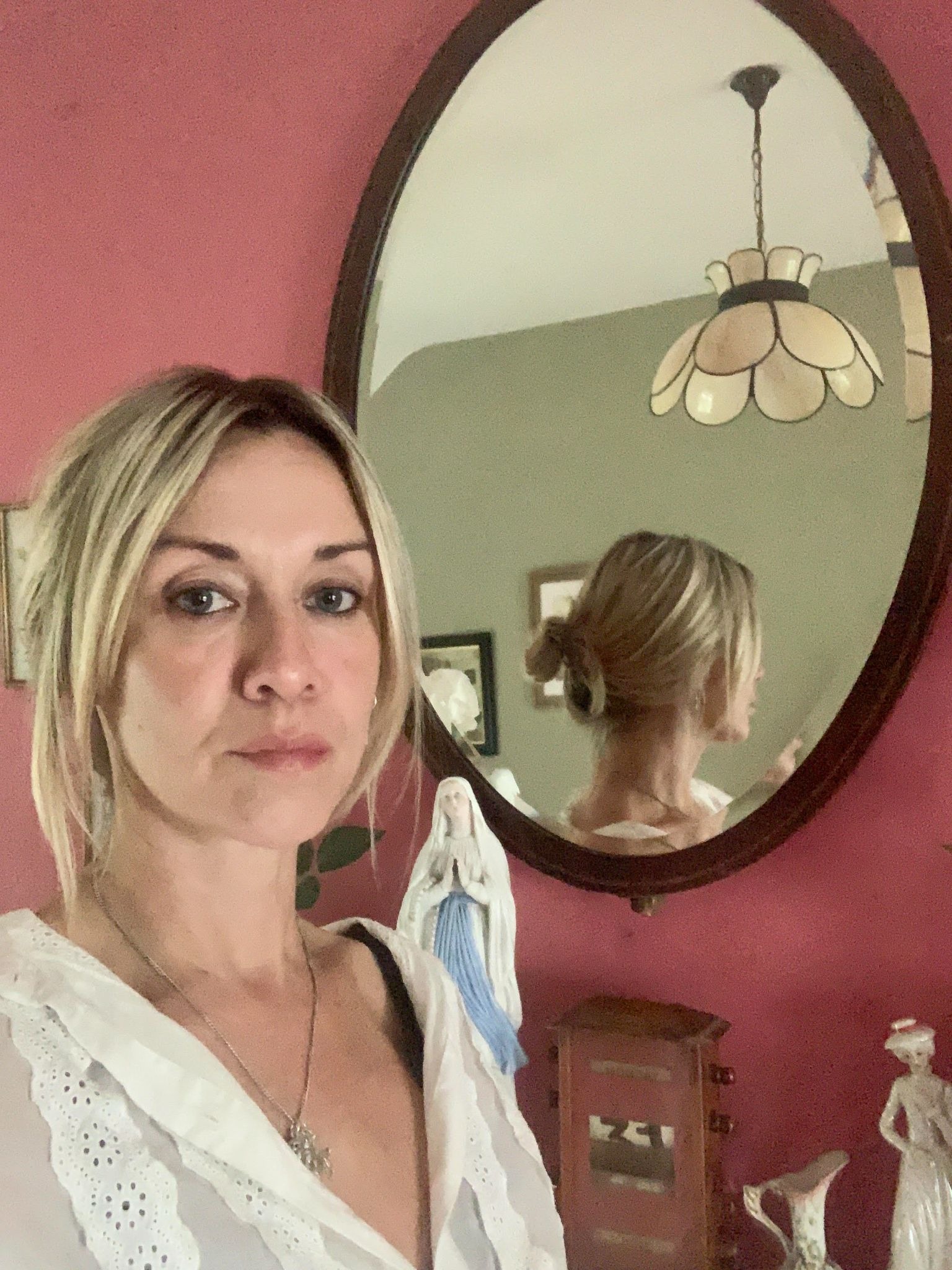
Sarah Theresa Lee’s paintings conjure a suspended moment in time: girls frolic in creature masks and frilly babydoll dresses, mysterious femmes pose by cracked open windowsills joined by their furry, pawed companions. They live in domestic interiors somewhere dear to Lee’s memory, of dusty pink and teal wallpaper and intricate tiled floors.
As her dog Blu joins and sits by her lap, she explains that time is central to her work. In Only my kitty knows I am a fembot (2026), the painted calendar in the kitchen points to the year 1987. A lucky charm cereal box lay on top of the fridge, as a solemn golem-faced lady dressed in a sheer nightgown holds a raw cut-out patch of her own face. These keys and products signal nostalgia and a “recall to a time.” Some of the backgrounds in her paintings are loosely inspired by her father’s home in Ireland that holds over 100 years of family legacy and history, a place that she describes as a “space of life, death and many different eras.” Staged vanity mirrors with bottles, soaps, perfumes, sprays, and other Irish knick-knacks serve as nods to her roots and upbringing in the ‘80s, growing up with four women in the house.
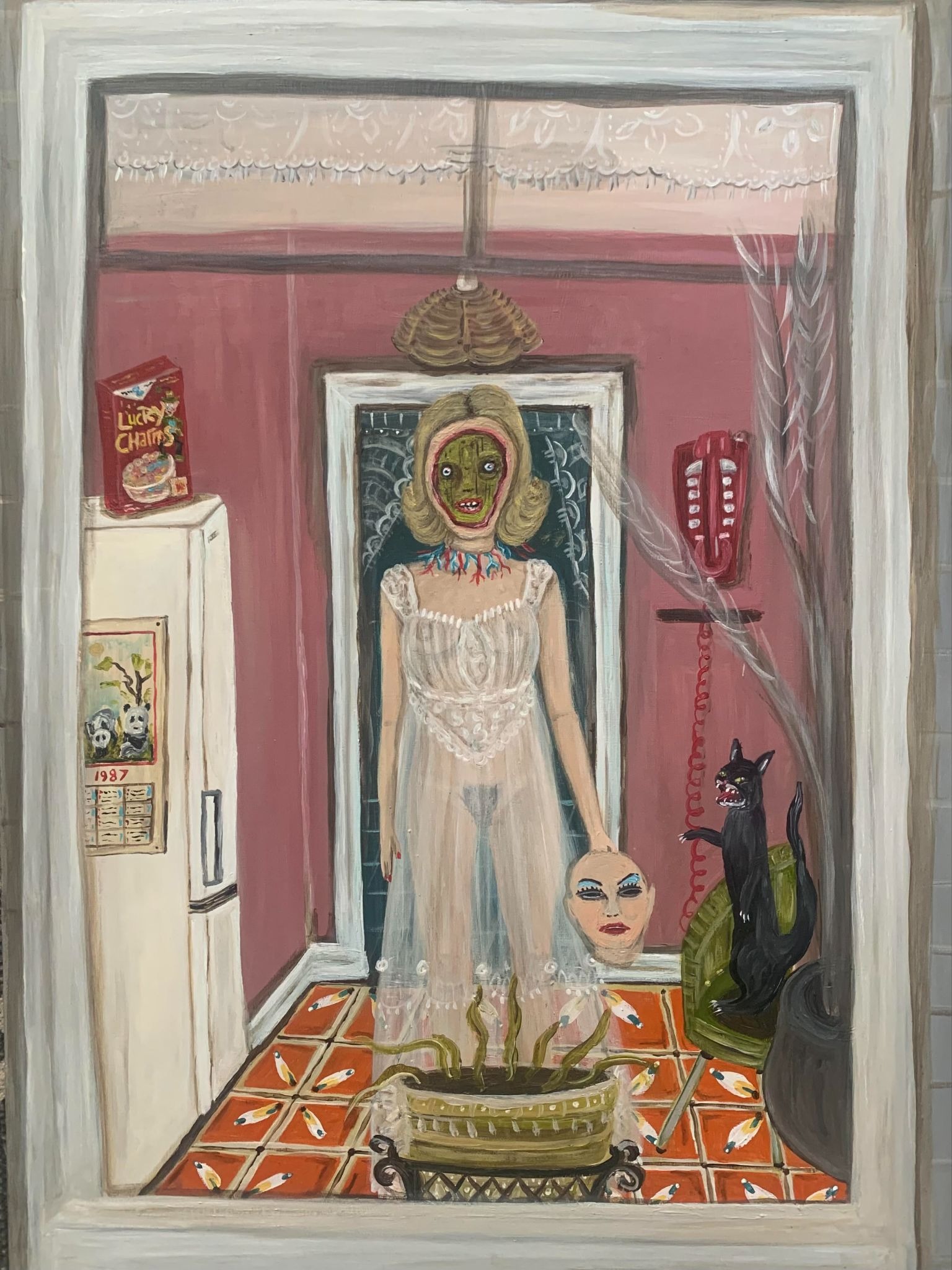
Growing up, Lee would spend late nights watching American horror films on TV. She naturally absorbed the aesthetic vocabulary of costumes, theatricality, supernatural effects, and the exaggerated drama of domestic unease into her paintings. The characters in her paintings dress in nightgowns that evoke the melodrama of classic horror akin to Roman Polanski’s Rosemary’s Baby (1968) and Dario Argento’s Suspiria (1977). Lightning shooting from the eyes, monster-masked faces, and references to witchcraft and the occult become playful signs that she borrows from horror tropes, and rather turns them toward whimsical humor and absurdity. Makeup, masks, and costumes become forms of performance, disguise, and magic that transform ordinary figures into characters that seem to travel between the domestic and dreamscape.
Whether these symbols of mystique and mischief read as luck or misfortune relies entirely on the eye of the viewer. Her background from a psychiatric nurse to an “outsider artist” now represented by Ricco/Maresca in New York puts her in a unique position in the arts. Lee believes that interpretation or meaning of symbols come secondary in her practice, as long as she is enjoying the process and knows in her heart that the story belongs to her. “However [the work] is achieved,” she states, “it should have space in the world.” Lee paints a strange, peculiar, but familiar world where her girls can simply exist on their own terms.
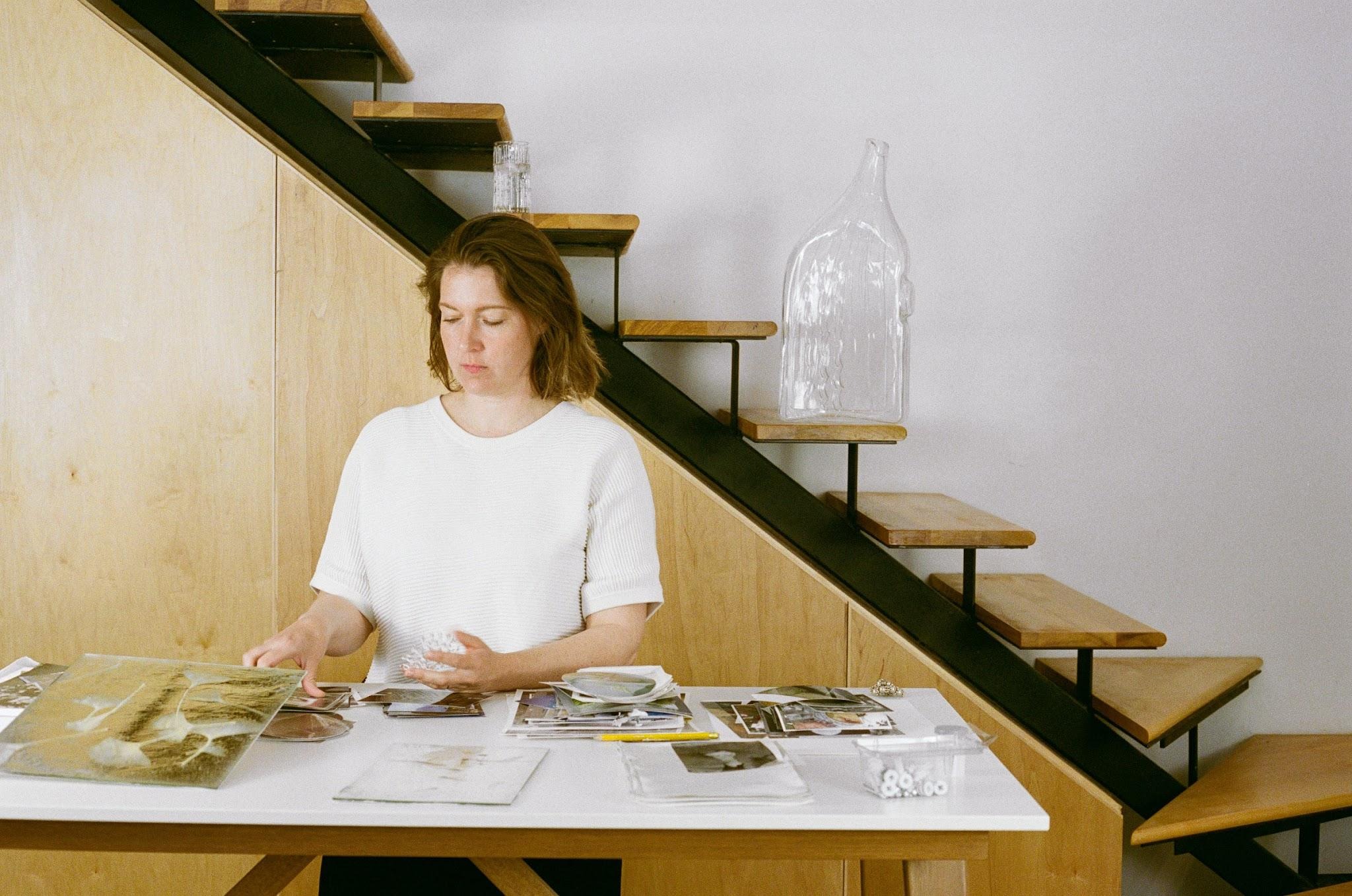
Lorna Bauer’s disparate studio spaces reflect her multi-disciplinary artistic practice. Bauer calls from her home studio in Montreal, nestled within her 1950s bungalow, but was quick to note that she primarily uses her home studio for scanning and storage. As the multidisciplinary artist works predominantly with analog technologies, she utilizes collaborative spaces around the city—the darkrooms at Concordia University for developing photographs, the glass studios at a cégep for flameworking, kilnworking, and glassblowing. Working between different mediums and traveling for site-specific research, Bauer expresses discomfort with the romantic notion of a single, solitary studio.
Our conversation lingers on Bauer’s sculpture Lemon Tree #2 (2026), recently displayed in her solo exhibition Maison en Bord de Mer at Trotter&Sholer. The work features glass lemons, tinged with burnt orange and blush pink pigments, hanging from meandering wire. The deep, burnt orange hues cluster at the top of the sculpture, reminiscent of ripe fruit hanging from the upper layer of a tree’s canopy, just out of reach. The sculpture draws from the ecological surroundings of E-1027, a remote, seaside retreat designed by Irish furniture designer and autodidact architect Eileen Gray in the late 1920s. Located on the Côte d’Azur, the modernist villa was the site of controversy regarding the vandalization of a white wall by French-Swiss architect Le Corbusier in the late 1930s. Upon visiting the contested site in 2017, Bauer was drawn to the lemon trees growing around the property’s rocky terrain and repeatedly photographed a specific lemon tree surrounded by ceramic black tiles in the villa’s courtyard.
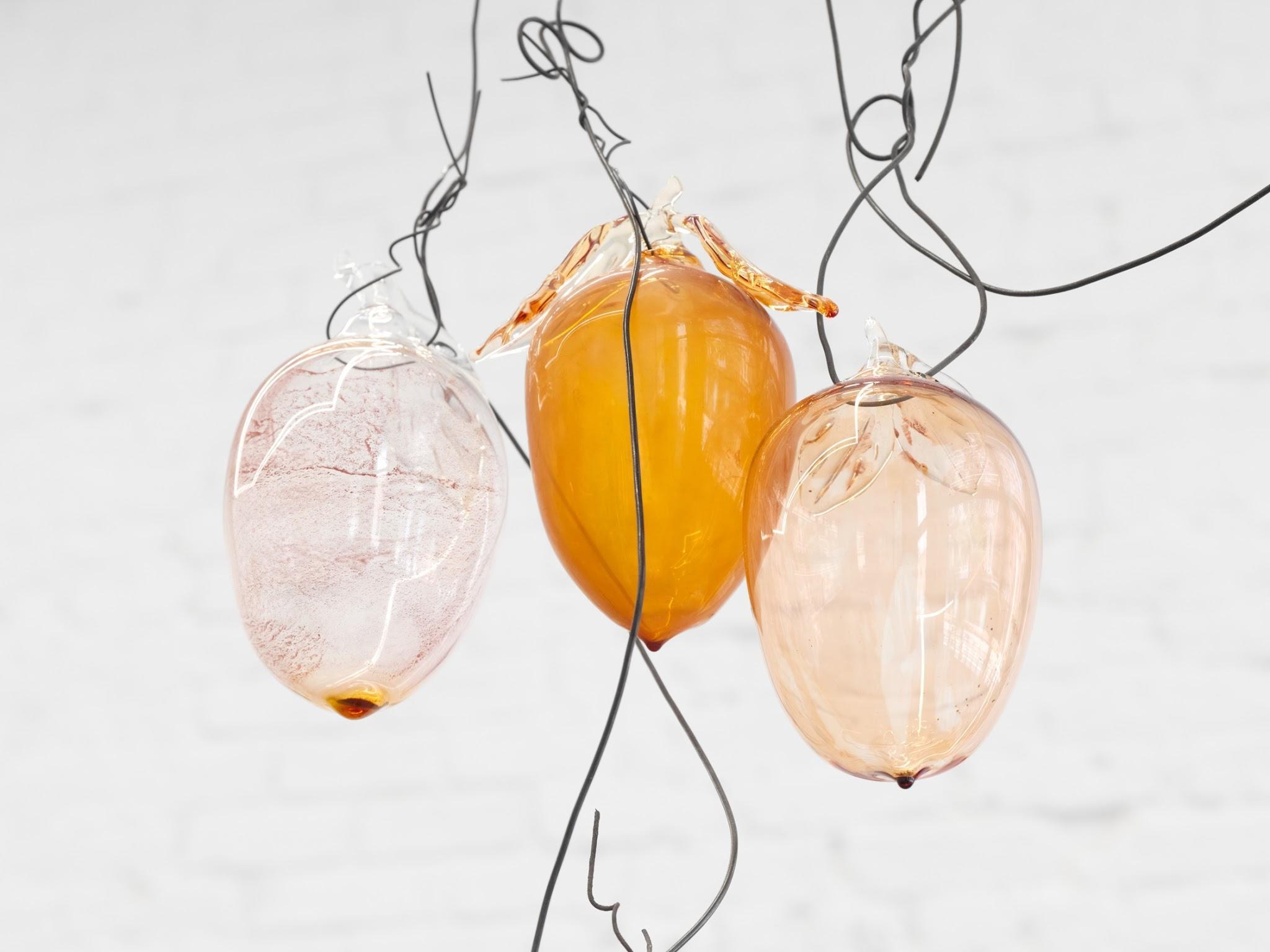
We speak at length about the process of blowing the glass fruit for Lemon Tree #2, producing around 60 lemons over a period of six months. To create the streaky, yellowish-orange color, Bauer painted the borosilicate glass with powdered silver stain. She was intrigued by the chemical reactions between silver stain and borosilicate glass, and the importance of “imperfect application” within the art-making process. “Moments where the mirror didn’t adhere, or colors were off, point to a chemical process where imperfections are often unavoidable. I choose to embrace them. If it were perfect, you would fail to notice the material reality,” she explains.
The intermingling of material reality and history is a critical component of Bauer’s artistic practice. The use of glass in Lemon Tree #2 connects to the extensive implementation of industrial glass as a building material in modern architecture, often used for constructing floor-to-ceiling windows like those at E-1027. However, Bauer’s handblown, biomorphic glass forms sharply deviate from the standardized sheets of industrial glass. Refusing the purported progress of technological advancements, Bauer’s work carries the material, imperfect reality of analog technologies.
A similar work, Lemon Tree #3 (2026), along with two other artworks by Bauer, will be on view in a group show at RAINRAIN, opening this September.
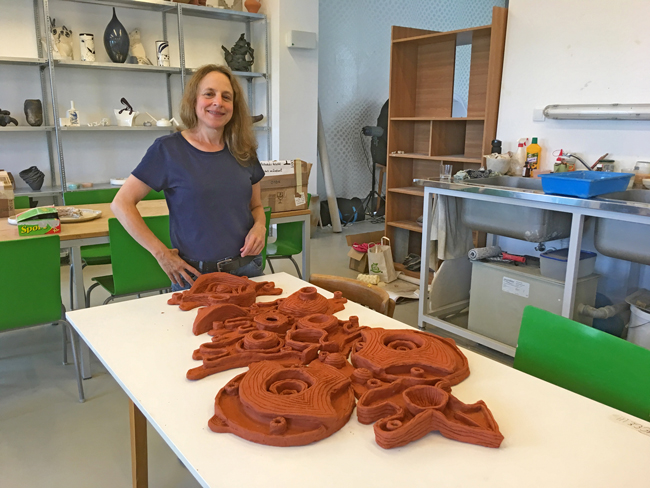
Sculptor Julia Kunin is usually found in her studio in Brooklyn, except for much of the summer, when she works in a collective studio space in Pécs, Hungary. Since 2009, Kunin has found a second home in the Hungarian city, which has fueled her imaginative vision in conceiving her signature biomorphic ceramics recalling bodily forms and organic matter. Kunin was recently a recipient of a Guggenheim Fellowship, a further boon to her career. In lieu of a traditional in-person studio visit, a virtual one was conducted with Kunin to better understand the nuances of working in her home-away-from-home.
The initial impetus for Kunin coming to Hungary was to research the history of Zsolnay Art Nouveau, a Hungarian strain of Art Nouveau distinguished by its crossing over of natural and sensual forms endemic to the cultural atmosphere of the region. Much like Rome or Paris, Pécs is the sort of place where its artistic vitality is present in every facet of the city. The architecture was especially resonant for Kunin, whose sculptures often present a convergence of bodily and architectural forms. No doubt the sumptuous and curvaceous forms associated with the Zsolnay aesthetic were perceived as stylistic kinship for Kunin.
For her ceramics, Kunin actively sought access to facilities for working with luster glazes. She eventually found success through collaborating with potters and craftspersons (both local and visiting), who she credited for their support in making the opportunity to work in Hungary possible.
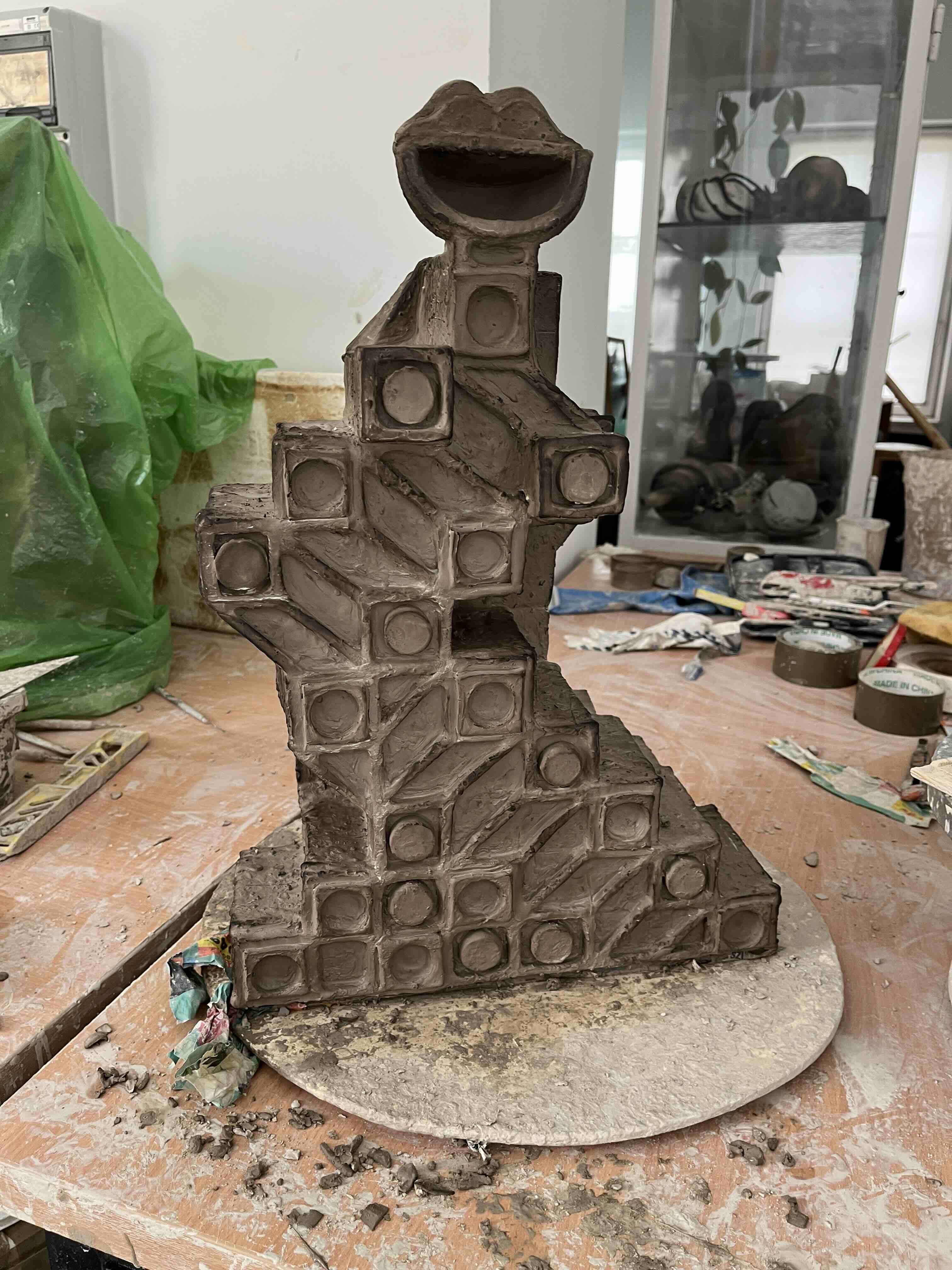
In Pécs, Kunin works within a shared studio space only accessible for certain hours of the day, but time constraints aside, the benefits outweigh any setbacks. Much as she enjoys being a part of the New York art world, that physical remove enables her respite from the chatter of influences and complete freedom to work at her heart’s content with ample material and technical resources on hand. The work she has been producing in Hungary is a continuation of her interest in exploring feminism and queerness through organic forms. Furthermore, her interest in Victor Vasarely, a pivotal figure in Geometric Abstraction, was a window for Kunin’s ceramics to be “a catalyst [ … ] to comment on male modernism, Pop Art, and kitsch.” Even more pointedly, she is devising ways to eroticize Vasarely.
Kunin’s Summers in Pécs upholds an important continuity to her studio practice: unfettered time devoted to making new artworks. For the rest of the year, Kunin teaches art at the Allen-Stevenson School for four days a week and has also taught at Pratt Institute. The balance between teaching and maintaining a personal art practice requires a certain equilibrium in how one’s creative energies are filtered without overextending oneself in either direction. Kunin handles this with great aplomb in recognizing the temporal parameters of school versus studio environments. In fact, the very first sentence of her bio reads: “Ever since completing my undergraduate education, I have structured my life in order to be an artist.” With the Summer winding down and the New York art world’s “back to school” moment just around the corner, Kunin returns to the Big Apple all the more enlightened by her annual sojourn to Eastern Europe.
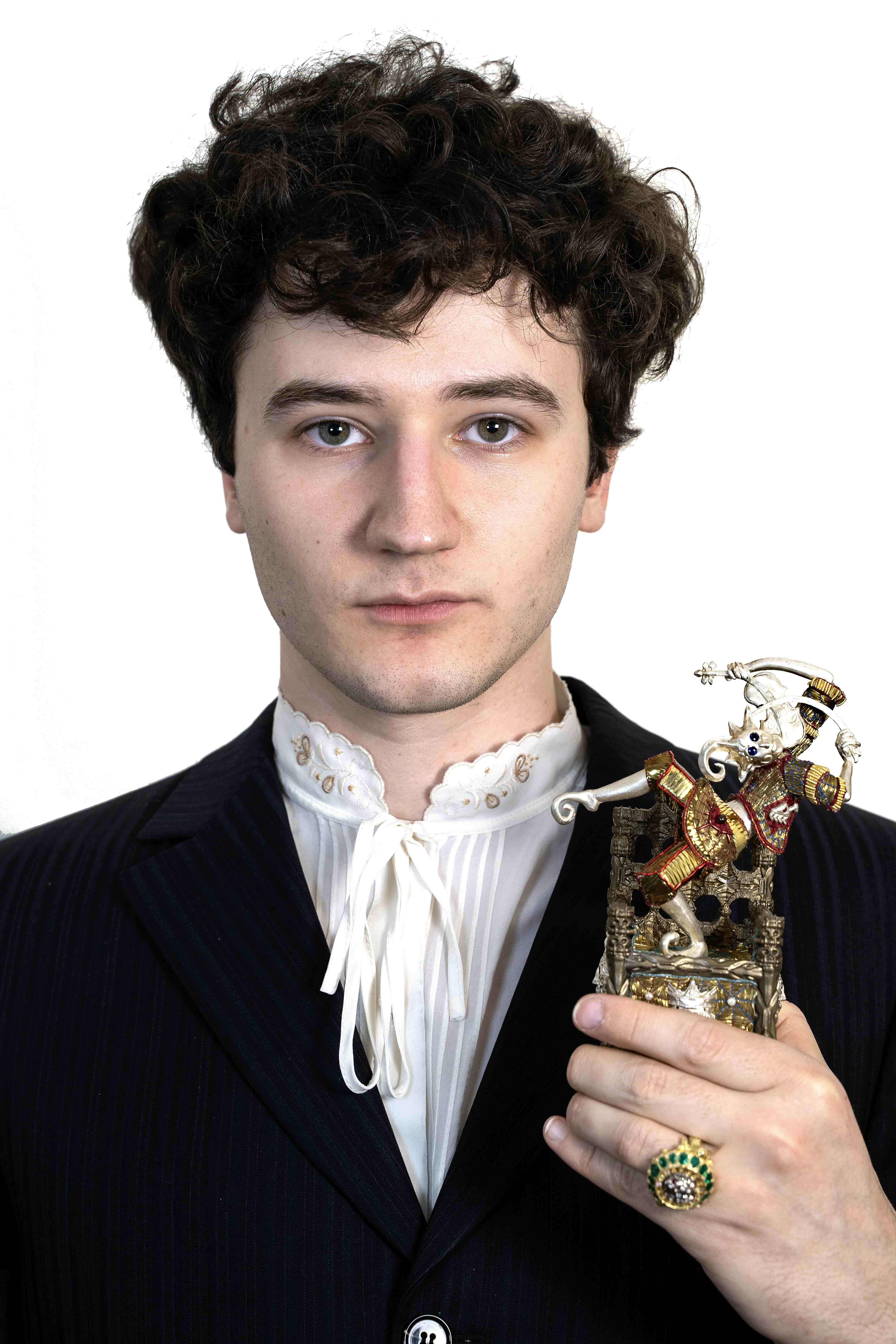
"I grew up telling stories to my younger brother," Joseph Arzoumanov explains to me in his Paris studio. "I was always talking to him about a palace hidden in the water.” It wasn’t until a trip to Jaipur in 2023, with his friend and close collaborator Brigitte Le Flem, that he saw one such palace rising from the water. He decided then and there that he would create the very place that connected his childhood fantasies and the physical world. The first step was the furniture, and thus, L'Échiquier des Songes (The Chessboard of Dreams) (2026) was conceptualized. "The chessboard of my dreams," he says, gesturing to the installation, "is the furniture of the palace I want to build." For Arzoumanov, the chessboard is the first step of a lifelong architectural project. The chessboard, now on view at the Fondation Dries Van Noten in the Palazzo Pisani Moretta, is really waiting for another, more permanent palatial home.
It is a work that demands time, a hallmark of Arzoumanov’s trajectory since his days in Paris fashion schools. His evolution—from garment construction to embroidery, then to jewelry, and finally to sculpture—is a search for the right medium to hold deep feeling. "I was creating garments," he explains, "and that led me very slowly to structural work and embroidery. That’s how I went from fashion to jewelry to art." The catalyst for this obsession was a six-month project at age eighteen: an "emperor dress" in silk and gold. In that prolonged labor, he felt he had finally "created a real treasure." Since then, Arzoumanov has intentionally chosen to work on projects for extended periods of time, over months and years.
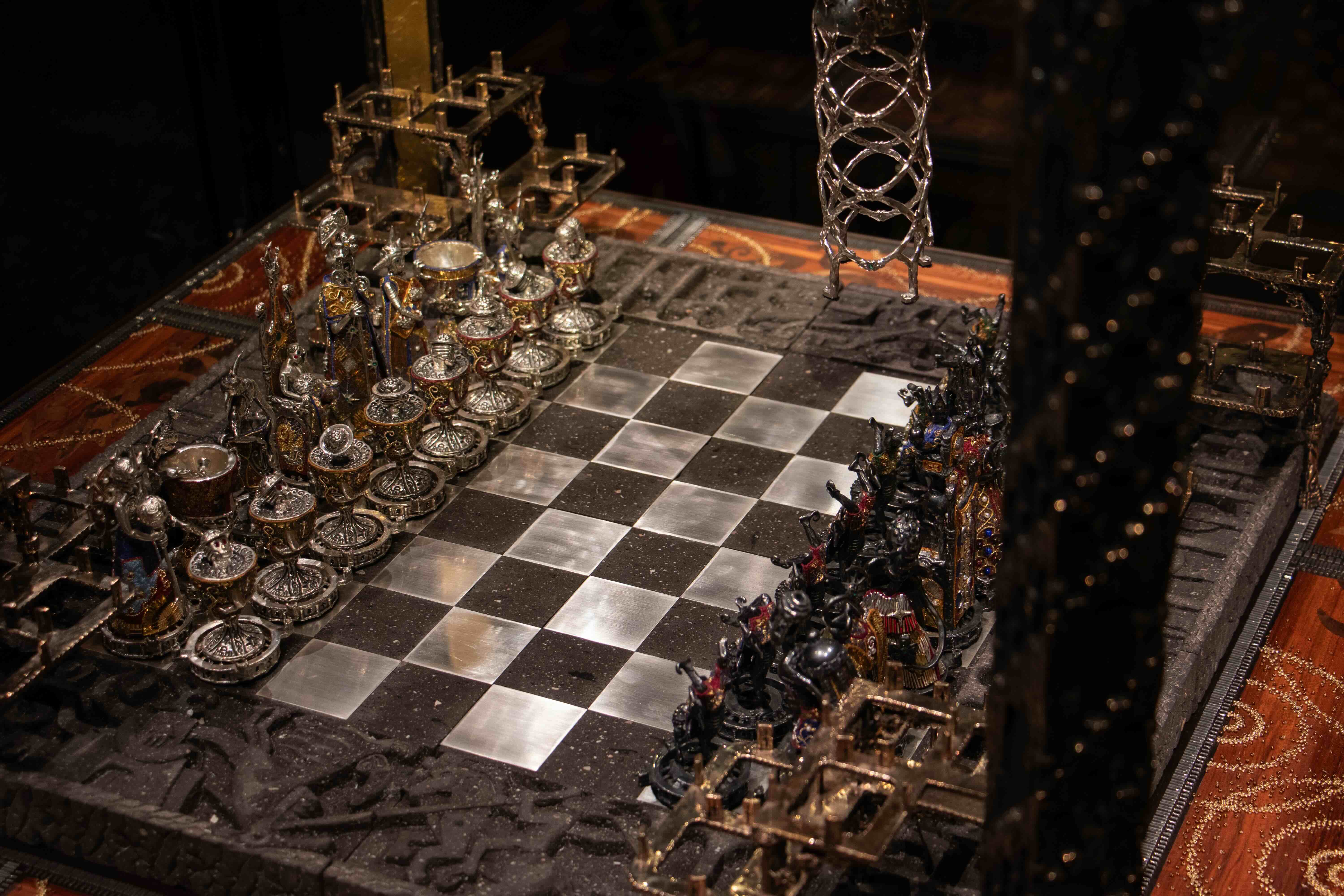
Arzoumanov’s studio is filled not only with jewelry-making tools, but also photographs and references to ancient rock carvings, Charlemagne’s own chessboard, and symbols that span religions and regions. As a boy dreaming of figures like Indiana Jones, Arzoumanov wanted to find treasures hidden in mountains, so as an artist, he decided he would craft this “treasure” himself. Certainly, with the sheer amount of skill, time, and precious materials he uses in his work, it qualifies, but when he felt he was beginning to "repeat the code of the past," he bought a 3D printer, despite a self-proclaimed lack of technical prowess. "I didn’t know how to do modeling," he laughs. "I just thought to myself, I’ll buy this machine and figure it out after."
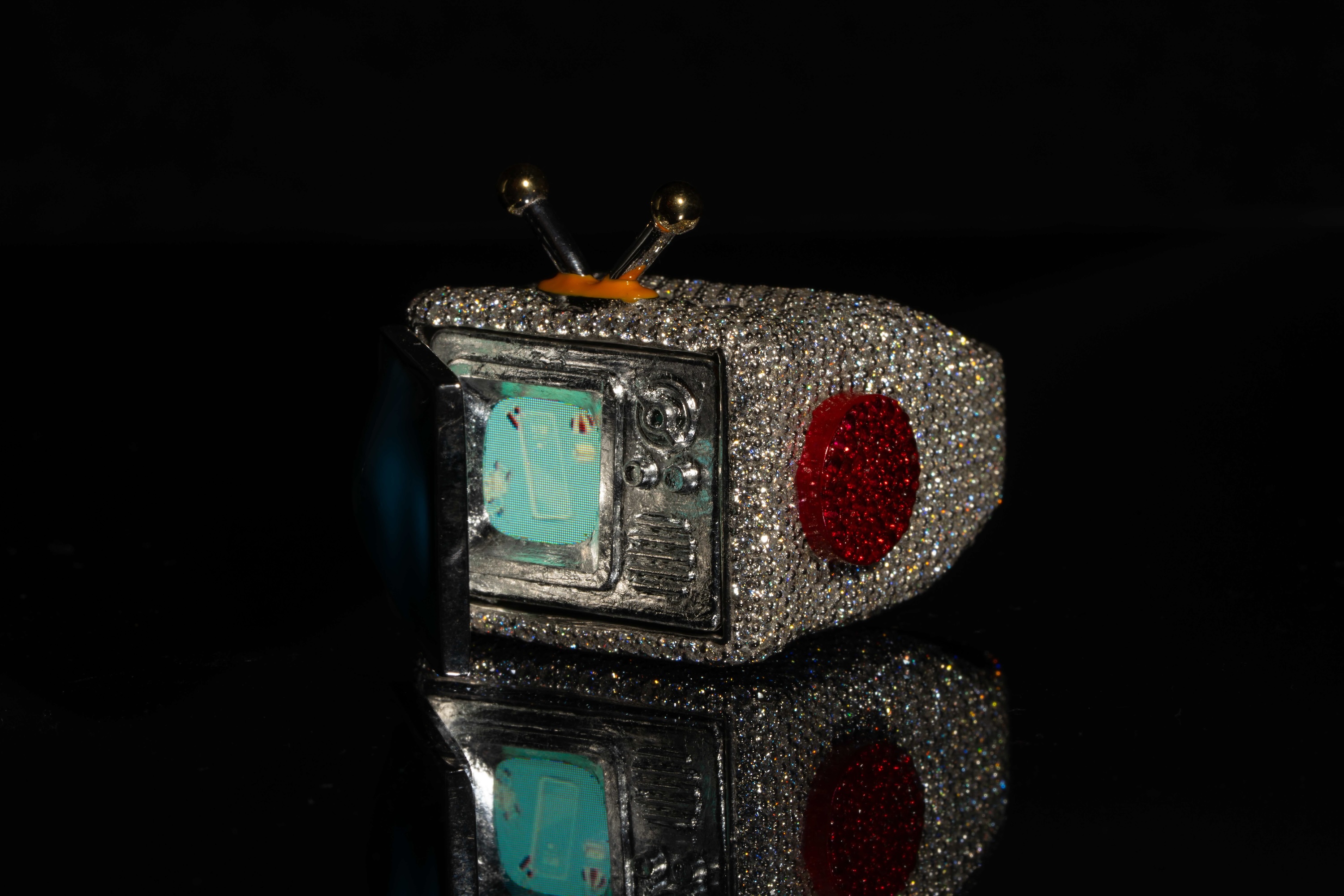
This "figure it out" mentality led him to the MIT Media Lab, where he began to construct a new language, confronting emerging technologies with ancient craft. "I wanted to find a way to use AI without losing my pleasure of creating things," he says. Imbuing the pieces of the chessboard with distinct personalities via an AI model and a robotic arm that mechanically mimicked the human hand, Arzoumanov turned his chess game into a generative narrative. “We asked the AI if the black queen and the white king could fall in love,” he says. Taking inspiration from Jean-Philippe Toussaint's 2023 memoir L'Échiquier (The Chessboard), Arzoumanov’s chessboard is a site of personal storytelling—the artist even used materials specific to his family’s history, like carved Armenian volcanic stone. “It’s all about the love story between my grandparents. They shouldn't have ever met,” he shares, showing me the gold ring he wears, studded with a vibrant constellation of emeralds, diamonds, rubies, and sapphires. He designed the ring as a portrait of his grandmother in love at the time she met his grandfather, with rosy ruby-red cheeks and her own rêves dorés (golden dreams) engraved inside the band.
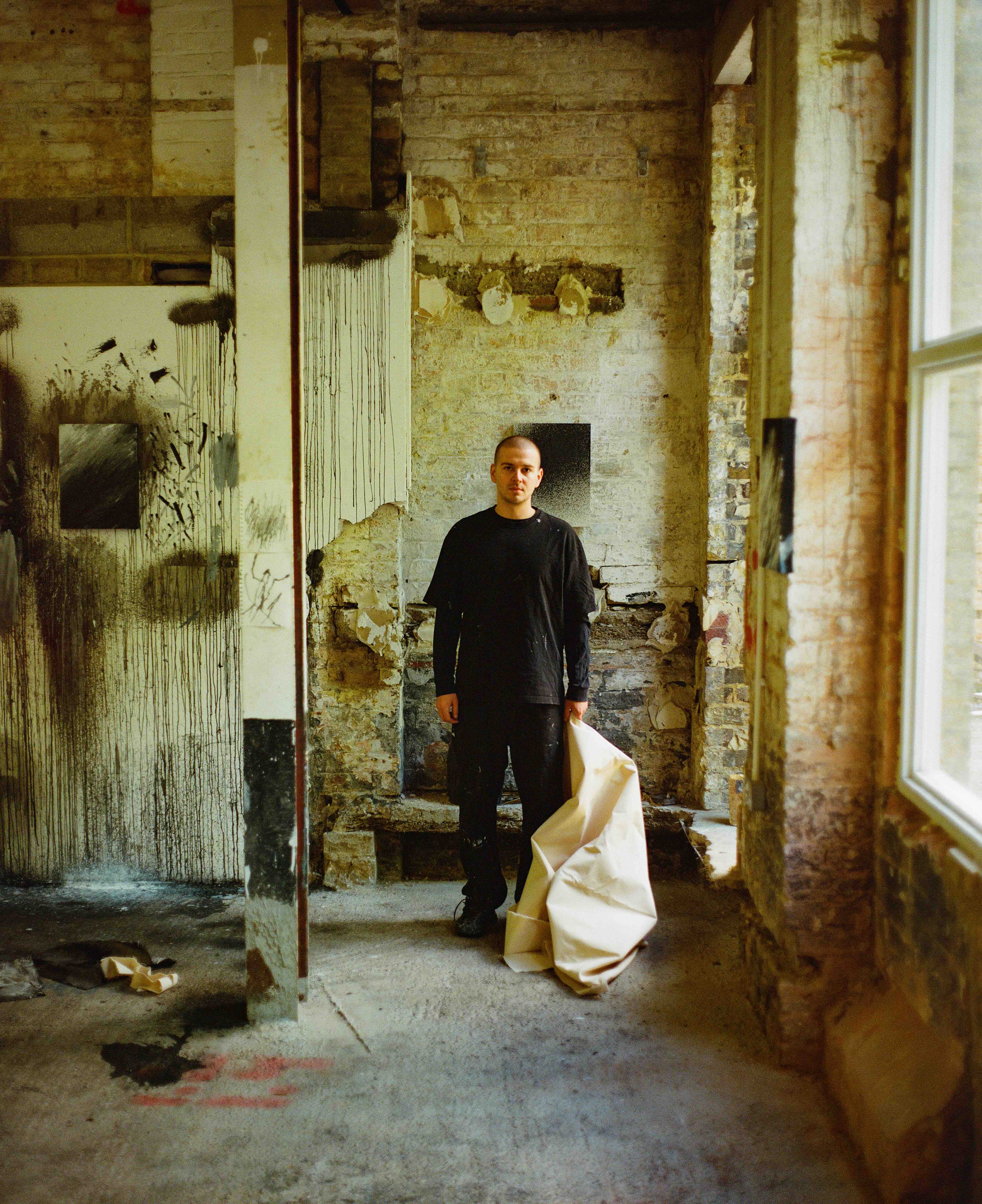
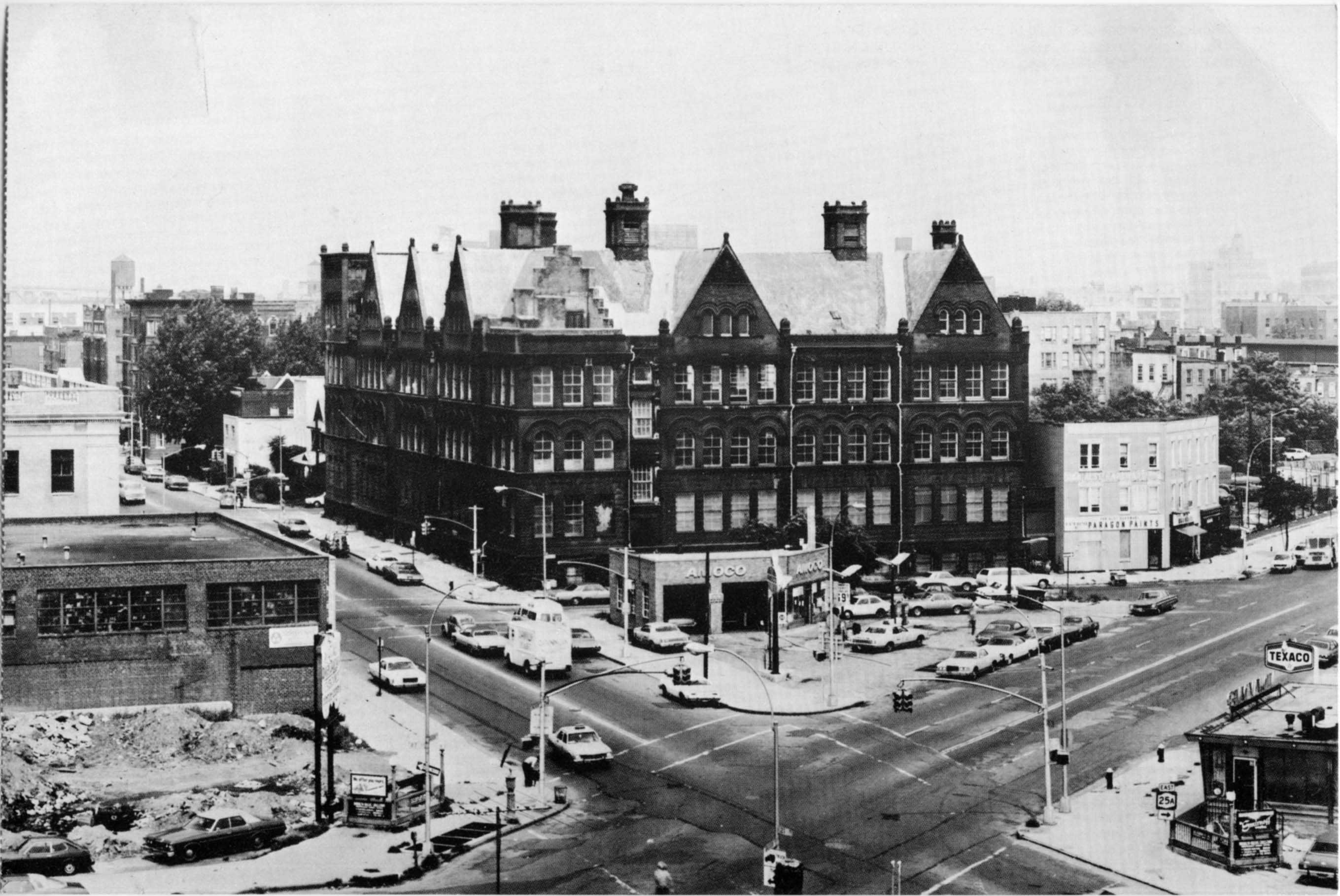
René Lazový wouldn’t describe his paintings as sacred, but heading out to his north London studio certainly feels like a pilgrimage. On a side road in Islington, a seemingly shuttered warehouse reveals itself to be host to a maze of artists' studios, with Lazový’s occupying half of the largest space on the ground floor. Lit by floor-to-ceiling windows, Lazový’s black canvases are stark against the exposed bricks, which the studiomates whitewashed themselves. “The spirit of creation still continues here”, he says while lighting sandalwood incense, referring to the building’s past life as the Pink Floyd-founded Britannia Row Studios from 1975-95. René’s cavernous space, provided by the arts charity Florence Trust, was once the music studio itself, seeing icons from Joy Division to Kylie Minogue, and most notably the recording of Pink Floyd’s Animals and The Wall albums.
The Bratislava-born artist does take some inspiration from his surroundings (he titled one work after another of the band’s albums), and listens to an array of music as he works into the late evening hours, when distractions are limited. His primary influences, however, are more philosophical than musical, such as the writings of American philosopher Timothy Morton. “It’s important to have a concept behind the aesthetic,” Lazový says, gesturing to his abstracted canvases, built from black-hued layers of ink, acrylic, oil stick, and graphite. He is interested in Morton’s concept of hyperobjects—entities that are so widely distributed that they are incomprehensible to humans, like climate change or even plastics—as well as the philosopher’s ideas of dark ecology. One might expect an artist whose practice is so embedded in environmentalism to create with shades of green, but that’s never been the case for Lazový. “Green ecologies are dead to me,” he explains. “The ecological answer to capitalism is dark.”
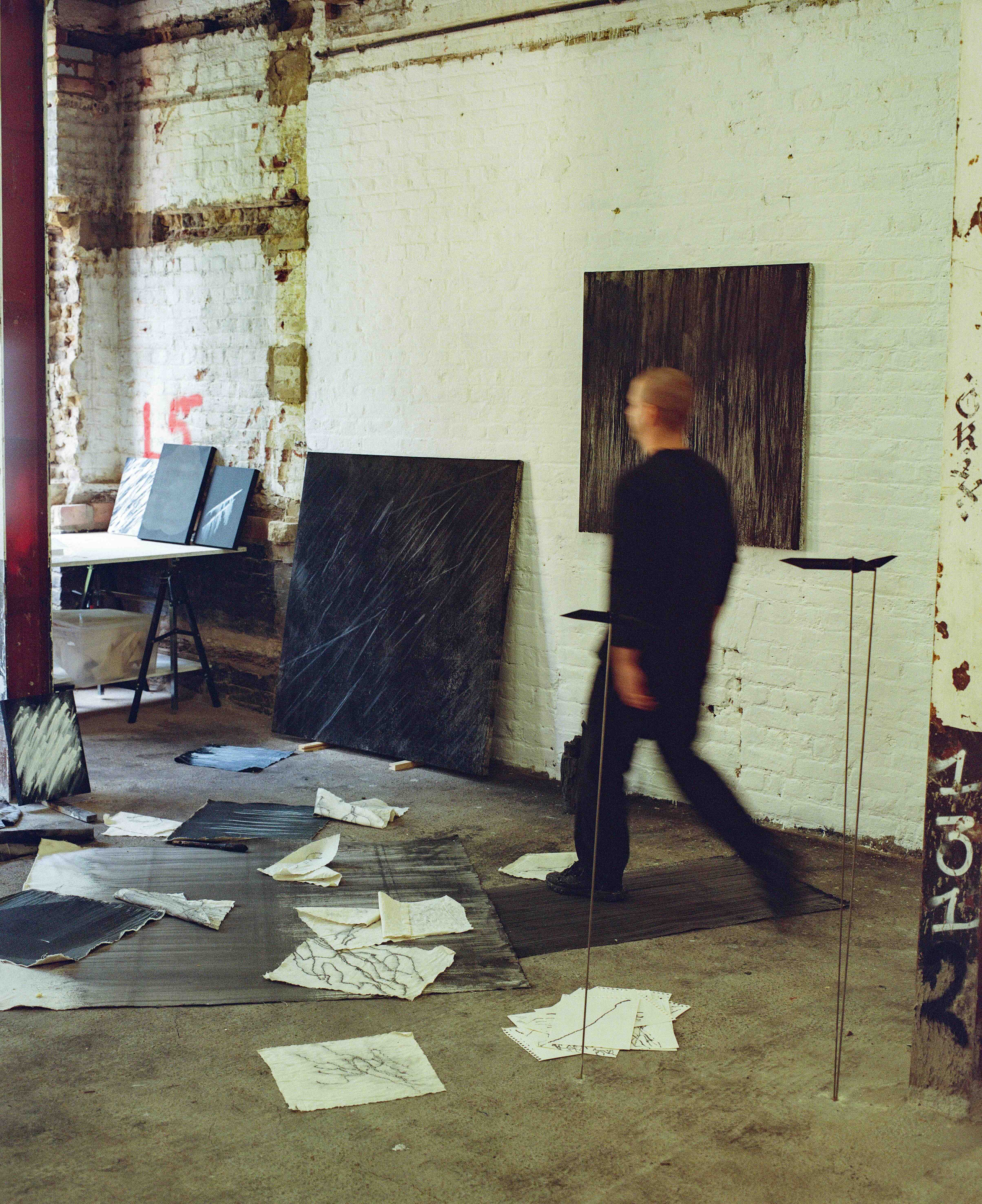
An earlier work, entitled hypertears (2024), catalysed this direction for Lazový’s practice. The monumental canvas is almost the inverse of his recent black paintings, with condensed, cloud-like forms dripping black streaks down the white background. The painting leans against the brick wall alongside printouts from Lazový’s other visual references, such as Alexander Calder, to whom his sculptural work shows a clear lineage, as well as David Ostrowski and Mária Bartuszová. But his paintings have evolved; rather than dripping or spraying ink like in hypertears, new works such as hyperwind (2026) feel far more visceral in their “gesturality”, as Lazový describes the rhythmic, oil stick marks dug into the layers of pigment and ink. If his earlier works evoke sadness through tears and rainclouds, then his newer canvases feel thoughtful but angry, perhaps even a call to action. When discussing his process, Lazový describes the canvas as getting “used up and destroyed.” His distressed canvases, albeit cloaked in black rather than earthy green, may therefore not be too dissimilar to the state of our planet.