
.webp)
Hou Yijie: “The Pulse and the Pause” at He Art Museum
Review
For her first institutional solo exhibition in Italy, Evelyn Taocheng Wang brings together paintings and painted garments whose imagery includes cakes, vegetables, the Dolomites, and even frogs. Central to the exhibition are the works for which she is best known: her sustained imitations of Agnes Martin, the Canadian-born American painter whose washed color bands were understood by their maker as expressions of happiness and innocence, states she described as impersonal, prior to the self. Read alongside the painted garments and within the layered context of South Tyrol, these works reveal a painterly intention that goes beyond imitation itself, with the very questions of self and tradition at stake.
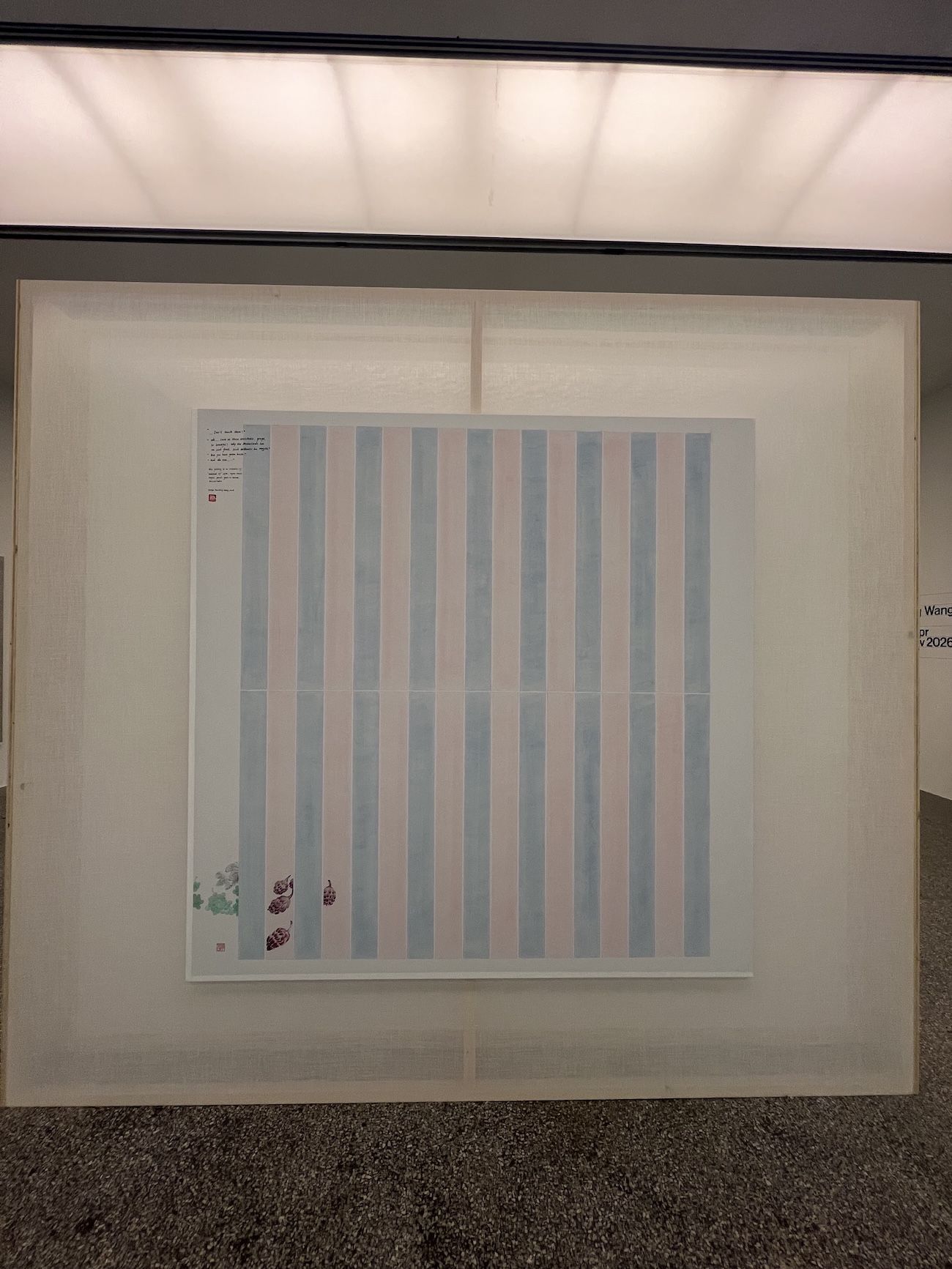
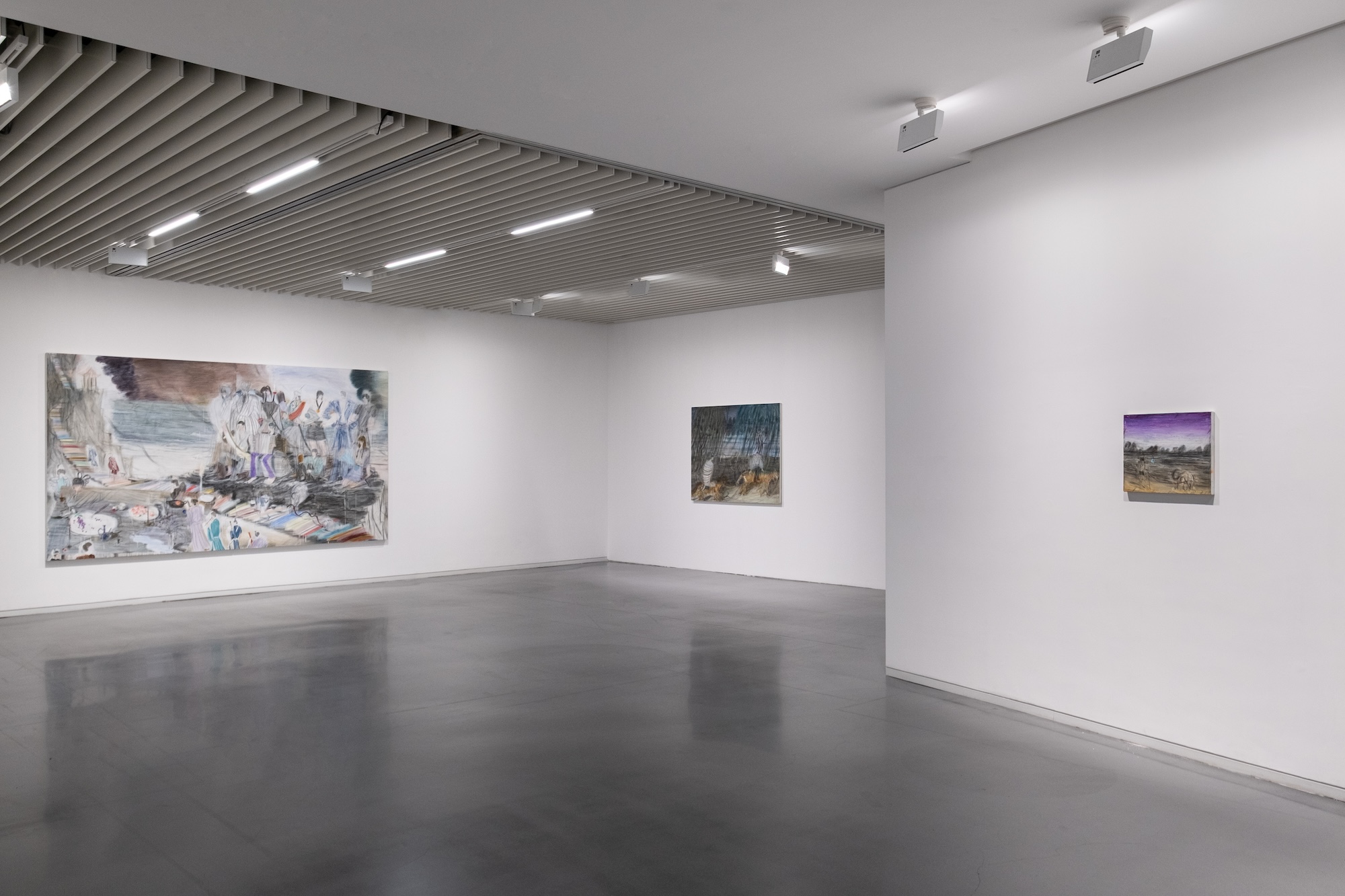
The imitation works are the first to catch attention when you arrive at the gallery. Across several large canvases, Wang recreates Martin’s washed geometric bands at the scale of the six-by-six-foot originals. Spaced apart on white walls, they render the kind of quiet Martin spent her life going after, the gallery space itself slowing down. In Bolzano Veggie and Imitation of Agnes Martin (2026), vertical bands of pale blue and sand pink interlace, spreading across the canvas in an approximation of Untitled #17 (1974). The bands are recognizably Martin’s: their rendition through translucent washes, their slight irregularity of hand-drawn edges visible only up close, and their narrow white interval running between the bands and cutting through the center of the whole composition. What distinguishes the work from pure imitation is the presence of other elements: purple artichokes and clusters of green grapes rendered in fine brushwork as corner accents, a crimson square seal at the lower right corner, and a conversation about the vegetables rendered in handwritten black text atop the leftmost color band.
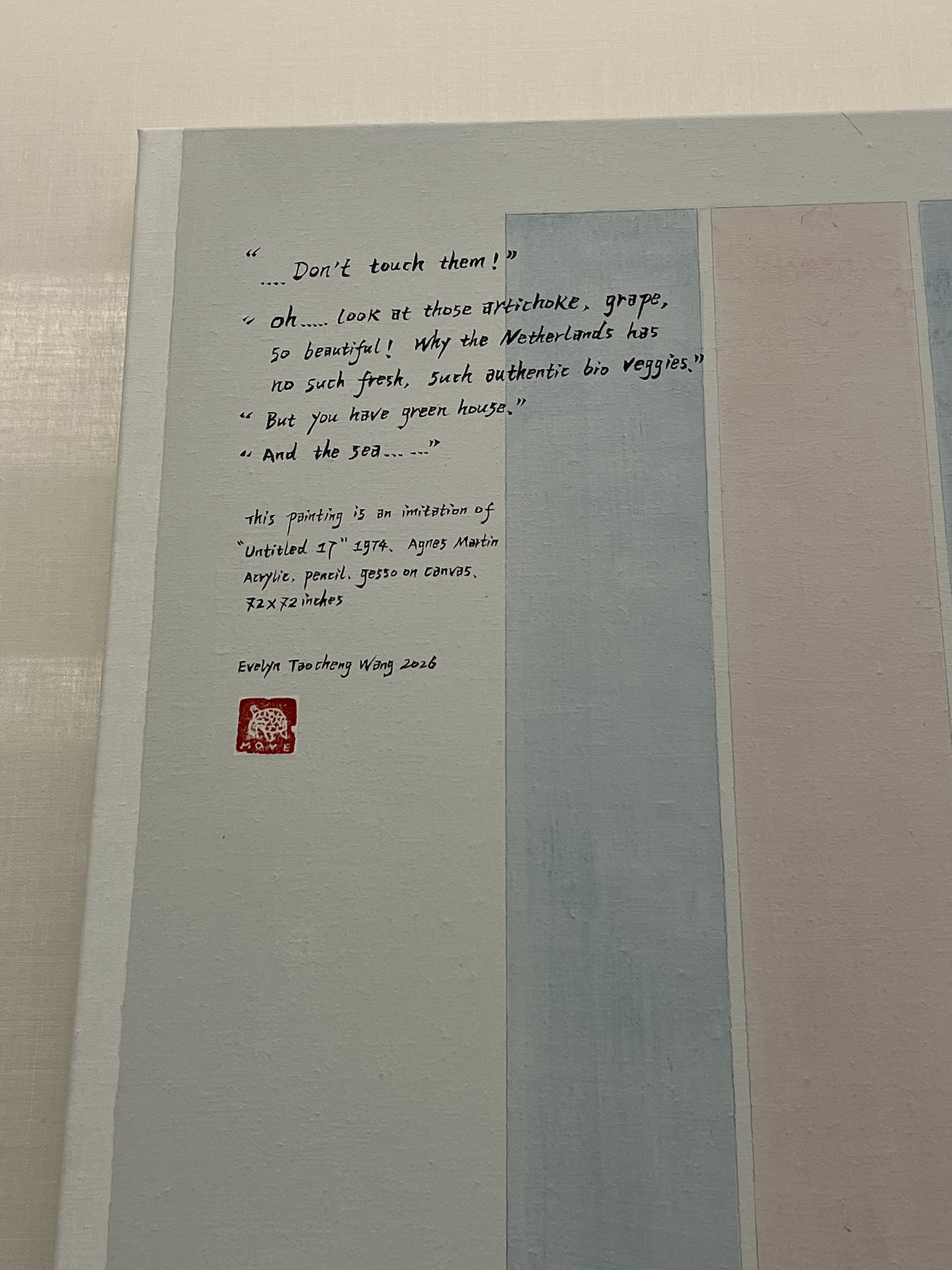
While each element occupies little space, together they help shift the work from pure imitation to another genre: literati painting updated to our globalized era of mutual influence. The red seal, the fine brushwork, the texts, plus the location and texture of their placement, all continue to serve as hallmarks of the age-old genre, leaving the Martin imitation itself the element to be understood. Here, it helps to recall that in literati painting, the act of painting itself is read as a form of self-cultivation, and that the act of copying itself constitutes a dialogue with predecessors. It’s also worth noting that, influenced by Eastern philosophy, Agnes Martin herself described abstraction as a means of reaching states of awareness prior to representation. Recalling the origin of her grid, she spoke of a vision that arrived while contemplating the innocence of trees. Such claims’ resonance with literati aesthetics is hard to miss. Rooted in Taoist thinking, literati aesthetics, as the Neo-Confucianist scholar Xu Fuguan argued, seeks not the faithful depiction of objects such as mountains and rivers but the spirit or sentiment they set into motion. For both a literatus and Martin, then, painting becomes a vehicle for articulating what lies beyond appearances: the invisible, deeper essence that representation alone does not and cannot reach.
Seen in this light, the Martin imitation that occupies the painting’s central location could be read as its being pulled into participation in an old artistic structure. Whereas traditional literati painters returned to mountains, rivers, or pine trees and bamboo because they provided a structure through which sensibility could take form, Wang evokes Martin to serve a similar function. Her paintings are thus not about Martin in any straightforward sense; they instead use Martin as a motif through which to think about painting, emotion, and life, much as earlier literati painters pondered these subjects through landscape.
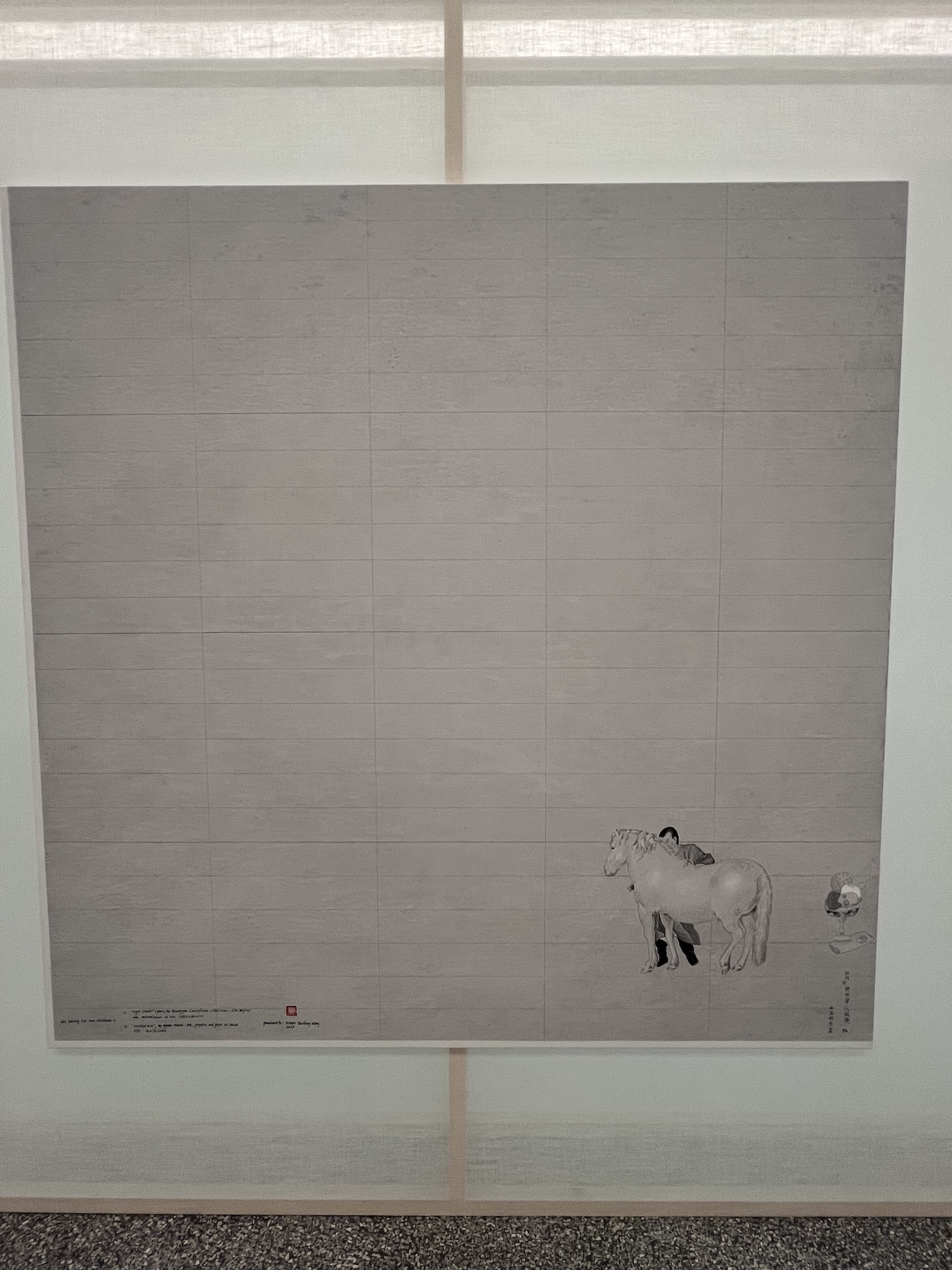
Put differently, Wang adapts literati painting to our era of global mutual influence. While poems, calligraphy, and old masters were the world available to a Ming Dynasty literatus, Italian cuisine, postwar abstraction, and the expanded field of global art history are what Wang uses to assemble a life on the canvas as both a student of traditional Chinese art and an artist living and practicing in Europe since the 2000s. The exhibition’s setting itself, the city of Bozen/Bolzano and the region of South Tyrol where it is located, accentuates this reading, as German, Italian, and Ladin histories sit side by side without resolving into one another. It bears noting that Wang’s reworking goes beyond replacing mountain and water with Martin, as even her calligraphy and seal register the shift: both are rendered in English rather than Chinese, a small, exact substitution that extends the form without abandoning it. This is not to say that all her updates land as cleanly: where literati calligraphy was disciplined and trained, Wang’s handwriting is loose, almost cartoonish. Whether this is deliberate is hard to tell, but what is clear is that Agnes Martin now joins mountains, bamboo, and old masters as one more object through which a painter can think and refine her own style.
On the other side of the gallery, a painted garment complicates this picture of inheritance. Lining Painting of Bolzano Veggie and Snow Mountains (2026) is a Max Mara coat hanging on the wall, its black exterior left untouched, its white lining painted with a colorful hodgepodge: vegetables, fragments of classical architecture, a compact makeup mirror reflecting the artist’s face, and the jagged silhouette of the Dolomites. Standing before it, the eyes stay not on the coat but go straight to the crowded lining, the elements’ discordant shapes and colors vying for space. Scattered between these recognizable objects are rainbow-colored patches of abstraction, rendered in fast brushwork that gives the whole composition a dynamic, unsettled feel. Whether this crowding is the point, and whether the interior would settle into more order or less if that frame were removed, are left for the viewer to decide.
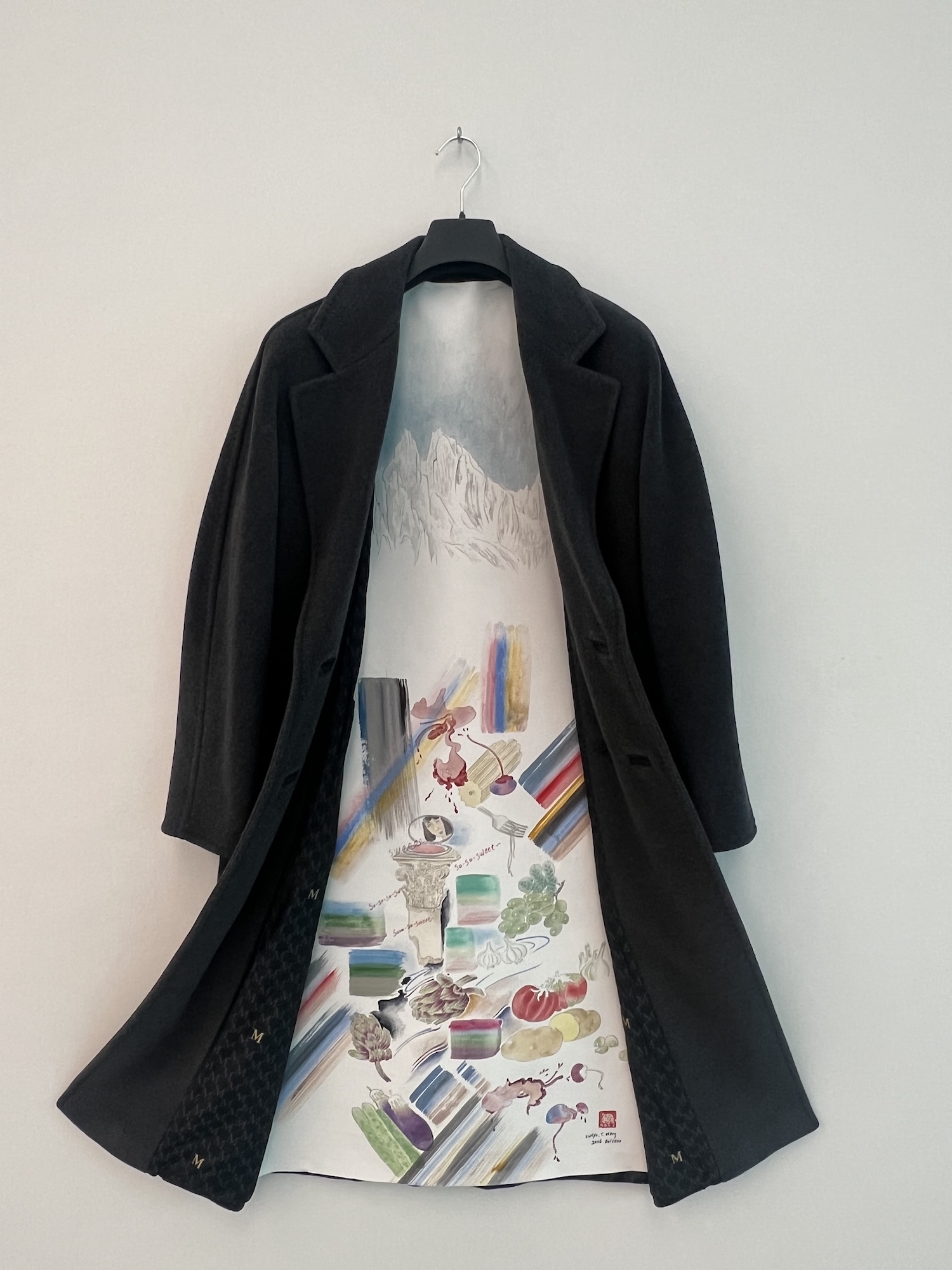
Seen together, the two bodies of work seem to argue with each other. The Martin imitations suggest harmony: different traditions are calmly co-present. The garments suggest otherwise: brought inside and held against the body, the traditions one now inherits could crowd and compete and create confusion.
The exhibition does not choose between these two pictures. In literati practice, the self was not declared but built, painting by painting, copy by copy. Wang’s canvases and her coat are both built this way, but they do not draw the same conclusion. Whether what results from holding many traditions at once is harmony or clutter, calm or cacophony, is a question Sweet Landscape raises twice, with two different answers, and leaves open.
Evelyn Taocheng Wang: Sweet Landscape is on view at Museion, Bolzano, Italy from April 25 to Nov 8, 2026.