.webp)

“Call me gravity” at WIELS
Review
Cally Spooner: Everything is Attempted, then Attempted Again
Casa Venezia, Galleria Zero | Calle Seconda dei Orbi 5201, Sestiere Castello, Venice
May 6 – July 26, 2026
In the renowned 1943 novel A Tree Grows in Brooklyn by Betty Smith, the growth of the main character, Francie, is paired with that of a tree of heaven, a species known for its capacity to grow with little to no care in harsh urban environments, sprouting even from small cracks in the concrete. This comparison runs throughout the book, underscoring how, even amid the continual bendings and readjustments of the situation in which Francie finds herself living and growing, the protagonist manages to bloom and overcome the challenges she faces.
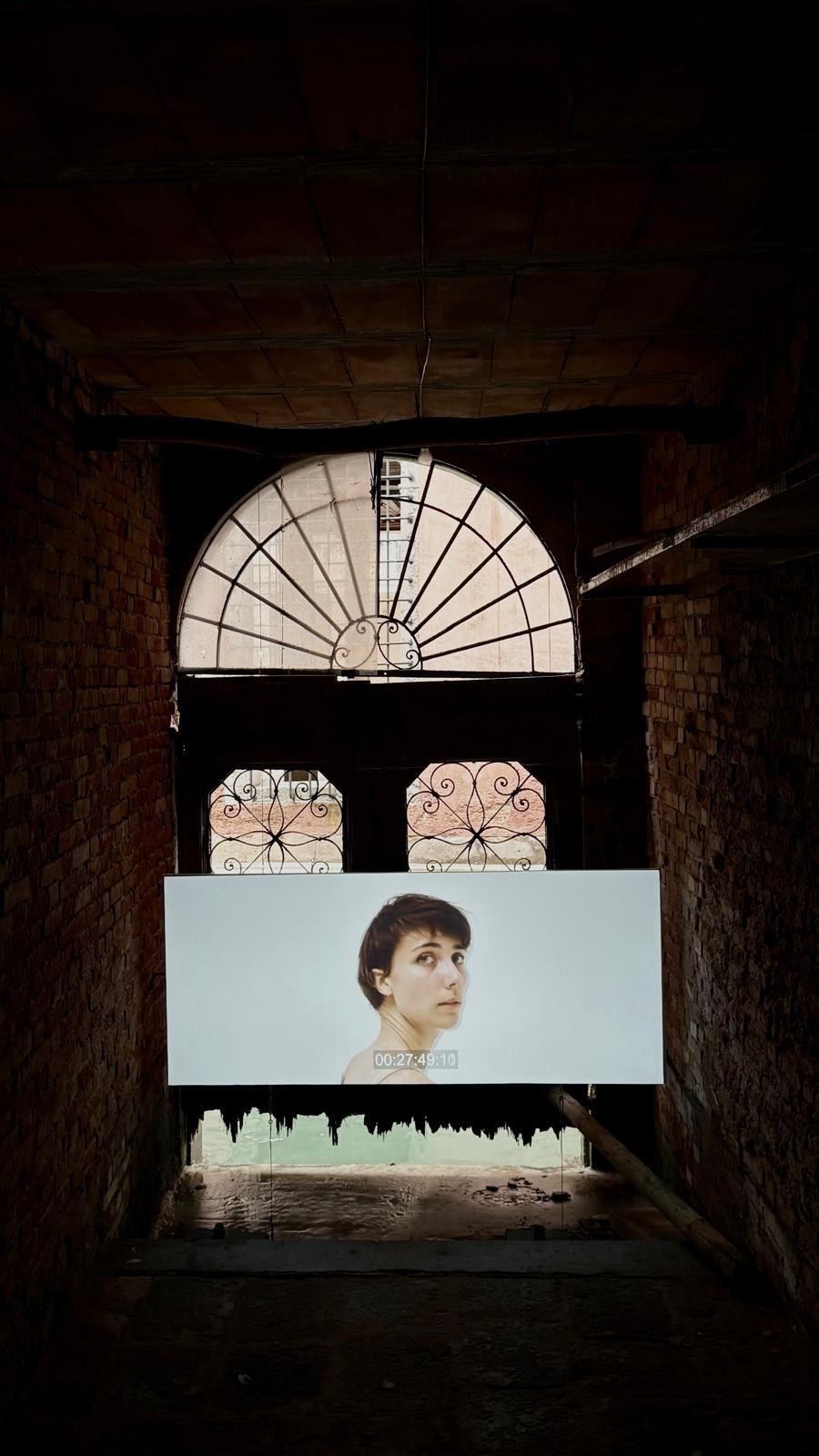
In Cally Spooner’s exhibition Everything is Attempted, then Attempted Again, growth becomes the main focus. Just as in Smith’s novel, the exhibition expands through the cracks of Casa Venezia’s domestic environment charged with objects, artworks and interior design classics. Throughout Spooner's works, different stories unfold, all connected to the idea that learning to do something requires continuous repetition.
Entering the courtyard, a six-metre-tall climbing jasmine attempts to grow upside down, placed in the most uncomfortable position for its natural predisposition. This effort is accompanied by DEAD TIME (Maggie’s Solo) (2021), a video in which a dancer, Maggie, works through an exhausting choreography composed of gym movements, all executed at an almost impossible pace. While the audio of the performance will appear later on the first floor, inside the house, the space resounds with a recording of the artist’s daughter, Franca, learning to count through tireless repetition. This whole orchestral courtyard piece introduces us to multiple kinds of effort, putting the body, whether the child’s, the dancer’s, or the plant’s, through unnatural tasks that require constant repetition to become daily. As common in Cally Spooner’s practice, this intervention is brought out silently, nesting itself in the interstices of the space, an attitude also present when we enter the house on the first floor.
At the entrance a concrete dog, A Full Scope of Movement (Domenico’s Dog, circa 1946) (2026), is slowly being corroded by moss, in the house Spooner’s work appears in multiple forms, a sterling silver cast of a half-consumed soap, sketches inspired by the courtyard and the audio from DEAD TIME, where the heavy breath of the performer and her movements embrace the whole space. Again, in the second act of this choral work, a sense of repetition unfolds through acts that gradually consume the elements. This corrosion happens in a domestic environment devoted to timelessness: artworks carefully conserved, original features of the apartment restored, immaculate rooms and beautiful furniture.
Like the tree of heaven, Spooner’s exhibition radicates itself through the cracks of the domestic environment to tell us one (or multiple) personal stories of repetition where a gesture or a sound to be owned by the individual needs a reiteration, an effort that consumes us and at the same time carves in our body its story. Acquired through movement and exercise, this body knowledge becomes the story of how, despite society's continuous challenges, we adapt and manage to grow and evolve, just like the jasmine plant will and just like Francie will reshape herself to learn how to count.
kinship II
KIN | 37 Rue RavensteinB-1000, Brussels
May 15, 2026 – July 18, 2026
Like a time capsule, a screen placed on the floor displays images of lush landscapes that appear as a distant memory or a suspended dream, at the entrance to the KIN gallery in Brussels. Voices narrate how to find one’s way and connect with the nature of Fogo Island, off the east coast of Canada. Through a series of sequence shots filmed in 16 mm, Eva Giolo’s Becoming Landscape (2024) introduces subtly kinship II, a group exhibition featuring 35 artists. Rather than adopting a strictly thematic framework, the exhibition approaches kinship, the gallery’s founding principle, through a desire to foster connections between artistic practices, without rigidly defining their points of intersection. It proposes a contemporary reading of kinship as a coherent non-structure, shaped by affects and grounded in a shared sense of solidarity.
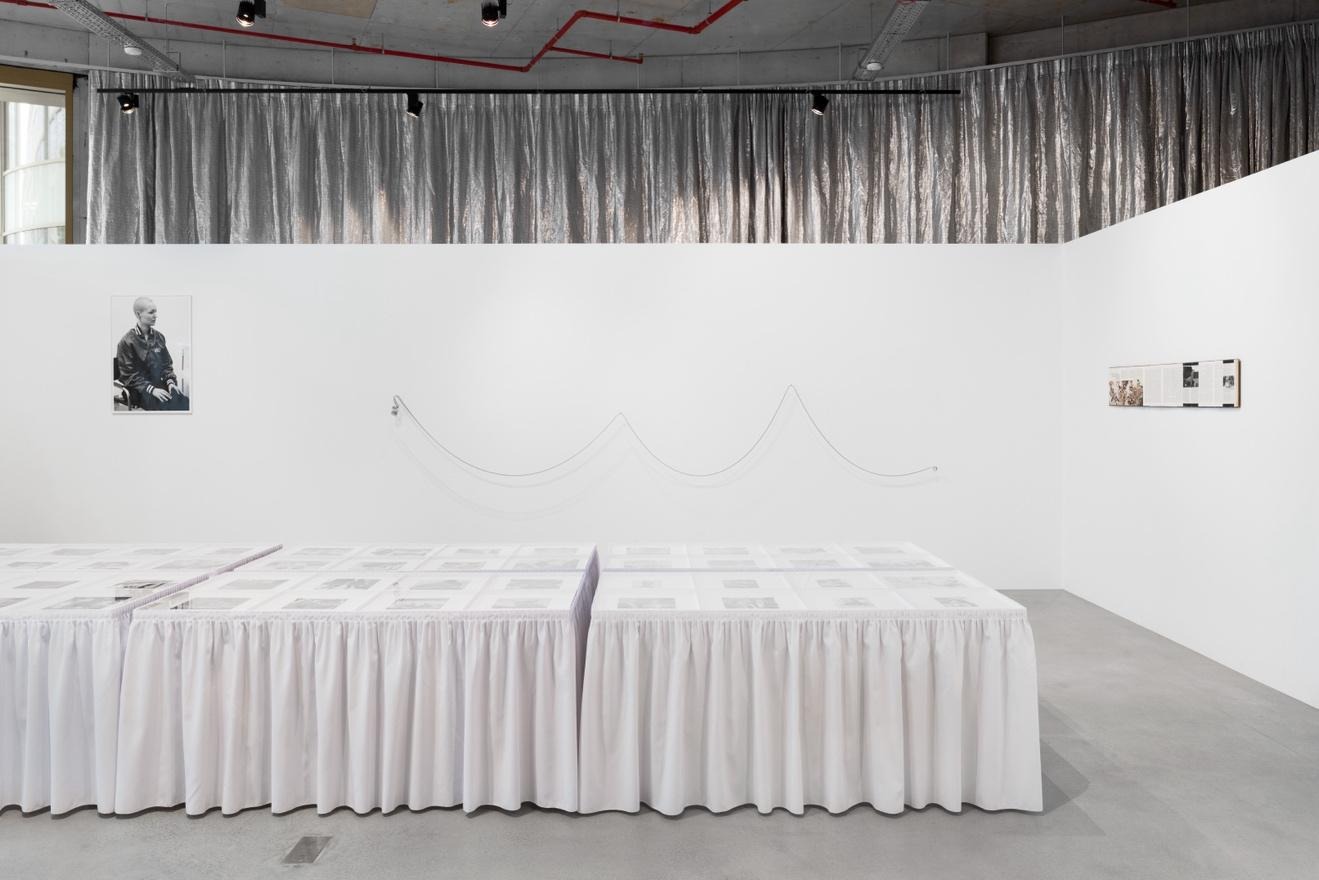
Without necessarily intending to, Fabrice Schneider’s work, Untitled (2026), echoes, rather ironically, the early essentialist theorizations of kinship studies. Six long tables, draped in white fabric, stand aligned side by side. Marked by absence, they stand as the silent relic of a past celebration. Upon the tables are a series of black-and-white images from luxury watch magazines, each reenacting stereotypical family scenes: a father and his son aboard a motorboat, a mother and her daughters blowing bubbles. They nonetheless reveal a fracture within the nuclear family structure: the enduring division of gendered roles, where men and women are never represented within the same frame.
We move away, however, from any attempt at thematic exploration within the exhibition’s trajectory, particularly with Abbas Akhavan’s work Grid (2021), a linen chessboard suspended from the wall by a single hanging point. The white squares have been cut out, revealing a drape riddled with holes. Stripped of its structural integrity, the work challenges the logic of the game and, implicitly, reveals the mechanisms of systemic racism. By removing the white squares, Akhavan makes the invisible visible: a system built on deeply rooted historical and colonial structures.
Behind the scenes of the exhibition, visitors are invited to discover, among other works, Natasja Mabesoone’s Bird Girl’s Unravelling and Re-knitting Epic into Cheap Novella Like Rom-Com Erotica — A Penelopean Palimpsest (2022–2024). Powdery hues are diffused in splotches, while hearts, ribbons, sequins, organza flowers and butterflies dot the surface of the work. The slender typography, marked by Y2K aesthetics, forms a coded and elusive language, evoking both the fragments of a young girl’s manuscript and a manifesto of gender emancipation. kinship II unfolds like a large, uninhibited family, where multiple states of mind merge into a single landscape to be contemplated.
Apsara Studio: Look How Brightly
Sentient Projects | 35 Britannia Row, London N1 8QH
June 4 – June 27, 2026
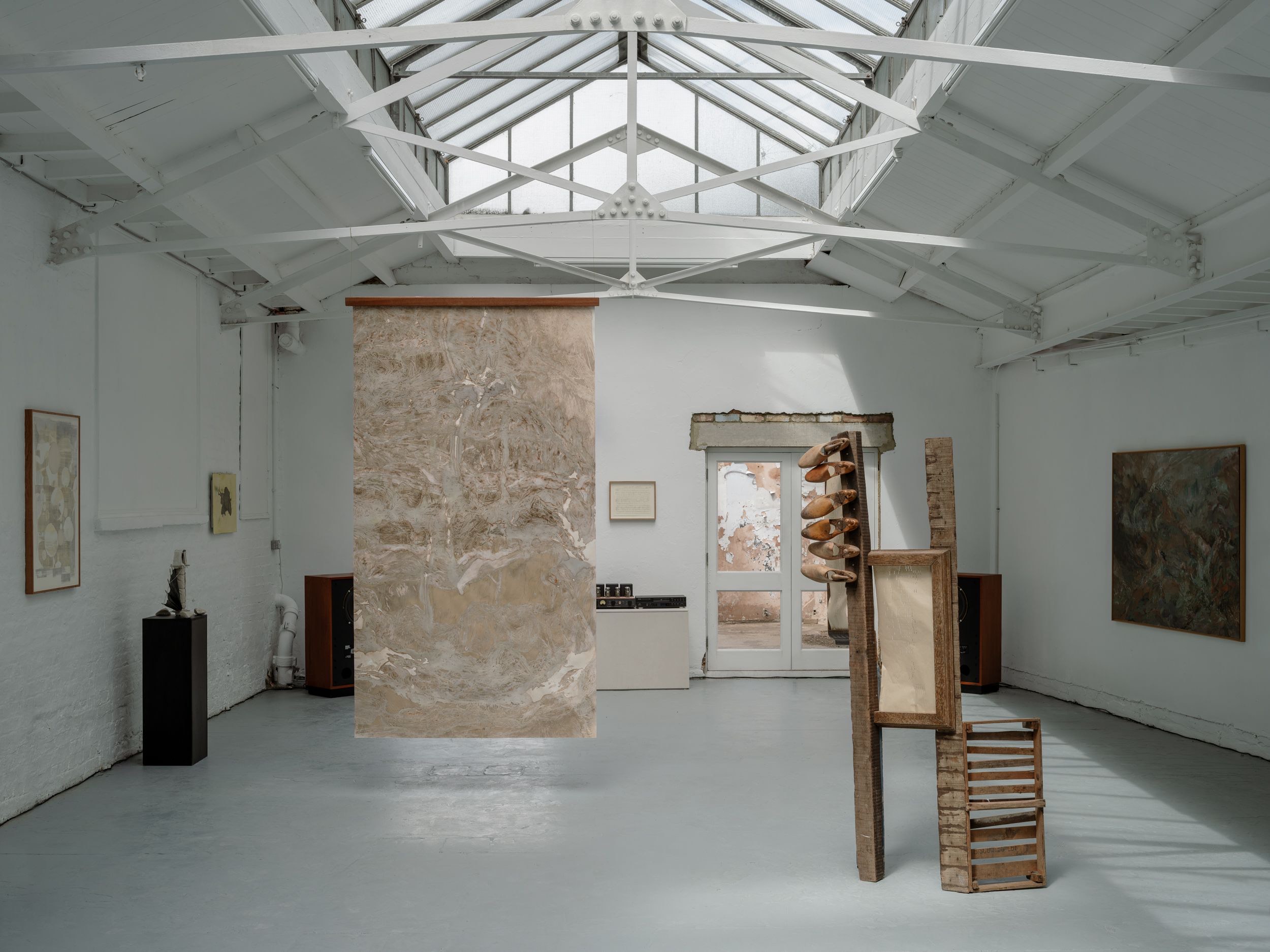
Tucked inside Britannia Row, inside Pink Floyd’s former recording studios and production warehouse, is a space that has been left untouched for 12 years but carries considerable historical resonance. With Look How Brightly, co-curators Jenn Ellis and Alex Mills have brought back to life the sun-washed, loft-like architecture, which acts as a visceral sounding board, showing how music functions as an architectural and physical presence. Mills’s debut album, a ten-year retrospective of compositions, establishes an underlying rhythm and sets a collective tempo for 21 international artists, each sharing a natural kinship with the themes explored throughout. In this space, text, sound, and visual matter constantly translate one another in real time, prompting new conversations about human relationships.
Before crossing the threshold, Swiss artist Sarina Scheidegger sets a meditative tone in the front courtyard with billboard-mounted fractured sentences in Collaborating Waters (2026) that challenge passersby to mentally complete them. Once inside, visitors are met by Mills’s handwritten musical scores, framed on the walls as dynamic "scores of becoming" that map out the human mark-making behind the audio flooding the space.
The exhibition sets up an easy dialogue between the visual and the auditory, focusing on how we experience fragmentation and transformation. This is seen in Dawn Ng’s painting, made with the runoff from a melting block of intense ice pigment, which looks at endings. Across the way, Tal Regev’s expansive canvas explores the vulnerability of the body, sitting alongside pieces by Florence Peake and Susan Rocklin that slip between physical form and surreal, animal-human dreams. Nearby, Helina Tesega’s ceramic works guide movement through the space, using the structure of the Ethiopian calendar to reflect our own changing emotional landscape.
The exhibition’s title can be traced back to German Symbolist poet Richard Dehmel, whose verse famously inspired Arnold Schoenberg’s 1899 string sextet, Verklärte Nacht (Transfigured Night). Fast forward a century, when cellist Clare O’Connell commissioned Mills to write a piece for her Behind the Mirror concert series, pairing Schoenberg’s sextet with Dehmel's original poem. Grounded in the text's theme of unconditional love during trying times, Mills focused on the poem's most comforting line: “Look, how brightly the universe shines!” If you look closely at his final musical score today, you can see those exact words scrawled by hand.
Look How Brightly reveals words and soundscapes as fluid, vital entities that pierce our everyday environments. Composition functions as poetry, and poetry as composition; both operate on the same rhythms, cadences, and textures to construct an architecture of human feeling. By layering these poetic references into the rock legacy of Britannia Row, the exhibition illustrates how a space retains a permanent capacity to be transfigured by community and creativity.
Merryn Omotayo Alaka and Sam Frésquez: Your Birth is My Birth
Jane Lombard | 58 White St, New York
May 1 – June 13, 2026
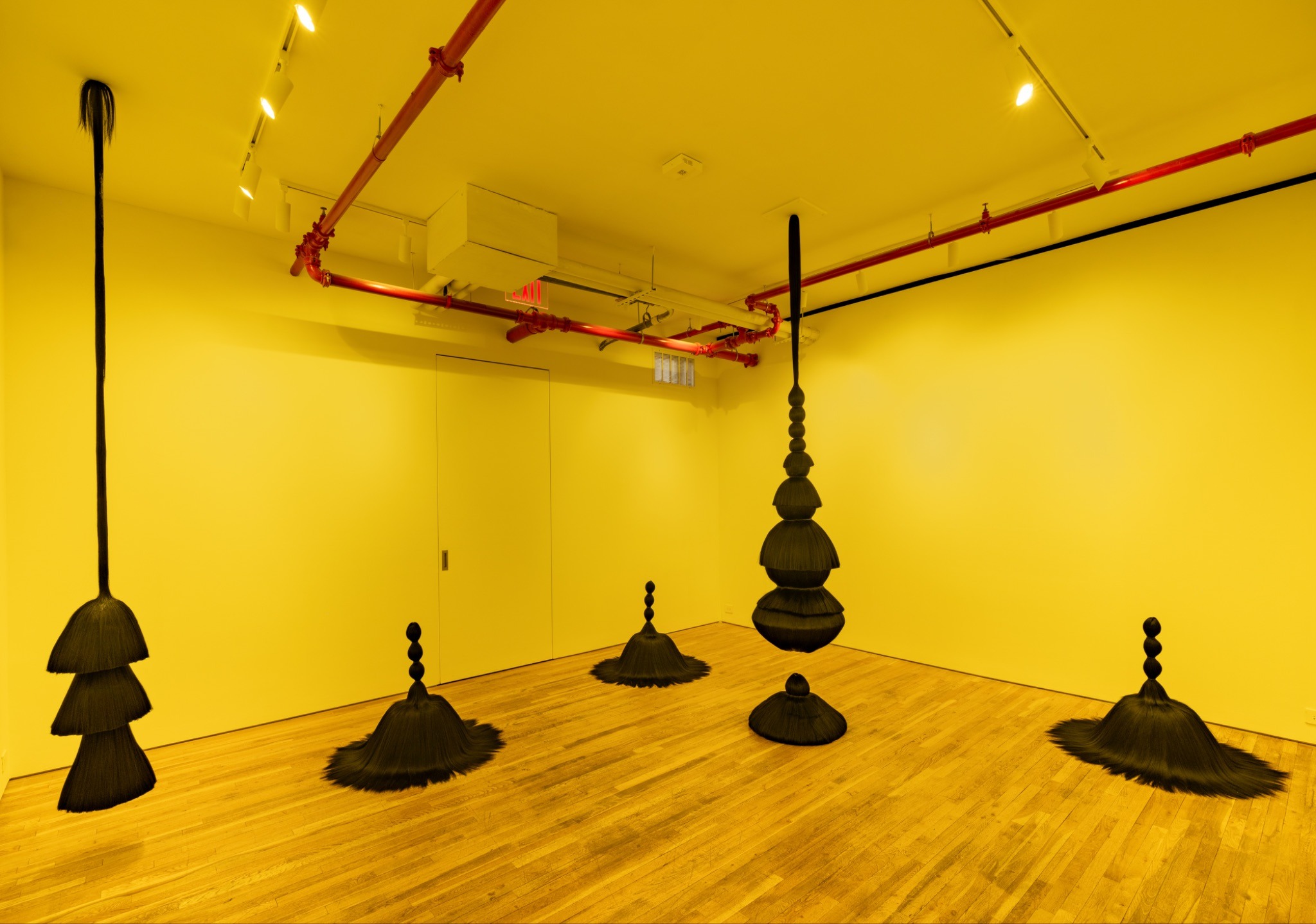
Aptly timed to close out the spring season in Tribeca, Merryn Omotayo Alaka and Sam Frésquez’s Your Birth is My Birth at Jane Lombard Gallery exudes a sense of fantastical play from the threshold of the gallery’s open door where warm, vernal air drifts in. Upon entry, the grand scale of the installation beckons viewers into a mutual dance, as one weaves around, under, and through the works. Closer contact with the sculptures reveals their material, pounds and pounds of Kanekalon hair, a popular synthetic hair product found in beauty shops around the globe. You can almost hear the sculptures, the thick, lush swooshes of tails, the rustle of strands flowing out in a radial pool on the gallery floor. The works hanging from the ceiling shift with subtle pendulum momentum, leaning into their own weight and the slight circulation of air within the gallery. The movements of the works and their organic, undulating forms mimic the terrestrial world of forests and even ocean depths.
Working as a collaborative duo, the installation is Omotayo Alaka’s and Frésquez’s newest iteration of their series Hairland, which the artists began roughly a decade ago as undergraduate students. Informed by a synthesis of influences across botany, science fiction, material and pop culture (the exhibition title comes from the television series I May Destroy You), the artists distill a clear language that scaffolds the speculative ecosystem on view. Consisting of five works termed species—Listening Roots, Hearing Bells, Mother & Child, Stacking Pearls, and Umbra Pods (all 2026)—Omotayo Alaka and Frésquez envision the work as a total world that the artists term the “Kanekalon forest,” creating a species chart describing each species’ life cycle in detail.
The affinities between hair and plant life are plentiful: both shed, display signs of disease, and decay slowly. Extremely responsive and resilient, hair and plants react to the elements, particularly water, air, and the sun. They nestle in abundance, coalescing whole forms out of many with individual strands of hair akin to blades of grass or the bounty of flora that makes up forests. Deeply connected to time, they leave behind traces of their existence, both witness and archive. Literally animate, hair and plant matter shift, overlap, and become entangled. Humans interact with hair and botany with a ritual reverence as emblems of healing, protection, and care, emphasizing maintenance and metamorphic transformation.
Perhaps the most salient connection between hair and botanicals is their relationship to roots and their ability to regenerate, possessing the power of growth. Inversely, they also hold vast records of history and information passed down across generations of evolutionary time. In Your Birth is My Birth, Omotayo Alaka and Frésquez evidence the poignant and relatable expression of a common need for both grounding and extension found in hair, plants, and all shared existence.
Nora Turato: I hear you, I hear you.
Art Institute of Chicago | 111 S Michigan Ave, Chicago
May 22 – August 26, 2026
I don’t put much stock into the informative function of language, and neither does artist Nora Turato—or rather, Turato understands that information in the age of accelerated capitalism and globalization is a slippery thing, prone to erosion and unexpected eruption. Like Turato’s sound installation ri-mEm-buhr THuh mUHn-ee (2021), in which the artist repeatedly mimicked the idiosyncrasies of Western syntax and elocution—a nod to the hegemony of American pop culture during her nineties-era childhood within the waning USSR—language is something that grows from the unconscious, imperfect signs, paroxysms born just below the surface.
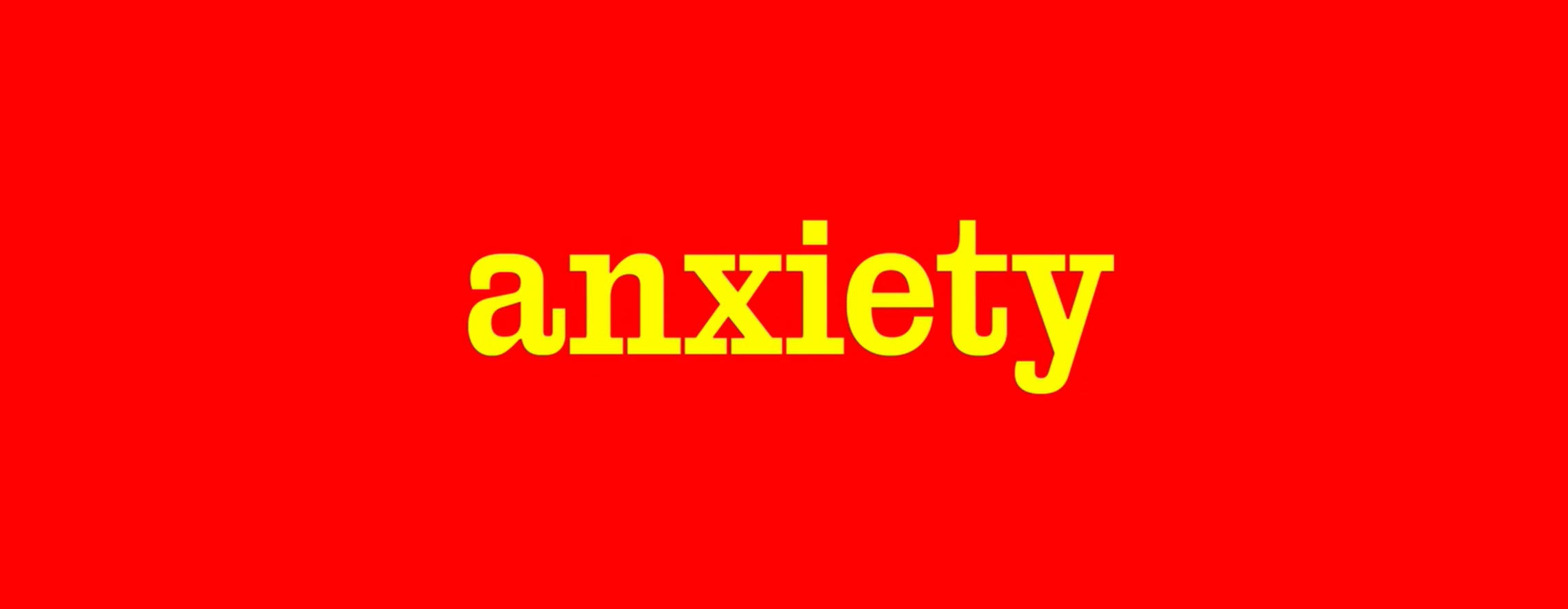
In Turato’s new work at the Art Institute of Chicago, I hear you, I hear you. (2024), the artist continues her analysis of language’s volatility, its inherent insufficiency. In a dark showroom, words Turato gathered from TikTok and YouTube videos, the fine print on prescription bottles, and lifestyle improvement and “optimization” stories flash yellow across a red screen. The words hurry by, often indecipherable—during my viewing, I could only make out “sphere”, “too”, and “nothing.” These sequences are interrupted by the words “I hear you” in a calm black-and-white layout. During these moments, viewers can better hear Turato’s breathing exercises; the rapidity of the yellow words can prove a distraction from the video’s audio. Her inhalations and exhalations are at first calm, albeit a bit labored, yet they soon crescendo to a painful wail as yellow words once again flash by.
I hear you, I hear you. is an uncomfortable looking glass for the age of “Make America Healthy Again” and “HealthTok”, TikTok’s “healthy” lifestyle community that is often rife with misinformation. In the US, the codes of these communities, borne of dubious medical advice and the ephemerality of commercial trends, have congealed together to create a syntax, a miasma, of language that functions not as a formula for health but as a veil that reveals something of the pain that lies beneath. Like Turato’s wails against text taken from cure-all pill bottles, listicles on how to fix your life in ten easy steps, or an influencer’s newest product placement, something is terribly wrong in a culture that claims you too can be your best, most perfect self if only you try hard enough; and if you’re not perfect, well that’s on you. We live in a moment where the self is just another product to be continuously refined, repackaged, and remade, under an increasingly Darwinian social marketplace. But like Turato’s piercingly sad wail, something beneath these burbles, these downpours of language, is fighting hard to break free.
Ruoxin Sun: Age of the Captain
Tutu Gallery | address by appointment
June 5 – July 31, 2026
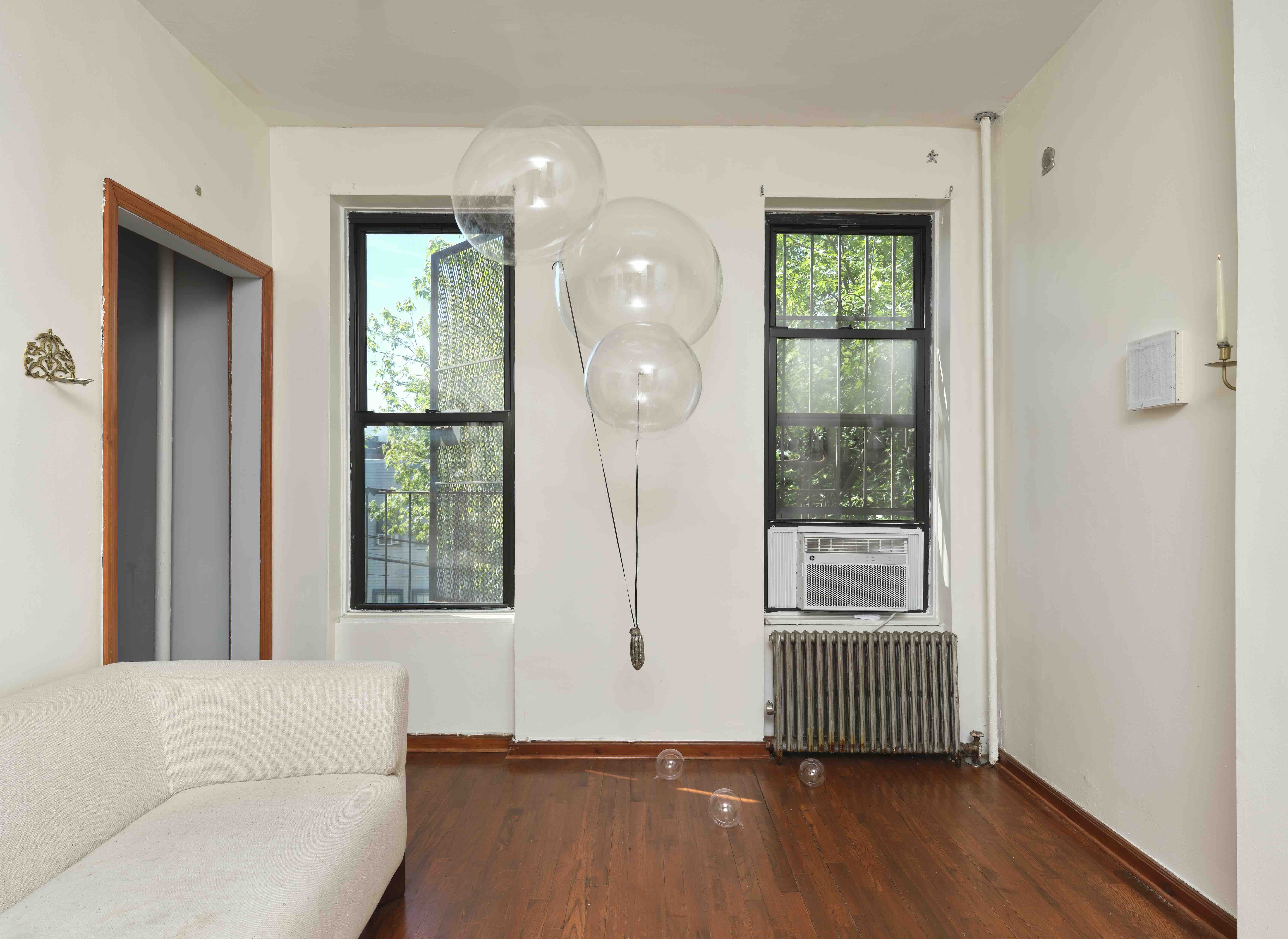
Viewing Ruoxin Sun’s solo exhibition, Age of the Captain at Tutu Gallery, is drifting back into the childhood summer afternoons. The kind that arrives after extracurricular classes when the sun has softened but heat is still suspended. You pretend to be doing homework with the workbook opened on the table. 3 red balls. 5 blue balls. 1 bag. Someone reaches in and draws 2. Who puts the balls there, and why must one know the chance of getting only red ones?
Ruoxin Sun transformed the common semantics in Chinese “Mathematics Olympiad problems” into a landscape of sculptures and imagery. The works draw from the abstracted and absurd worlds of the word problems in math that almost all Chinese kids have experienced: chickens and rabbits in a shared cage, colored balls in a bag, and travelers running between Point A and Point B. Designed to teach certainty, these stories promise that every question has a definitive correct answer waiting to be uncovered and, even more so, some correct ways to be approached. Yet when we come across realistic animal feet supporting an open metal cage, balls floating in midair, Point As and Point Bs scattered across the gallery walls in the form of metal cast tins with figurines, their abstract presence begins to feel real but strangely unstable. The specific problems and solid memories become like dreams.
Walking down the aisle, I accidentally knocked four transparent resin dominoes from the piece, Now Can We Play?. While frantically returning them to their places according to Sun’s instructions, I found myself quietly relieved that the catastrophic chain reaction in my imagination never occurred. The relief felt oddly familiar.
For Chinese children, math exists alongside a perpetual urgency. Every math problem implied failing to reach the correct answer carried consequences larger than math itself. The anxiety is attached directly to grades and, by that logic, all prospects. Such anxiety frequently exceeds other aspects of learning, as though the constant effort was the only thing preventing some unnamed collapse. Looking back, many of the disasters never happened.
There is something generous in Sun’s action of looking at this problem now as an adult and an artist. She took inspiration from the full emotional experiences and allowed it to become playful again. As much as she remembers struggling with Olympiad Math as a child because of the pressure and anxiety, she said that realizing this body of work required doing math as well: calculating the angles of a metal plate, estimating the volume of balloons, and more. The difference is that the math she did now serves curiosity but not evaluation.
Perhaps that is where the exhibition’s gentleness resides. The catastrophe never arrives. The homework and tests are finally over. The chickens, rabbits, balls, and running travelers are freed from the open cage of Henny Bunny (2026) and the obligation of producing sole answers. This time, we are allowed to simply have fun.
UNFOLLOW
FALCON Art Collective | 111 Broadway, New York
May 1 – 31, 2026
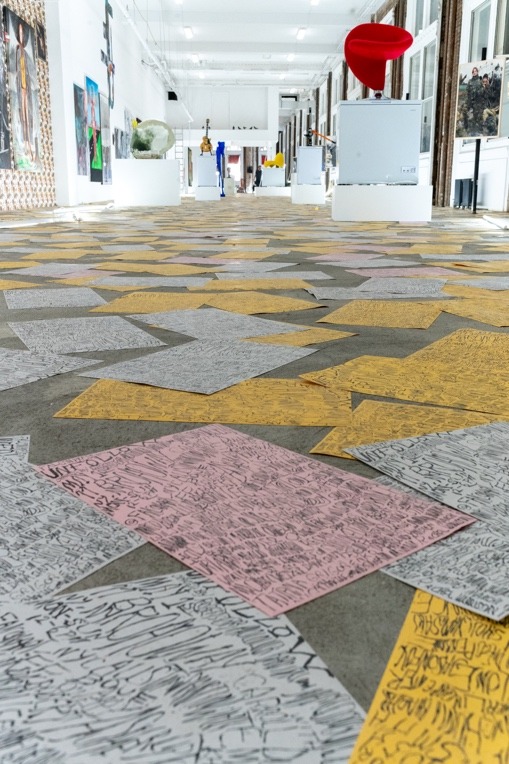
It takes guts to produce a show like UNFOLLOW— radioactive, explosive guts. Placing two artworks in a functioning bathroom is, yes, crazy, but has also allowed the artist-curators from FALCON Art Collective to express that crazy may be what the art world needs. In using these facilities, visitors’ frameworks of how art is displayed are contested, making them feel as if they’re misunderstanding the rules at play. The exhibition extends across the previously empty ground floor of 111 Broadway, a building in the heart of FiDi. In the open space, it looks as if a paper-dropping plane has just passed. There are orange, pink, and white posters covering the floor, each one presenting the name of every artist involved in the show, which are over 50
The curation is intentionally messy and takes full advantage of its unique architectural situation. Some paintings are hung over crater-like holes in the walls, while others are hidden in corners, and light fixtures are strung around the floor, begging viewers to trip over them. This generates a similar phenomenological reckoning of having to ask yourself whether you should feel sorry about “accidentally” hitting a purposefully concealed light, just as for using the restroom.
Art is everywhere, from the floor to the rafters, and also camouflaged. Andy Robert’s House Flies 2 (2023) visually and sculpturally mimics the thermostats of the building, but also emits the constant heating sounds very familiar to any New York resident. Amongst popping and clanking, we hear children screeching, laughing, playing. Robert’s soundscape cements the central thesis of the show: to create is to play.
Each artist inhabits a distinct voice, but put together, they create a collage of perspectives and materials that resist any uniform categorization or interpretation. Diego Perrone’s heavy cast sculptures complement recreations of Bertrand Lavier’s readymades, even though a clear dialogue is not readily apparent. Nonetheless, all the works maintain a sort of creative harmony—not in the sense that they work well together, but because they have been included for the same reasons: to experiment and play. From infamous artists like Maurizio Cattelan and his taxidermy pigeons who guard the space to RRASP residents like Hollis Robison and Patrick Conklin to others like Regan Heiserman, an artist who has spent the last 25 years working in law administration, UNFOLLOW brings together artists who would never have had the chance to be in conversation within a formidable space.
UNFOLLOW becomes both the antithesis and epitome of the contemporary New York art scene. On the one hand, it may fulfill the requirement of an exhibition to present, and possibly sell, artists' work, but on the other it presents participating artists with the opportunity to curate their own art world. UNFOLLOW has allowed its artists to play, to remember that art can and should be fun when it needs to be. Ultimately, this is a show by and for artists—artists who know how to follow their radioactive and explosive guts, and have fun doing so.
203 / H The Collector
CUE Art Foundation | 137 W 25th St, New York
May 23 – 29, 2026
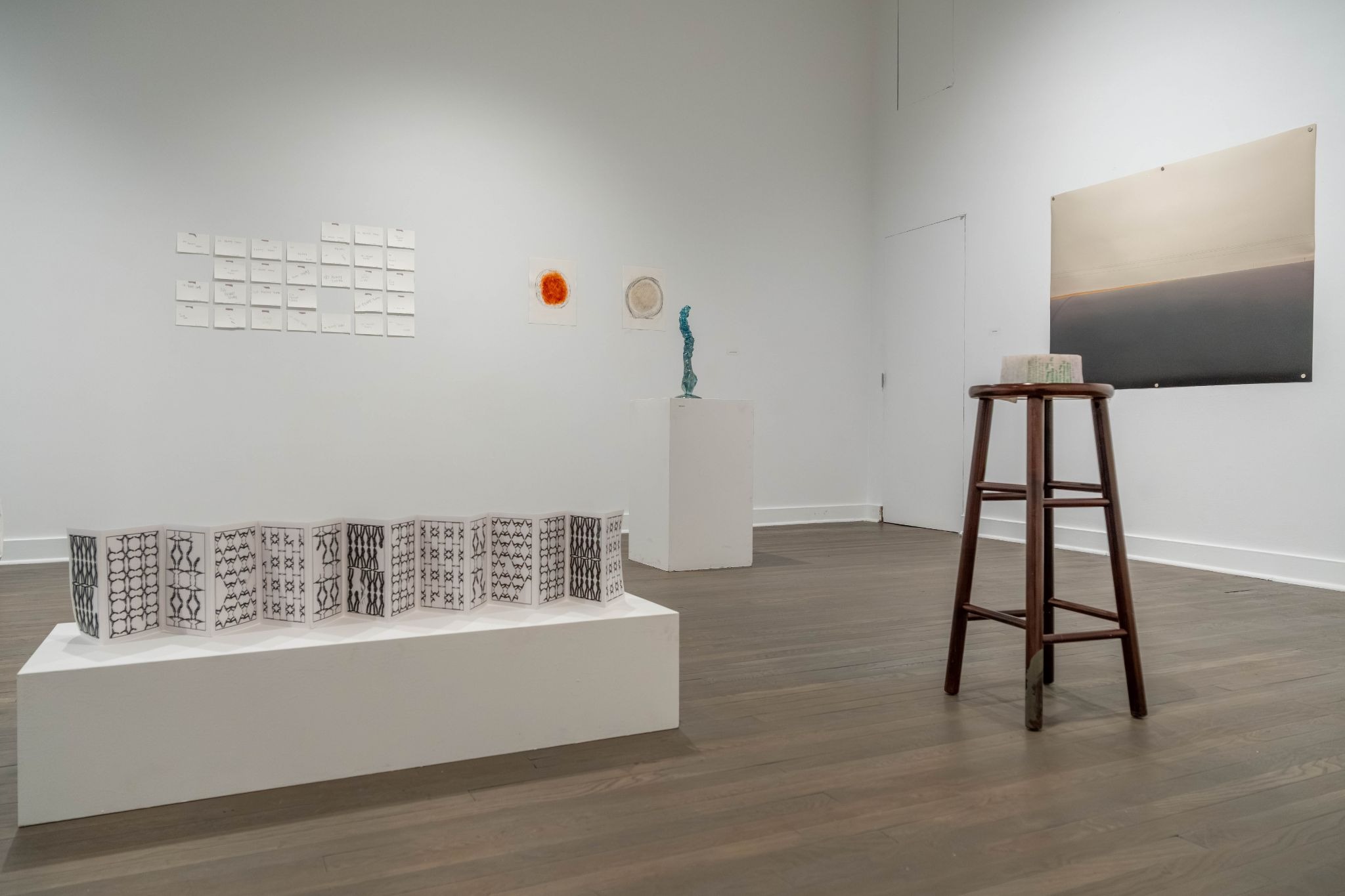
The collector’s world is present and ordered in each of their objects. Their collection is a window into the rhythms with which they are concerned: What objects should be brought together? What objects belong together? Walter Benjamin considers the characteristics of a collector and the desire to amass a collection in his essay, “The Collector,” in his unfinished, monumental Arcades Project. 203 / H The Collector at CUE Art Foundation takes its theoretical basis and title from the essay, citing its page number, 203, and manuscript categorization, “H.” The exhibition, organized by two students of CUE’s Interdisciplinary Art and Theory Program, Oorja Garg and Ridwana Rahman, is the product of the program’s framework centered around Benjamin’s Arcades Project, and purports to follow multiple material and conceptual threads, “attending to the meanings carried by collected objects, texts, and images.”
Miranda Samuels’s work traces printer-tracking dots, also known as “secret dots” or “yellow dots”—digital watermarks that color laser printers and photocopiers produce on every printed page, identifying the time, date, and the specific device used to print the document. Awareness of these codes only became public in 2004, although they were born of a secret agreement between major printer manufacturers and the US Secret Service in the mid-1980s. These dots are represented in two small oil paintings, Civil Society Painting 7: Telecomms: Starry Home Internet Plans New York Pamphlet ‘21 (2022) and Civil Society Painting 11: Gallery: Louise Lawler at Spruth Magers New York Roomsheet ‘22 (2023). Here we see collecting as a form of practical memory, of record.
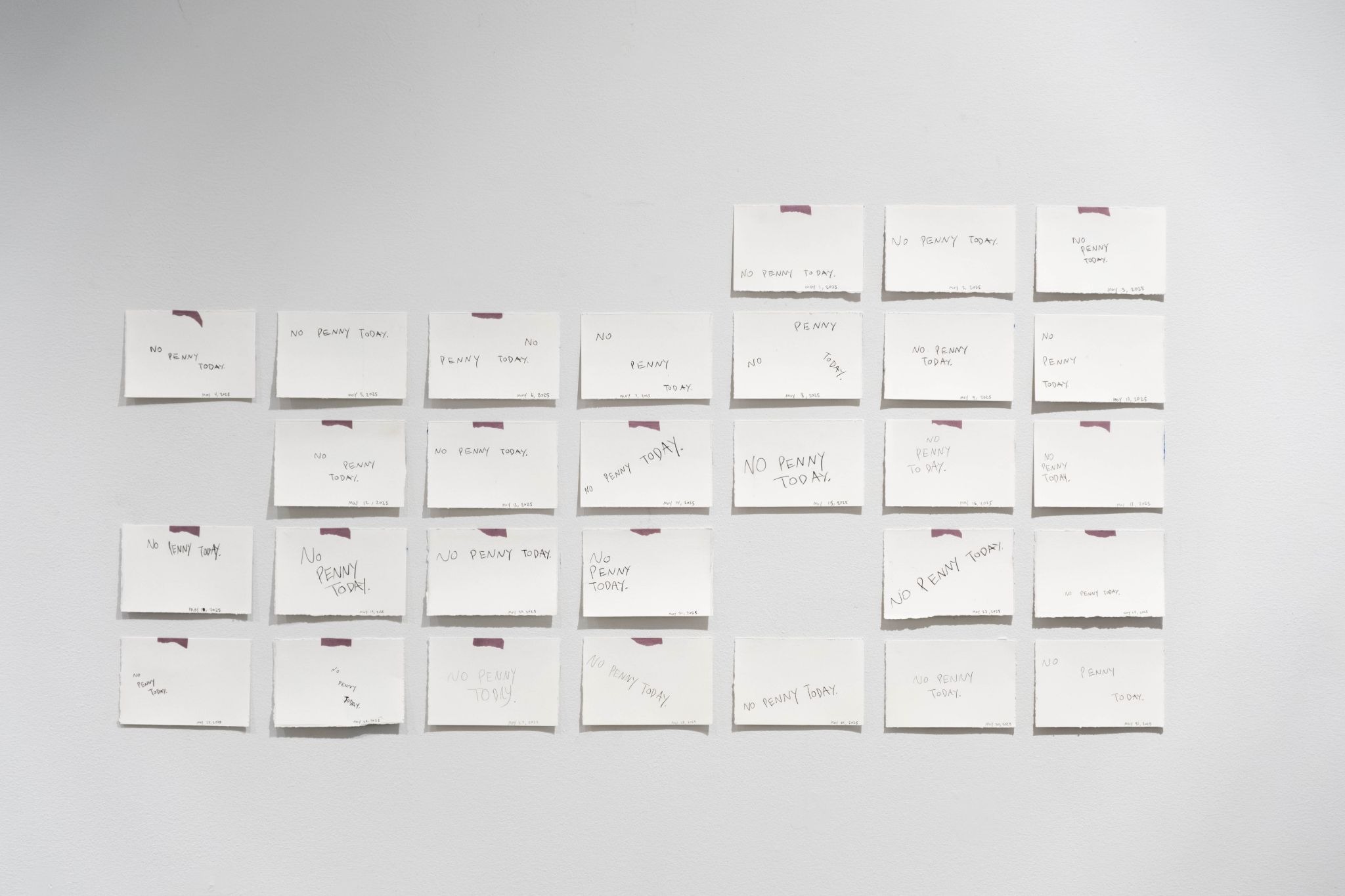
Christian Amaya Garcia’s May (2025) is a log of days, documenting when, in that month, the artist found pennies on the streets of New York. White postcards signal days when no penny was found. To the right of this wonderfully coherent calendar are watercolor paintings of two found pennies, 05/11/25 1 Mulberry St. between Spring St. and Prince St. (2025) and 05/22/25 17:23 1 37th St. between 5th and 6th Ave (2025). This artwork of coins found and absent in May is so playful and clear. Benjamin writes of “Animals (birds, ants), children, and old men as collectors.” The coins have something childlike and corvid about them.
There are also gestures towards the tactile; Benjamin asserts that the “collector” is tactile, while the flâneur is optical. Rujuta Rao’s Minibar (2026) is a wearable publication featuring a wristband through which cards can be attached and detached. Along with Yves Cao’s accordion zine, A Folding Screen for Your Mind (2026), a stunning work elaborating on a shadow puppet performance travelogue found in Arcades Project, these works are wonderfully tactile and stand out from the others, which are arguably catered to the flâneur.
But what world are we in here? It is slightly flimsy and vague in the exhibition text, one that “gestures of attention, intimacy, and relation, while remaining attentive to the systems that organise everyday life: governance, logistics, bureaucracy, extraction, and exchange.” At its core, this collection is born from the artists learning in the same program—a collection of art made by people who all wanted to study Benjamin and were selected to do so. This is each artwork’s closest conceivable relation to the others. It is a fun show when taken as is: an opportunity for the participants of the program to showcase their art—much of it brilliant—in CUE’s Chelsea space.