.webp)

Tim Kent: “Sojourn” at Hollis Taggart
Review
There is a new devotional space in East Williamsburg. At Amant, Christelle Oyiri: Belief May Vary marks the first institutional solo exhibition in the United States by the Paris-based artist and producer/DJ Christelle Oyiri. The exhibition inhabits darkness, a realm where god and prophecy linger, where faith emerges from the tension between vision and uncertainty. Rather than simply meditating on music or memory, Oyiri explores how belief arises from the debris of popular culture, revealing the strange spiritual residue left when myth, capitalism, and image-making collide.
Oyiri is deliberate in her selection of visual artifacts, drawing on rap ephemera as both memory and method. This dialogue with objects of mass culture becomes a rumination on fate and futurism, extending her work from personal recollection into broader inquiry. In doing so, Oyiri frames her work as a form of prophecy, tracing conditions of visibility and tactics of survival within interlocking cultural and economic systems that promise transcendence yet remain grounded in material struggle.
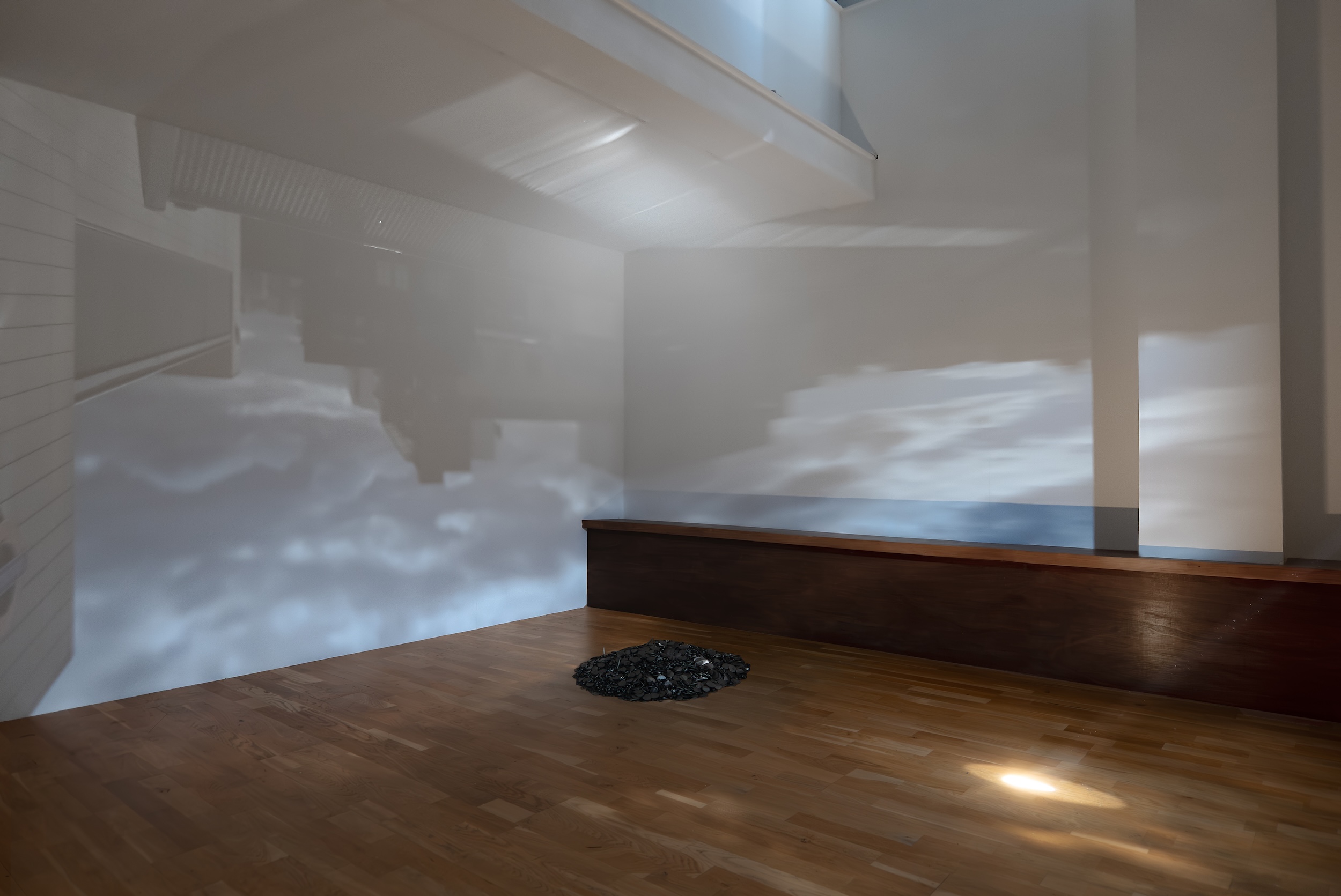
At first, the gallery appears sparse. The vastness of Amant carries a haunting quality, and the space seems far removed from the corporeally charged work it houses. But it is precisely this intentional desolation that encourages attentive viewing. Hard edges, dark tones, and uneasy spatial quiet are interrupted by the loud, enigmatic glow of video projections, inviting visitors to trace the formal and conceptual edges of each work as they move through physical and metaphysical space.
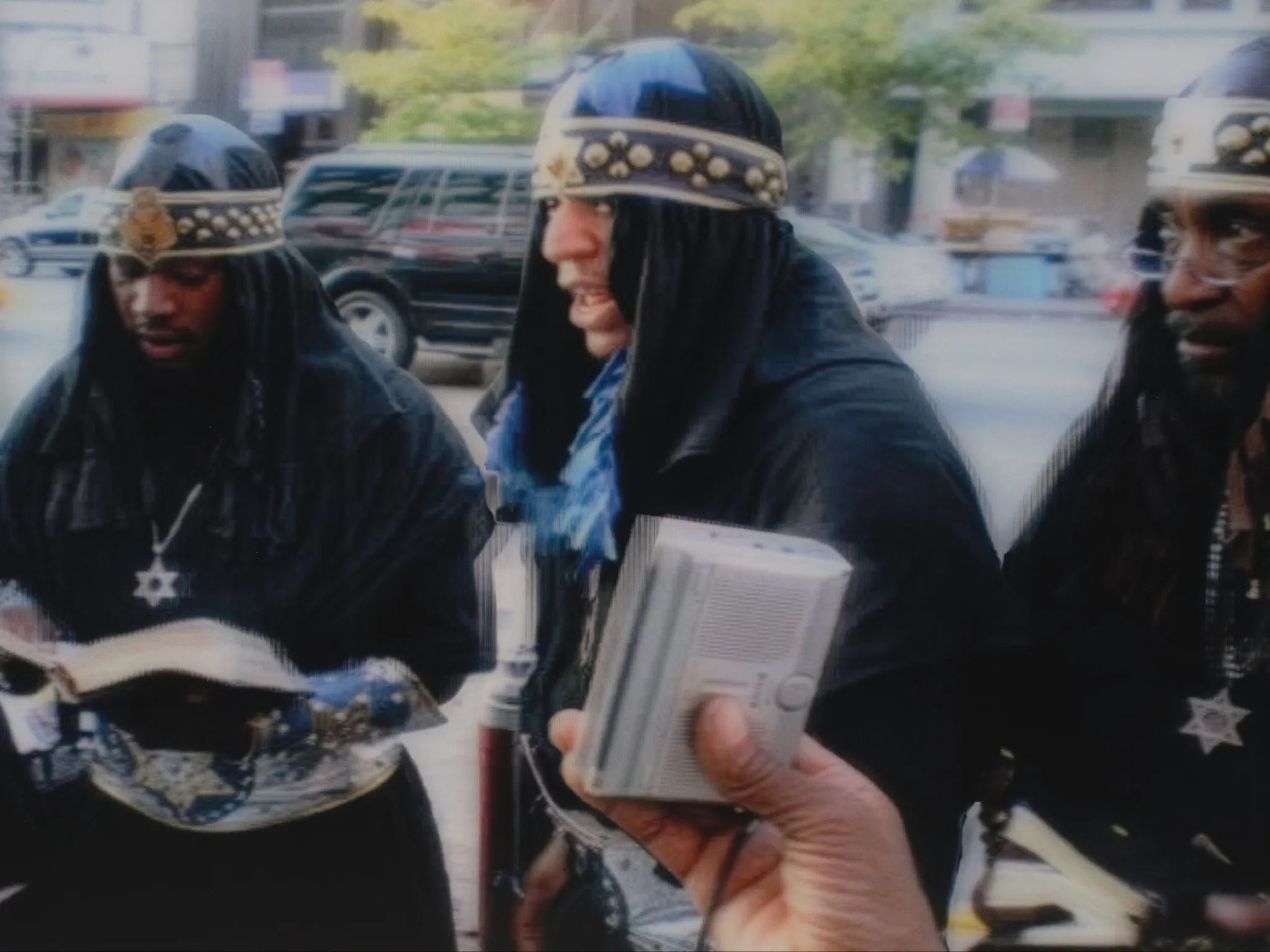
I DON’T TRUST A SINGLE IMAGE BECAUSE I SAW THE TRUTH FROM TWO ANGLES (2026) captures a tense interaction between three Black Israelites and a nondescript reporter. The lenticular print shifts with every step, seemingly following the viewer while implicating them within the image as the unseen reporter holding the recording device. What are the figures prophesying? Are we confronting the surreal or merely recording it? Either way, the piece evokes a quasi-religious charge, where images themselves operate as sites of belief, and perception becomes dreamlike and unstable with glimmers of truth emerging only through movement.
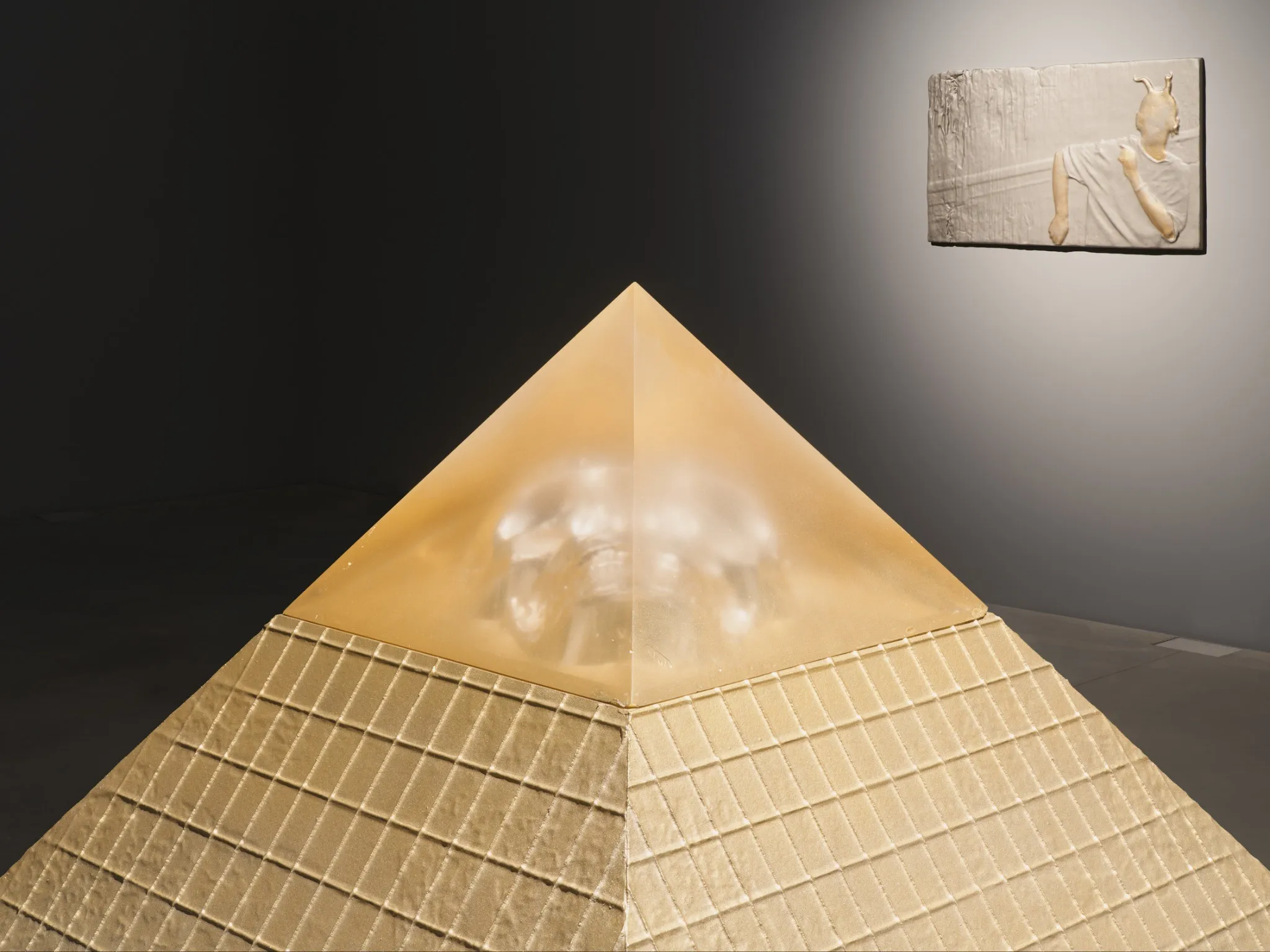
Nearby, REVELATION SYSTEM (2026) reimagines—perhaps mummifies—the Memphis Pyramid, now occupied by Bass Pro Shops and crowned with a crystal skull. The sculpture confronts American monumentalism head-on, exposing the habit of repackaging sacred forms within the spectacle of consumption. By formal measures, the sculpture is spectacular—its shine draws viewers in repeatedly, revealing not just a static object but a confrontation with the spirits that inhabit such monuments. Its grid lines contrast with the sloping geometry of the pyramid form, creating tension between precision and the weight of cultural memory. Moreover, the work demands movement. Viewers are compelled to circle it again and again, experiencing the devotional act of seeing.
At the center of the exhibition, Hauntology of an OG (2025)—which Oyiri produced after visiting Memphis—features the Memphis Pyramid as protagonist. Opened in 1991, the building is a modern capitalist landmark and a striking example of the commodification of the sacred. By repurposing Egyptian spiritual and necrological imagery, it continues a tradition of American Egyptomania, where motifs of power and transcendence are adapted to contemporary use. In Oyiri’s hands, the structure becomes more than architecture: it is a monument to belief reshaped by the marketplace, a sacred form emptied and refilled with new desires, where leisure and spectacle replace the promise of the afterlife.
Hauntology of an OG is a raw and unguarded meditation on Blackness at the threshold between death and glitzy rebirth. Memphis becomes a site of rupture—a symbolic ground where one world touches another. The city runs green with wealth, red with blood, and gold with spectacle. In the mind’s eye, these colors assemble into the architecture of an empire, an earthly apex that gestures toward the divine while remaining tethered to the violence that sustains it.
Yet the empire Oyiri evokes is not fixed or stable. It is diasporic, existing wherever Blackness gathers, disperses, fractures, and reconstitutes itself. At both the end and beginning of its loop, the video extends beyond the immediate scene, pushing viewers past geographic specificity. Viewers are no longer in Memphis, or even on Earth, but at the limits of human understanding. Here, empire is not only a structure imposed from above but one continuously renegotiated in every dimension. Past, present, and future coexist, complicating boundaries and demanding new ways of seeing. Blackness moves through spaces of collapse and renewal, absorbing contradictions and transforming them into new forms of cultural and spiritual power.
While small-scale, Belief May Vary leaves viewers suspended in productive uncertainty. The exhibition offers no singular interpretation of faith, empire, or spectacle. Instead, these concepts remain unstable, shifting between ruin and revelation. Within the quiet darkness of Amant, Oyiri suggests that belief is not fixed or inherited but continually assembled from fragments of memory. What emerges is less a finished statement than an open question: How do we construct meaning in a world where symbols of transcendence are constantly repurposed, sold, and believed again?
Christelle Oyiri: Belief May Vary is on view at Amant through August 16, 2026.