


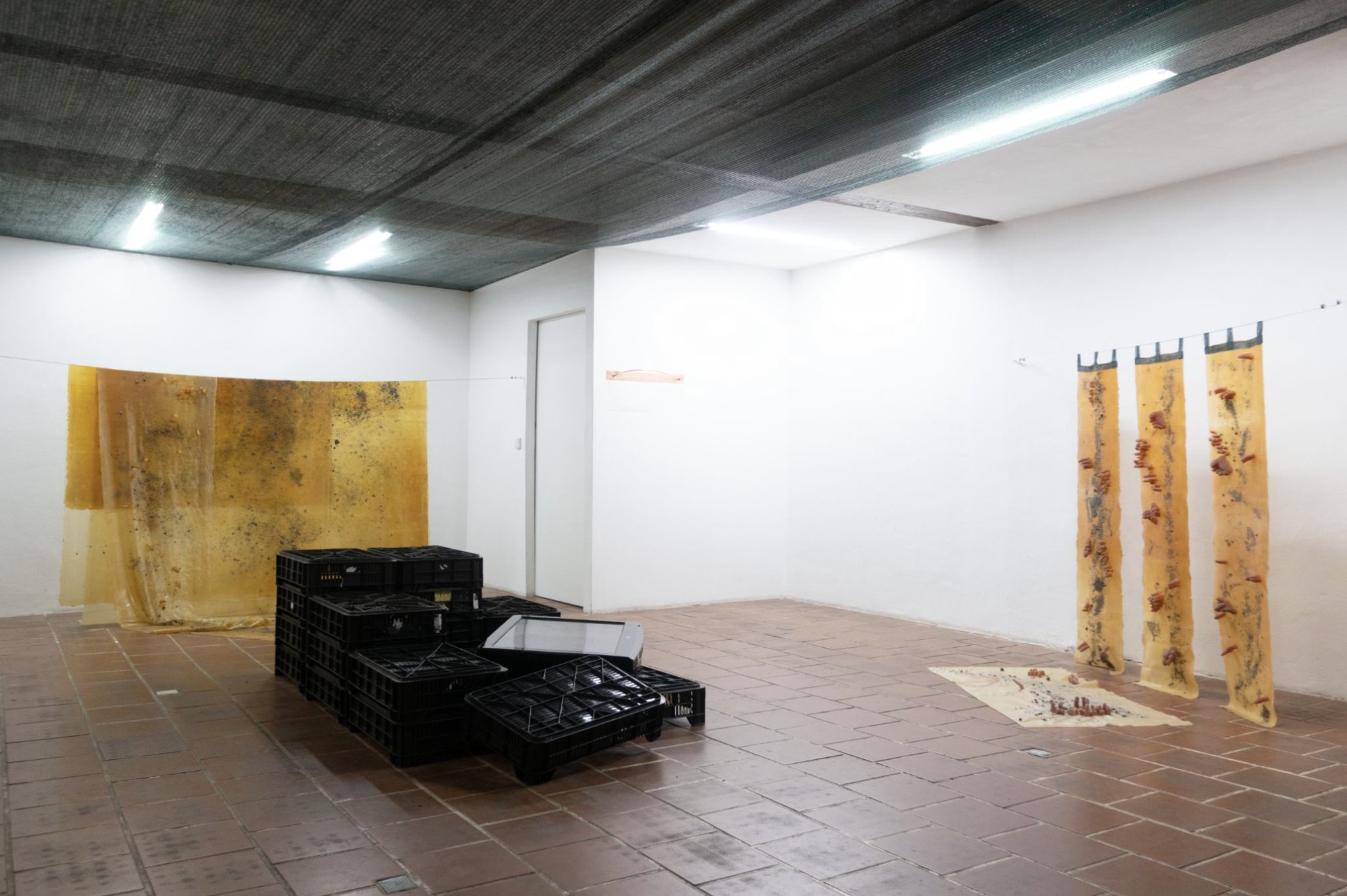
Project Spaces in Vienna
Review
At the beginning of Brian O’Doherty’s essay “Notes on the Gallery Space,” a seminal investigation into the implications of the white cube, he remarks that “life is horizontal, just one thing after another, a conveyor belt shuffling us toward the horizon.” Indeed, history is plotted out on horizontal timelines, events proceeding in an orderly fashion. This linearity is, of course, a reductive and colonial impulse, one which prioritizes dominant histories in fashioning the continued trajectory of modernism. In O’Doherty’s analysis, this rigidity is then echoed within the four sterile white walls of the gallery space: separated from any competing narratives, they enshrine the work as art and separate it from all that is non-art outside.
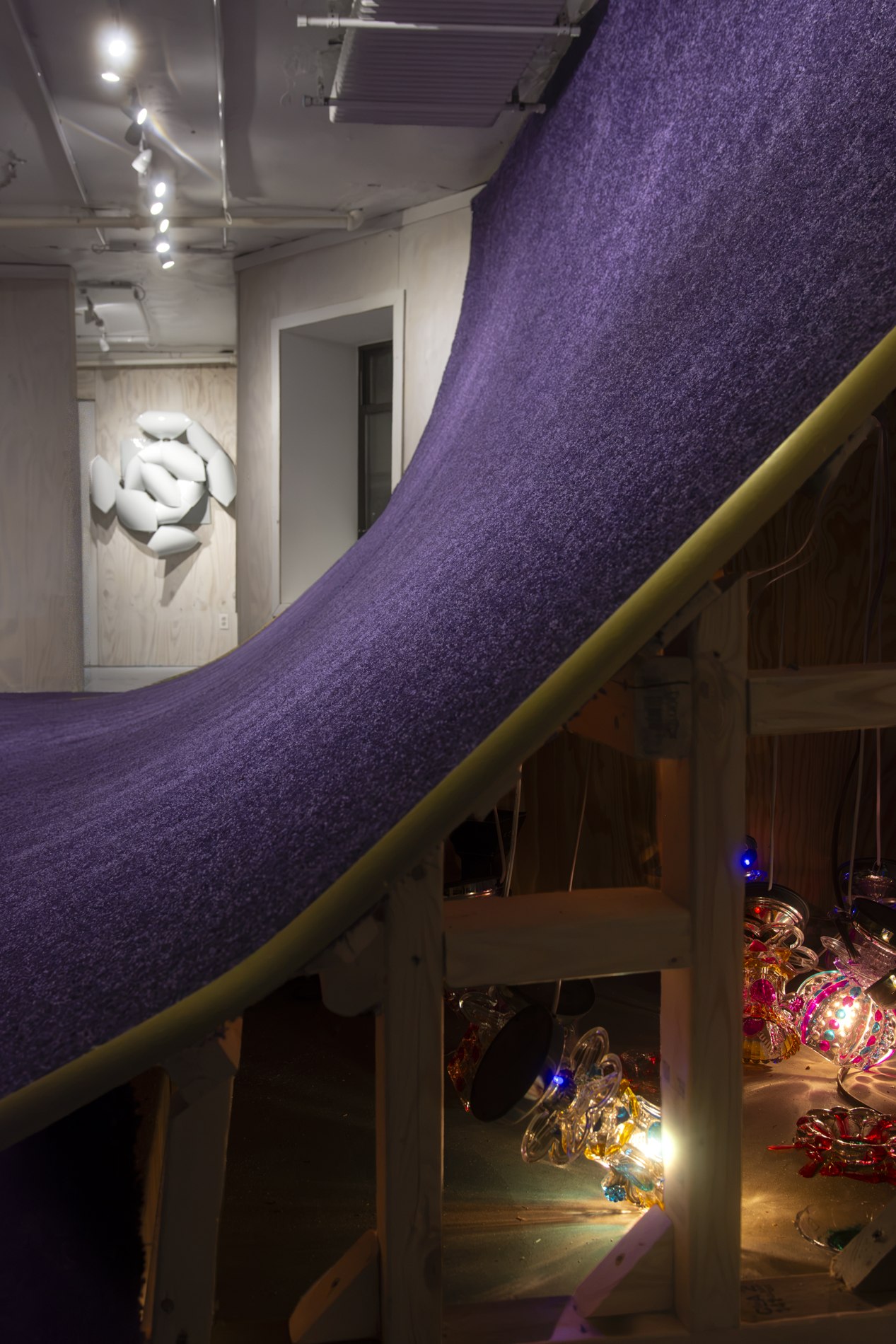
Cameron Patricia Downey’s exhibition, get you a straw, at Hair + Nails upends the (proverbial) white cube through one major action: the construction of a large, sloping ramp that consumes the gallery space. The ramp, which shares the title of the exhibition, is covered in a thick purple carpet and slopes from the base of the left-hand-side wall dramatically up to where the right-hand-side wall meets the ceiling. As it crests, wave-like, it accommodates the rough edges of the gallery itself. These idiosyncrasies within the Chinatown-based gallery—warped plywood walls, a strangely located window, and, perhaps most strikingly, a white-painted radiator attached to the ceiling—which, in O’Doherty’s formulation, would have been smoothed over completely, are both absorbed and accentuated by the artwork. The press release refers to the piece as a “gesture,” which is apt, as the slope seems to be in perpetual movement. O’Doherty wrote, “We have now reached a point where we see not the art but the space first.” get you a straw collapses the two. Beyond being site-specific, it constructs, and ultimately is, the space itself.
The ramp intrinsically possesses the possibility for an upward launch. Rather than the strict horizontal order enforced by modernism, the ramp implies a continuous curved movement, an exponential diagonal increase. Gravity is malleable in this space, as the floor seems to arch and thus upend any expected center point. The purple carpet, along with other incorporated details, undercuts the slope as simply a cold, conceptual gesture. Visitors are able to step, climb, or sit on the work, further blurring the boundary between the space and the object it houses. Looking at the ramp is not entirely the point; one must experience it as well. In selecting the warm, deep purple carpeting, Downey was inspired by the intimate settings of churches or community centers. This inclusion evokes an unpretentious gathering space, one concerned more with comfort than high aesthetics. The carpet’s role in this work is complicated; it is both the medium and the substance, both a canvas and a signifier. It references locations outside the gallery, but also signals that the gallery itself has taken on the qualities of those communal spaces. Perhaps, in creating get you a straw, Downey is working within the tradition of relational art, as identified by Nicolas Bourriaud. This type of art-making seeks to create spaces that facilitate human interaction so that those artificial relationships between people can be studied. Downey’s ramp is too elusive for such a neat categorization, as, although it indeed allows for seating and evokes nostalgic communal spaces, get you a straw is first and foremost a sculptural work. It functions just as well if someone is sitting on it and imbues it with use value. The responsibility to engage with it falls to the viewer, rather than the other way around. The sculpture forms the space without requiring any activation.

Inviting the already physically engaged visitor to crouch down by the base of the work, there is, underneath the ramp—visible through the wooden grids that act as makeshift ribs—an assemblage of illuminated, jewel-toned plastic vessels that look like chalices. According to Downey, these are fragrance lamps, used in this work as ornaments. Installed here, they hang down by their wires, edges resting on the uncarpeted cement floor below. In the same enclave, apple-green pools of cologne have been poured into small, clear plastic dishes, and the effect is that of a shrouded stained glass window, perhaps a makeshift altar. Downey combs thrift stores and markets in Jamaica, Queens in order to source the used objects that furnish this sculpture—including ones once used in the practice of santería. Tucked away, the objects act as a personal altar, perhaps an extension of the ecclesiastical theme. Maybe it serves to worship the form—the gesture—of the ramp itself. A small muffin wrapped in plastic sits deep in the recesses of the altar. Downey revealed that it was left there accidentally: the ramp has accepted an offering.
Cameron Patricia Downey: get you a straw is on view at Hair + Nails through December 2026.