“Are you lonely tonight?” at the Australian Centre for Contemporary Art
Review
Is there anything more human than a preoccupation with images of our own death—nuclear wasteland, climate disaster, rogue AI, the belief we are witnessing the end of history? This kind of dystopian vision emanates from Alix Vernet's solo show Landmarks at Chapter NY: letters and words inscribed in elegant cursive across aluminum condenser coils salvaged from air conditioners. The sculptures resemble dilapidated billboards, industrial structures transfigured into a monument to consumer desire: a plausible picture of a post-apocalyptic future, where pollution and disregard consume all but the infrastructure that gave rise to them.
Vernet has long located her practice in urban architecture. Previously, she cast, in iron, ornaments from former tenement apartments, manhole covers, and lettering from municipal architecture. By reassembling and modulating these fragments into poems and bricolages, she transforms neglected architecture into relics, granting them an existence in opposition to the dereliction of their origins.
In Landmarks, Vernet builds on these earlier techniques, but redirects them toward a mechanical register of urban life: ACs. When sourcing the AC condenser coils, the artist scavenged units mid-removal or already discarded on the street, deliberately choosing objects with visible signs of use. For the artist, the condenser coils retain the history of their pre-salvaged function but also implicate the systems of comfort and consumption, and with them, environmental damage.
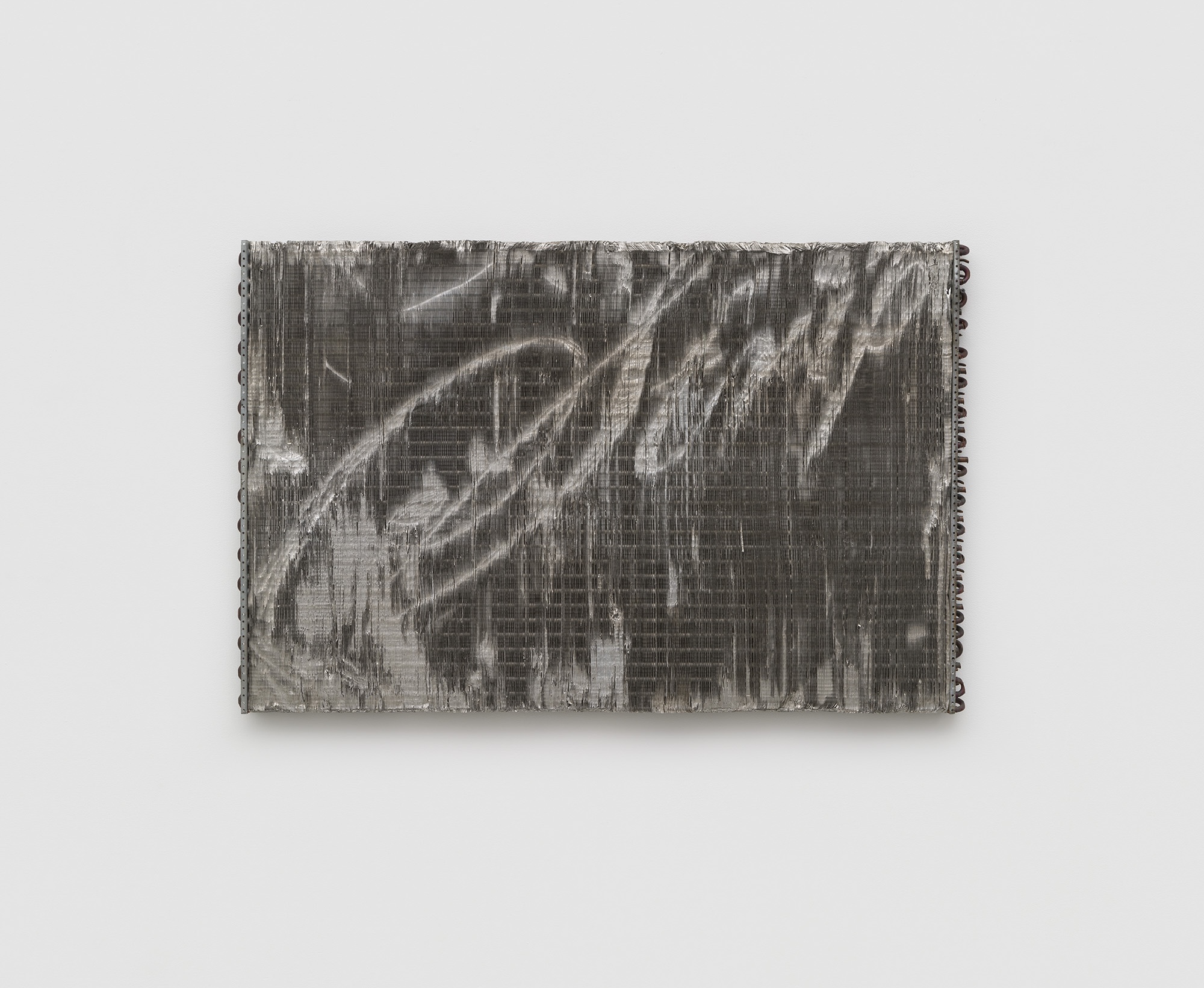
That improvisational method even extends to Vernet's typefaces, borrowed from earlier tracings of public monuments, and to her use of found language, like a crumbling women's bathroom placard or a "Welcome to New York" sign. The result is the city's disparate parts compressed onto a single surface, so that each sculpture is a cross-section of urban life itself. To approach the engraving, Vernet scratches into the coils with keys or kitchen tools—a technique partly learned from stone carving. In Strip (2026), the abraded and weathered surface that perforates the text reveals all the elemental cycles it withstood. Like the signs of corrosion and weather, Vernet's scratches become just another mark accrued on the coil's surface.
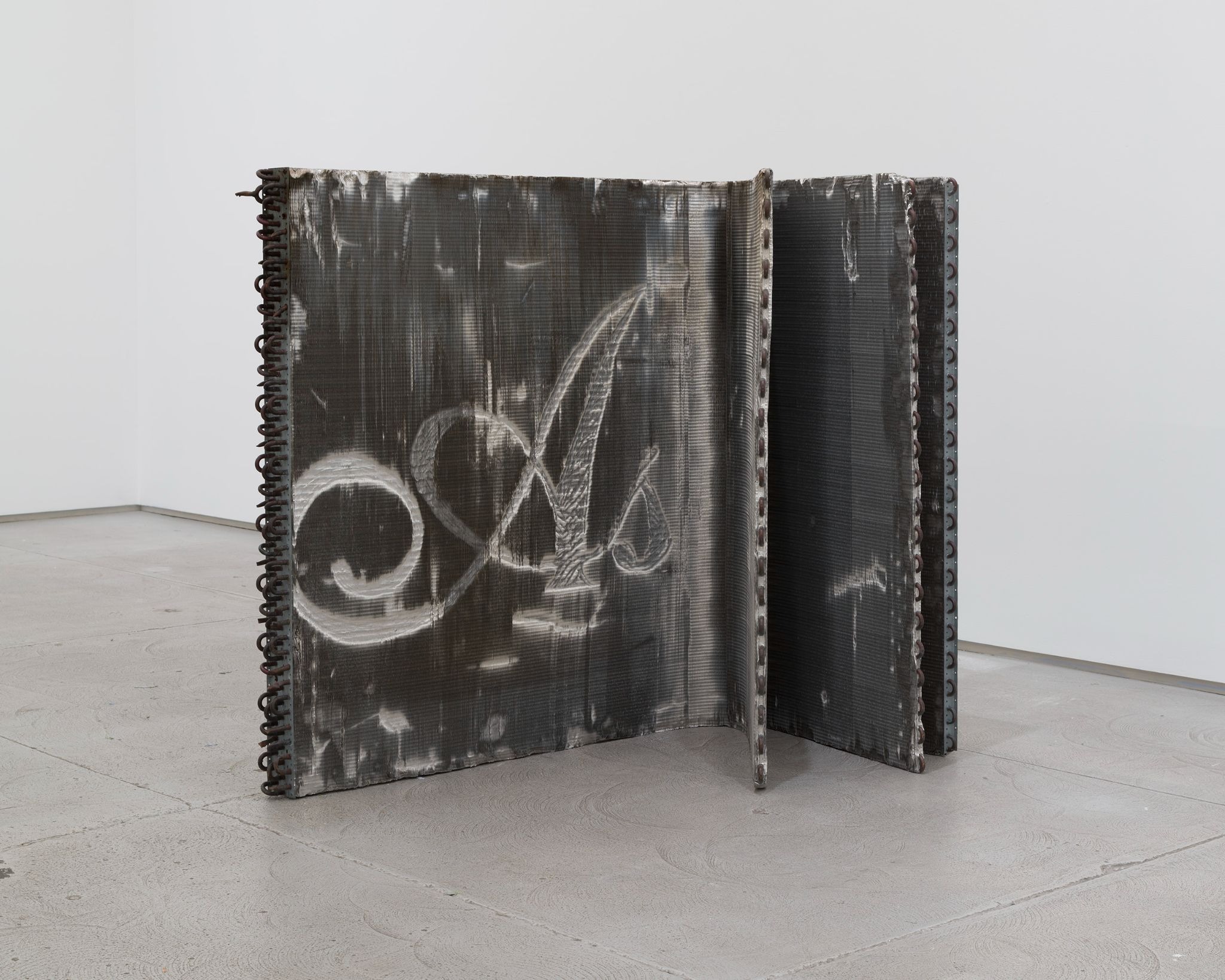
Wall-mounted pieces, like Women, Deep Blue (2026) and Baby, Super Blue (2026), more explicitly recall an AC in a window, although their dimensions disrupt any one-to-one analogy. The freestanding artworks—Almost Night, Almost Baby (2026), Repeat, As (2026), and Small Rhapsody (2026)—carry a more phenomenological weight. Repeat, As is a bent condenser upright in the center of the room, reminiscent of Richard Serra's industrial steel works. With both types of installation, the artworks jut into the gallery like obstacles to be navigated; they occupy the audience's space, refusing to be viewed from a safe, optical distance. Overall, the scale and abjection of cast-off machinery overwhelm the viewer, edging towards an industrial, entropic sublime.
Words and letters engraved on the surfaces become focal points that invite viewers to decipher the contexts to which they once belonged. The florid lettering, often rendered in a Times New Roman-like typeface or calligraphic cursive, shapes the connotations of a particular word. In Strip, for example, the script suggests something coquettish: not a strip of metal or land, but perhaps a strip club. Filtered and ornamentalized through typography, the vocabulary that Vernet chooses, such as “dream,” “boy,” and “baby,” evokes the banal sentimentality of decorative phrases like "live laugh love." Like Ed Ruscha's stylistic incorporation of language into painting, Landmarks invokes the visual language of advertising, even sourcing its typeface and phrases from advertising billboards. Yet, Vernet’s words are faded and unresolved, with a complicated relationship to visual pleasure.
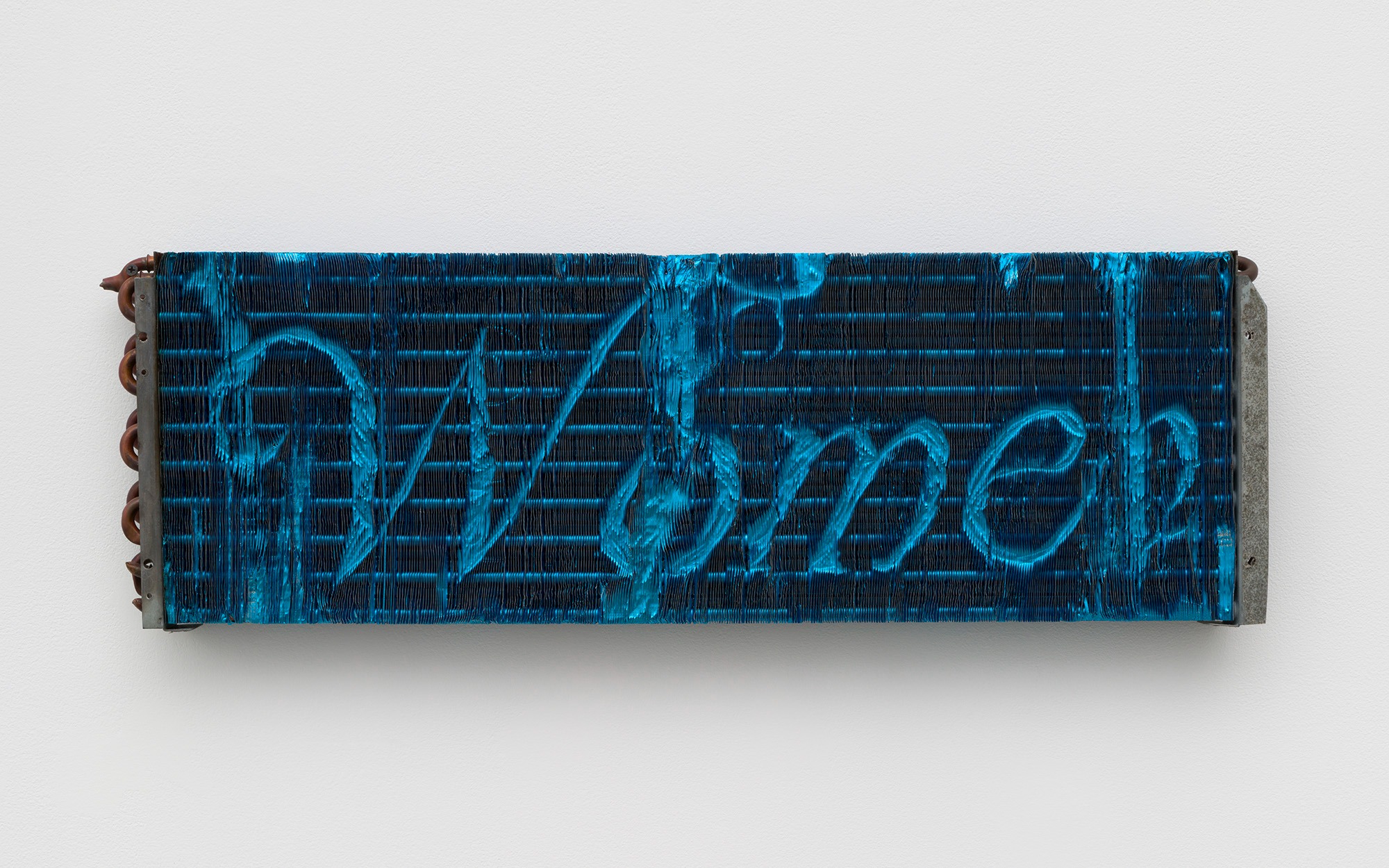
Although air conditioners make the urban environment more bearable, they are also energy-intensive and polluting, creating a less habitable planet. Where the press materials describe Vernet's sculptures as "indexical records of the city's life" and "embodied events," the works themselves read more as meditations on consumerism and the colonization of the environment. As Michael Fried argued in "Art and Objecthood" (1967), the minimalist object's theatrical presence and sense of endless duration make it confrontational. In Vernet’s sculptures, that confrontation becomes existential: the viewer encounters the possibility of personal and ecological mortality before an object that may endure. The corrugated surfaces alongside the text resemble advertising consumed by its own product, climate change—like a snake eating its own tail. It's an eschatology that has always both terrified and enraptured the human mind, and Vernet's cast-off machinery makes it briefly, uncomfortably tangible.
Alix Vernet: Landmarks is on view at Chapter, New York, from September 9 to October 17, 2026.