.jpg)
.webp)
“Love in a Fallen City” at lovers
Review
"The alternative space is the most autonomous method of reinventing invention. Without alternatives, culture has no respite from action, no perspective, no mirror to see its shortsightedness, no future. Alternative spaces are alternative societies that construct parallel histories."1
Writing for the Drawing Center’s 1996 exhibition Cultural Economies: Histories from the Alternative Arts Movement, NYC, Julie Ault observes that the terms “alternative,” “marginal,” and “oppositional” were contested for inscribing a hierarchy into the art world, designating a center and its margins. Today, these terms remain contested, but they persist in naming a distinctly counter-institutional logic that prioritizes accessibility and low-cost production, placing the means of creation, exhibition, and circulation back into the hands of the artists.
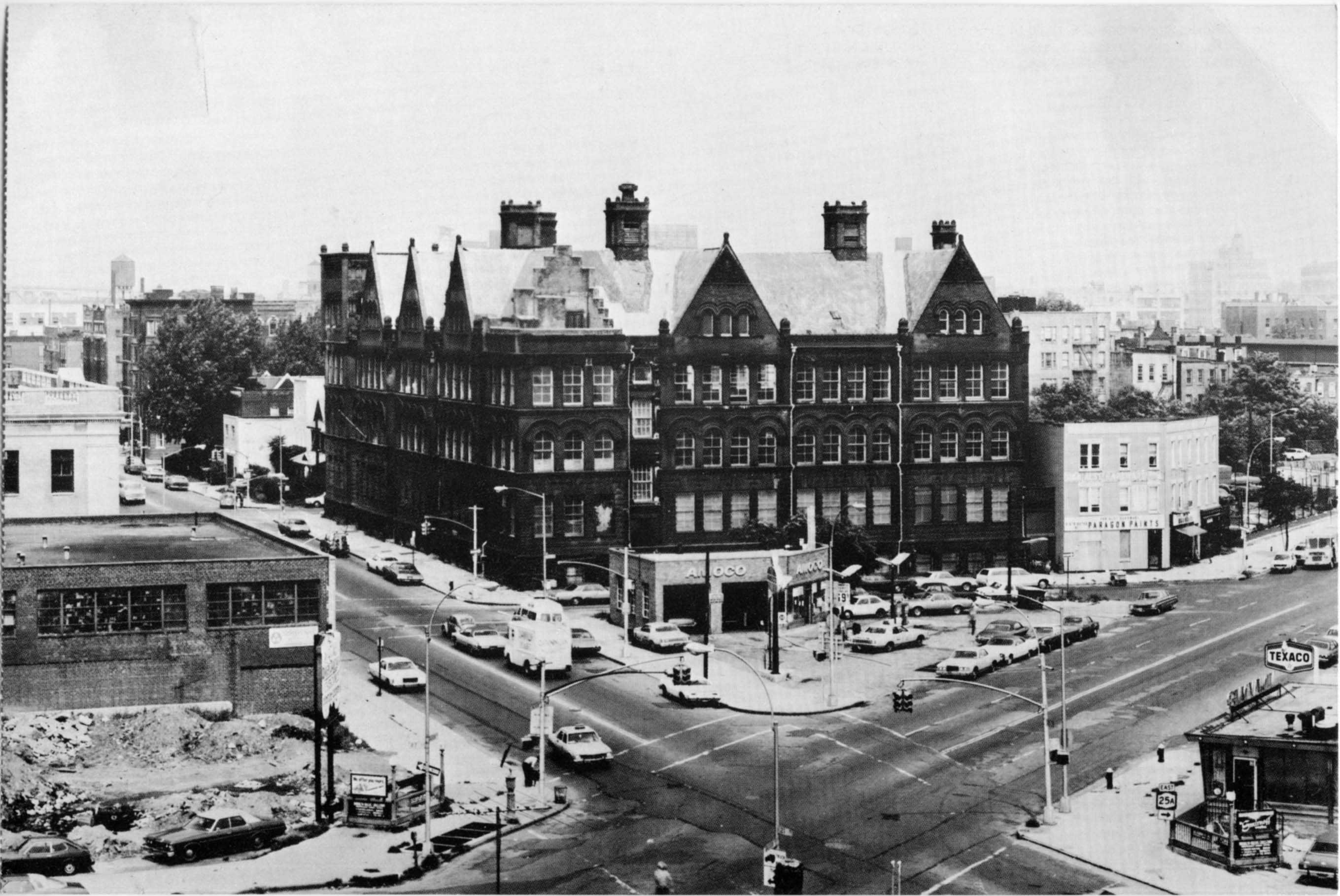
The architectural history of alternative art spaces is a history of reuse. An industrial kitchen facility, a vacant public school, a nineteenth-century ironworks factory: the typology of the alternative space is often that of a building no longer needed for its original purpose. Professor and architect Liliane Wong opens Adaptive Reuse: Extending the Lives of Buildings with a dictionary definition of the term: “transforming an unused or underused building into one that serves a new use.”2 Adaptive reuse, formalized in architectural discourse in the early 1970s, paralleled the rise of alternative art spaces, reflecting a moment shaped by global resource scarcity and political upheavals that carried forward the idealism of the previous decade.3 Alanna Heiss, arriving in a near-bankrupt New York, pioneered the practice as it is now recognized. Through The Institute for Art and Urban Resources, Inc. (I.A.U.R.), which later became P.S.1, she rehabilitated “derelict warehouses and unused city-owned property in an environment reeling from blight and decay, creating nonprofit art spaces that blurred the lines between studio, gallery, theater, and community center.”4
Wong positions adaptive reuse as one of three possible destinies for existing structures—alongside demolition and preservation—arguing that it uniquely “perpetuates a continuum of growth and change.”5 The practice refuses both the erasure of demolition and the stasis of preservation in favor of a slower, more negotiated transformation. By taking a structure as it stands, complete with its quirks, structural limits, and load-bearing habits, and fitting a new function within its shell, adaptive reuse hinges on the dialogic tension between original material and modern intervention. Ultimately, the significance of this practice lies in its manipulation of temporality: rather than restoring a building to an idealized past and pinning it in place, adaptive reuse returns the structure to the flow of time, allowing it to continue aging, accumulating scars, and eventually yielding to decay.
Extracted from architecture and applied as an analytical framework, adaptive reuse offers a useful strategy for New York City’s alternative art spaces. This framework reshapes not only physical sites but also funding models, governance, programming, and social infrastructures—repurposing each for functions beyond their original scope. The following four case studies demonstrate this strategy in practice: Wonderville operates through a bar license, Mothership NYC through a ship’s chain of command, Printed Matter through publishing distribution networks, and Public Works Administration through a storefront space inside the subway station. This adaptation is necessary given that alternative art spaces inhabit the same economic ecosystem as major museums, meeting many of the same pressures with far fewer resources to absorb them. The labor sustaining them is no less real for being framed as commitment or care. The critical question is not whether a space mimics an institution, but how it handles the labor sustaining it: How is it named? How is it organized? What becomes possible when a space makes that labor structurally visible?
Wonderville
Wonderville, the indie-game venue Stephanie Gross and Mark Kleback opened in 2019, rests on an inversion: a commercial bar along one wall pays for a free arcade along the other. It takes the form of a licensed New York bar, with its liquor license, food service, ticketed events, fire and health inspections, and commercial lease. Gross emphasizes that Wonderville needed this established infrastructure with a known regulated shape: “We knew we needed a bar. The bar, snacks, and hot dogs provide the means to pay the bills and keep the games free.”6
The arcade subverts the very logic that the bar observes. By refusing to charge visitors to play, Gross and Kleback remove what they call the pay-to-win or quarter-munching barrier, while asking visitors to engage with each arcade cabinet design, narrative, and mechanics as they would with a gallery installation. The cabinet is not a coin-operated commercial machine but rather something the venue treats as art. Alongside arcade machines, the stage hosts a dynamic schedule ranging from quiet sets to high-energy Hip-Hop shows, kept fresh by rotating acts on a three-month cycle. The framing of the adjacent arcade machines as art actively reshapes audience behavior: Gross has observed that fans “actually mosh inward away from the cabinets to protect the arcade machines."7
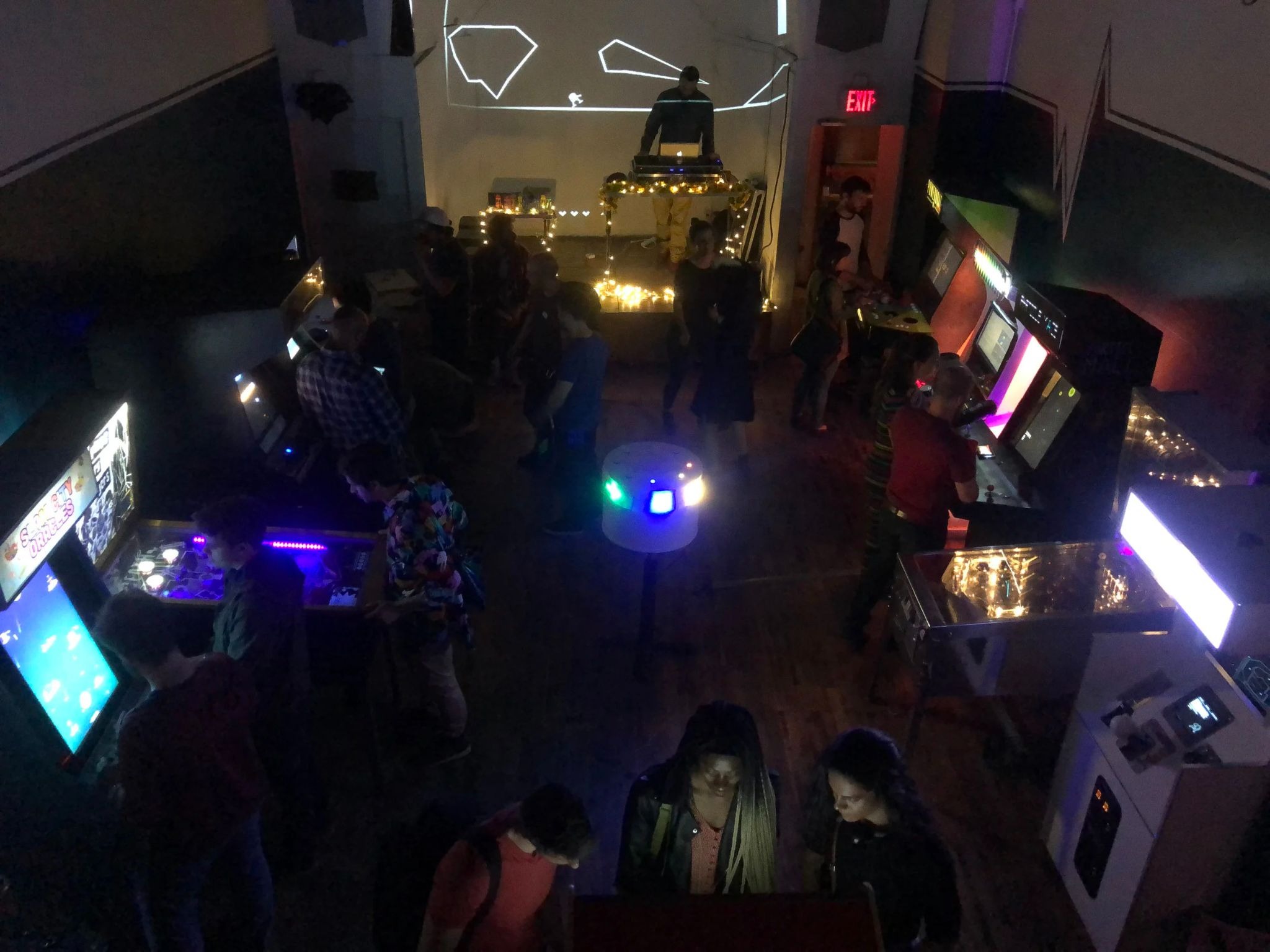
Running a regulated venue in New York presents relentless operational pressures. Gross describes a mindset of fragility shaped by the precarity of small-business operations. A four-hundred-dollar projection screen took a year to buy on such a tight budget. Without commercial rent stabilization, Gross notes, a landlord raising rent from twelve thousand to twenty-five thousand dollars can end a small business overnight. Compliance with the FDNY and the Department of Health is constant crisis management: A broken sink on a Saturday drew a seven-thousand-dollar emergency weekend quote from a plumber to avoid a ticket. When the soda gun once sprayed the staff, Kleback biked over to shut it off himself.8 Gross jokes that Kleback has become the head custodian, having taught himself plumbing.
Functionally, Wonderville operates through opposing forces: the bar’s profit motive counters the arcade’s refusal to charge, while quiet performances share space with the lively gaming floor. Reconciling these tensions requires continuous, hands-on labor. To handle routine maintenance, the space relies on a whiteboard where staff and visitors collaboratively log broken fixtures. This reciprocal care extends to the surrounding community. By scheduling weekend matinees, Wonderville supports its performers while respecting local noise limits, cultivating a neighborly relationship rooted in mutual consideration. The operational labor that sustains Wonderville is fundamentally collective, distributed across founders, staff, patrons, and neighbors alike.
Mothership NYC
Founded in 2005 by Norwegian painter Sol Kjøk in a converted Greenpoint loft, Mothership NYC draws on the organization of a ship as a metaphor for a self-sustaining social order that prioritizes collective survival and creative cooperation. As Captain, Kjøk oversees a space defined by its nautical terminology: the kitchen is the “galley,” a bell signals new arrivals, and lifebuoys line the walls of the “main deck.” The vocabulary, she explains, fulfills “two of my childhood dreams: being an artist and being a sea captain—everyone who comes aboard indulges that narrative."9
Mothership operates in rapidly gentrifying Greenpoint without institutional funding, facing rents that have risen nearly 80 percent since the 1990s.10 The space exists because Kjøk’s landlord—who initially tried to evict her, actively opposed to artists—eventually became a benefactor who offers a manageable rent. Mothership expanded from her personal studio, which remains the primary event space. Kjøk describes the maintenance of relationships as a form of labor she hopes to streamline before it further consumes her time and energy. The ship metaphor supplies a ready-made structure of roles and durations that a residency would otherwise have to invent. The titles designate lengths of stay more so than ranks: the Sailor and the Sea Artist reside there for a month or six weeks, the Second Mate for a year, and the First Mate semi-permanently, with the Captain never leaving the bridge. In practice, the hierarchy is less a chain of command than a map of mutual obligation.
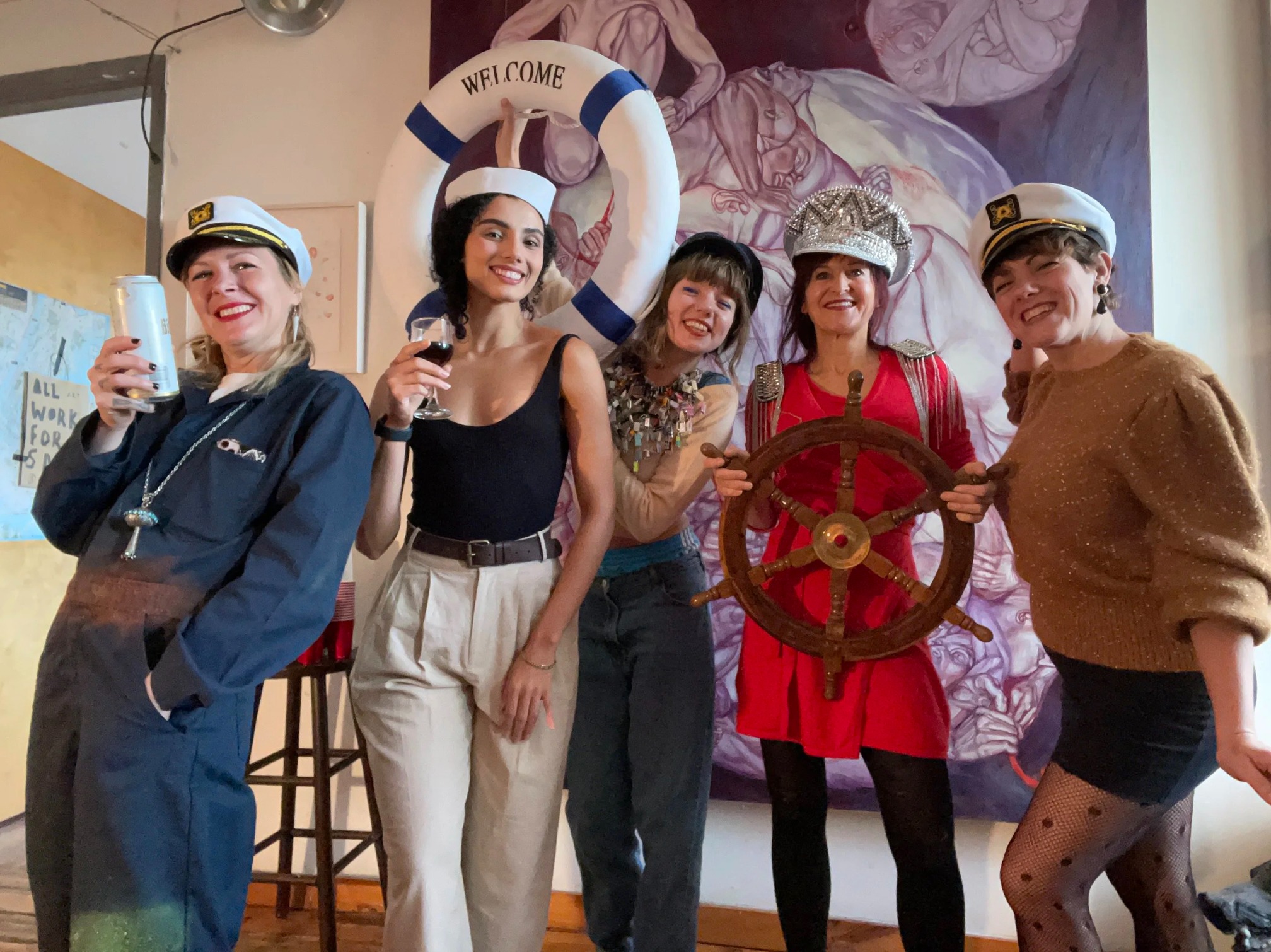
This appropriated system is animated by a peer-support principle that Mothership names “Artists-Helping-Artists.” Across two decades, the network has grown to roughly 210 artists in 48 countries, sustained by traveling collaborative projects such as the Tarot exhibition with 78 contributors: “Once you become a Mothershipper, you remain part of the network. If you travel to a place where we have members, you have a local connection. We stay in touch continuously.”11 Kjøk also maintains a deliberate balance in every small, tightly knit residency cohort: two or three New York artists are paired with two or three international artists, ensuring that locals expand outward while visitors enter into existing communities. This support system is encoded into daily rituals: each room provides an “invisibility cape,” a simple cloth cloak worn in shared areas to request individual focus without the social friction of turning others away. By embedding peer support directly into the spatial environment, this simple mechanism navigates the boundary between collective engagement and individual practice. Through its adapted maritime framework, Mothership affords both community and privacy, offering a clear vocabulary for who inhabits the space and for how long before the next crew steps aboard.
Printed Matter
Founded in 1976 by a small circle of conceptual artists including Lucy Lippard and Sol LeWitt, Printed Matter maintains flexibility by treating circulation itself as its core infrastructure. Over the past forty years, Printed Matter has adapted its physical footprint to follow shifting artistic hubs across New York: from Tribeca to SoHo in 1989, then relocating to a Chelsea storefront on Tenth Avenue before settling at its current Eleventh Avenue site in 2015, while also running a secondary location inside the Swiss Institute in the East Village from 2018 to 2024. As Director of Distribution and Bookstore Operations, Craig Mathis notes that these strategic moves allow the organization to “benefit from incidental foot traffic from people visiting nearby galleries.”12 Crucially, each relocation leaves the bookstore and its distribution network intact, demonstrating that Printed Matter’s primary site is not a fixed address but an adaptable system spanning storefronts, publication distribution, and annual art book fairs.
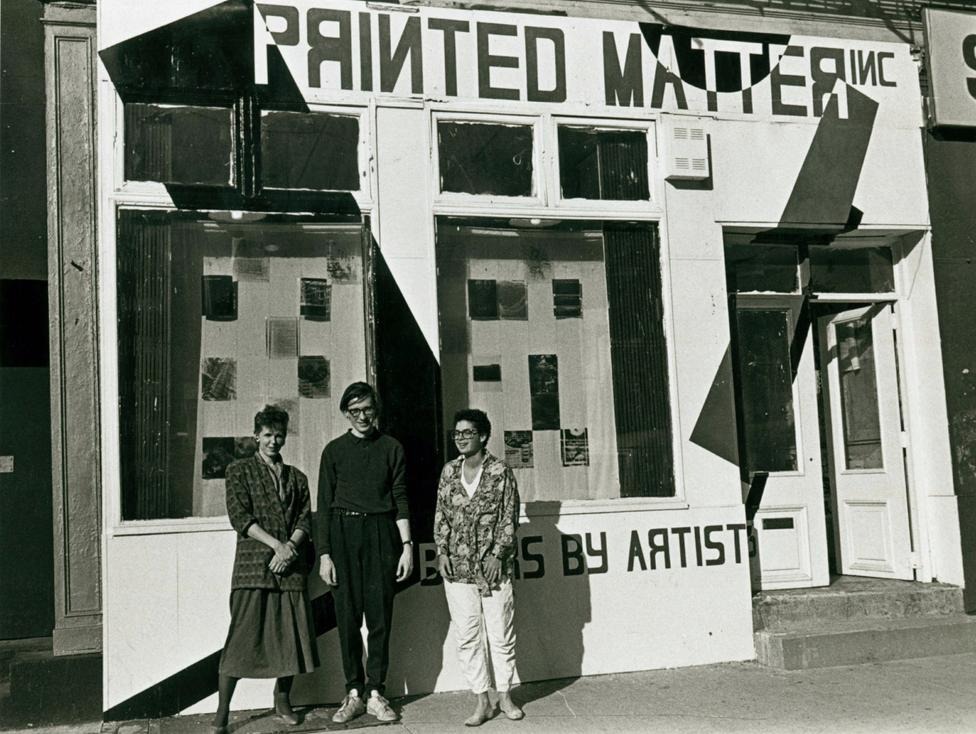
Mathis names two distinct operational pressures. On a practical level, New York real estate, staff wages, and healthcare weigh heavily against the modest profit from books and zines, requiring a non-profit model sustained by grants, fundraising, and institutional partnerships. Politically, independent publishing remains vulnerable to broader shifts in public arts funding, university support, and speech policies, which restrict the institutional resources available to non-profit platforms. In response, Printed Matter adapts across scales, using its physical storefront as the first interface to engage the public and support its broader network. Window Installations, a program initiated by co-founder Lucy Lippard in 1976, converts the storefront window into a site-specific platform for politically provocative art exposed to hundreds of daily passersby. Inside, exhibition walls and event programming are structured to drive foot traffic directly to the retail floor. As Mathis emphasizes, Printed Matter is fundamentally a bookstore whose programming operates to drive engagement with artists’ publications.
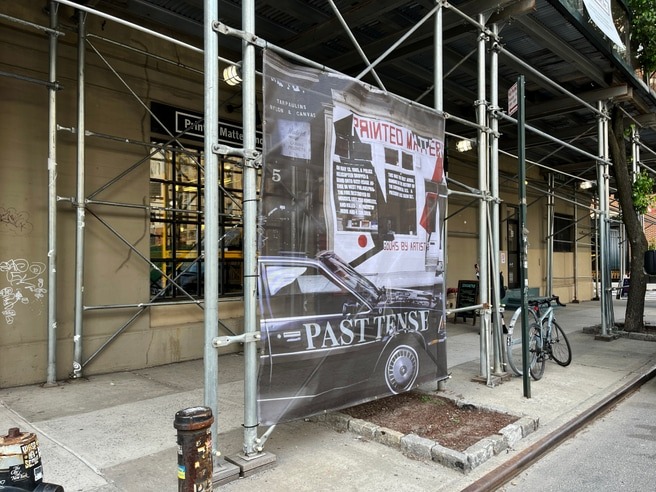
Within this broader circulation network, adaptive reuse shifts to the artist book itself. Mathis describes adaptive reuse as a form of conceptual appropriation, wherein artists take tropes, layouts, or visual formats from earlier publications and reinterpret them in new printed works. This strategy extends to economic access through bootlegging and unauthorized facsimiles, subversive methods of sharing information at an affordable price when originals become cost-prohibitive. For Mathis, independent publishing itself constitutes a structural adaptation born of historical necessity. As censorship, deplatforming, and institutional defunding narrow mainstream avenues, artists bypass traditional gatekeepers by building self-sustained print networks: “Artists are again realizing that the only way to circulate their ideas is to work independently [from the mainstream publications]. That’s an adaptation to the system, and also a refusal of it."13
The NY and LA Art Book Fairs represent the largest and most expansive circulation system Printed Matter has constructed. By temporarily occupying major cultural venues such as MoMA PS1 and the Brooklyn Museum, Printed Matter leverages institutional space and prestige to draw public traffic, transforming museum grounds into a global platform where independent publishers share work directly with readers. To capture the current state of artist publishing—from first-time zine makers to antiquarian dealers—the organization processes six hundred to seven hundred applications annually for roughly three hundred exhibitor slots through an open call. Each fair multiplies the storefront’s daily reach across a single weekend, sustained by Printed Matter’s ongoing labor of curation, publisher communication, and small-press relationship-building. Yet this temporary, large-scale reach continually feeds back into the store’s core year-round operations. As Mathis observes, acquiring titles through open submissions, distributors, and direct artist relationships remains “a decentralized process that reflects the nature of artist book production.” Ultimately, whether operating through temporary international fairs or its physical storefront, Printed Matter sustains an adaptable distribution network whose reach extends far beyond any single physical address.
Public Works Administration
Public Works Administration (PWA) is a two-person artist-run project space that reclaims the name of the New Deal agency established in 1933 that built roads, schools, and dams across a collapsing country. Founded by Sam Black and Alison Sirico in 2022, PWA operated out of a storefront in the 50th Street Times Square subway station until 2025. Since leaving that space, it has continued programming nomadically with plans to reopen in a new location in fall 2026. PWA focuses on under-recognized artists working in digital media while framing exhibition-making less as a business than as a civic function. Sirico puts the model plainly: “In the same way that the subway is a public service, we felt like art could be a public service as well.”14 Operating out of an initially rent-free MTA space allowed PWA to invert traditional gallery economics, redirecting savings away from overhead and directly into exhibition budgets and artist support.
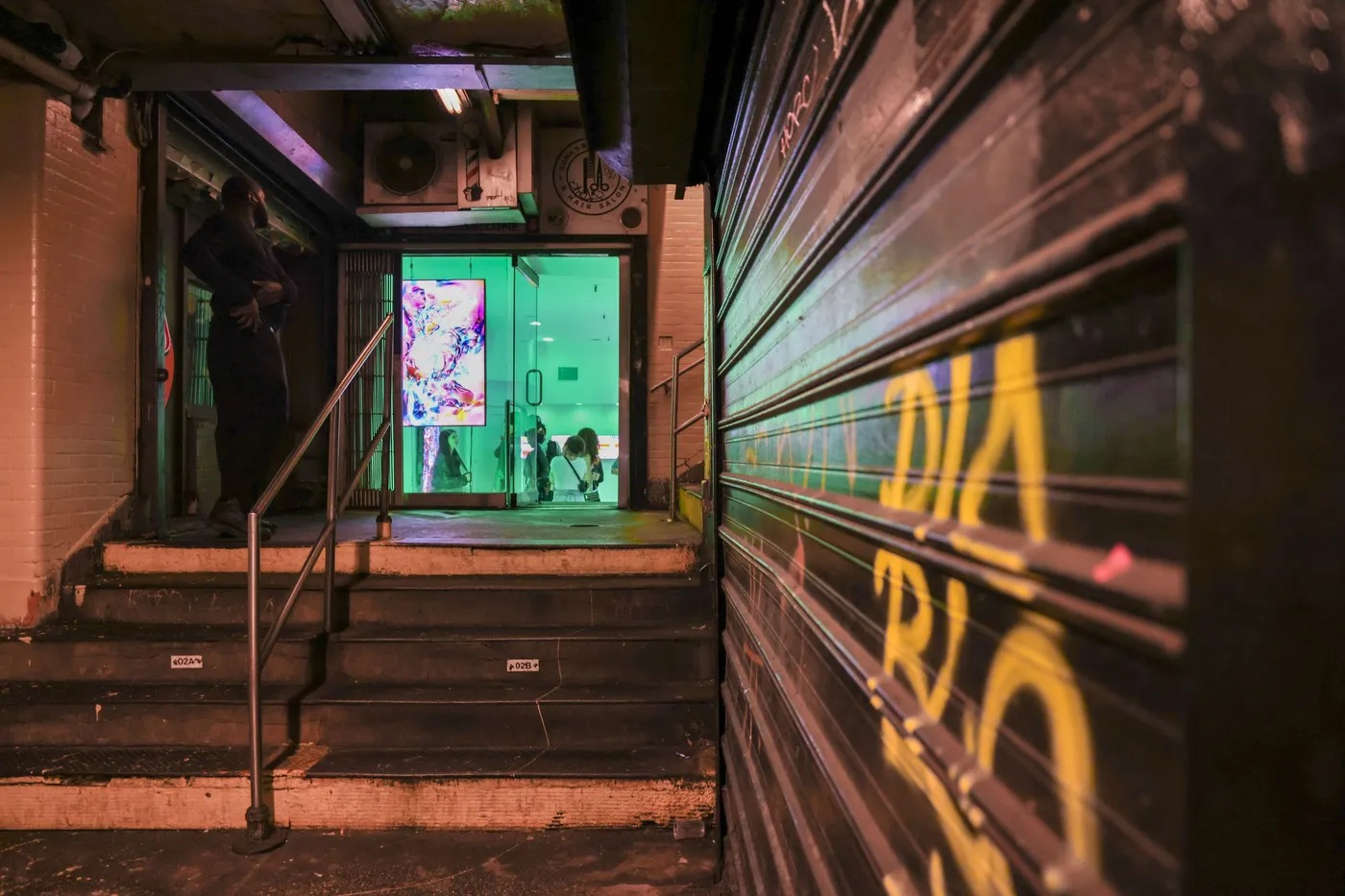
PWA was shaped by both ideological commitments and pragmatic pressures. Seeking an alternative to the white-cube gallery, which Sirico likens to a sterile doctor’s office, the founders chose the subway for its broad accessibility: “The MTA is something that all New Yorkers share. It’s a space where everyone goes […] You don’t have to be trying to go to a gallery. You don’t have to go in and introduce yourself to someone that's sitting at a front desk. You don’t have to have that whole rigmarole. It’s just art existing in the world.”
The inaugural exhibition In Transit displayed work by Astrosuka, Peter Burr, Hypereikon, Sofja, Kitasavi, and Yoshi Sodeoka, with pieces displayed through the glass-window storefront and within the gallery space. This arrangement invited commuters hurrying past to slow down long enough to notice something they might otherwise overlook. However, the MTA came with strict security protocols, limiting installations to two-dimensional, wall-based prints and screens. PWA constantly pushed these limits, for example, installing works by Calla Henkel and Max Pitegoff that incorporated LED lights.15 Screen captures, GIFs flattened to print, and video stills transposed to vinyl transformed the constraint of “printed, adhered to the wall” into a creative directive with art designed to catch a hurrying eye.
PWA’s subway storefront functioned as an architectural vitrine, establishing a deliberate progression of screens that scaled digital media into the public sphere. At the fundamental level, artists utilized screens within the space to display digital and two-dimensional works. Expanding outward, the glass storefront itself functioned as a macro-screen, turning the space into an active, luminous interface for daily commuters. Working with Times Square Arts’s Midnight Moment, PWA subsequently scaled this subterranean interface to a citywide scale. Featuring Yoshi Sodeoka’s Infinite Ascent throughout January 2025, PWA co-presented videos across more than ninety electronic billboards throughout the tourist attraction. For three minutes each night, an artwork that originated on a digital screen underground surfaced across the largest screens in the city.
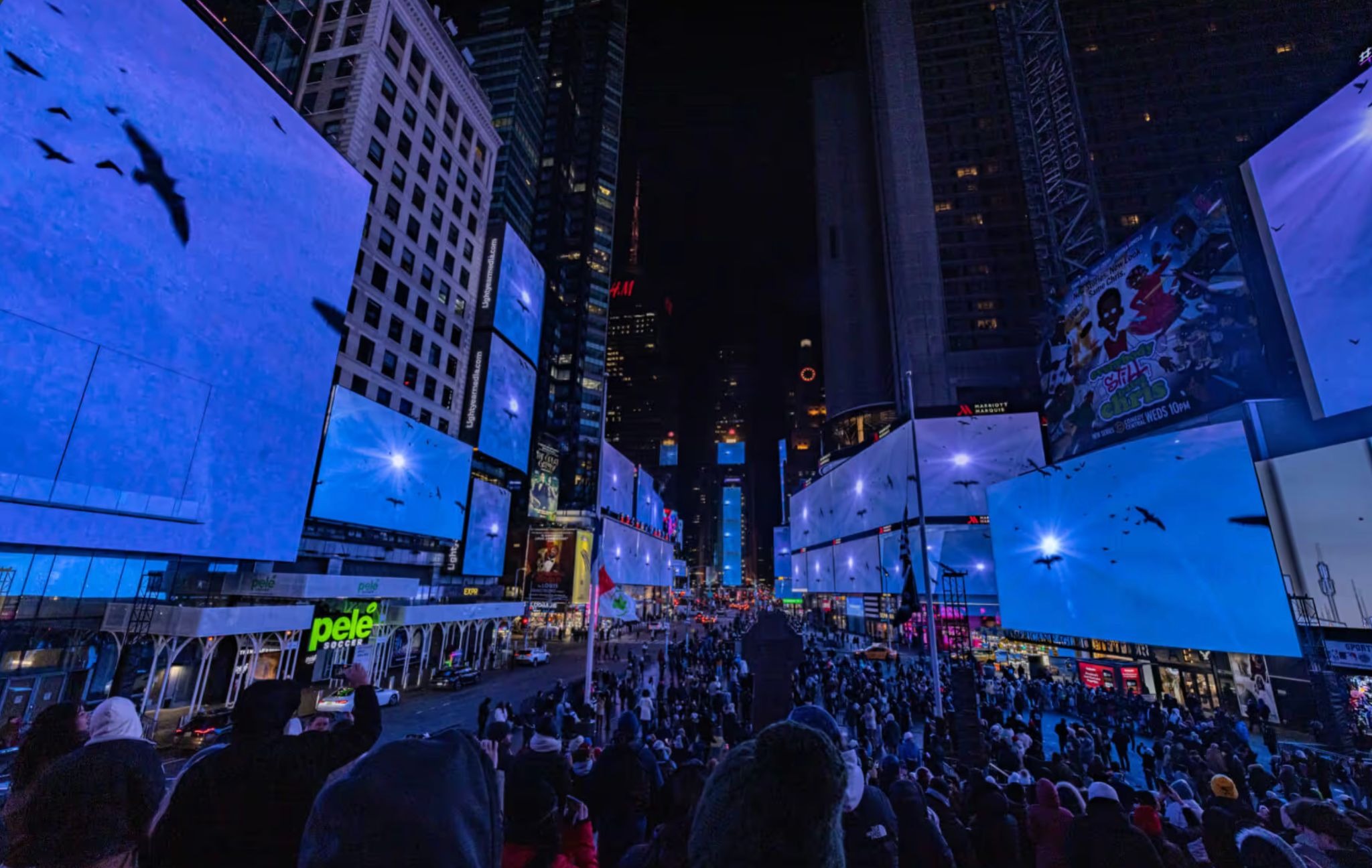
Though PWA closed its station storefront in 2025, its migration from underground gallery to billboards demonstrated that its logic was never bound to a single lease but was a mobile strategy for infiltrating public infrastructure. In its present, migrating format, PWA carries forward the founders’ premise: If art can be a form of public service the way transit does, it should reach people where they already are.
Reuse as Condition
Applied beyond physical architecture, adaptive reuse describes a framework that exceeds traditional renovation: not a project completed when contractors step away, but an active system that absorbs friction and evolves over time. Across these four projects, adaptive reuse describes a persistent yet flexible condition of survival. The borrowed structure—whether a licensed bar, a maritime hierarchy, a distribution network, or a subterranean storefront—remains viable only through continuous spatial and administrative maintenance. In this light, the architectural concept becomes a blueprint for the endurance of alternative art spaces.
Read together, these four projects operate as prototypes rather than a set of isolated exceptions. The historical conditions that once enabled alternative spaces—cheap rents, abundant vacant buildings, and more accessible public funding—have largely diminished. Yet their survival relies not on static real estate, but on the ordinary, mostly invisible labor of passion, community, care: Mark Kleback biking over to fix a soda gun, Sol Kjøk sustaining relationships across continents, Craig Mathis organizing the daily operations of a bookstore, or Sam Black and Alison Sirico installing work where thousands of commuters would encounter it. These are not mere accidents of inspiration or romanticized responses to scarcity but rather the result of deliberate choices. Adaptive reuse, for these alternative spaces, is less a distinct aesthetic than a practical strategy to sustain non-commercial production and public access. In persisting, they do more than survive. They sustain a cultural model that neither the market nor the museum provides, offering a way of working that answers to something other than profit. Whether these spaces endure is never settled; it depends, as it always has, on who is willing to keep them open.
References:
1 Papo Colo, “Alter the Native,” in Alternative Histories: New York Art Spaces 1960 to 2010, ed. Lauren Rosati and Mary Anne Staniszewski (New York: Exit Art; Cambridge: MIT Press, 2010), 15.
2 Liliane Wong, Adaptive Reuse: Extending the Lives of Buildings (Basel: Birkhäuser, 2016), 30.
3 Wong, Adaptive Reuse, 124.
4 Jonathan Lill and Alana Miller, “The Artist in Place: The First Ten Years of MoMA PS1,” Museum of Modern Art, 2012, https://www.moma.org/interactives/exhibitions/2012/artistinplace/.
5 Wong, Adaptive Reuse, 30.
6 Stephanie Gross, interview by Ariel He, March 25, 2026.
7 Gross, interview.
8 Gross, interview.
9 Sol Kjøk, interview by Ariel He, April 24, 2026.
10 NYU Furman Center, State of New York City’s Housing and Neighborhoods in 2015: Focus on Gentrification (New York: NYU Furman Center, 2016), https://www.furmancenter.org/wp-content/uploads/eelegacy/sotc/NYUFurmanCenter_SOCin2015_9JUNE2016.pdf, 5–6.
11 Kjøk, interview.
12 Craig Mathis, interview by Ariel He, March 24, 2026,.
13 Mathis, interview.
14 Alison Sirico and Sam Black, interview by Ariel He, April 10, 2026.
15 Sirico and Black, interview.